

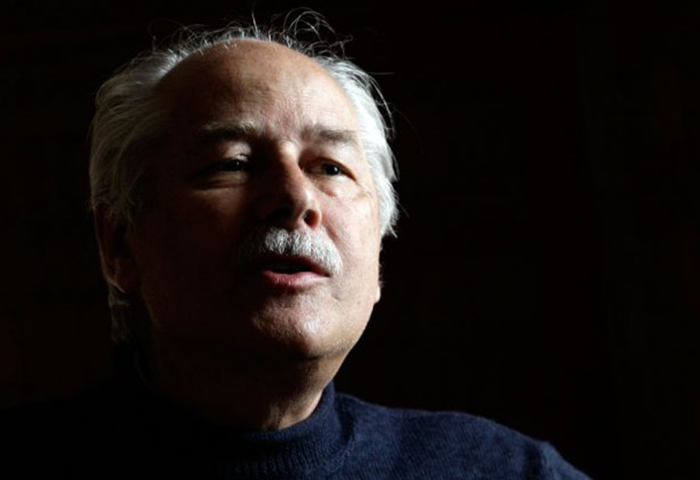
The Marxists have long argued that the only way forward for the Venezuelan revolution is to strike blows against the counterrevolutionary bourgeoisie, by expropriating the bankers, landlords and capitalists, etc. However, there are other voices saying rather different things. One of the most persistent of these voices is that of Heinz Dieterich, who has been waging a noisy campaign in favour of what he calls “Socialism of the XXI Century” - a strange kind of socialism indeed in that it differs very little from capitalism.
In Venezuela the forces of the counterrevolution are engaged in an all-out offensive against Chavez and the Revolution. Right-wing students stage armed provocations on the campuses and the streets. The bourgeois media, nationally and internationally, are whipping up a campaign of hysteria against "tyranny" and "dictatorship". US imperialism, with the help of Juan Carlos and the Spanish bourgeoisie, is striving to isolate Venezuela and create an anti-revolutionary bloc in Latin America, based on Brazil and Colombia, Chile and Argentina.
As on previous occasions - the coup of 2002, the bosses' lockout, the recall referendum and the elections of 2005 and 2006, the reactionaries are using the slogan of supposed "defence of democracy" as a means of mobilizing the counterrevolutionary forces, creating a climate of fear and instability in order to prepare the ground for a right-wing coup.
In the present battle who is opposed to the reform of the Constitution? Fedecamaras, that is, the landlords, bankers and capitalists, the Episcopal Conference, representing the reactionary hierarchy of the Church, the right-wing media and imperialism. On the other side of the barricades are the workers and peasants, the poor and dispossessed, the revolutionary youth and the progressive intelligentsia: in other words, all the living forces of Venezuelan society.
Why does the ruling class hate the constitutional reform? They say it is because Chavez wishes to introduce a dictatorship, to be a President elected for life and so on. But the reformed constitution does not concede such powers or anything like them. It merely removes the restriction on standing for President more than twice. In Europe there is no such limitation. Sarkozy and Merkel can stand as often as they like. So can Gordon Brown. And in any case, the reformed constitution only allows Chavez to stand for election. It will be up to the people whether they elect him or not.
This should be the normal procedure for electing a head of state in a democracy. In Britain, which is supposed to be a democracy, we have a hereditary head of state who was never elected and never will be. The same is true in Spain where Juan Carlos, who permits himself the luxury of telling the elected President of Venezuela to "shut up", has never been elected by anyone but was appointed by the fascist dictator Franco. Who elected the Venezuelan Episcopate? Who elected the editors of the right-wing newspapers? Who elected the business leaders? Not the people of Venezuela, who voted massively for Hugo Chavez less than one year ago, and will undoubtedly vote for him again in the referendum in a few weeks time.
The reformed constitution is therefore not a recipe for dictatorship but contains many points in the interest of the masses. It contains the 36-hour working week, which is one reason why Fedecameras does not like it. Nor do the bosses like the clauses that make it easier to nationalize their banks, estates and factories. They do not like the idea of the formation of Bolivarian militias or workers' councils in the workplaces. They do not like the commitment to building a socialist economy in Venezuela. That is why they are fighting against the reform, for a "No" vote in December. That is why the working class must fight with even greater determination for a "Yes" vote.
A Constitution, even the most democratic constitution, is only a scrap of paper. It means nothing unless it is put into practice. And this depends on the class balance of forces: the willingness of the masses to fight. The end result of the Revolution will not be decided in lawyer's studies or parliamentary meetings, but on the streets, in the factories, in the villages and in the army barracks.
It goes without saying that the struggle for socialism will not end with the referendum. But the referendum is one more in a series of partial battles, the result of which can influence the struggles of the masses in a positive or negative sense. As the masses push forward towards a socialist transformation, the counterrevolutionaries become ever more desperate and aggressive. The Revolution must meet the threat head on. The only way to disarm the counterrevolutionaries is by taking firm steps in the direction of completing the Revolution. The first step is to achieve a massive "Yes" vote in the referendum. This will deal a heavy blow against the counterrevolution, and open the way to further measures against the oligarchy.
There are those on the Left who refuse to see this as a struggle between the classes and who advocate abstention or even a "No" vote. This is a fatal position. It is necessary to understand that a victory for the "No" vote would be a victory for the counterrevolutionary opposition. It would dishearten the masses and encourage the opposition to intensify their counterrevolutionary agitation and conspiracies. If there are some people who consider themselves revolutionaries and even "Marxists" who do not understand this elementary fact, one can only feel sorry for them.
Baduel's declarations
The declarations of General Raúl Isaías Baduel on 5 November were a key part of this counterrevolutionary offensive. Until his retirement last July, Baduel was Defence Minister and apparently an ally of Hugo Chávez. Now Baduel has come out against the President. In a news conference, he described the President's proposed changes to the Constitution as "in effect a coup d'état" and a "non-democratic imposition that would put us into tragic retreat." This attack was clearly intended to cause a split in the ranks of the Bolivarian Movement and promote a "No" vote in the referendum on the constitutional changes scheduled for Dec. 2.
How can we prevent the Venezuelan Revolution from going down the path of Chile? The Marxists say: only by carrying the Revolution forward, by striking blows against the counterrevolutionary bourgeoisie, by expropriating the bankers, landlords and capitalists and making the Revolution irreversible. In order to do this it will be necessary to arm the workers and peasants to fight against the counterrevolutionary forces both inside and outside the country.
That is what we say. But there are other voices saying quite different things. One of the most persistent of these voices is that of Heinz Dieterich, a German professor living in Mexico, who in recent years has been waging a noisy campaign in favour of what he calls "Socialism of the XXI Century" - a kind of socialism that differs very little from capitalism. Heinz Dieterich has been consistently opposed to expropriations and workers' control. He is against touching the property of the bankers, landowners and capitalists. And naturally he is opposed to touching the bourgeois state and the army.
It is not a coincidence that General Baduel wrote the Preface to Heinz Dieterich's book on "Socialism of the XXI Century" (Hugo Chávez y el Socialismo del SXXI) and helped to launch it in Venezuela. One can say that Heinz Dieterich cannot be held responsible for the views and actions of Baduel. But what was his reaction to the General's statements? Was it to distance himself from Baduel? Did he repudiate what Baduel was saying? Not at all.
On 8 November, Rebelion published an article by Heinz Dieterich entitled "The Chavez-Baduel Break: Stop the Collapse of the Popular Project". We republish it here in its entirety so that our readers can judge for themselves, and so that there can be no suggestion that we are misquoting the words of comrade Dieterich, which can be found at http://www.rebelion.org/noticia.php?id=58708
Let comrade Dieterich speak for himself. Here is the full text of the article:
1) What is at stakeThe public announcement of former General in Chief and Venezuelan Defence Minister Raul Isaias Baduel, that he would vote against the constitutional reform proposed by President Hugo Chavez and endorsed by the National Assembly, has shaken the national order that seemed stable. At the same time, it has opened a phase of uncertainty which could have serious consequences for the Venezuelan popular project and the Bolivarian integration of Latin America. Understanding the objective causes, consequences and possible solutions to this conflict is thus essential to avoid a triumph of the oligarchy and imperialism.
Despite having had a personal relationship of appreciation for both characters for many years, I will not make a defence of either of the two protagonists, but a rational analysis, which seeks to contribute to a progressive solution of a grave situation. A key variable for understanding the conflict is the personality of both these military men, but this is not the time to introduce that variable in the analysis.
2) The causes of the conflict
The accusations that Baduel has sold out to the extreme right, that his anti-communism has got the better of him, or that he is a traitor, do not get to the heart of the problem. Ever since he was commander of the 42 Infantry Parachute Brigade, there have been many attempts to bribe him and several plots to assassinate him and he did not give in. He is a man who acts on conviction, not expediency, and that is why he confronted the coup of April 11, although the putschists tried to bribe him to work with them. And the fact that he did not participate on February 4 and November 27 has an explanation, which the leaders involved know and one day will be made public.
The assertion that he excluded himself from the Bolivarian project of the President, by positioning himself against reform on November 5, is the key to understanding the current situation. Baduel was unable to accept the government project because he was already excluded. He was marginalized, and the primary responsibility for this marginalization was that of the government.
3) The model of Lucius Quinctius Cincinnatus
When he left the Defence Ministry in July 2007, the General stated that he was going to withdraw from public life for a time, to work on his farm and ponder his future as a public figure, like the consul Lucius Quinctius Cincinnatus in Rome 2500 years ago. On Monday, November 5, this meditative phase ended with his dramatic eruption into the public debate on constitutional reform.
There are, however, two fundamental differences with the historical model: a) the General was not convened by the State forces to "save Rome," but volunteered motu proprio, on his own initiative, and b) he chose the time and place so as to ensure the maximum impact and surprise in order to launch his future political career. Part of the impact was due to the fact that some 18 days earlier he had publicly supported the constitutional reform.
However, those observers are quite right who noted that Baduel had shown unmistakable signs of public concern at the evolution of the Bolivarian project that he saw: such as the scant will to fight against corruption, the inflationary development of the economy, the discretional use of the revenues from PdVSA and the lack of definition of the institutionality of Socialism of the XXI Century.
4) The offensive of the General seeks to occupy the political centre of the country
The field of political battle chosen by the General was constitutional reform and the time, the start of the official campaign for the Yes vote and the violent protests on the right. Raul Baduel is an extraordinary military man with strategic vision which explains the content and timing of his public statement. Contrary to what the official propaganda and sectarianism say, he is not a man of the extreme right, which by definition is extra-constitutional, but a man of the Law. His pronouncement in favour of the Constitution of 1999, against the excessive concentration of power in the executive branch, is the kind of speech that aims to occupy the political centre of the country.
Lacking a national organization and adequate funding to launch a national political campaign, the General transformed the growing controversy about the content and procedures for constitutional reform into the equivalent of what is in military terms the strategic reserve of a belligerent: a pre-organized force in stand-by for any offensive or defensive purposes. In the dramatic situation on Monday, after the demonstrations for and against the reform, a statement of the kind that he made, would give him an immediate global media forum, and within Venezuela, leadership of the political centre, which the country now does not have.
5) The break with the President and the decisive battle
The statement by the General does signify, of course, an open break with the President and the Bolivarian project, which the chief of state has been shaping from 2003 to date. The timing may seem brutal, because it launches a "war" with no quarter, in the style of Bolivar. The immediate withdrawal of the bodyguards of the General and his family by the Ministry of Defence, at the end of the press conference, is one example of this situation. But it is obvious that Baduel considered all the bridges were burnt and that, in going on the offensive, he decided that maximum force had to be used.
The intervention of the General amounts to a decisive battle, because if the President does not win the referendum, or if he does not win at least 60 percent of the votes, he would be forced to call new elections. That is, the call for a "no" vote is much more than a simple electoral issue or a debate on the constitutional prerogatives of the state and people: it is, for now, the decisive battle on the kind of country created by the President in the last four years from the proclamation of "Venezuelan socialism" to the fundamental changes that he is trying to introduce to the Constitution of 1999.
6) Venezuela is entering a phase of uncertainty
There is no doubt that the intervention of the General has caused two important effects: a) has reinforced all the forces of the "No" vote, from the radicals to moderates; this is a historic responsibility of enormous dimensions that undoubtedly will weigh on the conscience of General until the end of his life, and b) has ruled out abstention as an option.
However, it is difficult to predict accurately the consequences. Raul Baduel has undoubtedly lost the great support that he had within the ranks of hard-line "Chavismo". We will have to see if the support he wins among the Centre and disappointed Bolivarians can compensate for this loss of political capital. On the part of the President, it remains to be seen if he can mobilize electoral forces which were previously undecided or inert in his favour.
Within this calculation it is necessary to remember that one of the characteristics of Venezuelan politics is that from 1999 onwards, the government has failed to reduce the opposition bloc, which has a hard core of around 35 to 40 per cent of the population, which is a fairly high platform for any government to jump in a crisis.
7) The way out: a strategic alliance between Chavez and Baduel
The danger of defeat, absolute or relative, of the "yes" vote, opens once again a chronically chaotic phase in Venezuela that in a few years could finish the government of Hugo Chavez. And if Chavez leaves the Miraflores Palace, the integration of South America could be halted. That is what is at stake.
To avoid this uncertain future and prevent the right and imperialism from taking power in Venezuela, it will be necessary for Chavez and Baduel to reach a negotiated settlement that is based on a strategic alliance between the country's political centre and Bolivarianism. It would be convenient to stop seeing the new constitution as a sacred cow and see it for what it is: a legal modus vivendi built on the correlation of forces in a given historic moment. Otherwise, we run the risk of paying the political price being paid by Evo Morales in Bolivia, as a result of the Constituent Assembly.
It is obvious that the new Constitution is not necessary to advance the anti-imperialist and popular Bolivarian process headed by the President at the national and international levels, nor is it necessary to progress towards Socialism of the XXI Century. And it is equally obvious that the current model has a number of structural weaknesses, which can cause crises in the coming year, particularly in the economy and the absence of dialectic in the organs leading the country.
In the light of what is at stake for the people of Venezuela and the peoples of Latin American, a strategic compact between the two forces is not only necessary to protect the process, but also, to go back to the original collective democratic spirit of the Samán del Guere. Anyone who thinks that this is impossible after the declaration of Raul Isaias Baduel is forgetting the conflict between Lieutenant Colonel Arias Cardenas of the MBR-200 and President Hugo Chavez.
In the year 2002 Arias Cardenas said literally during a live program on RCTV that Chavez was a "murderer", a "sick person", paranoid" and that the "leader of this band of criminals" was is in government. Years later he was appointed by the President as Ambassador of the Bolivarian Republic of Venezuela to the United Nations and is now the head of the United Socialist Party of Venezuela (PSUV) in the most powerful state in the country, Zulia..
Politics is the art of possible alliances and, in light of what is at stake, the inescapable historic responsibility of these two former comrades in arms, Hugo Chavez and Raul Isaias Baduel, is to resolve the current political (and future economic) crisis, so that the oligarchy and imperialism cannot win another strategic victory in the Patria Grande.
What does it mean?
What is the meaning of this? In the first place let us note that Dieterich does not criticize the substance of Baduel's speech, let alone repudiate it. On the contrary, he assumes the role of a Witness for the Defence. In the first part he states that Baduel "has shaken the national order that seemed stable". We do not know what country comrade Dieterich is talking about, but it cannot be Venezuela. The "national order" there is not stable at all and has not been stable for some time.
In Venezuela there is a fierce class struggle taking place. The masses are striving for a fundamental change in society, that is, they are striving for socialist revolution, while a handful of wealthy parasites, the oligarchy, is clinging to its wealth, power and privileges. In order to do this, the oligarchy is prepared to go to any length, mobilizing mobs on the streets to stir up violence and chaos, engaging in economic sabotage, organizing conspiracies to overthrow the democratically elected government, intriguing with foreign powers. If this is what comrade Dieterich calls "stability", we would like to know what instability is.
The frenzied hatred of Chávez and the desire to get rid of him at all costs is, at bottom, class hatred. The bourgeoisie and the imperialists know that behind the Bolivarian leader stand the Venezuelan masses: the workers, the peasants, the poor and oppressed, who have been aroused by the Bolivarian Revolution and are challenging private property and the "sacred rights" of management. The masses are learning from their experience and pushing the revolution forward in the direction of the expropriation of the landlords and capitalists. That is the real fear of the ruling class. That is the reason they are squealing about "tyranny" and "dictatorship".
The 1999 Constitution limits presidents to two six-year terms, and would end Chávez's presidency in 2012. That is the main aim of the opposition and the pro-bourgeois wing of the Bolivarian Movement: to get rid of Chávez as soon as possible. They calculate that without him, the movement would dissipate and fracture. What they really object to in the 69 amendments is that they include measures in favour of the masses and against the oligarchy. They include a six-hour working day and more expropriations. This implies a further movement in an anti-capitalist direction. This is intolerable, not only to the Venezuelan oligarchy and its friends in Washington but also to those sections of the Bolivarian Movement who are opposed to the socialist revolution.
The main danger to the Revolution, as we have said many times, is not so much the enemy without but the enemy within: the agents of the counterrevolution inside the Bolivarian Movement: the bourgeois Fifth Column: those "Bolivarians" who wear a red shirt but who secretly are opposed to socialism, who fear the masses and are flirting with the opposition. These people want to halt the revolution and arrive at a compromise with the counterrevolutionary opposition.
The new charter would allow Chávez to be re-elected and would cut down the influence of governors and mayors. The reason is that many of the latter cannot be trusted. Baduel is not an isolated case. Other supposed supporters of Chávez have also broken with him, including Ismael García of the Podemos party, which has now gone over to the opposition.
This should not surprise us. The polarization between the classes, between workers and capitalists, peasants and landowners, poor and rich, is being reflected in an inner differentiation within the Bolivarian Movement. A section of the leaders, alarmed at the rising revolutionary movement and utterly opposed to socialism, is moving rapidly to the right, towards the counterrevolution, while the masses and the Bolivarian rank and file are moving even more rapidly to the left, in the direction of socialist revolution.
The masses have rallied to Chávez, who they see as representing their interests. Yet again Chávez showed that he was able to mobilize supporters in a mass demonstration in favour of socialism and a new constitution. Yet again the streets of Caracas were flooded with workers and youth in red shirts. At the rally, the President correctly described student leaders as "rich bourgeois brats" and also attacked the hierarchy of the Roman Catholic Church for its role. These sentiments were enthusiastically applauded by the demonstrators. The masses are in no mood to passively accept the aggression of the counterrevolution. This is the answer to all those who argue that the revolution is finished, that the masses have no will to fight, the balance of forces is unfavourable and we must compromise with the counterrevolutionary opposition.
Whose interests does Baduel stand for?
Lenin explained that the state, in the last analysis, is armed bodies of men. The army is the key question in the Venezuelan Revolution. While it is clear that the overwhelming majority of the rank and file soldiers support the Revolution, the situation in the top ranks is not so clear. Many officers are loyal to the President, but this is not true of everyone, as Baduel has shown. He was supposed to be a loyal Chavista. But Pinochet was also supposed to be a democrat and loyal supporter of Allende - until the 11th September 1973.
What effect might Baduel have within the armed forces? It is impossible to say. But it is known that there has been an intense internal discussion in the army. The army - any army - is only the mirror of society in general. How many Baduels remain in the upper echelons, waiting for their moment to act? The only way to deal with this problem and disarm the counterrevolutionary elements before they are able to turn their weapons against the Revolution is that the Revolution must penetrate the armed forces.
In his speech, Baduel chose his words carefully. He used the word "coup," as a deliberate provocation. It is the opposition, not the President, who are trying to prepare the ground for a coup. But, as Churchill used to say, attack is the best form of defence. Cilia Flores, president of the National Assembly, said of Baduel: "He is a traitor and the people here disown traitors". That is well said. This is a very serious matter. The intention is to provoke the maximum chaos and prepare the way for a military coup. José Vicente Rangel, the former vice president, warned over the weekend that he had intelligence that some in the political opposition were paving the way for a coup. We do not doubt it.
It is in the interest of the counterrevolution to cause the maximum chaos and instability. So whose interests is Baduel defending when he attacks Chavez? Dieterich continues:
"At the same time, it has opened a phase of uncertainty which could have serious consequences for the Venezuelan popular project and the Bolivarian integration of Latin America."
Indeed it could! And that was precisely Baduel's intention. He is openly playing the card of the counterrevolution. He is hoping to play the role of Bonaparte and the gravedigger of the Revolution. One has to be blind not to understand this. But as the proverb says, there is none so blind as they who do not want to see.
How Dieterich poses the question
Heinz Dieterich tells us that "understanding the objective causes, consequences and possible solutions to this conflict is thus essential to avoid a triumph of the oligarchy and imperialism". So what are these "objective causes"? Dieterich modestly informs us that he has "had a personal relationship of appreciation for both characters for many years". Heinz always likes to tell people that he is close to so-and-so and that he has met so-and-so. This is intended to give him a special authority and insight into affairs of state. He claims the right not only to tell us "what Chavez really means", but even to tell Chavez himself what he really means.
Unfortunately, he now finds himself in difficulties, since Baduel and Chavez are now in a head-on confrontation. How does Heinz get out of this little difficulty? Despite his friendship with both men, he "will not make a defence of either of the two protagonists, but a rational analysis, which seeks to contribute to a progressive solution of a grave situation."
The Sybill in ancient Greece made mysterious utterances that nobody can understand. The priests then interpreted these utterances for the ignorant public. We would require the services of such a priest to answer a very simple question: in the conflict between Chavez and Baduel, where does Heinz Dieterich stand? He stands in the middle. He tries to act as an arbiter between them, and in the process he places himself above both - since the referee always decides in the case of a conflict and the referee's decision is final.
A trivial explanation
Pursuing his role as a Sybill-referee, Heinz informs us:
"A key variable for understanding the conflict is the personality of both these military men, but this is not the time to introduce that variable in the analysis."
This is classic Heinz Dieterich. It means: "I know these two men better than you. I know them better than anybody. In fact, I know them better than they know themselves. I also know that this is, at bottom, only a conflict of personalities. But I will not tell you how or why I know this, because then you would know as much as I do!"
Only a superficial mind seeks to interpret major political events in terms of personalities. This is a trivial approach to history and politics. It is on the level of sentimental novels and gossip journalism. It explains nothing at all. If Chavez and Baduel's personalities are different now, they were also different five or ten years ago. Why did the clash not occur then instead of now?
In reality, the conflict between Chavez and Baduel is at bottom a class question. Personal and psychological elements played at best a secondary role. These men do not act in a social vacuum. Baduel reflects the ideas, the interests and the psychology of the bourgeoisie, while Chavez is expressing the aspirations, interests and psychology of the mass of poor and oppressed people. That is why immediately Baduel was received as a hero and Saviour by the bourgeoisie and the media nationally and internationally, while Chavez received the support of the workers and peasants. Again, only a blind man cannot understand this.
Now we come to the causes of the conflict. Heinz informs us:
"The accusations that Baduel has sold out to the extreme right, that his anti-communism has got the better of him, or that he is a traitor, do not get to the heart of the problem."
This is a very strange formulation indeed! Either Baduel has sold out to the right and is a traitor, or he has not and is not. What does comrade Dieterich think? We do not know. He does not say. All he says is that these accusations "do not get to the heart of the problem." What kind of statement is this? It is the kind of lawyer's circumlocution and sophistry that is not supposed to explain but only to distract ones' attention.
Dieterich defends Baduel
Dieterich is very anxious to present his friend in the most favourable light. We are informed: "He [Baduel] is a man who acts on conviction, not expediency." These words amount to a defence of the General who is attacking the Revolution and supporting the counterrevolutionary opposition. Even if we accept what Dieterich says, that Baduel only acted from conviction, that would be no justification. A counterrevolutionary who acts on conviction, not expediency is more dangerous than an enemy who is guided by short-term personal considerations.
He reminds us that he "confronted the coup of April 11 [2002]" and informs us that the fact that he did not participate in Chavez's attempted coup in 1992 "has an explanation, which the leaders involved know and one day will be made public". Yet again he puts on the cloak of Sybill and hints that he (Heinz Dieterich) knows many secret things about which we are ignorant and about which he cannot speak. This is a very interesting argument. It is like a man who is asked to pay the rent at the end of the month saying: I know a secret formula that will enable me to win the lottery, but I cannot speak of it now. This may impress some people, but it will not convince the landlord or prevent him from throwing his insolvent lodger, together with his secret formulas, onto the street.
Why did Baduel oppose the reform on November 5? Baduel was unable to accept the government project because he was already excluded, Dieterich tells us: "He was marginalized, and the primary responsibility for this marginalization was that of the government". So there we have it! The fault for this situation is not Baduel's because the poor man was "already excluded". Whose fault was it, then? Why, the government and the President, of course! What does this signify? In the present conflict, which, as we have already explained, is a class conflict, a clash between the forces of revolution and counterrevolution, Dieterich stands with the latter against the former. And no amount of sophistry and ambiguity can conceal this fact.
The line of argument used by Dieterich here is absolutely typical: it is lawyer's sophistry. Let us draw an analogy that will make this clear. A man is accused of burning down his neighbour's house with everyone inside it. He goes to trial and his defence lawyer is a friend who has known him for many years. Does his friend plead not guilty? No, he cannot do this, because the house was burnt down in daylight and everybody saw who did it. The case being hopeless, the lawyer resorts to trickery to save his friend. What arguments does he use? He does not deny the accusation (because he cannot) but argues that the accusation "does not get to the heart of the problem."
Having thus begun to confuse the jury and draw its attention away from the central accusation, he then continues to create a smoke screen of irrelevant matters:
1) I have known the accused for many years and he is a very nice man.
2) The accused only acts out of conviction. He only burned the house out of conviction. In fact, he always burns down houses out of conviction.
3) The house was very ugly and deserved to be burnt anyway.
4) The neighbours stopped inviting him to dinner and this made him feel marginalized. Therefore, the neighbours were responsible for his actions and deserved to be burned.
When this lawyer's rhetoric is stripped of its embellishment, its dishonesty is clear to any normally intelligent person. The lawyer does not deny that his client is guilty as charged. But he defends him as a person and tries to present his criminal actions in the best possible light. He then proceeds to justify the crime itself and to make the victims of the crime appear the aggressors and the criminal look like the real victim. If the lawyer is sufficiently skilful, he can sometimes succeed in persuading a jury to release the criminal, who then immediately proceeds to burn down more houses.
A "sincere" counterrevolutionary
Heinz Dieterich, as we have seen, does not deny that Baduel has gone over to the counterrevolutionary opposition. He cannot deny this because everyone in Venezuela knows that it is true. He therefore attempts to justify his actions, presenting his counterrevolutionary speech as the action of a true democrat and patriot. He says he acts only out of conviction, not from bribery or other base motives.
Since we have not been present at the meetings between the General and the opposition and have no access to his bank account, we have no means of knowing whether this is true or false. However, let us note that Dieterich contradicts himself when he writes: "Part of the impact [of Baduel's statement] was due to the fact that some 18 days earlier he had publicly supported the constitutional reform."(my emphasis, AW) How does a "man of conviction" change his convictions about the Constitution in the space of 18 days? Evidently, the General's convictions resemble those of the politician who said: "All right, if you don't like my principles I'll change them!"
Even if we accept that he has acted only out of conviction, this argument counts for nothing. Many of the greatest villains in history have acted out of conviction. The mad emperor Nero no doubt acted out of conviction when he burned Rome and blamed the Christians. Adolf Hitler always acted on the basis of very deep convictions - convictions of racial superiority and fascism. Both Tony Blair and George Bush are said to be motivated by deep convictions - imperialist convictions that they have a god-given right to rule the world. To justify his support for the criminal invasion of Iraq Blair told the British people: "I did what I did because I believed sincerely it was right". Does this make the crimes of these men any less atrocious - because they were sincere and "acted from conviction"?
Many of the Venezuelan opposition are deeply convinced that Chavez is a dangerous revolutionary, a threat to the existing social order who must be overthrown and even killed to save the Fatherland. Oh yes, they believe this quite sincerely. And from their class point of view they are correct. They are acting from conviction. The counterrevolutionary opposition sincerely defends the standpoint of the landlords, bankers and capitalists. Baduel sincerely defends the counterrevolutionary opposition. And Dieterich sincerely (we assume) defends Baduel. However, we are not interested in whether they are sincere or not, but what interests they defend.
The only way we can judge the actions of Baduel is not from the standpoint of personal sincerity but from a class point of view. For our part, we sincerely defend the standpoint of socialism and the working class. We defend President Chavez against the attacks of the counterrevolution. Not to do so in this situation would be a betrayal. And it is also the only way we can interpret the actions of those who use lawyer's sophistry to defend him. If an arsonist is allowed to escape justice because of the arguments of clever lawyers, he will be free to burn houses. If a counterrevolutionary is tolerated, he will engage in counterrevolutionary conspiracies that threaten the lives of many more people than a single arsonist.
In our opinion the Bolivarian Revolution has already been far too lenient with the counterrevolutionaries. How many of the golpistas of April 2002 are in prison? Until recently, not one, as far as we know. This is a serious mistake and the Revolution will pay a heavy price for such leniency.
Although Dieterich does his best to cloud the issue, the facts speak for themselves - Baduel has broken with the revolution, and now stands on the side of the counterrevolution. To propose the unity of the two forces - revolution and counterrevolution – is like hoping to unite fire and water.
Baduel's "concern"
"However, those observers are quite right who noted that Baduel had shown unmistakable signs of public concern at the evolution of the Bolivarian project that he saw: such as the scant will to fight against corruption, the inflationary development of the economy, the discretional use of the revenues from PdVSA and the lack of definition of the institutionality of Socialism of the XXI Century." [my emphasis, AW]
We have not the slightest doubt that Baduel and the entire rightwing of the Bolivarian Movement were concerned about the evolution of the Bolivarian project. Why were they concerned? They were concerned because the Revolution was beginning to go beyond the limits of capitalism and threaten the wealth and property of the oligarchy. They were concerned about the nationalizations and the non-renewal of the licence of RCTV - that nest of counterrevolutionary agitation and nerve-centre of the golpistas.
They were also concerned about corruption, but not for the reasons Heinz Dieterich gives. Everybody knows that Chavez is personally incorruptible but that he is surrounded by a layer of corrupt bureaucrats and careerists who are sabotaging the Revolution from within. These elements are the Fifth Column of the counterrevolution and are far more dangerous than the open counterrevolutionaries.
They complain about "the discretional use of the revenues from PdVSA". What a joke! As if the revenues of PdVSA were not always used for political ends! The only difference is that in the past the vast resources of PdVSA were used for the benefit of the oligarchy, its friends and political servants. Now these resources are no longer controlled by the bourgeois and they do not like it. Their protests about corruption stink of hypocrisy.
It is quite true that there are bureaucrats in PdVSA - and not only in PdVSA - who need to be purged. But how is this to be done? It is necessary to take a big broom and sweep out all these corrupt "Bolivarian" officials and create a new state that is fit to carry out the socialist transformation of society. This can only done by the active involvement of the masses, the workers and peasants, in the running of industry, society and the state.
What is needed is the expropriation of the oligarchy and the dismantling of the old, corrupt bureaucratic state machine. That is the only way to achieve a clear "definition of the institutionality of Socialism of the XXI Century." Is that what Baduel and Dieterich are proposing? No, it is not. They are vehemently opposed to this. They are against nationalization and workers' control. When they talk of "Socialism of the XXI Century" they do not mean socialism at all, but only capitalism under another name. That is why they are "concerned" at the direction taken by the Bolivarian project. They are determined to halt the Revolution in its tracks.
In fact, Baduel himself explained what his real concerns were at the time of his parting speech as Minister of Defence. While he dressed his speech in socialist phraseology, what he said is very clear. For instance, he declared that, "socialism is about distributing wealth, but before you can distribute wealth you have to create wealth" which is a typical argument of reformists everywhere against socialism and nationalisation. He added that "a regime of socialist production is not incompatible with a political system which is profoundly democratic with counter-balances and divisions of power," adding that "we must move away from Marxist orthodoxy which says that democracy with division of powers is just an instrument of bourgeois domination". He said, "yes, we must go towards socialism, but this must be done without chaos and disorganisation". And using a very strange analogy with Lenin's New Economic Policy he said, "we cannot allow our system to become a type of State Capitalism, where the state is the only owner of the means of production". And added "war communism in the Soviet Union taught us that you cannot implement sharp changes in the economic system... the wholesale abolition of private property and the brutal socialisation of the means of production always have a negative effect on the production of goods and services and provoke general discontent amongst the population". It is quite clear what he was saying. These incorrect analogies with War Communism and the NEP in Russia are just a cover for what he was really saying: "we should not go towards nationalisation of the economy".
Some people at the time argued that Baduel's speech was not a criticism of Chávez, but rather, that he was just putting forward his view of "democratic socialism" (that is, reforms within the limits of capitalism). These are by the way, exactly the same ideas that Heinz Dieterich has been putting forward under the name of "Socialism of the XXI Century", socialism without nationalisation of the means of production, which is ... capitalism! It is for this reason that Baduel was so enthusiastic about Dieterich's ideas and wrote the prologue of the Venezuelan edition of his book "Hugo Chavez and Socialism of the XXI century". In this prologue Baduel says very complimentary things about Dieterich's book: "I feel honoured, since I recognise in this work an immense contribution to the building of the theory of the new non-capitalist society", he adds that despite the appeal by the president to participate in the debate about socialism "after a while, Heinz Dieterich's contribution remains as an almost unique and compulsory point of reference, due to the clarity and simplicity of his ideas". Baduel was in fact, so impressed with Dieterich's ideas that he suggested that Chapter 7 of his book "should be published separately for massive distribution in schools, universities, trade unions, factories, hospitals, peasant communities, communal councils and in all those spaces where we need to generate a debate and a healthy discussion about the socialism that we want to build."
This has to be really embarrassing for Dieterich! The person who only a few months ago was praising his ideas so much has now broken with the Bolivarian project and joined the counterrevolution. Maybe this is the reason why Dieterich is so keen to argue that Baduel is not really a counterrevolutionary and that at the end of the day Chávez and Baduel should make an alliance. But one could argue that Baduel's ideas have changed and that therefore Dieterich is not really responsible for his latest ideological evolution. Nothing could be further from the truth. What attracted Baduel to Dieterich was Dieterich's idea that you can have "socialism" without nationalising the means of production. This was a kind of "socialism" that Baduel could live with. And this is what he explained in his parting speech on July 23. What did he say in his speech on November 5? Exactly the same thing. Let's quote him at length:
"The reasoning for the constitutional reform, as it has been presented, is to take the Venezuelan people towards a process of transition towards something which is generically called "socialism", without clearly explaining what is meant by this term. As I already said on another occasion when I departed the Ministry of Defence, the word socialism does not have a uniform meaning, and can include regimes like that of Pol Pot in Cambodia and the Stalinist Soviet Union, as well as Nordic Socialism or European Democratic Socialism. Which socialism are we being taken to? Why are the people not being told clearly where the nation is being led to? As a people we must demand that we are told clearly the destiny of our future and that we are not lied to with a so-called Venezuelan socialism".
Baduel admits himself that his ideas have not changed! And Dieterich himself described Baduel's parting speech as a "great step forward for Socialism of the 21 Century" (See: Hugo Chávez, Raúl Baduel, Raúl Castro and the Regional Block of Power advance the socialism of the future" http://www.rebelion.org/noticia.php?id=54425)
The reason why Baduel is passing to the opposition is clear: he sees that all the talk about socialism might actually mean socialism and he does not agree with that. He was happy to accept socialism of the Dieterich variety (i.e. social democracy), but he is completely opposed to genuine socialism. Chávez explained this very well when he said: "It is not strange that when a submarine goes deeper the pressure is increased and can free a loose screw, the weak points are going to leave, and I believe it is good that they leave".
We can only draw one conclusion, Dieterich's ideas about his so-called "Socialism of the 21" century, provide a cover for counterrevolutionaries who are opposed to socialism.
A misleading analogy
Having begun by confusing the issue Dieterich continues on the same track, only this time he takes us back 2,500 years, to ancient Rome. Baduel, you see, is following the model of Lucius Quinctius Cincinnatus:
"When he left the Defence Ministry in July 2007, General stated that he was going to withdraw from public life for a time, to work on his farm and ponder his future as a public figure, like the consul Lucius Quinctius Cincinnatus in Rome 2500 years ago. On Monday, November 5, this meditative phase ended with his dramatic eruption into the public debate on constitutional reform."
Anyone who has read the books and articles of Heinz Dieterich will know that he likes to quote all kinds of historical analogies. This is intended to create an impression of great erudition and thus place him in a position of unassailable intellectual authority. It also plays a role analogous to that of a squid, which, when it wishes to distract an enemy, squirts a large amount of ink. The amount of ink squirted by Heinz Dieterich would distract all but the most persistent opponent. But since we are very acquainted with this tactic it will not distract us. We are also aware that Heinz's historical analogies are frequently misleading.
Cincinnatus was a nobleman in the days of the Roman Republic. Unlike our modern Venezuelan landowners, he worked fields with his own hands. One day a messenger arrived to inform him that Rome was being attacked. Like a good patriotic Roman citizen he dropped his plough and went to the city to lead the army and city to victory.
In those far-off days a Roman Dictator was elected for six months in times of national emergency, during which time he had total control.At the end of his period of office, he gave up power and went back to his farm.The Romans were very proud that their leader just wanted to serve them.To this day citizens of the USA like to compare George Washington to Cincinnatus.Washington also went back to his plough, and returned to his farm at Mount Vernon, where, unlike the Roman general, he did not work with his hands but relied on the services of his black slaves.
What has all this got to do with the case of Baduel? It has nothing to do with it and has been dragged in by the hair, as usual with Dieterich, to confuse the issue. Baduel was Minister of Defence, which is an important office, but hardly that of a dictator with total power. He was not called to power by the universal acclamation of the people of Venezuela but appointed by President Chavez, who has now decided to dispense with his services.
Baduel did not voluntarily relinquish power in order to work the land with his hands. He was removed and left office unwillingly, refusing to swear the oath of loyalty to Fatherland, Socialism or Death. This was an act of political insubordination that clearly indicated the way the General was thinking. He did not require time to reconsider his position, whether planting potatoes or not. His mind was already made up. In fact, it was already made up a long time ago.
Baduel was willing to follow Chavez as long as the Bolivarian Revolution remained within the limits of private property and capitalism. But the Revolution is moving beyond these limits and Baduel was unable to stop it from within. A clash with the President was inevitable, and once it came Baduel knew exactly what he had to do. The reason for the delay had nothing to do with Cincinnatus, potatoes or meditation but only the logistics of planning.
"There are, however, two fundamental differences with the historical model: a) the General was not convened by the State forces to ‘save Rome,' but volunteered motu proprio, on his own initiative, and b) he chose the time and place so as to ensure the maximum impact and surprise in order to launch his future political career. Part of the impact was due to the fact that some 18 days earlier he had publicly supported the constitutional reform."
Yes, every historical analogy holds good only within certain limits. But here it is false from start to finish. The above passage is so peculiar that one scratches one's head to find any sense in it (this is a sensation one frequently experiences when reading anything written by this author). Our modern Cincinnatus "was not convened by the State forces to ‘save Rome,'" No indeed! The "State forces" sacked the General precisely because he was a danger to "Rome" (that is, Venezuela).
Our Venezuelan Cincinnatus is now attacking those very "State forces" publicly, and openly supporting the counterrevolutionary opposition. This he is certainly doing motu proprio, that is, on his own initiative, and he certainly chose the right time and place "so as to ensure the maximum impact and surprise". That is to say, he chose the right time and place to inflict the maximum damage on the Bolivarian Revolution, the run-up to the December referendum. This he is doing, as Dieterich is compelled to admit, not for the benefit of the Republic, but "in order to launch his future political career". That is to say, he is doing precisely the opposite of what Cincinnatus did. Yet Heinz sees him as a heroic figure in the tradition of the Roman hero. This tells us a lot of how Heinz understands ancient history - and modern politics.
A candidate - for Bonapartism
Heinz Dieterich is a utopian reformist, an academic who lives in a world of dreams yet (for some reason) considers himself to be a supreme political realist. It would not be fair to describe him as a counterrevolutionary. No, the Professor detests the counterrevolution and wishes to avoid it. Nor would it be correct to describe him as a revolutionary, since he also fears that the Revolution, which is being propelled forward by the "untutored masses", will go too far (has already gone too far) and will provoke (has already provoked) the counterrevolution. For Heinz all extremes are bad, and we must have moderation in all things. Therefore, the answer is in the Centre.
Heinz Dieterich insists that the General has not gone to the right. Where has he gone, then? He is now the candidate of the Centre, Heinz tells us. But what is the Centre? In Venezuela there is no Centre, except in the fevered imagination of Heinz Dieterich. In Venezuela there is a sharp polarization between left and right - that is, a sharp polarization between the classes, which has now become an unbridgeable gap. Everybody knows this. The opposition knows it, the masses know it, Hugo Chávez knows it, Baduel knows it, the US State Department knows it, a child of six knows it, and even George W Bush knows it. But Heinz Dieterich does not know it. He intends to solve all the problems of the Revolution by uniting everybody in the Centre and forming an alliance between Chávez and Baduel.
This means uniting revolution with counterrevolution, which is only a little more difficult than uniting fire with water, turning lead into gold or squaring the circle. However, our friend Heinz is not a man to be deterred by such small details. Baduel, he tells us, is very intelligently positioning himself as candidate for leader of the Centre. But the General has a small problem. The Centre does not exist. Having broken with the Bolivarian Movement (where he was always on the right) he has no alternative but to go even further to the right.
Baduel has no alternative but to find common cause with the opposition, with whom he has no real differences. Some of the more stupid oppositionists will not want him. They see anybody remotely connected with Chavismo as an enemy. But the more intelligent ones who lead the opposition will welcome him with open arms. More importantly, the US State Department, which pulls the strings of the opposition, will certainly welcome him with open arms. This has a logic of its own.
Baduel chose his moment to secure the maximum impact on public opinion nationally and internationally. Naturally, the mass media controlled by big business has given him a lot of publicity, praising him as a hero. He is the hero of the hour - for the counterrevolutionaries. He is putting himself forward as the future Saviour of the Nation, a nation that has left the path of "democracy" and is sliding towards chaos and anarchy. A firm hand is needed to save the Nation. That means the hand of a General, and that General is called Baduel.
For anyone with the slightest knowledge of history, this is the language of Bonapartism. The real historical analogy for Baduel is not Cincinnatus but Napoleon Bonaparte who rose to power over the dead body of the French Revolution. It was Bonaparte who came to power on the slogan of national Unity and Order. That meant the crushing of the revolutionary masses who under the Jacobins had "gone too far". It means the deposing and murder of Robespierre and the other revolutionary leaders and a White Terror against their followers. It meant the restoration of rank and privilege and the domination of France by the bankers and capitalists, in alliance with those who had made their fortunes out of the Revolution through corruption and careerism and who were convinced that the Revolution had gone too far.
If he succeeds, Baduel will not be the candidate of the non-existent Centre but the candidate of the Reaction. He will not be the candidate of the middle class but of the oligarchy that exploits the fears and prejudices of the middle class. He will not be the candidate of moderation and democracy, but of ferocious counterrevolution. Insofar as he speaks of unity, what he means is the Bonapartist notion of standing "above all classes" and speaking for the Nation. But there is no Nation apart from the classes that make up the Nation. The Bonapartist Leader who claims to speak for the Nation in reality speaks for the rich and powerful who own the wealth of the nation and who jealously guard it.
By citing the example of the Roman hero Cincinnatus, Dieterich is giving credence to the propaganda of the ruling class and the imperialists. Was Cincinnatus not a hero? And did he not save the Fatherland in its hour of need? The oligarchy is desperate and is looking for a strong man who can stand against Chavez and halt the Revolution. When they talk about "saving Venezuela" what they mean is saving the power and privilege of the oligarchy that is being threatened by the movement of the masses. They cry for Order. And what they mean is a coup and a dictatorship that will put an end to the Revolution and teach the masses a lesson they will never forget.
Centre or right?
Everybody knows that Baduel has gone over to the Right - straight to the camp of the counterrevolution - everybody, except Heinz Dieterich. He is convinced that "the offensive of the General seeks to occupy the political centre of the country". And Dieterich expresses his unbounded admiration for the General's tactics:
"Raul Baduel is an extraordinary military man with strategic vision which explains the content and timing of his public statement."
Moreover: "The field of political battle chosen by the General was constitutional reform and the time, the start of the official campaign for the Yes vote and the violent protests on the right".
And again:
"Lacking a national organization and adequate funding to launch a national political campaign, the general transformed the growing controversy about the content and procedures for constitutional reform into the equivalent of what is in military terms the strategic reserve of a belligerent: a pre-organized force in stand-by for any offensive or defensive purposes. In the dramatic situation on Monday, after the demonstrations for and against the reform, a statement of the kind that he made, would give him an immediate global media forum, and within Venezuela, leadership of the political centre, which the country now does not have."
Dieterich writes like the commentator in a baseball match, remarking favourably on the technique of one of the players. But he pointedly declines to say which team he supports. Yes, we can agree that Baduel was a skilful counterrevolutionary and that his technique and timing are excellent from the point of view of the counterrevolution. His intervention was carefully organized to coincide with the violent provocations of the right-wing students on the streets and campuses. The General succeeded in adding to the chaos and instability and materially assisted the camp of the "No" vote. Bravo, Baduel!
If we were to look for historical analogies rather more recent than Cincinnatus, we can find plenty. Mussolini was an even cleverer tactician than Baduel. His tactics in 1919-23 were impeccable and resulted in his taking absolute power and establishing a fascist state in Italy. Does this entitle us to write with admiration about Mussolini, to present him as an extraordinary military man with strategic vision?
The thousands of Italian workers, socialists, communists, trade unionists who were murdered, tortured and imprisoned by Mussolini would find it hard to share such admiration. And in Venezuela the consequences of a victory of the counterrevolution would not be less serious. And let us not forget that before his conversion to fascism Mussolini had been one of the leaders of the Italian Socialist Party. Despite the self-evident fact that Baduel is acting in co-ordination with the rightwing, Dieterich continues to deny this:
"Contrary to what the official propaganda and sectarianism say, he is not a man of the extreme right, which by definition is extra-constitutional, but a man of the Law. His pronouncement in favour of the Constitution of 1999, against the excessive concentration of power in the executive branch, is the kind of speech that aims to occupy the political centre of the country."
This is based on several misconceptions. The extreme right is not necessarily "by definition extra-constitutional". Let us recall that Hitler skilfully made use of the Weimar Constitution to manoeuvre himself into power. With the help of big business he contested elections and even came to power by parliamentary means in 1933, thanks to the criminal policies of the German Stalinists and Social Democrats. The same was true of other fascists like Dolfuss in Austria and Gil Robles in Spain. Even today the European extreme right contests elections and has parliamentary representatives in several countries and even (until recently) a parliamentary group in the European parliament, which included Mussolini's granddaughter.
In Venezuela the counterrevolutionary opposition makes use of all the democratic and constitutional mechanisms open to it - or not, according to tactical considerations. They used the mechanism of the recall mechanism provided by the 1999 Constitution in an attempt to get rid of Chavez. Had they succeeded, they would have immediately abolished the right of recall and liquidated the Constitution. They failed because of the high level of revolutionary consciousness of the masses. In 2005 they boycotted the legislative elections because they knew they would be defeated and wanted to cast doubt on the legitimacy of the result. This got them nowhere, so last December they participated in the Presidential elections and mobilized their supporters in mass demonstrations. Once more the masses showed a very high level of maturity, coming out onto the streets and voting massively for Chavez. At present the opposition is combining extra-parliamentary methods (armed provocations, riots and economic sabotage) with parliamentary tactics (calling for a "no" vote). In other words, this is a purely tactical question for them.
In concluding that General Baduel has gone to the right and has joined the ranks of the counterrevolutionary opposition we do not need to refer to "official propaganda" or "sectarianism" (whatever that might be). We refer only to the facts, and facts are stubborn things. Is the "No" campaign in Venezuela being organized by the counterrevolutionary opposition with the support of US imperialism? Yes, it is. Is the intention of this campaign to discredit and overthrow Chavez and reverse the Revolution. Yes, it is. Is it co-ordinated with the violent provocations of the right-wing students? Yes, it is. Are the latter intended to sow chaos and instability and create an atmosphere favourable to a coup as in April 2002? Yes, they are.
What is Badel's role in all this? Is it to occupy the political centre of the country? No, it is not. He has publicly aligned himself with the extreme rightwing, which seeks to destroy the Revolution and throw Venezuela back. His intention (which Dieterich finds so technically excellent) is to sow chaos and instability, which is the same aim being pursued by the right-wing provocateurs. Faced with these facts how can one deny that the General has gone over to the side of the counterrevolution? Because he calls himself a democrat and makes reference to the Constitution of 1999? So does every other right-wing demagogue in Venezuela (although they opposed the Constitution of 1999 at the time!).
But let's look at what Baduel actually said in his speech in which he broke with Chávez. It is true that he did not appeal openly for a military coup. But he said the following: "This project of a new constitution promotes polarisation and contributes to confrontation amongst Venezuelans. It is absurd to try to build it around an ideology, on the contrary, it should be a social pact of the widest consensus amongst all Venezuelans, otherwise, a broad majority will not accept it and will always try to change it even if they have to resort to violent means to do so". [my emphasis, AW]
What he is saying clearly is that unless Chávez withdraws the constitutional reform and agrees to one that pleases the counterrevolutionary opposition, then they will use violent means to oppose it. This is clearly a threat! And not a democratic, parliamentary one.
Furthermore, Baduel ended his statement with a warning not to "underestimate the capacity of Venezuelan military men to analyse and think", which can only be interpreted as a coded appeal to the armed forces to come out against the reform and the referendum.
If something looks like a sausage, smells like a sausage and tastes like a sausage, there is a very high possibility that it is a sausage. If a man acts like a counterrevolutionary, thinks like a counterrevolutionary and speaks like a counterrevolutionary, there is an equally high possibility that he may be a counterrevolutionary.
Break with Chavez
In the section entitled The break with the President and the decisive battle we read:
"The statement by the General does signify, of course, an open break with the President and the Bolivarian project, which the chief of state has been shaping from 2003 to date. The timing may seem brutal, because it launches a "war" with no quarter, in the style of Bolivar. The immediate withdrawal of the bodyguards of the General and his family by the Ministry of Defence, at the end of the press conference, is one example of this situation. But it is obvious that Baduel considered all the bridges were burnt and that, in going on the offensive, he decided that maximum force had to be used."
Dieterich remarks in passing that Baduel has broken with the President and the Bolivarian project. He makes this remark as if it were an insignificant detail, something perfectly natural, which should not cause us any undue surprise or shock. "Oh, by the way, Baduel has broken with Chavez and the Bolivarian Revolution: pass the mustard, please."
Why does he write in this way? Because he wishes to make Baduel's betrayal look like something unimportant. Moreover, as we shall see, he wishes to stitch together an agreement between Baduel and Chavez. He continues to prettify Baduel. Not satisfied with comparing him with the Roman hero Cincinnatus, he now compares him with Simon Bolivar - the Liberator: "The timing may seem brutal, because it launches a "war" with no quarter, in the style of Bolivar." Was it also in the style of Bolivar to side with the rich and powerful against the poor and downtrodden, with the oppressors against the oppressed? We do not think so.
The timing was brutal because it was aimed to coincide with the violent provocations of the rightwing and the counterrevolutionary agitation against the constitutional changes. But Dieterich places the word "war" in inverted commas, once again, in order to make Baduel's act of aggression seem less severe, a mere trifle, not a real war at all, but only a playful little game, a "war" of words, a little misunderstanding between friends who ought to be reconciled as soon as possible so as to put an end to the "war".
But no, this is not a game but precisely a war - a class war - and the war has been launched in earnest. It is a war between two mutually antagonistic and irreconcilable camps. And as Dieterich correctly says, it is a war with no quarter. Both the revolutionaries and the counterrevolutionaries know this. They know they are playing for the highest possible stakes. As for Heinz Dieterich, he adopts the policy of "one of sand and one of cement". In one sentence he places "war" in inverted commas and in the next he says:
"The intervention of the General amounts to a decisive battle, because if the President does not win the referendum, or if he does not win at least 60 percent of the votes, he would be forced to call new elections. That is, the call for a "no" vote is much more than a simple electoral issue or a debate on the constitutional prerogatives of the state and people: it is, for now, the decisive battle on the kind of country created by the President in the last four years from the proclamation of "Venezuelan socialism" to the fundamental changes that he is trying to introduce to the Constitution of 1999." [my emphasis, AW]
So in a couple of sentences we pass from a phoney "war" to - a decisive battle, a battle to decide the kind of country Venezuela is going to be. And that is partially correct. The Venezuelan Revolution has been a series of battles in which the antagonistic classes have fought ceaselessly to conquer ground, inch by inch. The ground has been defended stubbornly by the ruling class and all those with large fortunes and powerful interests to defend. The latest battle is the constitutional reform and the December referendum, which will indeed be an important stage in the struggle to determine what kind of society Venezuela will have.
In this important battle Baduel has taken sides with the counterrevolution. And Heinz Dieterich has taken sides with Baduel. In one sense, however, we can agree with Heinz Dieterich. Whoever wins this battle, the war will have yet to be won. A constitution, after all, is only a bit of paper. It reflects the existing balance of forces. It is necessary to win this battle, but once it is won, we must continue to mobilize and fight for the socialist programme to be carried into action. Deeds, not words and bits of paper, are what the Revolution needs in order to triumph.
However, before we reach X, Y and Z we must first get to A, B and C. The battle of the December referendum must be won before the Revolution can defeat its main enemies. And in order to defeat its main enemies, it must first clear the ground, pushing to one side all those self-styled "friends" who are constantly advising it to compromise, retreat and surrender, and not to give battle because it may lose. If Simon Bolivar had listened to the advice of such "friends" when he raised the standard of revolt with just a handful of followers, the peoples of Latin America would still be languishing under the boot of Spanish colonialism. Yet Professor Dieterich presumes to speak in the name of Bolivar!
The question of the state and the armed forces now occupies a key position in the revolutionary equation. The bourgeois state has been disintegrating for some time. But no new state power has been created to take its place. This is a dangerous situation. The formation of a new state power necessarily entails a new kind of army - an army of the people, a workers' and peasants' militia. The new Constitution includes provisions for the setting up of a Bolivarian Popular Militia (Art. 329) "as an integral part of the Bolivarian Armed Forces" and states that they shall be made up of "units of the military reserve ". That is more than one and a half million Venezuelans. Such a force would be a powerful revolutionary instrument for fighting the enemies of the Revolution both inside and outside national frontiers.
It is not by chance that one of the issues which led to the removal of Baduel as a Minister of Defence was his opposition to the question of a militia army in his debate against Muller Rojas.
If the trade unions were organizations worthy of the class they would immediately take up this proposal and set up workers' militias in every factory and workplace. The workers must learn the use of arms in order to defend their conquests, to defend the Revolution against its enemies and to proceed to new conquests.
As for the army, like every other army it reflects the society in which it lives and breathes. The overwhelming majority of the soldiers, NCOs and junior officers are for the Revolution, just as the overwhelming majority of the population is. In the upper echelons there are honest officers who loyally serve the people and the Revolution. But the higher you go in the upper ranks the less clearer the situation becomes.
The only way to ensure that all the Baduels are removed from the army is by introducing democracy into the army, allowing the soldiers full freedom to join political parties and trade unions. Officers should be subject to election at regular intervals, as should every public official. Those who are loyal to the Revolution would have nothing to fear.
The balance of forces
Professor Dietrich now shows a most tender concern for the fate of President Chavez:
"The intervention of the General amounts to a decisive battle, because if the President does not win the referendum, or if he does not win at least 60 percent of the votes, he would be forced to call new elections." [my emphasis, AW]
Heinz Dieterich does not want the President to hold a referendum - because he might lose! On this logic, Chavez should never have stood in an election or held any referendum in the past, because he could have lost at any time. This is an argument, not against Chavez's reforms, but against democracy in general. We know that the masses, the workers and peasants, do not exist for Heinz Dieterich. He has no time for them, he has no faith in them, he does not trust them. All his trust is deposited with bureaucrats and generals like Baduel. Yet the main motor force of the Revolution has been the movement of the masses.
To make matters worse Dieterich invents a new barrier: Chavez must get at least 60% of the votes or else call an election. Why? Who says so? A referendum, like any election, is won or lost by a simple majority. Chavez is under no obligation to call an election since he has only recently won an election by an overwhelming majority - in fact, the biggest majority in the history of Venezuela. Yet again Heinz Dieterich is trying to frighten the Revolution into beating a retreat.
The class balance of forces remains enormously favourable for the socialist revolution in Venezuela. That was proved yet again by the result of the Presidential election last December. Although nine years have passed (and what years!), despite all the difficulties, the shortages, the hardships, the sabotage and corruption, the persistent media offensive, the masses have remained absolutely firm and unwavering in their support for the Revolution and socialism. But sceptics like Dieterich do not see this. They see only problems, difficulties and dangers. When assessing the chances of Baduel and Chavez he writes:
"However, it is difficult to predict accurately the consequences. Raul Baduel has undoubtedly lost the great support that he had within the ranks of hard-line "Chavismo". We will have to see if the support he wins among the Centre and disappointed Bolivarians can compensate for this loss of political capital. On the part of the President, it remains to be seen if he can mobilize electoral forces which were previously undecided or inert in his favour."
It is certain that Baduel has lost all support among the Bolivarian masses who represent the decisive majority of Venezuelan society. The talk about "hard-liners" merely echoes the poisonous propaganda of the right-wing media. As for "disappointed Bolivarians", they will hardly support Baduel. If Bolivarians are disappointed, it is not because the Revolution is going too fast but on the contrary, because it is not going fast enough, not because it is going too far but because it is not going far enough.
That is why it is essential that, after winning the referendum, it is necessary to carry all the promised measures into practice immediately, sweeping all resistance to one side. The only way that the President can mobilize electoral forces which were previously undecided or inert in his favour is not by making deals with the opposition and retreating from his programme but by showing the utmost determination to carry through the socialist transformation of society. Everything indicates that the masses will once more rally to the defence of the Revolution and vote "yes".
One by one, we have stripped away the false and demagogic arguments of Heinz Dieterich, who is now practically as naked as the day he was born. But we will leave him a jacket to cover his nakedness and from his sleeve he pulls his last remaining card:
"Within this calculation it is necessary to remember that one of the characteristics of Venezuelan politics is that from 1999 onwards, the government has failed to reduce the opposition bloc, which has a hard core of around 35 to 40 per cent of the population, which is a fairly high platform for any government to jump in a crisis." [my emphasis, AW]
The opposition has regularly been defeated in every election and referendum in the last nine years. In 2005 they did not even stand in the legislative elections because they knew they would get a ridiculous result. In the Presidential elections of December 2006 they were massacred. Yet, like a repeating groove on an old gramophone record, Dieterich keeps on harping on the idea that the opposition is tremendously strong and the revolutionary forces are tremendously weak.
This is nonsense. The revolutionary forces are stronger than ever, and this is shown by the phenomenal growth of the PSUV, which, with 5.5 million members, must be the biggest political party in the history of any country. Moreover, the class struggle is not only a question of electoral statistics. The millions who vote for the opposition are mainly petty bourgeois elements. The shock troops of the counterrevolution are hijos de papa - spoilt middle class brats, as Chavez correctly called the student provocateurs. They would be scattered very quickly in any serious conflict with the workers and peasants.
"A phase of uncertainty"
The biggest concern to our friend Heinz is that Venezuela is entering a phase of uncertainty. But who is responsible for this uncertainty? There is no uncertainty on the part of the masses, who have repeatedly demonstrated their burning desire to change society, to overthrow the oligarchy and to move towards socialism. This will to change society was demonstrated yet again in the Presidential elections last December.
It is the opposition that is doing everything in its power to create an atmosphere of fear and uncertainty, in order to destabilise the democratically elected government and create the conditions for a coup. In this dirty work, the opposition counts on a most valuable asset in the person of Baduel. This is admitted in so many words by Dieterich:
"There is no doubt that the intervention of the General has caused two important effects: a) has reinforced all the forces of the ‘No' vote, from the radicals to moderates; this is a historic responsibility of enormous dimensions that undoubtedly will weigh on the conscience of General until the end of his life, and b) has ruled out abstention as an option."
So there we have it: the General's intervention has reinforced all the forces of the ‘No' vote, that is to say, has reinforced the counterrevolutionary opposition. This, we are informed, is "a historic responsibility of enormous dimensions that undoubtedly will weigh on the conscience of General until the end of his life". Dieterich is afraid of the revolution "going too far". But he is also afraid of the counterrevolution "going too far". He therefore asks the General to think carefully before acting. He appeals to Baduel's conscience. A most touching detail!
We doubt very much that the General will lose much sleep over this appeal to his finer instincts. In serious matters like the class struggle the consciences of generals are rarely troubled. But whereas Dieterich appeals to Baduel only to examine his conscience, he demands much more from Hugo Chavez. He demands complete surrender to the counterrevolution. What does he propose? Only this: a strategic alliance between Chavez and Baduel.
Yes, you read that correctly! In order to save the Revolution, Chavez must ally himself with the Counterrevolution. How does Heinz arrive at this wonderful conclusion? As usual, he tries to frighten us with the spectre of defeat:
"The danger of defeat, absolute or relative, of the ‘yes' vote, opens once again a chronically chaotic phase in Venezuela that in a few years could finish the government of Hugo Chavez. And if Chavez leaves the Miraflores Palace, the integration of South America could be halted. That is what is at stake."
This is the scenario he paints: if there is a referendum on constitutional reform, Chavez may not win (an absolute defeat), or he may win with les than 60% (a relative defeat). The possibility that he might win does not enter into Heinz's calculations. He foresees the worst possible variant: defeat (absolute or relative) in the December referendum will open up a chronically chaotic phase ending in Chavez being ejected from the Palace and a halt to the integration of South America.
We leave aside the observation that the only way to achieve a genuine and lasting unification of Latin America is by revolutionary means, as Simon Bolivar understood very well. As long as the oligarchies continue to dominate, all talk about the integration of South America is just so much hot air. The last 200 years is sufficient proof of that. Once the Venezuelan Revolution is carried through to the end, which means the expropriation of the landlords and capitalists, the workers and peasants of Latin America would follow its lead, creating the conditions for a socialist federation of Latin America.
The first task is to finish what has been started: to carry out the socialist revolution in Venezuela. But this is what Baduel and Dieterich do not want:
"To avoid this uncertain future and prevent right and imperialism from taking power in Venezuela, it will be necessary for Chavez and Baduel to reach a negotiated settlement that is based on a strategic alliance between the country's political centre and Bolivarianism."
What Dieterich proposes is to unite Revolution with Counterrevolution: that is, to unite fire with water. How is this miracle to be achieved? Both sides must make some concessions. What concession does he demand of Baduel? He suggests that the General examine his conscience. This is not really much of a concession! What concession does he ask of President Chavez? Let him speak for himself:
"It would be convenient to stop seeing the new constitution as a sacred cow and see it for what it is: a legal modus vivendi built on the correlation of forces in a given historic moment. Otherwise, we run the risk of paying the political price being paid by Evo Morales in Bolivia, as a result of the Constituent Assembly."
What does this mean? It means that, in order to please General Baduel (who represents only himself), Hugo Chavez (who represents the overwhelming majority of the people) must change his policies which he was elected to carry out, cancel the referendum and abandon the constitutional reform. This would mean abandoning the movement towards socialism, leaving the land in the hands of the landlords, the banks in the hands of the bankers and the factories in the hands of the capitalists. It would also mean that the majority would surrender to the minority. This is the precise opposite of democracy. But for Heinz Dieterich it is just what democracy means: the tail must wag the dog.
If President Chavez were mad enough to pay any attention to Heinz Dieterich he would certainly lose power and very quickly. Such an abject surrender to the forces of reaction would demoralize the millions of people who voted for a decisive change last December and are looking to the President to carry this out. Once the reactionaries saw that the masses were no longer prepared to fight, they would organize an offensive on all fronts. They would stage provocations and cause chaos on such a scale that the conditions for a coup would be created and this time it could be successful. That is the real scenario that would occur if Dieterich were listened to. Fortunately, he will not be listened to.
The example of Evo Morales is relevant, but not in the sense intended by Dieterich. The problem with Evo Morales is not that he confronted the oligarchy but that he did not confront it with sufficient strength and determination. The kind of policy advocated by Dieterich has been attempted by Evo Morales with fatal results. It is impossible to arrive at a compromise with the counterrevolutionary bourgeoisie by moderation and negotiation. That only encourages them to intensify their campaign of sabotage and provocation.
Those like Heinz Dieterich who argue that the Bolivarian Revolution has gone too far and must retreat are playing a pernicious role. It is impossible to make half a revolution. Either the Revolution advances and strikes blows against the counterrevolution or it will begin to unravel and decline, allowing the initiative to pass to the reaction. Thus, the so-called "realism" of Dieterich turns into its opposite. As the English proverb goes: weakness invites aggression.
London. 21st November, 2007.