

The ideas of Leon Trotsky have already been referred to on a number of occasions by president Chávez, who has said he is a follower of the permanent revolution, and commented favourably on the Transitional Programme.
Now, on August 20th, the Venezuelan authorities have organised a public meeting to commemorate 67 years since the assassination of Trotsky in Mexico. This is certainly an historic event. It is the first time in 67 years that this date has been commemorated officially by a government institution anywhere in the world.
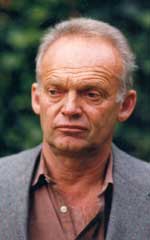 |
| Esteban Volkov |
Amongst those invited to take part in the event are Esteban Volkov, Trotsky's grandson, who has dedicated most of his efforts to the rehabilitation of the figure of the Russian revolutionary from the pile of slanders and lies of the Stalinists; Celia Hart, the Cuban communist who has played a key role in reintroducing the debate on Trotsky on the island and reclaimed his ideas; and Ricardo Napurí, a Peruvian army officer who became a revolutionary, collaborated with Che Guevara and is also a Trotskyist.
While in Caracas to participate in the event today, they were also interviewed on the main Venezuelan state TV channel by the well-known journalist Ernesto Villegas in one of the programmes with the highest audience ratings, "En Confianza". This was probably the most public debate on Trotsky that has taken place in the Venezuelan revolution.
In the programme, Villegas introduced Estaban Volkov as the "grandson of Leon Trotsky, the great figure of the world revolution". Esteban replied: "I am also the last surviving witness to the two attempts on Trotsky's life, the first one, and then the second when Ramón Mercader destroyed one of the most brilliant Marxist minds that has existed", and added that he was only 14 at the time.
Villegas explained that: "they are here to participate, in the framework of the debate about socialism of the 21st century, in the discussion about the role of Leon Trotsky, there are many Trotskyists amongst the Venezuelan revolutionaries"
When asked about who Leon Trotsky was, Esteban Volkov explained that: "Trotsky was one of the greatest revolutionary Marxists in history, one of the key figures, together with Lenin in the organisation and carrying out of the Russian Revolution, and then he became a defender of that revolution when the regime became bureaucratised and moved in a direction completely opposite to Marxist ideas, something that led finally to the destruction of the Soviet Union and the restoration of capitalism. Trotsky, in the last period of his life, defended that revolution. He paid with his life and fell in the trenches of that struggle. In Mexico, on August 20th it will be the 67th anniversary of when he fell victim to an agent of Stalin. But Trotsky is still alive."
Permanent Revolution
The discussion then moved on to the question of permanent revolution and Volkov was emphatic: "Yes, the revolution must reach its conclusion, it cannot be stopped at intermediate stages. We are not in the business of making the French Revolution, which was something that Stalin defended, and the working class paid with blood for this. In China he defended the revolution of Chiang-Kai Shek, which was a nationalist movement, and he instructed the working class to support Chiang-Kai Shek and then Chiang-Kai Shek massacred and assassinated the working class at that time, in the 1920s."
Celia Hart, who was wearing a red T-Shirt with the face of Che Guevara, also insisted that what was happening in Venezuela could only be understood if one understood Trotsky's permanent revolution.
"You introduced me as a comrade from abroad, but in Venezuela, thanks to the permanent revolution, a Cuban revolutionary is a comrade from within. What you are discussing here now is part of the Cuban revolution, I have no borders that separate me from the Venezuelan revolution. Socialism of the 21st century and the relationship between the Cuban and Venezuelan revolutions have a lot to do with the permanent revolution. Leon Trotsky is brought back to life, he is alive in Che Guevera, and I am very pleased to be alive and be able to see what is happening now, the permanent revolution. Next year is also the 70th anniversary of the transitional programme, which comrade president Chávez has already mentioned. We are witnessing unprecedented events, the fact that a Ministry is organising a commemoration of Trotsky, this is the first time in world history."
Asked about the differences between the Cuban and Venezuelan constitutions, Celia stressed the need for the planning of the economy:
"I am a physicist and I think that the processes should be seen in their dynamics. The revolution in Venezuela is moving towards a socialist revolution. I agree with the economist in the previous programme who said that there is a struggle between private and socialised property and that we need to move towards planning of the economy, as a Marxist and as a Guevarist as well, I fully agree. In fact when Che Guevara was Minister of Industry this was one of his battles, even against many Stalinists, to make planning and centralisation central features."
This is very relevant to the discussions that are taking place now in the revolutionary movement in Venezuela, where some are arguing that we can have some sort of "mixed economy", where an expanded state sector co-exists with private capitalists dominating key sectors of the economy. In order to have democratic planning of the economy, the key economic levers (the land, the banks and the main industries) must be expropriated and put under democratic workers' control.
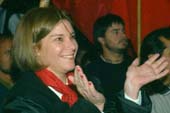 |
| Celia Hart |
When asked about the current state of the Cuban revolution Celia said that the fate of the Cuban revolution was closely linked to the Venezuelan revolution: "The revolution in Cuba is permanent thanks to Caracas, and the Cuban revolution is passing through the streets of Caracas. So, what you do here, do it right, because the Venezuelan revolution in a sense is the continuation of my revolution."
Ricardo Napurí explained that he became a revolutionary in 1948, when as a Peruvian air force officer he refused to bomb an APRA left wing uprising and had to go to exile in Argentina. Napurí was one of those who convinced Che Guevara to read Trotsky when he met him in Havana in 1959 and gave him a copy of The Permanent Revolution. He insisted that the Venezuelan revolution could not be seen in isolation but as part of a worldwide process:
"One of the questions that needs to be discussed in Venezuela, regarding socialism of the 21st Century is the following: is this a purely Venezuelan invention, or do we need to see it in relation to the Latin American context, its history, and the process of the world revolution? In this respect, Trotsky is alive because he raised the idea, also in his criticism of Stalinism, of the transition towards socialism. When we are talking about permanent revolution, we are talking about the dynamics of a revolutionary process. In Venezuela it is not enough to discuss the building of tools to transform today's reality but also we need to discuss where we are going, and this is related to the Latin American and world context. If we were to think just about Venezuela, this would be worse than trying to build socialism in one country. President Chávez is travelling around Latin America, opens links, looks for the support of the peoples because he knows that without the dynamics of the Latin American revolution, Venezuela would become isolated."
And he also emphasised that the revolution cannot stop half way:
"The message from Trotsky of the permanent revolution is that a revolution that stops half way loses it dynamism and becomes stale. If we are talking about a socialist revolution we must raise the issue: in today's world, with the barbarism of the capitalist system, with imperialism, what kind of socialism can we build? And for that Trotsky is useful, not just as an historical figure, his thoughts are alive, they are relevant for today"
Trotsky and the Cuban revolution
Celia Hart admitted that Trotsky had been a polemical figure in the Cuban revolution: "Yes, that is true, and unfortunately for a period of time Trotsky was silenced, but he was always present in the Cuban revolution." In fact, the Stalinists of the PSP (the Cuban Communist Party) had supported the Batista government (which at one point included two "Communist" ministers) and only joined the revolutionary war against the dictatorship in the last few months. After the coming to power of the July 26 Movement they were opposed to the nationalisation of the economy.
When asked about jailing of Trotskyists in Cuba she explained that: "One of the comrades who was supposed to be here today, Ydalberto Ferrera, unfortunately was jailed in Cuba during the revolution, this was the effect of the Stalinists razors. Today he is a supporter of permanent revolution and of Chávez and Fidel. I myself became a Trotsky through Che Guevara, who never called himself a Trotskyist, but who pushed me in the direction of discovering Leon Trotsky. These two figures are my prophets. And I think that this discussion will also open in Cuba and during the congress of the PSUV, the discussion on Leon Trotsky, who belongs to us."
She explained how Stalinism was like a virus: "In our revolution in Cuba, which is a socialist revolution, Stalinism is like a virus, contracted by the revolution and we must constantly be on guard and vaccinate ourselves against it. We must ensure that this virus does not spread and take over the whole revolution as happened in the Soviet Union. We are no longer under the influence of Moscow, the relationship between Caracas and Havana is very different, it is a relationship between two revolutions, and others that will come, Ecuador, Bolivia."
In her view, internationalism also means that the PSUV had to spread beyond the borders of Venezuela: "If we want to follow the path of Simon Bolivar we must create a revolutionary party of the Gran Colombia", and in relation to the PSUV she added that: "Revolutionaries and Marxists must be able to join this train or the train of history will leave them behind" in what was an implied criticism of the position of the Venezuelan Communist Party and some sectarian elements in the trade union movement around Orlando Chirino who have stayed outside the new United Socialist Party. And she is quite right, since while 5.7 million people have already registered to join, staying outside of this party, which is where the struggle between reform and revolution will take place in the next few months, is highly sectarian.
Asked about Fidel's health and the series of articles that he is writing under the title "reflections" (reflexiones), she appealed for Chavez's "Alo Presidente" to be broadcast in Cuba: "Fidel's health is improving, he is writing now his ‘reflections' articles. It would be good in Cuba if the whole of Alo Presidente could be broadcast because we are used to our leaders making 6 hour long speeches and maybe Chavez could help us with that."
Stalin eliminated the Bolshevik Old Guard
Esteban Volkov was asked to give a message to the Venezuelan people about Trotsky:
"Trotsky is an inspiration for any revolutionary movement and is the most current and relevant expression of Marxism in our epoch in the 21st century. The persecution against Trotsky was not an isolated fact. It was the elimination of all of Lenin's comrades, all the Bolsheviks that made the revolution, Stalin had to eliminate all of them in order to impose his counter-revolution and totalitarian bureaucratic dictatorship. Trotsky is the last one in a long chain of assassinations, of hundreds of thousands of revolutionaries assassinated by Stalin so he could consolidate his regime, which caused untold damage to the socialist cause."
Villegas added to this: "I was very impressed when I visited Trotsky's house in Coyoacán and I saw a picture of the members of the CC of the RSDLP who made the revolution, and after a period of time, Stalin was the only survivor."
Events like this interview, joining together Trotsky's grandson, a Cuban Trotskyist who is also rooted in the historical tradition of the Cuban revolution, and a Peruvian military officer who became a Trotskyist, added to the fact that they are all speaking today in a meeting officially organised by the Venezuelan authorities, are an indication of the enormous thirst for ideas that exist in the Venezuelan revolution.
See also:
- Ted Grant on the assassination of Trotsky (August 1940)
- Leon Trotsky - revolutionary martyr by Rob Sewell (August 1985)
- Trotsky.net website dedicated to the memory of Leon Trotsky