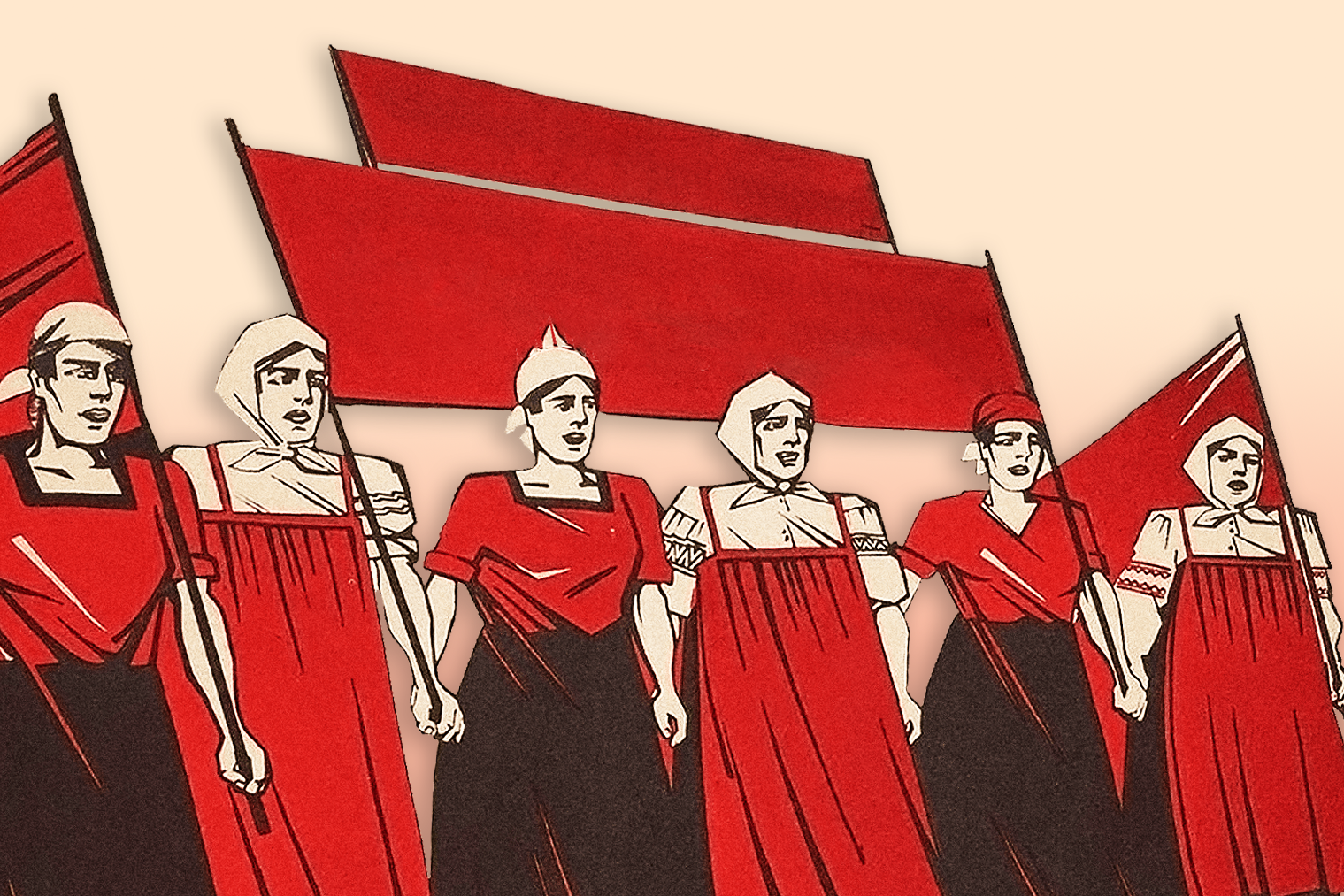
Russian working class women gained much from the October revolution of 1917 and the subsequent planned economy that was put in place. Later under Stalin many of the gains were destroyed, although as the economy developed the conditions of women also improved. The return of capitalism in Russia dramatically worsened the conditions of women. How does all this compare to the current situation working class women are facing in the UK?
“I really believe the revolution has changed us. People are acting differently towards each other.” These are the words of Ms Kamel, 50, one of the many women who were out on Tahrir Square, actively participating in the revolution.
The crisis of capitalism means attacks on workers at all levels, including women, who very often work in low paid jobs. The Austrian Social-Democratic Women’s Organisation prides itself at being “feminist”. However, when it comes to sacking women workers or cutting their wages the “feminism” of this organisation proves to be wafer thin, as we see in this case of the Sozial Global AG company in Vienna.
Should women separate themselves from the labour movement or should they be an essential part of it in struggling for their rights? Any attempt to divide trade unionists and workers in general according to gender is reactionary and plays into hands of the bosses. Experience itself shows that once women start to organise in the workplace and fight for their rights, this cuts across divisions, unites men and women workers and strengthens both the position of women and the working class as a whole.
Biological differences between the sexes are often raised to justify all kinds of reactionary concepts, such as supposed differences in intelligence. These are also used to justify confining women to the four walls of the home, as if this were somehow biologically inbuilt. In reality, these ideas reflect material forces that have emerged as a result of the development of class society, where one class oppresses another.
One hundred years ago today, 99 women from 17 different countries attended the Socialist Women's Conference held in Copenhagen in the House of the People. In this first part, we look at the origins of Women's Day, the origin of women's oppression in class society, how capitalism lays the material foundations upon which the question of women's emancipation can be tackled as part of the struggle of the working class for the emancipation of the whole of humanity from class oppression.
The case against Ruby Dhalla in Canada, although yet to be judged by a court, demonstrates that women do not have the same interests at heart. Women are divided by class, just like racialized minorities are divided by class, and people of different sexual orientation are divided by class.
Page 1 of 6
Donate to help spread Marxist ideas.
[Read the appeal]