

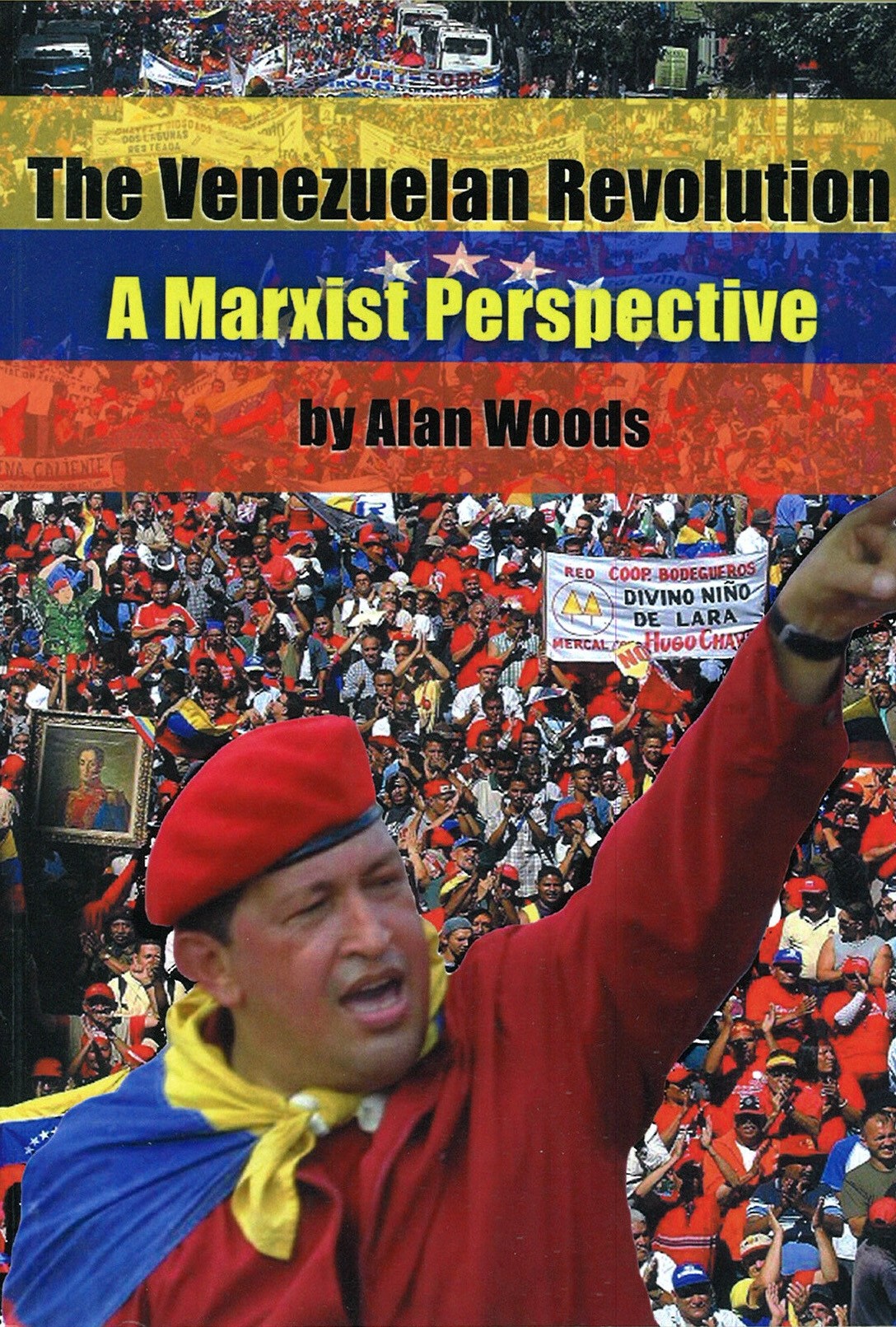
The central thesis of this book from beginning to end is the following: that the Bolivarian Revolution can only succeed if it goes beyond the boundaries of capitalist private property, expropriating the oligarchy and transforming itself into a socialist revolution. The Revolution has begun, but it is not finished. The old state apparatus is still largely intact and a number of key economic levers (including the banks and the land) remain in the hands of the Venezuelan oligarchy.
Salus populi suprema est lex ("the good of the people is the supreme law", Cicero)
The present work is a collection of articles that I wrote from 2002 to 2005. Although they were not written with the intention of publication in book form, I believe that, taken together, they form a fairly complete and coherent account of the stormy events of that period. The central thesis of these articles from the very first was the following: that the Bolivarian Revolution could only succeed if it went beyond the boundaries of capitalist private property, expropriating the oligarchy and transforming itself into a socialist revolution.
At that time, despite its extraordinarily bold and heroic character, the Bolivarian Revolution did not question capitalist property relations. Its perspectives were limited to the programme of what Lenin used to call the national democratic revolution. It was in this (Leninist) sense that I described it as a petty bourgeois movement, that is, a revolutionary movement that vacillated between the bourgeoisie and the proletariat, between socialism and capitalism. This petty bourgeois outlook was summed up in the expression "the third way".
Lenin was very fond of a Russian proverb: life teaches. Through his own experience, together with a lot of reading and discussion, President Chavez became convinced that socialism represents the only way forward for the Bolivarian Revolution. This was a bold and absolutely correct conclusion that corresponds precisely to the objective needs of the Revolution and the aspirations of the mass of Venezuelan workers and peasants, the revolutionary youth and the progressive intellectuals - in short to all the living elements in Venezuelan society.
The last 15 years have witnessed an unprecedented ideological counteroffensive of the bourgeoisie on a world scale. President Chavez's advocacy of socialism - not only for Venezuela but for all of Latin America and the whole world - was particularly important at a time when, after the collapse of the Soviet Union, it was fashionable to claim that socialism was dead and that the ideas of Marxism had been falsified by history. The aim of this propaganda was to convince the peoples of the world that only one system was possible: capitalism.
The apologists of capitalism stand everything on its head. The central problem facing the world today is the existence of imperialism and capitalism. The giant corporations are trying to control the whole world and plunder it for profit. They are supported by the big imperialist bullies, in the first place the USA, which, after the collapse of the USSR, enjoys unprecedented power and uses it to make and unmake governments and subject whole countries and continents to its will. It has invaded Iraq and plunged that country and the whole of the Middle East into a bloody chaos. It is shamelessly bullying Cuba and Iran. Above all, it is striving with all its power to overthrow Hugo Chavez and destroy the Bolivarian Revolution.
The Fifth Column
The counterrevolution in Venezuela has been defeated by the masses on at least three occasions. But it has by no means reconciled itself to defeat. Washington cannot be reconciled to the Bolivarian Revolution because of the effect it is having on the masses of poor peasants and workers of all Latin America. If it cannot succeed through a direct assault, it will try other means. Imperialism and the oligarchy have plenty of weapons in their armoury: bribery, corruption, infiltration of the revolutionary movement to undermine it from within, and a thousand other tricks.
A Conservative Member of Parliament in Britain once told a Left Wing Labour MP: "You can never succeed because we will always buy your leaders". This man was expressing with unusual frankness a fact of which every conscious worker is well aware: that the ruling class uses corruption to buy off the leaders of the movement, to control it from the top, to water down its revolutionary essence and convert it into something harmless and impotent.
The biggest danger that now faces the Bolivarian Revolution is bureaucracy - that poisonous cancer that gnaws at the entrails of the Revolution and devours it from within. The pro-bourgeois "Bolivarian" bureaucracy is a Fifth Column that threatens the future of the Revolution. The fight against bureaucracy and corruption is therefore an important part of the fight against counterrevolution.
When President Chavez came out in favour of socialism, the workers, peasants and youth were enthusiastic. The rank and file Bolivarian activists began to study the ideas of scientific socialism - Marxism. This development was a mortal threat to the bureaucracy, who resorted to all manner of means to combat it. They could not openly oppose the idea of socialism, since the President himself had supported it. Instead, they tried to argue that "socialism of the 21st century" was something new and unique - that is, something quite different from Marxism.
President Chavez has said many times that capitalism is slavery, that its continued existence is a threat to the survival of the human race and life on earth. He quotes the famous phrase of Rosa Luxemburg: socialism or barbarism. Is that not absolutely clear? Not one of the problems facing the masses can be solved without an all-out struggle against capitalism and imperialism. That is the first point that needs to be made.
Here we have the first point of disagreement with the reformists. They believe that it is possible to achieve our ends without a radical break with capitalism. They agree that things today are perhaps not quite as nice as we would like them to be, but that can change. All that is necessary is a little patience and moderation and all will be well. Unfortunately, a large part of the Left (including some who call themselves Marxists) have fallen into a trap. They refer, not to a struggle against capitalism, but a fight against "neo-liberalism". That is to say, they do not propose a struggle to abolish capitalism but only a change of model. They say, in so many words, "we do not want this nasty capitalism, we want another nicer, more humane capitalism."
This chorus is often sung by the Social Democracy and reformist groups like Attac, who systematically spread confusion and disorientation among the revolutionary vanguard. What do these people propose? Only this: that the rich are too rich and the poor are too poor. Therefore, the rich should agree to give up part of their riches so that the poor can be rather less poor and everyone will be happy. The bosses will still be bosses, and the workers will still be wage slaves but they will be happier wage slaves and therefore less inclined to rebel.
New ideas?
It is quite amusing that these people claim to represent new and modern ideas, while Marxism represents old-fashioned ideas. In fact, the ideas of the reformists merely repeat the confused notions of pre-Marxist socialism - the ideas of the utopian socialists like Robert Owen, Fourier and Saint-Simon, who spent all their lives trying to persuade the capitalists by rational argument that it would be in their own interests to give up some of their profits to improve the lives of the workers.
Astonishingly, the reformist critics of Marx regard themselves as political realists. In reality, the reformists behave like a man who tries to persuade a tiger to eat grass instead of flesh. Such a person will not succeed in changing the eating habits of the tiger but will end up inside its stomach. The reformists do not understand that it is impossible to reconcile antagonistic class interests. It is impossible to reconcile the interests of wage labour and Capital. This is not realism at all, but the most absurd utopianism.
Society is divided into antagonistic classes. The great Irish socialist James Larkin put it like this: there are two classes: those who produce everything and possess nothing and those who produce nothing and possess everything. That is a slight oversimplification, of course, because there are also intermediate layers, the middle class (to which the reformists inevitably belong). Nevertheless, it accurately describes the two main classes in society: the proletariat and the bourgeoisie.
Do Marxists advocate violence?
The criticism of revolutionary Marxism is based on all kinds of arguments, mostly the result either of ignorance and misunderstandings or of deliberate misrepresentation. One of the commonest accusations against Marxism is that it advocates violence, whereas the Bolivarian revolution is a peaceful revolution that is proceeding gradually, step by step, to transform society by legal and parliamentary means. We can all agree, in general, on the undesirability of violence as a means of settling political and social disputes. But the most superficial consideration of history immediately leads us to the conclusion that violence has always been used by the ruling class to perpetuate its power and privileges.
The Venezuelan Revolution does not contradict this rule but confirms it completely. President Chavez has won every election with overwhelming majorities. What was the reaction of the Venezuelan landlords, bankers and capitalists? They organized a campaign of sabotage outside parliament, culminating in the coup of April 2002. This was in effect an armed uprising against a democratically elected government, in which dozens were killed. That coup was defeated by the revolutionary movement of the masses that saved the Revolution by its extraordinary heroism.
After the failure of the coup in April 2002, in my view, it would have been easily possible to have expropriated the oligarchy and finish the revolution without bloodshed or civil war. The reactionary forces were shattered, demoralised and divided. They were incapable of resistance. However, instead of taking the offensive, the Revolution lost the initiative.
After that, a serious attempt was made to achieve some sort of national reconciliation. The counterrevolutionaries were treated with great kindness and consideration. What was the result of this? Did they drop their opposition? No, they were even more determined to destroy the Revolution than before. They concluded that this was a sign of weakness and organized the second attempt to overthrow the government. In a few months they launched the bosses' lockout and criminal sabotage of the oil industry that seriously damaged the economy.
What conclusion can we draw from this concrete experience of the Bolivarian Revolution? Only this: that it is not possible to reconcile the interests of the proletariat and the bourgeoisie. One can support the interests of the working class, who are the great majority of society, or one can support the interests of the minority of wealthy parasites - the bankers, landowners and capitalists. But one cannot support both. By trying to reconcile irreconcilable class interests, the reformists in the end inevitably support the ruling class against the working class.
Somewhere in the Bible it says the lion shall lie down with the lamb. But in real life a lamb that tried to lie down with a lion would have a very uncomfortable experience. A government that is elected by the working class to act in its interest, but then left the economic power in the hands of the bankers, landowners and capitalists, would soon discover that it was unable to fulfil its promises. Although elected by the votes of the majority, it would find that the important economic decisions were not in its hands.
Either capitalism or socialism
Let us express this idea in a different way: if you accept the capitalist system (the "market economy") then you must accept the laws of the capitalist system. But the laws of the market dictate that the capitalists must make a profit and that everything else is subordinate to this. It is useless complaining about it.
Socialism is a system of planned economy, based on the nationalisation of the means of production and the democratic control and participation of the working class. The capitalist system is an anarchic system. It cannot be planned. The financier George Soros a few years ago wrote a book in which he described in great detail the anarchic nature of international finance markets, but then he advocated (a bit like the reformists) measures to regulate international finance markets, which was a complete joke - like teaching the tiger to eat grass. Needless to say, this had not the slightest effect on international finance markets, or anything else.
In order to solve problems like unemployment or the lack of houses and schools it is necessary for the government to introduce economic planning - to draw up an economic plan based on the needs of the majority, not the profit of the minority. But you cannot plan what you do not control and you cannot control what you do not own. As long as the land, the banks and the big industry remain in private hands, no solution is possible.
That is the central challenge that faces the Venezuelan Revolution at the present time. The Revolution has begun, but it is not finished. As a matter of fact, the main task remains to be accomplished. What is the central problem? Only this: that the old state apparatus is still largely intact and a number of key economic levers (including the banks and the land) remain in the hands of the Venezuelan oligarchy.
As long as this situation continues the Revolution will be in danger. The oligarchy will never be reconciled to the Revolution. Although its property has hardly been touched, although it still enjoys its wealth and privileges, although it still holds in its hands powerful means of communication in the shape of the main daily papers and TV channels, which is uses to spew out a daily torrent of filth, lies and slander against the democratically elected government - despite all this, it is not satisfied. And it will never be satisfied until it has overthrown the government and crushed the masses under its feet.
These facts are known to all. Even the blindest of the blind ought to be able to see the real situation. But, as they say, there are none so blind as they who do not wish to see. And the reformists never wish to see reality. They prefer to fool themselves and others with comforting myths about lambs lying down with lions, and tigers eating a healthy diet of lettuce. And these people have the nerve to describe the revolutionaries as "utopians"!
The law and the counterrevolution
Should we respect the "rule of law?" In order to answer this question, we must first understand the nature of laws, where they come from and whose interests they represent. Solon the Great was a man who knew a lot about the law. The author of the Constitution and laws of Athens, Solon said the following: "the law is like a spider's web: the small are caught, and the great tear it up." How very true! And how very like the present situation in Venezuela! The same oligarchy that howls about the alleged "violations of the law" by the government organised a military coup against the democratically elected government. Where was its respect for the rule of law then?
If a worker or a peasant breaks the law he is put in prison. But the great majority of those scoundrels who organised the overthrow of the legal government remain at liberty. They continue their intrigues and plots with no problem, while complaining to the whole world that they have been very badly treated, their human rights have been violated etc., etc. Is this not a joke in very bad taste?
In April 2002, when the mass of workers and ordinary people rose up, risking their lives to save democracy in Venezuela, dozens of innocent people were killed by the police. How many of these murders have been punished? How many have been sent to prison? What sort of "rule of law" is it that protects the guilty and allows criminals to continue their criminal activities with impunity?
It is well known that elements in the police have been guilty of constant provocations, illegal acts, even murders. Why is this permitted? What has this lawlessness got to do with the rule of law? No, this is an intolerable state of affairs even from the standpoint of ordinary bourgeois law. The Revolution has the right to defend itself and it must defend itself. It must take action to dissolve reactionary bodies and replace them with a citizens' police organized by armed revolutionary committees.
Would such an act be in strict accordance with the letter of the law? I do not know. But I do know that it is absolutely necessary and would be applauded by the great majority of the people of Venezuela. How could it be justified? It can be justified quite easily by the words that preface this article: Cicero, that great Republican, long ago explained that the Good of the People is the Supreme Law. And we will express the same idea even more concretely: The Safety of the Revolution is the Supreme Law.
The truth is always concrete
The French have an expression: "A la guerre comme a la guerre". The revolutionary people of Venezuela are at war, even though the war has not been declared. The truth of the matter is that they have been at war for several years, and the war is constantly intensifying. Hegel used to say: "The truth is always concrete." At a time when the enemies of the Venezuelan Revolution are gathering their forces to deal a mortal blow to the people of Venezuela, when CIA death squads are planning to assassinate the President in collaboration with the Venezuelan opposition, what good is it to quote legal niceties?
In time of war even the most democratic countries discover the need to place some restrictions on civil liberties - including the famous freedom of expression. During the Second World War, in Britain, known sympathisers of Germany were put in prison even though they had not committed any crime. Opposition newspapers were closed or submitted to censorship. During the struggle for independence Simon Bolivar also issued the famous Decreto de Guerra a Muerte by which all those Spaniards who would not join the struggle against tyranny would be executed. This was a harsh measure, but necessary in conditions of war. Yet the Venezuelan opposition - which at the very least is guilty of apologising for terrorism - remains outside the law.
How long can this situation be allowed to continue? That is the question that is being asked by many workers and rank and file Chavistas. The masses are demanding decisive action. The masses instinctively understand that the Revolution has not been carried out to the end. They see the danger of counterrevolution, and they know exactly what this means for them and their families. That is why they are demanding action.
The worker has not read many books, and has no diploma but he has a keen class instinct and knows what has to be done. He (or she) knows that a serious fight lies ahead and that this cannot be avoided. However, there are some very clever people who have read lots of books and can make speeches so profound that nobody can understand them - least of all those who make them.
These "clever" individuals all have one thing in common - they are against revolution. However, they do not say so clearly (because they never say anything clearly). They talk scornfully about the "old ideas" (of Marxism) and always refer to the "new ideas" that are so necessary. Unfortunately, when asked to say what these "new ideas" consist of, they immediately change the subject or begin to talk in generalities about "power", "co-operation" or anything else except what is demanded by the situation.
What is the essence of this "wisdom", stripped of the verbiage? That it is not necessary for the working class to take power, that it is possible to seek "alternative methods" and so on. What are these methods? Broadly speaking, we are talking about different forms of co-operation. This remarkably "new" idea is as old as Robert Owen, the great Welsh utopian socialist - that is to say, almost 200 years old. Now Robert Owen - my fellow countryman - was a great pioneer of socialism and his ideas were extraordinarily advanced for his period. But to counterpose his ideas to those of Marx and Lenin is like proposing to return to the horse drawn cart and the wooden plough instead of the tractor and the combine harvester.
Even today co-operatives can play an important role in the struggle for socialism, of course. They are particularly important as a means of stimulating co-operation among the peasants in a country like Venezuela. But they can never be an alternative for a nationalised planned economy. The idea that one can have "islands of socialism" within the capitalist economy is just foolish. The historical experience of co-operatives shows that under capitalism in the end they inevitably tend to degenerate into normal capitalist enterprises. And this can be seen in Venezuela today.
What the workers are demanding is not co-operation but expropriation, not participation but workers' control. Workers' control is a big step forward, and we must encourage it. It challenges the "sacred right" of the capitalists and bureaucrats to manage industry, while giving the workers priceless experience in administration and control that can be put to good use in a socialist planed economy. However, as long as key elements of the economy remain in private hands, as long as there is not a genuine nationalised planned economy, the experience of workers' control will inevitable have only a partial, one-sided and unsatisfactory character.
How to make the Revolution irreversible
The reformists, to give them credit, show an extraordinary wealth of inventiveness. They constantly develop the same theme in different keys. In Venezuela they often resort to the following variant: yes, the Revolution is not finished, but it will never be finished, because it is a process. This theme of the Revoution-as-permanent-process sounds quite profound and revolutionary. Actually, it is neither. It is a very banal rhetorical trick, a play on words. Because if a process is always taking place, then nothing fundamental ever changes.
The French express this idea as a proverb: "plus ça change, plus c'est la meme chose" - the more things change, the more they stay the same. But this is fatal to the Revolution. At a certain point the masses will begin to ask: what has really changed? We have the same old bureaucracy, the same corruption as before, the same capitalists run the factories, the same landowners own the land, the same police, the same judges and ambassadors. We did not make a Revolution for this!
Up till now at every decisive turning point the masses have saved the Revolution from its enemies. The masses have been its main motor force. But if a mood of tiredness and scepticism develops, the class balance of forces can change. The initiative can pass to the counterrevolution once more. Therefore, those "Bolivarians" who are trying to put the brakes on the Revolution, arguing that we "must not go too far", are in fact undermining it and playing the game of the counterrevolution.
"But what about parliament?" our reformist friends will protest. As a Marxist and not an anarchist, I have no objection to using parliament. In general, we must use every democratic opening that is available to us under capitalism, to the degree that this is permitted to us. The case of Venezuela shows that parliamentary elections can play an enormous role in mobilizing the masses, organizing them and striking blows against the oligarchy. This allowed the working class to recover and regroup after the defeat of the Caracazo.
Since it was elected, the Bolivarian government has passed a series of progressive laws that have benefited the people in such important fields as education and health. A start has been made on agrarian reform, although it is still insufficient. All this is progressive and we support it wholeheartedly. But it still does not mean that the fundamental problems have been solved or that the Revolution cannot be overturned.
Hugo Chavez has obtained substantial majorities in every election since 1998. He decisively defeated the opposition in the recall referendum of August 2004. He has a big majority in parliament. In the Legislative Elections of December 2005, the opposition boycotted the elections. This action can only be interpreted in one way: the Venezuelan bourgeoisie has abandoned all idea of achieving its ends by peaceful, legal, parliamentary means. The struggle is now approaching a decisive stage.
What is necessary is to nationalise the land, the banks and what is left of private big industry. That will enable us to plan the economy and mobilise the productive forces in the benefit of the majority. We are now on the eve of new Presidential elections. President Chavez has stated that the next stage will make the Bolivarian Revolution irreversible. But how can this be done? Only by putting an end to the power of the oligarchy once and for all. This can be done quite legally and through parliament, but only on condition that the masses are mobilised outside parliament to fight the counterrevolution, to take over the factories, the banks and the land.
What is to stop the elected government from introducing an emergency law (ley habilitante) nationalising the property of the oligarchy? It would be possible to explain to the country on television the reasons for this (there are a number of very sound reasons). At the same time, an appeal should be made to the workers and peasants not to wait for parliament (which tends to be slow) but to take immediate action, occupying the land and the factories.
"But this would mean violence and civil war!" This is the standard argument of the reformists against revolution. But in fact, it is the precise opposite of the truth. It is the dialectic of reformism that it always produces results that are the exact opposite of those intended. The attempt to conciliate the oligarchy, to adopt moderate policies, to avoid clashes etc., - this will inevitably lead in the end to the most terrible violence.
As we have already pointed out, weakness always invites aggression. However, there is a way of avoiding bloodshed and civil war - only one way. It was understood long ago by the ancient Romans who said: "Si pacem vis para bellum" - "If you want peace, prepare for war." That is to say: if the workers are armed and mobilised, and prepared to go to the end, then the likelihood of violent resistance on the part of the property owners is reduced to a minimum.
The Venezuelan Revolution has reached the point of no return. All the revolutionary forces will fight to ensure the re-election of the President. But the only way to make the Revolution irreversible is to expropriate the landlords, bankers and capitalists, and create the basis for a socialist planned economy with the democratic control and management of the working class. A workers' and peasants' Venezuela will be a beacon that will encourage the masses to follow its lead everywhere. This is the only way to revive the dream of Bolivar: a united Latin America, which today can only be achieved as The Socialist Federation of Latin America.
London, June 16, 2006