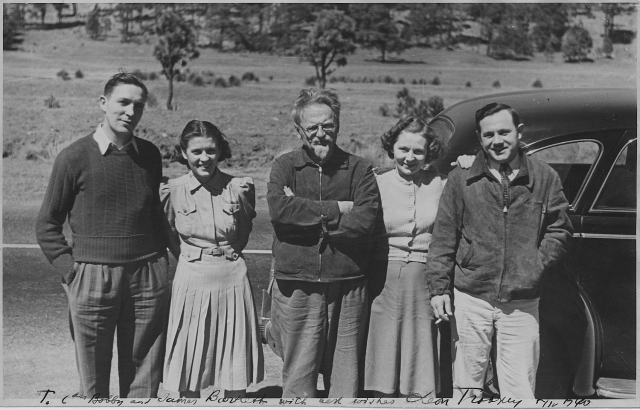
In 1988 Alan Woods interviewed Esteban Volkov (Leon Trotsky's grandson) in a room in the Trotsky Museum in Coyoacan, of which he is the curator. On the night of 24 May 1940, Esteban Volkov, then only 14 years old, was wounded in a brutal machine-gun attack by Stalinist supporters, from which the Trotsky family miraculously escaped alive. Sixty-six years after the murder of Leon Trotsky (20 August 2006), we republished this interview dealing with the various assassination attempts on Trotsky and his family.
First published in Militant 17 june 1988
I interviewed Esteban Volkov in a room in the Trotsky Museum in Coyoacan, of which he is the curator. On the night of 24 May 1940, Esteban Volkov, then only 14 years old, was wounded in a brutal machine-gun attack by Stalinist supporters, from which the Trotsky family miraculously escaped alive. With no visible emotion, Esteban showed me the bullet holes which still remained in the wall of what had once been his bedroom. In the room alongside the study where his grandfather was murdered by a Stalinist agent, I questioned him about his past.
Alan Woods: Your family has suffered dreadfully at the hands of the Stalinists. Your father and sister were sent to concentration camps, and your mother, Zina, was persecuted to the point where she committed suicide. What recollections do you have of them and of your early childhood in Russia?
EV: About Russia I have only the haziest memories. I had a half-sister a bit older than myself. She stayed behind in Russia and, as you say, was sent to concentration camps. Nothing more was heard of her. I suppose it is just possible that she might still be alive. But I have heard nothing from her.
About my father I have no memory at all. He was arrested when I was very young. A few years ago Pierre Broué sent me a photograph he had discovered when doing some research. That was the first time I got to know what my father looked like.
As for my mother, she was separated from me when I was seven years old, when she went to Berlin for treatment for a nervous disorder. That was at the time when Hitler was on the point of coming to power. I only learned of her death a year afterwards. They decided to keep the news from me.
AW: And your grandfather?
EV: My first recollection is when I arrived in Turkey with my mother, on the island of Prinkipo where my grandfather was living in exile with my adoptive grandmother, Natalya. I lived there for about a year. I remember accompanying him on fishing expeditions among the islands in the sea of Marmora. I was five years old then. That was the first time I met my grandparents.
In August 1939 1 finally went to live with them in Mexico, one year before the assassination. I travelled to Mexico with Alfred and Marguerite Rosmer. I was then thirteen years of age, so I can remember a lot more.
AW: Can you describe the life of the Trotsky household in Mexico?
EV: We were a numerous 'family'. There were comrades from many nationalities. There were Germans, and I remember also a Czech comrade, but mostly Americans, all of whom came to help defend the family. They were from all walks of life, including some workers. One was a lorry driver, Jackie Cooper. There was a painter called Harold Robbins and another was a teacher called Charlie Cornell.
AW: How do you remember your grandfather's work?
EV: He was a tremendously active and extremely dynamic person. He always got up very early and used to spend some time feeding the chickens and rabbits, which were a source of food for us before getting down to work. That was his way of getting a bit of physical exercise. You must remember that he was virtually locked up in this house, with no other opportunity of getting about. After that he had breakfast, and then spent virtually the whole day in his study, till 5, 6 or 7 o'clock, reading and working on his books and manuscripts. Then at night there were usually political discussions with the comrades.
AW: Can you say something about the assassination attempt led by the Stalinist Siqueiros on the night of 24 May 1940?
EV: In the weeks and months prior to this attempt you could sense an increasing tension in the house. The attacks in the Mexican Stalinist press were becoming increasingly virulent. This already indicated that some kind of physical attack was being prepared.
About four o'clock in the morning, I heard the garden gates being suddenly thrown open, and shortly afterwards there was a tremendous noise of gunfire, and the place was turned into a battlefield.
I could just make out a silhouette inside my room, and then they opened fire. Incendiary bombs were thrown inside, which set my room ablaze. I was crouching behind the bed in a corner of the room. But when I saw the bombs I ran out into the courtyard and called for my grandfather. This was a great relief for Trotsky and Natalya who at first feared I had been kidnapped.
AW: You were wounded?
EV: Yes, I was grazed in the foot by a bullet and left a trail of blood on the floor. Very soon the attackers fled and I could hear voices from all sides. The whole family got together and were overjoyed to see that we had all survived. All that is, except for Sheldon Harte, the young American guard who had disappeared. This worried us all tremendously. (He was later found murdered - AW).
AW: And what do you. remember of your grandfather's assassination? Did you know his assassin, Jackson?
EV: Mercader? Yes, I remember him. He was one of a number of people who hung around the place. He took great pains to get on friendly terms with the guards and also with the Rosmers. He was always doing them little favours, giving them lifts and so on. But he did not at first express an interest in meeting Trotsky himself.
AW: That was a tactic?
EV: That's right. It was a means of not drawing attention to himself and arousing suspicion. He was living with a young American Trotskyist called Sylvia Ageloff and gave the impression of someone who greatly admired the comrades, and was anxious to help, without getting openly involved in politics. It was all part of a tactic. He kept this up for many months.
AW: And do you remember the assassination itself?
EV: I arrived late on the scene. I had been at school all afternoon and was walking home when I noticed unusual movements around the house, with people coming and going and a car parked outside. I suddenly felt a strange feeling. A kind of anguish, like a premonition that something was badly wrong.
I went in and saw a, lot of people in a state of tremendous agitation. Some policemen were holding on to Mercader who had been beaten up by the guards and was bleeding. He was completely beside himself, weeping and blubbering. Then I went into the study and saw my grandfather stretched out on the floor. It seems he had told them to keep me away. That made a big impression on me that with his dying breath he should be so concerned about a child. Shortly afterwards the ambulance came and took him away.
AW: Now to pass on to the field of politics, how would you describe yourself politically?
EV: Well, as you know, I am not a member of any political party. However, I would describe myself as a Marxist because I consider that Marxism is the only valid political theory in the modern world.
AW: But with regard to the hundreds of thousands of comrades who perished under the Stalin terror, including so many members of your own family, how would you describe your own involvement in the fight for their political rehabilitation?
EV: I believe that any person who sincerely defends the ideas of socialism is under a moral obligation to fight to re-establishh the truth about the history of the Russian revolution and for the rehabilitation of all Stalin's victims, and to denounce all the crimes and falsifications of Stalinism. It is necessary to fight to ensure that never again will such a monstrous regime be allowed to exist, and worst of all under the name of 'socialism' and 'communism'.
AW: And the Moscow trials?
EV: It is imperative that all those monstrous falsehoods be exposed and denounced, and that every page should he expunged and cleansed, so that there is not the slightest remnant of the slanders used to blacken a whole generation off revolutionaries. The process must be carried through to the end.
AW: You are aware that this cause is receiving ever wider support in the labour movement internationlly. You know that in - Britain we are launching a major campaign for the rehabilitation of Trotsky and the old Bolsheviks. Is there anything you would like to say to the comrades in Britain and other countries who are fighting along these lines?
EV: Only to say that these activities have my wholehearted support. They are fundamental for the health of the entire working-class movement. The record must be put straight. The falsifiers of history must be branded as traitors to socialism. Stalinism has been one of the most serious setbacks suffered by the cause of socialism in the whole of its history. There is no doubt that socialism will triumph in the end. But this represented a colossal reverse of the historical process.
AW: While we are on the subject, could you say what you think of the present situation in Russia and the Gorbachev 'reforms'?
EV: There can be no doubt that the winds of change are blowing. There is a change - though how far it will go remains to be seen. The main thing is that the whole system has now reached a blind alley. They can't go any further down that road. The bureaucratic system is in crisis. There is no way they can go badeto the old system of open dictatorship as under Stalin.
AW: Do you still think the October Revolution was justified in the light of the experience of Stalinism?
EV: Of course it was! Whether we like it or not, the historical process is full of all kinds of ups and downs, including violent upheavals, involving tremendous human suffering. But nevertheless society moves forward. The October Revolution was one of the greatest events in the whole of history. The fact that it subsequently took a different course, arising out of the concrete situation in Russia at that time, and the fact that the revolution did not spread to other countries, does not alter that fact in any way. Don't forget that in France too, after the revolution of 1789-93, there were important setbacks, but in the long run the revolution - in this case the bourgeois revolution - succeded in consolidating itself.
AW: Do you believe the bureaucracy in Russia can abolish itself?
EV: Well, in as much as society requires skilled personnel to run industry, technicians and so forth, they have an important role to play. The problem arises when, as happens in Russia, the bureaucracy acquires enormous privileges and constitutes itself into the ruling elite, which devours a large part of the surplus produced by the working class and lives on the backs of the workers.
Power must pass from the hands of the bureaucracy into the hands of the working. class as a whole. There must be a genuine workers' democracy that would involve the rural proletarians and also the technicians, scientists and other layers who under modern conditions, in my view, should really be regarded as part of the proletariat.
AW: Could, you say something about your role as curator of the Trotsky Museum?
EV: Despite an acute shortage of resources, we are striving to maintain the building as far as possible just as it was when Trotsky lived and worked here. We have help from young people who come to work here. Of late the Mexican government has also begun to give assistance.
AW: How many visitors do you get on average?
EV: It varies from day to day, sometimes 50, sometimes 30. We also get groups of schoolchildren of 100 or 200.
AW: I was struck by the fact that there are quite a number of signatures of visitors from the Soviet Union, some of whom have even left messages of support.
EV: Yes indeed. Times have changed a lot! You can see how the people are gradually losing their fear of expressing their thoughts. These days they are not only willing to sign their names, but, as you say, leave messages. The latest one, earlier this year, said the following: "After Bukharin, the next revolutionary to be rehabilitated in the USSR will be Leon Trotsky."
AW: That is of enormous symptomatic importance. And what do you think of the rehabilitation of Bukharin?
EV: Well, it seems to be a step in this direction, doesn't it? Of course, we must bear in mind that Bukharin stood on the right wing of the party and therefore it was far easier for the bureaucracy to accept him than it would be in the case of Leon Trotsky who was implacably opposed to it. Evidently Bukharin, with his policy of concessions to the capitalist element was more acceptable to Gorbachev.
AW: As a Marxist and someone who believes in the socialist future of mankind, would you like to give your view of the future?
EV: I consider it indisputable that mankind must arrive at a form of society which is at harmony with itself. How can we continue to live on an atomic minefield, squandering colossal resources, while millions are suffering from the lack of the minimum necessities of human existence?
The level of technological development is more than sufficient to provide abundance for the whole human race. It seems absurd that the perpetuation of an outlived social structure based on class inequality and exploitation should continue to be the cause of artificial shortages and enormous suffering. The development of science and technique in itself provides the answer to all these problems, if it were placed on a harmonious and planned basis.
AW: In conclusion, do you have any message to British workers and socialists?
EV: Only to encourage them to keep the banner of socialism flying, to rally to the ideas of Marxism and never to give up the fight for the real socialist society.