

Redundant Daqing Oil Workers and Liaoyang City Steel and Textile Workers Battle Paramilitaries
Strike Leaders Arrested
Movement Continues Unabated
By Ho Jun-bo,
Hong Kong, March 19, 2002
From the Asian Marxist Review,
Theoretical Journal of the Workers' International League, Hong Kong & Macao
 Not since the struggles of the workers, youth and students of the 1987-9 period has China witnessed the level of worker, youth, poor farmer and poor peasant and migrant worker struggles that we are witnessing at present. The period from 2001, the beginning of the Chinese millennium celebrations, to now, has demonstrated the enormous potential that these mass proletarian movements possess in the historical struggle against the attempts at capitalist restoration and for the anti-bureaucratic political revolution (this is a revolution for the overthrow of the parasitic Stalinist bureaucracy of the Chinese Communist Party and the establishment of genuine workers' democracy) in China. The most significant factor in the development of the revolution has been the protest of the proletariat in China and its continuation and development over the past year. From sporadic industrial, labour, poor farmer and migrant worker unrest with 225,000 separate labour disputes and some 30,000 registered political disputes taking place in 2001 to combination and organisation of the class at very high levels. Aside from which China faces a vast social crisis, especially in the so-called developed coastal regions, the base of the so-called "new capitalism" before one even raises the question of the fate of the economy.
In a significant departure from this previous period of worker and farmer unrest, the workers of north east China have begun to generalise their struggle with the formation of independent organisations and trade unions. This represents a significant development on the period of struggle by these workers in 2001 where the same were sporadic and general in nature but only with an occasional circumstance of generalisation.
Labour unrest has again been demonstrated in the north, north-east, east and west, which have witnessed strikes in the oil industry and shipping, factories and the mines and migrant worker unrest in the coastal areas and the south. Rural China has witnessed poor farmer and peasant revolt with even very recent examples such as in Henan province where several hundred poor farmers in one township fought street battles with the police over attempts to collect unpaid taxes after a tax strike lasting five years! The money still hasn't been collected! January, February and March 2002 have again seen a number of protests erupting over jobs, wages, conditions, corruption and bureaucracy. The "Country" - a social force of vast and vital importance is dissatisfied en masse.
The reforms of Deng have also found in the "new capitalism" of China their very own and new grave-diggers, the migrant workers. The power of the country and the city combined.
 In preparation for the greatest error in the history of the Party, President Jiang Zemin stated at the recent National People's Congress (NPC): "In our effort to modernise, we must go swimming in the great ocean of the global marketplace. We must strive hard to be good swimmers and do everything we can to enhance our ability to struggle with wind and waves."
The course of the party bureaucracy is still firmly towards the rocks - a consequence of hugging the revolutionary coastline.
Oil Industry Crisis
Of most significance has been the development within the last weeks of strikes in the oilfields, mass protests and the formation and declaration of independent trade union organisation from embryonic workers organisations. This dispute threatens to spread and to generalise across the industry and across the oil fields affecting other industries and workers.
The significance of the size and weight both economically and socially of this movement can be found in reference to the industry. China's oil and gas industry is not only the fifth largest producer of oil but also one of the top twenty major natural gas producers in the world. Currently, 80 percent of the proven oil reserves, 86 percent of production and 62 percent of consumption are in the industrialised east and north of China, where the majority of industry lies and the majority of strikes and disputes have taken place. Further development of reserves in the west and offshore is intended under the state energy development plans.
China's oil and gas industry is regulated by three giant state-controlled corporations, China National Petroleum Corporation (CNPC) which exploits national oil and gas resources, China National Offshore Oil Corporation (CNOOC), and China Petro-Chemical Corporation (Sinopec) which was formed in 1983 as the bureaucracy broke up the monopoly of CNPC and stripped it of refining tasks. Sinopec now has a 60% market share which with PetroChina now enjoys a near-monopoly in the refinery process in the oil and gas industry and is the first "privatised" state-owned enterprise (SOE) in the industry. PetroChina is similarly rationalising its workforce in preparation for listing.
Sinopec itself commands enormous resources including 38 oil-refining, petrochemical, synthetic fibre, and fertiliser enterprises; research institutes, nine corporations, 11 companies, sales, materials, engineering, finance, consultation, and international concerns! And 10 colleges and universities. It employs 670,000 with a further 200,000 more in its sales system and 1.3 million workers in related industries. It has enjoyed a series of increasing profits since its formation in achieving Rmb 30 billion in profits after tax in 2000. 2001 saw a 75% drop in profits as the world recession struck the industry hard.
Some 27,000 jobs, or 5.7 percent of its direct workforce have so far been cut this year, some three months in, as part of a five-year programme to cut its workforce by a further 100,000. There already exist some 250,000 pensioned employees and former workers who were entitled to draw company benefits as their "rice bowl", who have been forced to claim state benefits, and are a time bomb waiting to go off. In the context of 25% unemployment in these areas, the importance of social security has been raised as a fundamental issue. Entitled both under national statute as a former state-owned enterprise (SOE) for compensation and by individual contract with the company, these workers were entitled to a range of unemployment benefits, pensions, health, housing and winter fuel allowances.
All such allowances have been attacked and the insurance premiums that these workers have to pay into the fund has been unilaterally increased. As the company strives to expand for investor purposes, the resources of the welfare and pension funds themselves are being used to finance the companies provoking further outcry from workers in the schemes.
The manner in which these cuts have been conducted has provoked a fierce response of these "restructured" and "retrenched" workers. Chen Ge, deputy director of Sinopec's secretariat stated with evident pride last year as the first cuts were put through that: "We have completed our staff-cut program for the whole year in the first half.'' The target for this year has already been met. This whilst the profits of the company were some Rmb 12 billion for 2001. At a cost of Rmb 1 billion the compensation package has been deemed expensive, despite it realising a return of Rmb 2.2 billion.
Aside from Sinopec, there are an estimated 440,000 other jobs presently at risk in the industry and in subsidiary industries, and other smaller refinery corporations as the national modernization plan for the industry continues.
With rationalisation comes an increased productivity achieved by imposing a heavier burden on those still in employment. The oilfields are a powder keg of discontent. These proletarian workers do not accept the "new capitalism" much vaunted by an elite former Communist bureaucracy and their "gilded youth" (children). The situation is similar to that which provoked the 1949 revolution in the first place.
 Given the gusto in which these "new capitalists" slash jobs and break agreements on compensation there is a fear and an anger at the precarious existence by all workers in the SOEs and the nascent privatised sector as they do not know if their job will be there tomorrow. If in 2001 companies can reach their targets for job losses by the mid part of the year and in 2002 in the first quarter, these individuals will be attracted to the idea of increasing the size of the annual quota. In such circumstances wholesale job losses could be forthcoming in the next period as they are "fast-tracked". There is big pressure to follow this line because of their new-found wealth and perceived power, and the arrogance that comes from this.
There is a layer in the party leadership who in the words of Lan Jiping of Beijing University "still believe a free market is evil", and are either concerned or working in anticipation of further disputes that could be provoked by a continuation and extension of the privatisation programme.
In order to minimize such costs of retrenchment and despite the levels of return for these companies on the savings by such retrenchments, for individuals such as Chen Ge of Sinopec this is not enough. Extreme pressure now exists on these individuals as the world economy is in crisis in that despite the cost-saving exercise these companies such as Sinopec and its subsidiaries report cuts of up to 75% in earnings for 2001. This is the gem of all listed companies that form the still state-controlled and planned former SOEs. As the fortunes of the world economy suffer, and deflation turns to stagflation, and world trade slows down, Sinopec which was launched as a lean capitalist enterprise, is failing and pushing the workers to become more militant.
A Bosses' Lie
Whilst the whole field is running tired there are still massive reserves in the industry with 80% lying in the very geographical region where these trained and skilled workers live. Relocation is not a problem and China does need to develop these resources. A further and particular factor is revealed, the "Go West" campaign is also an attempt to "Dilute the East" in terms of proletarian combativity.
Daqing Workers' Struggle
China has built 21 large oil and gas production bases, among which Daqing in north-eastern Heilongjiang province, Shengli, Liaohe, Xinjiang in the west and Sichuan are the most important. Of these Daqing, which is one of the oldest Chinese oilfields, is where the bulk of the workers have been laid-off. The irony of this is that Daqing, situated between Harbin and Qiqihar in Heilongjiang Province, was made a national model in 1964 when Mao Tse-Tung famously issued the call: "In industry, learn from Daqing." Between 1959-1964 there were a great many posters, documents and speeches glorifying the Daqing workers as model workers.
Daqing was the first major oilfield opened up in China and in an accident of history, these workers, basing themselves on the Communist traditions of China, have taken what amounts to almost insurrectionary activity in protest against the dishonoured agreements on compensation and social security and begun an organised industrial movement that has spread to all the major oilfields
Indeed Comrade Chairman the workers across China are beginning to learn from the Daqing workers!
The reason being is that as in any great working class they have shown their courage, determination, education, spirit and capacity. Their history in the advancement of their own country has been etched to the extent that they carry a most significant social weight. They have power to carve the rock to mark their name. They do control the environment around them. They recognise this instinctively as Chinese workers have always done throughout history.
It was not by chance that Mao highlighted the traditions of these workers. Anyone with an understanding of the history of the industry will laughingly point out that the British never considered that China had any significant resources of oil or gas (or that they weren't telling anyone). The Germans in north-east China began the exploitation but thought of it as a quaint cottage industry. Only the Japanese imperialists in the 1930s thought it important enough to exploit. Important enough with the coal and the minerals to declare war for it. The parents and grandparents of the workers of Daqing also learnt their trade at the point of the bayonet and the threat of decapitation and under the greatest of human distress during the Sino-Japanese occupation. These areas were liberated by the forces of the Communists. The workers reacted by virtue of history and of accident in the subjugation of their skills and labour and of their lives to the task of the industrialization of China after the beginnings of our long overdue revolution.
These workers were perhaps glorified more than any others by the Communist Party in the past. They have "Chinese Communist Face", something that they will maintain.
The Daqing Petroleum Administration Bureau (DPAB) has withheld release of the special allowance payments to retrenched staff and increased the level of the insurance premium on the scheme. To protest against the bureau's breaking of the agreement on the terms of retrenchment the Daqing workers have engaged in almost insurrectionary activity. Such militancy with sympathy strikes and strikes and protest in the neighbouring but smaller eastern fields of Shengli and Liaohe.
Xinjiang oilfield in the west and accounting for 12% of total production is the second key area in the industry from where reports of strikes and protest have been received. It is expected that the dispute will spread to the Sichuan gas field and to the Dagang, Jianghan, Huabei, Changqing, Jilin, Zhongyuan, Henan, Jiangsu, and Jidong oilfields whose workers are all affected by these attacks.
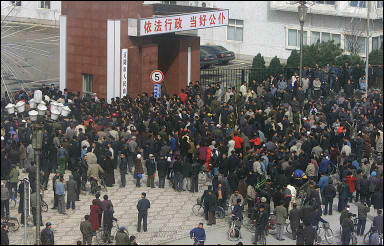
The movement began in Daqing on March 1, when 3,000 redundant oil workers marched to the PAB's headquarters demanding payment of the stopped allowances. The rally ended after a riot when the building was attacked with the workers stoning the windows in. This movement escalated on March 4 with reports that up to 50,000 workers had demonstrated outside the headquarters with a local railway worker reporting that train services have been interrupted. Paramilitary police and a tank regiment were sent to be deployed against the movement. Reports are that with resistance the PLA special forces were allowed safe passage by the workers. The workers responded with another demonstration of some 40,000 workers on March 6, again with confrontations with state paramilitary forces.
These thousands of workers have carried out a second week of mass protests with 50,000 workers again rallying on March 11 and over 20,000 on the following day. Local police, paramilitary police and military units including reportedly a tank regiment have now surrounded the headquarters on a permanent basis with the management effectively locked in behind a wall of armed bodies of men. Again no reports have been received to the contrary that safe passage was given to the workers in uniform. Such has been the seriousness of the dispute and the seriousness of the leadership. It is telling that the smaller disputes are targeted directly by the security forces as weaker military opposition. The larger forces of working men and women are not so easily dealt with. It is one thing to commit an atrocity against several thousand students, it is yet another to do such against 50,000 workers.
Workers' representatives have warned that if the company does not back away from the insurance premium increase they will begin blocking traffic and in turn taking control of an element of communication. This is a strategic turn, regularly used in industrial and insurrectionary activity in China. In an embryonic form, it signifies the intent of capture by workers or of poor farmers of the command of politics, economics and of the state.
During the course of the past two weeks of struggle by these Daqing workers they have formed an independent union, the "Daqing PAB Retrenched Workers Provisional Union". This organisation is reported to be being replicated throughout the industry and again particularly on the larger production bases of Shengli, Liaohe, Xinjiang and Sichuan. Frustration with the established union movement, that far from assisting the workers it in effect stands in their way, has led these workers to the path of independent organisation.
It is important to remember that in late September and early October 2001, hundreds of workers gathered outside Daqing city government offices. There were clashes with paramilitary police while workers played cassette recordings of the Internationale.
These workers from the textile industry demonstrated that these workers are joining existing workers in so doing are generalising the struggle for decent living standards. That they are singing the Internationale demonstrates the level of political intervention by these workers. It cannot in turn be ruled out that given the objective level of organisation, its organic nature and the immediacy of the conclusions drawn that elements of the subjective factor (this a conscious Marxist leadership) exist amongst the workers already. We cannot rule out the near certainty that many of the advanced layers of these workers have already drawn revolutionary conclusions and are formed into cells of an embryonic revolutionary party.
The significance of the development of independent unions is not lost on the movement especially in an area of existing militant struggle. They are organic and of a far higher level than the ossified labour bureaucracy in China. Such organisations, as especially with migrant worker and poor worker and farmer organisations are easily transformed into fighting unions. The conclusions of independent class development and movement indicate that the process in China is at a very high level.
With the 225,000 separate labour disputes in 2001 being concentrated in the industrial areas, as expected, there have been some 616 separate labour disputes daily. Even as a proportion of the gigantic size of the proletariat of China, this is a lot. With the size and character of these disputes, one can see the generalised tendency of proletarian organisation and the development of political conclusions.
The psychology of the mass of the working class has been transformed over these past two years as the "new capitalists" run out of steam and threaten to go into reverse in terms of economic development. The Chinese workers do not suffer fools gladly and communist workers will under such conditions readily take to the offensive!
One must remember that the entire class in the past was educated in dialectics (albeit in a distorted Stalinised form) with a section maintaining a basic understanding of development and processes of revolution. As the mass draws these same conclusions, or perhaps remembers such, combination, unity and organisation become the combatant tools of the proletariat. On a further level the ability, as has often been demonstrated, bravery and courage of these workers has an underlying force in itself, that of determination, a reference to a state of desperation but with a programme. It appears military lines have been drawn in that safe passage has been given in battling with the paramilitary forces in the case of the Daqing workers, to a tank regiment! The events of the next period will tell all.
Liaoyang City Struggles
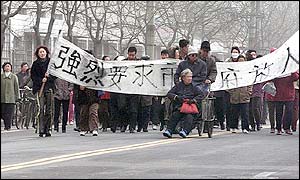
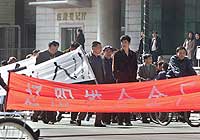
Many of the 225,000 disputes last year have continued into 2002. Such case in point is the struggle of the steel and textile workers of Liaoyang City, Liaoning province. This area is situated in the north-eastern industrial belt and adjacent to the insurrectionary workers of Daqing. Several thousand laid-off workers from six bankrupt state-owned textile factories staged a two-day protest outside the Town Hall between March 11 and 12, 2002 as part of ongoing protests against the corruption of local officials and of the factories who were responsible as it were "Enron-style" for bleeding the once-productive state planned units, into capitalist bankruptcy. The workers claimed that official corruption was responsible for the collapse of their industries and demanded the payment of outstanding wages and the provision of unemployment benefits.
They were joined for two days by the workers of the bankrupt Liaoyang Iron and Metal factory. These several thousand former steel workers are in the good company of their sister plant, the Liaoyang City Ferro-Alloy Factory who had blockaded the very same Liaoyang City in sporadic clashes in 2001. In November 2001 five hundred armed police dispersed the thousands of workers from the state-owned factory after they had blockaded a main road in protest at their workplace going bankrupt. The demonstration by employees followed a larger demonstration that involved more than 1,000 workers in October. 4,000 workers had been made redundant after the plant went bankrupt due to massive corruption.
In this city, an industrial city and once lauded as part of China's new modernisation programme there is 25% unemployment. Sporadic protests at the factory have been going on for over a year and have generalised into a movement and independent organisation throughout the steel industry.
10,000 or so workers of differing industry, of steel and textile, joined forces in carrying banners calling for the sacking of Gong Shang Wu, a senior government official in the city, drawing the conclusions of the political role of the local officials. It is interesting to note that there is little condemnation of the party in these disputes with most targets being not of the state apparatus but of the administrators of the state, many party and many non-party members, the corrupt ones.
The demands of the workers of Liaoyang City that have been raised are demands that the administration "solve the problems of livelihood faced by the retrenched workers; bring to justice the corrupt leaders of the Iron and Metal Factory; and to stop the Public Security Bureau police from arresting workers' representatives."
It appears that every mass redundancy program in the state-owned industries whether as part of their privatisation or not will be fought with these same workers drawing industrial and potentially revolutionary conclusions.
"According to the China Daily (March 12), during the ongoing annual session of the Ninth NPC, president Jiang Zemin, also general secretary of the Communist Party of China (CPC) Central Committee, told the deputies from Liaoning that "the province must rely closely on the working class and the broad masses of the people in promoting SOE reform and development and the revitalisation of the old industrial base, giving full play to their initiative, enthusiasm and creativity."
In examples from 2001 of the nature of the movements of the workers and migrant workers, in mid 2001 some 10,000 miners and office workers from Jishu Mine Bureau blocked the main Jilin-Harbin railway line for three days in protest over wages that had been due for up to 30 months, with corruption being the reason for arrears. Over 1,000 workers from a sugar factory in the Inner Mongolian city, Linhe protested outside the local Communist Party offices of the city's Lake Bayan district over the failure to pay labour insurance premiums.
From November 26 to 28, 2001, 600 workers protested in Nanchang City, Jiangxi Province, for three consecutive days over the amount of their severance pay by the city government. Workers of the Jiangxi Chemical Fibre Factory in Nanchang City blocked Qing Shan Road in front of the factory.
Already we have had reports such as 400 Guangzhou workers who went on strike threatening suicide over the loss of jobs. The scene was described as "the most desperate of many recent labour disputes in Guangdong". 40 workers of the Louyang Electromechanical Equipment Company, Henan Province, blocked Luoyang's Zhongzhou Road for most of a day in defiance of arrest threats.
China: A Revolution In Preparation
It is the perspective of the Marxists that China is again becoming ripe for Political Revolution. That the Communist Party of China (CPC) is becoming ready for internal overthrow on the back of a forthcoming workers' movement. In fact on the back of the forthcoming ebbs and flows of the current struggles. The events of the Asian revolution from the movement of students, youth, workers in the Philippines last year, in Indonesia in 1998, the crisis of our economies, the revolution in Latin America, the imperialist war in Afghanistan and the world recession, have all had a remarkable effect on the consciousness of the Chinese workers.
What must be recognised is that the economy is still under the auspices of the Stalinist CPC, despite those who point to quantum. The commanding heights of industry and the levers of power in economy are still firmly under the grasp of the Stalinist bureaucracy. All recent data points to this. This is not an irreversible return to Capitalism like in Russia now but a new twist in the fate of the bureaucratically-run planned economy and of the revolution of 1949. Part of it has been sold to friends that are influential and can be influenced. Money investment from overseas - to prop up the massive debt of China - is under the stewardship of the bureaucracy. If re-nationalisation without compensation was required as a diversion from the tasks of the revolution by the workers, it would be utilised. The situation is in effect entirely dependant on what the workers will say or do next. The strategic nature of the Communist workers of Daqing and Liaoyang and their very actions indicate that the ground is again beginning to shake under the feet not only of the Stalinist bureaucracy but of the whole world.
The base of the next period of struggle we believe lies within the ranks of organic and fresh labour organisation of an educated proletarian nature and to the direction the Communist Party and of the People's Liberation Army as part of an escalating movement to struggle and independent organisation of the gigantic working class of China.
China's revolution of 1949 was the second greatest event in the history of humanity after that of the Russian Revolution of 1917. The forthcoming revolutionary period is indeed pregnant with the possibility that the question of power will be posed by this gigantic working class once again as part of a political revolution. The lessons of Argentina and Latin America, as they are unfolding daily, are very relevant to the events we are facing in China.
We base such an analysis of empirical fact obtained through careful observance of events and participation in them. The Marxists of Hong Kong have long had at least eye-witness accounts and verification from traders in the area. These reports on the industries govern not only problems of price fluctuation but of labour.
China has had greater success than Russia in developing the productive forces, while moving towards capitalism, but the bureaucracy has maintained firm control of the state. The Chinese leadership was alarmed by the fate of Russia and Eastern Europe and determined not to go the same way. Although the Chinese bureaucracy has gone a long way in moving towards capitalism, the nature of the regime has not yet been resolved in a decisive way. Important elements of a nationalised planned economy co-exist uneasily with the rising capitalist sector. Even though a large part of the economy is now privately owned, there is still a large section of the bureaucracy which is linked to the state-owned sector. (In Vietnam, the process of capitalist restoration is still in an embryonic state.)
If the perspective on a world scale were one of sustained economic growth over a long period, then, at a certain stage, capitalism would eventually triumph. But that is not at all certain. In order to maintain a stable regime, China must achieve growth rates of at least 7 percent per year. With the slowdown on a world scale this will prove impossible to maintain. This opens up the prospect of social conflicts on a massive scale, which sooner or later must produce splits within the bureaucracy. Some sections have already successfully transformed themselves into capitalists, i.e. the owners of the means of production. But there is also a large layer whose power and privileges are still based on their position in the state-owned sector. Thus, in spite of the fact that the Chinese bureaucracy has been more successful in introducing market methods the potential for a major conflict within the state apparatus is even greater than in Russia.
For a time the policy of a "controlled" movement in the direction of capitalism ("market socialism") achieved good results. China's growth rates were among the highest in the world. In effect, China occupied the position which western investors originally had for Russia. But now the perspective of a world slump places a big question mark over the future of China. The abandonment of Comrade Mao Tse-Tung's policy of autarchy and the integration of China into the world economy have merely created new and insoluble contradictions. China is tied to the world market in a way that was not the case in the past. The destiny of China depends upon the vagaries of the world economy.
The present crisis has been accompanied by a big contraction of demand in both America and Asia - China's main markets. And the domestic market is insufficient to absorb the vast quantities of commodities being produced by China's industries. Thus, the very successes of the Chinese economy are preparing a serious crisis.
If it wishes to continue to move towards the consolidation of capitalism, the Beijing government will have to close down a large part of state-owned factories. But this would produce the risk of a social explosion which terrifies a bureaucracy which is well aware of the revolutionary traditions of the Chinese workers and peasants. The bureaucracy is therefore moving very cautiously.
China has combined the worst features of a Stalinist regime with the worst features of Asian capitalism. Although the economy has grown rapidly, it has created an economic and social disaster of huge proportions. There are at least 120 million urban unemployed, and a similar number in the countryside. The cities cannot absorb such huge numbers without creating explosive conditions like those that existed in Tsarist Russia on the eve of the 1905 revolution.
As long as the bureaucracy is able to deliver good economic growth, and therefore hold out the prospect of better living conditions in the future, the masses are prepared to tolerate its rule. But there is increasing discontent with the growing corruption, inequality and misuse of power by the privileged caste of officials. Already there has been a spate of workers' strikes and peasant disturbances. The persecution of the Falun Gong sect is a symptom of the unease of the ruling elite, which is bracing itself for the inevitable social consequences of economic depression. In such a situation even innocuous cults can quickly get out of hand. Therefore the bureaucracy wants to assert its control. The attacks on this strange sect can only be explained as a manifestation of extreme nervousness. The bureaucracy, terrified of the prospect of social explosion, cannot tolerate the existence of any movement that is not under its control.
The perspective of rising industrial movements is held for all China with the industrialised and investment-rich coastal areas being joined by farmers' struggles against taxes, corruption and poverty. This is certain and recognised; the effects of migration from the country and the resultant army of millions of dispossessed with the perspective of rising unemployment (China must maintain 7% growth to ensure that unemployment of up to 25% in certain areas does not further worsen) will together with the industrial and farmers' movements give rise to mass movements for social change. The central task of this new workers' movement is to bring together, to develop and to train a conscious leadership based on the programme of the political revolution enriched with the experience of the struggle of the last few decades.
- Immediate and unconditional release of Yao Fuxin.
- No military or police repression against the workers in action.
- Guarantee all jobs of all workers in all industries.
- Develop the remaining mass resources of the area as with the West.
- Arrest the corrupt leaders, privateers, politicians and businessmen.
- Purge the party of the "new capitalists" and the restorationists.
- Renationalise the privatised works and conglomerates under workers' control and management.
- Democratic election and right to recall of all state officials.
- No official should earn more than the average workers' wage.
- All trade unionists and socialists to be mobilised in support of the workers in the north east of china.
- Set the ground to develop links and cooperative action in their support.
- Defend free trade unionism - defend the working class.
- Forward to genuine workers' democracy in china.
Reports from the bourgeois press agencies on the strikes currently taking place in China
From the South China Morning Post, Hong Kong, March 18, 2002:
Police in the northeastern Chinese city of Liaoyang have detained an organiser of worker protests against corruption and unpaid wages, local sources said on Monday.
They said the detention followed two days of peaceful demonstrations last week at the Liaoyang government headquarters in which about 5,000 workers waved banners demanding the local legislature head be sacked for not protecting their rights.
Yao Fuxin, 53, a laid-off worker from the city's bankrupt Ferroalloy Factory, was hauled into a police van by plainclothes officers on Sunday morning and had not been heard of since, fellow workers told Reuters.
''He's a representative chosen by workers to speak with the government about our unpaid wages. Some of us have not been paid for 24 months,'' said a worker from the factory.
Yao, along with dozens of labour activists from other bankrupt state firms in the city, was planning another protest at the city government compound involving some 30,000 workers, the SAR-based Information Centre for Human Rights and Democracy said in a statement on Monday.
The workers also planned to block a railroad connecting the northeastern city of Dalian and Beijing, as they accuse officials in the city's state-owned factories of corruption and demanded better welfare, the statement said."
From BBC World News, London, March 18, 2002:
Tens of thousands of sacked workers have surrounded the main office at China's largest oilfield in protest against cuts in their lay-off benefits.
Up to 50,000 protesters are reported to have gathered every day at the Daqing oil field in north-eastern Heilongjiang province for nearly two weeks.
Han Dongfang, a Chinese labour activist based in Hong Kong, said that the authorities had readied paramilitary police and a military tank unit, but that there had been no confrontations.
The BBC Beijing correspondent says this is one of the biggest labour protests in China in recent years. An oil company official said the protests were the result of a misunderstanding and "should be resolved soon". A local official confirmed that the demonstrations had been going on, but said the police were not interfering.
Reports said the workers were protesting against cuts in severance pay and heating subsidies promised them when they were sacked three years ago, and an increase in unemployment insurance premiums.
"The workers have real grievances, and they seem to be committed to continuing the protests until those grievances are addressed," said Mr Han.
Mr Han's organisation, the Chinese Labor Bulletin, says the workers have set up their own independent union. This is illegal in China, where workers can only seek redress through official unions controlled by the Communist Party.
Daqing oil field is China's biggest, and opened in the 1950s. It was long-promoted as a symbol of China's revolutionary industrialisation, employing some 300,000 workers at its height. But the Daqing fields are now well past their peak, revenues are falling and thousands of workers have been sacked in recent years.
Our correspondent says labour unrest is growing across China as economic reforms force decrepit state run industries to lay off millions of workers. "
From the China News Agency, Los Angeles, March 19, 2002:
Thousands of laid-off workers remain in a long-running standoff with officials at one of China's largest oil fields.
Dissatisfied with the terms of their severance, the workers have surrounded the offices of the Daqing Oil Management Bureau in China's northernmost province, Heilongjiang, since March 1, but dispersing peacefully each night.
A public relations official for PetroChina, the oil field's parent company, rejected earlier reports of tens of thousands of protesters as exaggerated.
China hailed completion of Daqing's main facilities in 1963 as a sign that the country no longer needed to import oil. The following year, the Communist Party directed government departments to learn from the "Daqing spirit" of self-reliance. At its peak, Daqing produced about two-fifths of China's crude oil.
In its transition to a market economy, however, China has increased its reliance on petroleum imports.
In 1998, in anticipation of foreign competition after its entry into the World Trade Organization, China organized its oil companies into northern- and southern-based conglomerates. The northern one, PetroChina, absorbed Daqing. But during restructuring ahead of its stock market listings in New York and Hong Kong in 2000, PetroChina took its best-performing assets and Daqing was left with outdated plants and a bloated staff.
Last year, the Daqing Oil Management Bureau was named the fourth-worst corporate performer nationwide in giving the government money for retirement benefits.
In recent years as many as 80,000 bureau employees have signed severance contracts worth up to $500 for each year they worked at the company. Although the payment was a substantial sum for many workers, many still felt it would not cover rapid increases in the cost of living and hence wanted their jobs back.
"But they looked at the contract before signing it. You can't just walk off the job one day and then come back tomorrow," said the PetroChina spokesman.
From the Chicago Tribune, March 19, 2002:
One of the most vocal anti-government labor protests in recent memory intensified Monday in China with as many as 30,000 laid-off factory workers demonstrating in a northeastern factory town a day after one of their organizers was arrested.
Angry about losing pay and benefits as obsolete state-owned factories have gone bankrupt, the workers surrounded the city hall and police headquarters, intent on challenging an authoritarian government that tolerates no dissent and uses force to quash any protest it considers threatening.
The protests in Liaoyang are significant because they have directly challenged the legitimacy of the communist government by demanding the ouster of a local party official and because they were organized by workers from different factories, bringing together disaffected people from various organizations.
Labor unrest has become a major issue in China as tens of millions of workers have been left behind by an economy transforming itself from a system of state control to one of private enterprise.
The police allowed Monday's peaceful protest to conclude, but they detained one of about a dozen leaders of the protest Sunday and were searching for the others, according to interviews with an organizer in Liaoyang and with a Hong Kong-based human-rights monitoring group.
The detention appeared to signal the start of an offensive against the workers, who had been allowed to stage several remarkably brazen rallies last week outside city hall at which they paraded anti-government slogans.
Thousands of workers returned to demonstrate Tuesday, but dispersed soon after government officials came out to talk to the crowd around midday.
Hundreds of reports of illegal factory protests have surfaced in recent years, and China watchers have surmised that these demonstrations could become a trigger-point for a wider challenge to the Communist Party's authority if they were allowed to grow beyond isolated incidents.
Last week, there were reports of a major protest at the Daqing oilfield in far northeastern Heilongjiang province by workers who had been laid off by the state-run petroleum bureau in 1999. More than 10,000 workers a day were said to be gathering to protest cuts in promised payments.
The protests in Liaoyang seemed to raise the stakes. About 7,000 workers from six factories supported last week's rallies, while Monday's was said to have been attended by 30,000 workers from 20 factories.
News of Monday's demonstration was reported by the Hong Kong-based Information Center for Human Rights and Democracy and confirmed by one of the organizers in Liaoyang. But details could not be independently verified because local authorities prevented foreign journalists from reporting from the scene. Cars were stopped at Liaoyang's border and reporters were followed by unmarked police vehicles.
The workers said they were angry because they had not received severance pay and promised benefits. They were demanding the ouster of a government official and permission to start an independent union, which China does not allow, the Hong Kong group said.
Frank Lu of the group said it was a new phenomenon for workers from different factories to coordinate their protests.
"The worker leaders in Liaoyang city met several times, and they have the telephone numbers of other worker leaders," he said in a statement. "So the authorities are quite worried about how the situation might develop."
Until now, authorities have managed to isolate anti-government labor demonstrations, silencing protesters either through quiet negotiations or harsh retribution.
Last week, workers in Liaoyang said they had gathered enough people on the streets outside the city hall to force government officials to hold meetings and offer a promise not to retaliate, but the arrest of one of the leaders, 54-year-old Yao Fu Xin, seems to have changed the dynamic.
Analysts said there was no way to predict how the Liaoyang protests would end.