

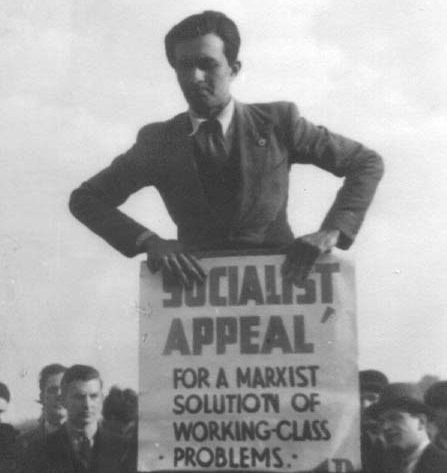
Trotsky's struggle with Stalin was a life or death struggle. It was a struggle to defend the clean banner of Lenin against the growing bureaucratic reaction within the Soviet state and party. While Lenin was on his deathbed, the triumvirate of Zinoviev, Kamenev and Stalin waged a campaign to discredit Trotsky and prevent him from taking over the Russian leadership. Matters came to a head after the tragic defeat of the German Revolution of 1923, when Trotsky wrote an article drawing parallels between the vacillations of Stalin and Zinoviev in regard to Germany, with those within the Bolshevik Party on the eve of the October Revolution. In particular, Trotsky drew out the lamentable role of Zinoviev and Kamenev, who opposed the insurrection in 1917.
At the same time, Trotsky formed the Left Opposition to organize the fight for party democracy and a return to a Leninist policy. The publication of Lessons of October served to intensify the conflict within the Russian leadership, and opened up a vitriolic struggle by the triumvirate faction against "Trotskyism". This was further accentuated after Lenin's death in January 1924.
Trotsky's fight to defend Lenin's ideas within the Soviet Union had international repercussions. News of the internal struggle within the Russian Communist Party gradually leaked out, and prominent individuals within the International began to rally to Trotsky's defence. The majority of the French Communist Party leadership, for instance, carried a resolution condemning the attacks against Trotsky. The same was true of the majority of the Belgian Party. Early on, individuals like Alfred Rosmer, a leading member of the Communist International, raised support for Trotsky.
This situation could not be allowed to develop. Quickly, Zinoviev, the president of the International, intervened on behalf of the triumvirate to eliminate opposition currents within the international sections. Under the banner of "Bolshevisation", the Russian leadership intervened to undermine and remove leaderships that were not totally reliable to the triumvirate.
British CP
Unlike on the Continent, there were no widespread opposition feelings within the British Communist Party. Traditionally on a low political level, the British party had little real interest in the great questions that had rocked European sections. This was a key reason for the swift obedience of the British Party. In the dispute within the Russian Party, the young British section felt obliged, despite some early hesitation, to line up behind the Russian majority. Loyalty to the Russian Party was clearly used to bring the British Party into line. Few of the British Party leaders had read any of the material of the Opposition.
The first support for the Russian majority took place at the Party Council meeting in November 1924, and again at an extended Party Executive meeting in January, which endorsed the ECCI decision condemning Trotsky for publishing his Lessons of October. This decision, however, was questioned by the London District Committee, which complained about a lack of material. However, in the report given to a 200-strong London Aggregate on January 17, 1925, an attempt to delay the decision pending further information was defeated by 81 votes to 65.
The main resolution condemning Trotsky's book as "an open attack upon the present leadership of the CI", moved by Murphy, was overwhelmingly passed, while 15 votes were received for an amendment supporting the fight of the "Left Wing Minority" in the Russian Communist Party against divergences from Leninism.[1] An Oxford Communist, member of the London District Committee, and business manager of Labour Monthly, A.E. Reade moved the amendment. Reade knew German and was able to read Trotsky's work at first hand. One of those voting for Reade's amendment was the young Harry Wicks, destined later to become a founding member of British Trotskyism. The decision was reported in the Weekly Worker under the title "Trotskyism - a Peril to the Party" on January 23, 1925. Reade himself was soon suspended from the District Committee and later expelled. He played no role in the movement after this.
At the Seventh Congress of the CPGB (May-June 1925), a resolution on Trotskyism was moved by Tom Bell again reaffirming the Party's position and declaring "complete agreement with the Central Committee of the Russian Communist Party in its estimation of the principles of Trotskyism and the measures taken to combat them."[2]
At this time, the Party issued a book entitled The Errors of Trotskyism, which printed Trotsky's Lessons of October and a series of replies from Zinoviev, Kamenev, Stalin, Krupskaya (who had initially flirted with the Opposition) and others. The book was not intended as an analysis of Trotsky's ideas, but as the title clearly indicates, as an exposure of "Trotskyism". J. T. Murphy, who was the British representative on the International Executive Committee, wrote the introduction. At this time, given the prestige of Trotsky in Communist ranks, those who attacked Trotsky had to be somewhat cautious. "It is undoubtedly true," states Murphy, "that it came as a great surprise to the British working class when they saw the Communist International in the throes of a great controversy with Comrade Trotsky."[3]
Murphy was forced to recognise, even at this time, Trotsky's colossal reputation and authority within the ranks of the Comintern. In his preamble he states: "Comrade Trotsky's name has always been associated in our minds with Comrade Lenin. 'Lenin and Trotsky!' These were the names with which we conjured in all our thoughts and feelings about the Russian Revolution and the Communist International. As the news of the Russian Revolution spread westward, these two figures loomed gigantically above our horizon and we never thought of differences...We saw only leaders, Soviets and masses, and over all the great historical giants, Lenin and Trotsky."[4] Nevertheless, a string of articles, which filled the majority of the book from Comintern leaders, were used to reinforce the myth of "Trotskyism".
At the beginning of 1926, Trotsky's book Where is Britain Going? was published, which drew a wave of criticism from the British reformists, stung by Trotsky's analysis of their prejudices and hopeless approach to fundamental questions. So, as late as April 1926 in Labour Monthly, Palme Dutt, still not sure which way to jump, took up a robust defence of Trotsky's book. "Trotsky's book will be eagerly read, and will give stimulus and help; will help to break the chains of enslavement to old ideas and leadership, to give confidence and clearness and strength, and to show the plain path forward of the struggle," states Palme Dutt. "The English working class has cause to be grateful to Trotsky for his book; and to hope that he will not stay his hand at this short sketch, but will carry forward his work of interpretation, polemic and elucidation, and elaborate his analysis further, which is so much needed in England."[5] Any hint of support had, however, completely evaporated by the time of Trotsky's criticism of the Anglo-Russian Trade Union Committee and his expulsion from the Russian CP in late 1927.
Trotsky completed Where is Britain Going? in May 1925, but it was not in fact published in Britain until February 1926. Even then, it was published by a bourgeois publisher George Allen and Unwin, and contained an introduction by H. N. Brailsford, which sought to challenge Trotsky's ideas. It was only reprinted by the Communist Party in October 1926, substituting Brailsford's introduction with Trotsky's own May 6, 1926 preface to the second German edition. Although the book demolishes the ideas of gradualism and reformism, it also constituted a disguised attack against the then line of Stalin and Bukharin who were looking towards the left of the TUC General Council.
The most "loyal"
A few months later, Thaelmann, the German Communist leader, remarked that the British CP was the only major party that had no differences with the ECCI.[6] It was regarded as the most "loyal" and its leaders, after a period of selection, considered the most pliable by the Kremlin. Pollitt and Co. simply followed every change in the party "line". On all occasions, they were with the "majority".
In April 1926, under pressure from the workers of Leningrad, Zinoviev and Kamenev split from Stalin and founded, with the veterans of the 1923-25 Opposition, the United Opposition. Their principal document was The Platform of the Left Opposition (1927), which served as a rallying point for opposition forces with the party, and was submitted to both the Politburo and the Fifteenth Party Congress. By this time, the British Communist Party was firmly in the anti-Trotskyist camp, endorsing every dictat from Moscow. In fact it was Murphy himself who proposed the motion to expel Trotsky from the ECCI on September 27, 1927.
"...I went to the platform," recalls Murphy. "I expressed the view that the time had come for decision, and that Trotsky himself had made it abundantly clear that the struggle had reached the stage when it was no longer an internal fight concerning differences of opinion among members of one organisation, but a fight against the Communist International itself and all its sections. We had no option but to accept that challenge, and I moved that he should be no longer recognised as a member of the Communist International. It was carried with two dissents."
Murphy continued: "I did not dream when I moved that resolution that some few years later I myself would also be outside the Communist International."[7] The Moor had done his duty and was shown the door, expelled ironically on a charge of "Trotskyism"!
The development of a genuine Trotskyist current did not emerge in Britain until the crisis of 1929-31 and the rise of fascism in Germany. This took place when a group of comrades in the Communist Party in Balham, South London, moved into opposition to the leadership. As a group they came relatively late to the ideas of Trotsky, although some had read and were influenced by Where is Britain Going? and the Lessons of October. The leading lights of the Balham Group, Billy Williams, Stewart Purkis, and Reg Groves, joined the Party after the 1926 General Strike. They were soon elected to the London District Committee. During the inter-party controversies surrounding Trotsky, they tended to sympathise with the arguments of the Opposition, either abstaining or opposing the leadership on anti-Opposition resolutions.[8] In 1929, they linked up with Henry Sara, and the following year with Harry Wicks, who had just returned from a three-year stint at the Lenin School in Moscow.
With the decline and isolation of the Party due to the ultra-left policies of the "Third Period", the members of the Balham Group came into opposition to the CP leadership on a series of questions. "Up to 1931," admits Groves, "most British Communists had scant knowledge of communist oppositional groups abroad." Then, in the spring of that year, Groves visited Henderson's left-wing bookshop, the "Bomb Shop" in Charing Cross Road. "On sale in the shop on that day in 1931 were bundles of two American weeklies - Labor Action, run by Jay Lovestone, an expelled "Rightist"; and The Militant, published by the American Left Opposition, with articles in it by Trotsky himself, which appeared the more promising publication," continued Groves. "The three or four numbers bought that day were passed round six or seven of us - and our little world was enlarged."[9]
It was then that the Balham Group became aware of the existence of the International Left Opposition. "True, we were woefully ignorant," states Groves later, "particularly about the situation in Russia, and as we struggle for enlightenment and understanding and clarity, some of us found help in the writings of Trotsky and, to a lesser extent, in the periodicals published by the American Left Opposition."[10]
At first, they wrote to the Americans for pamphlets advertised in The Militant. Later, Arne Swabeck on behalf of the International Secretariat sent them a letter from the United States proposing "that some concrete steps should be taken towards organisation in a preliminary sense," adding that Albert Glotzer, the youth representative on their national committee, after visiting Trotsky and the IS, would "stop over in England for the purpose of being helpful in bringing our various contacts together." Another letter told them that Max Shachtman was also coming to England "to do whatever possible to help towards the formation of a Left Opposition Group in England."[11] But the Balham Group didn't want to be rushed into any premature action or anything they would later regret.
According to Harry Wicks, "in November 1931 Max Shachtman visited London and at a meeting with Groves, Sara, Purkis and myself discussed the formation of a Left Opposition group in this country. Shachtman proposed that one of us should 'stand on the altar' for demonstrative expulsion as a declared Trotskyist. This we objected to. We saw our task as that of attempting to win a wider group of party members to challenge the leadership on the fateful line of the CI."[12] Albert Glotzer also tried to assist Shachtman's efforts, and concluded: "Although no specific organisation emerged from this discussion, either during my stay or in the brief period that remained to Shachtman, the spadework had been done for its later emergence."[13]
Critical moment
But events would drive things along. In May 1932, the Balham Group published The Communist anonymously, which reproduced Trotsky's main writing on Germany, Germany, The Key to the International Situation. On the front page it proclaimed boldly: "The Communist International is unable to gain the leadership of the world proletariat. It is - at this critical moment - unable, unready and unfit to lead the world revolution, and there is no possible alternative. The Left Opposition - led by Comrade Trotsky - is fighting to win back the CI to its task of leading the world revolution; the British group begins its work by the issue of this bulletin."[14] Trotsky wrote to the group congratulating them on "this excellent duplicated publication". Throughout the summer of 1932, the Balham Group spoke out against the suicidal line of the party over Germany and called for a united front to defeat the menace of fascism.
At a London aggregate in which the issue of Germany was raised, Stewart Purkis identified himself with Trotsky's views and was confronted by Party's General Secretary Harry Pollitt. Soon afterwards Purkis wrote to Pollitt: "You have asked a straight question: you have a straight answer. You have asked how far I go with The Communist: bulletin...My answer to you and my comrades in the British Party is: 'I go with it all the way.'"[15]
In August 1932 Purkis, Williams, Groves, Flower and Wicks were expelled for factional activity against the party line. Henry Sara was "suspended" and the Balham Group "liquidated". The expelled comrades issued an appeal against their expulsions to delegates attending the British party congress in November, but were denounced by Pollitt, who urged delegates "to go away from this Congress full of contempt, hatred and loathing for the miserable gang of counter-revolutionaries."[16] It was the crossing of the Rubicon for these comrades. There was no way back on the present basis. Their only road was the building of a viable British section of the International Left Opposition, as an expelled faction of the Communist Party.
As Groves put it later, they had "entered the world of international Trotskyism, which was beyond our control and often beyond our understanding."[17] Together with other sympathisers, they finally held a conference in December 1932 to establish the British Section of the International Left Opposition. By May Day 1933, the Communist League, as the group was now called publicly, issued a new publication called Red Flag. The work of British Trotskyism had truly begun.
February, 2002
Footnotes
[1] See L. J. MacFarlane, The British Communist Party, London, 1966, pp. 140-41.
[2] Quoted in Klugmann, History of the Communist Party of Great Britain, p. 327.
[3] The Errors of Trotskyism, p. 5.
[5] Labour Monthly, April 1926.
[6] Imprecorr, March 17, 1926, quoted in MacFarlane, p. 141.
[7] J. T. Murphy, New Horizons, London 1941, p. 275.
[8] See Reg Groves, The Balham Group, London 1974, p. 16.
[12] International, vol. 1, no. 4, 1971.
[13] Revolutionary History, Spring 1988, p. 3.