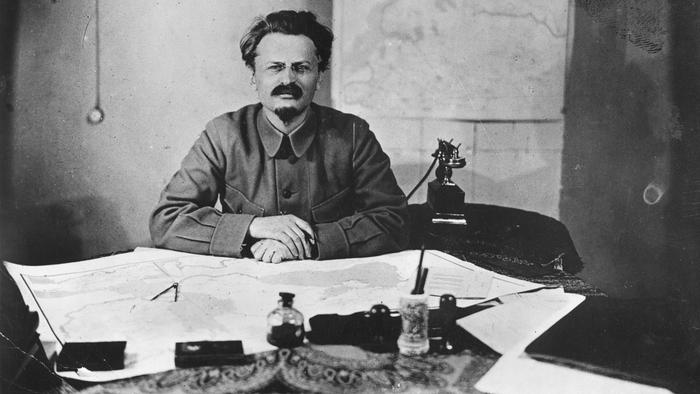
21 August marks the anniversary of Leon Trotsky's death, following an attack by a GPU agent, on the orders of Stalin. This article by Alan Woods, commemorating Trotsky, was originally published in the year 2000. We share it today in memory of a revolutionary titan whose work and sacrifices preserved the authentic traditions of Marxism and Bolshevism for future generations.
Lev Davidovich Trotsky was, alongside Lenin, one of the two greatest Marxists of the twentieth century. His whole life was entirely devoted to the cause of the working class and international socialism. And what a life!
Introduction
Lev Davidovich Trotsky was, alongside Lenin, one of the two greatest Marxists of the twentieth century. His whole life was entirely devoted to the cause of the working class and international socialism. And what a life! From his earliest youth, when he worked through the night producing illegal strike leaflets which earned him his first spell in prison and Siberian exile, until he was finally struck down by one of Stalin’s agents in August 1940, he toiled ceaselessly for the revolutionary movement. In the first Russian Revolution of 1905, he was the chairman of the Petersburg Soviet. Sentenced once again to Siberian exile, he again escaped and continued his revolutionary activity from exile. During the First World War, Trotsky adopted a consistent internationalist position. He was the author of the Zimmerwald Manifesto which attempted to unite the revolutionary opponents of the War. In 1917, he played a leading role as the organiser of the insurrection in Petrograd.
After the October Revolution Trotsky was the first Commissar for Foreign Affairs and was in charge of the negotiations with the Germans at Brest Litovsk. During the bloody Civil War when Soviet Russia was invaded by 21 foreign armies of intervention, and when the survival of the Revolution was in the balance, Trotsky organised the Red Army and personally led the fight against the counterrevolutionary White armies, travelling thousands of kilometres in the famous armoured train. Trotsky remained Commissar for War until 1925. “Show me another man”, he (Lenin) said, thumping the table “capable of organising in a year an almost exemplary army and moreover of winning the esteem of the military specialists.” These lines reproduced in Gorky’s memoirs accurately show the attitude of Lenin to Trotsky at this time.
Trotsky’s role in consolidating the first Workers’ State in the world was not confined to the Red Army. He also played the leading role, together with Lenin, in the building of the Third International, for the first four congresses of which Trotsky wrote the Manifestos and many of the most important policy statements; the period of economic reconstruction in which Trotsky reorganised the shattered railway systems of the USSR. In addition, Trotsky, always a prolific writer, found time to write penetrating studies, not just on political questions but on art and literature (Literature and Revolution) and even on the problems faced by people in everyday life in the transitional period (Problems of Everyday Life).
After Lenin’s death in 1924, Trotsky led the struggle against the bureaucratic degeneration of the Soviet State—a fight that Lenin had already begun from his death-bed. In the process of the struggle, Trotsky was the first to advocate the idea of five-year plans, which was opposed by Stalin and his followers. Thereafter, Trotsky alone continued to defend the revolutionary, democratic and international traditions of October. He alone provided a scientific Marxist analysis of the bureaucratic degeneration of the Russian Revolution in works like The Revolution Betrayed, In Defence of Marxism and Stalin. His writings of the period 1930-40 provide us with a veritable treasure-house of Marxist theory, dealing not only with the immediate problems of the international labour movement (the Chinese revolution, the rise of Hitler in Germany, the Spanish Civil War), but of all manner of artistic, philosophical and cultural questions.
This is more than enough for several lifetimes! Yet, if one were to examine the life of Trotsky objectively, one would be compelled to agree with the appraisal which he himself made of it. That is to say, despite all the extraordinary achievements of Trotsky, the most important period of his life was its last ten years. Here one can say with absolute certainty that he fulfilled a task which nobody else could have fulfilled—namely, the fight to defend the ideas of Bolshevism and the spotless tradition of October in the teeth of the Stalinist counterrevolution. Here was Trotsky’s greatest and most indispensable contribution to Marxism and the world working class movement. It is an achievement upon which we are building to this day. The present article does not pretend to be an exhaustive account of Trotsky’s life and work. For that, not an article but several volumes would be needed. But if this very insufficient outline serves to encourage the new generation to read Trotsky’s writings for themselves, my purpose will have been achieved.
The Early Beginnings
On 26th August 1879, just a few months before the birth of Trotsky, a small group of revolutionaries, members of the underground terrorist organisation Narodnaya Volya, announced the death sentence for the Russian Tsar, Alexander II. Thus began a period of heroic struggles of a handful of youths against the whole of the state apparatus which was to culminate on 1st March 1881 with the assassination of the Tsar. These students and young intellectuals hated tyranny and were prepared to give their lives for the emancipation of the working class, but they believed that all that was needed to “provoke” mass mobilisations was the “propaganda of the accomplished fact”. In reality, they attempted to substitute the bomb and the machine gun for the conscious movement of the working class.
The Russian terrorists actually succeeded in assassinating the tsar. In spite of all this, all the efforts of the terrorists led to nothing. Far from strengthening the mass movement, the acts of terrorism had the opposite effect of strengthening the repressive apparatus of the state, isolating and demoralising the revolutionary cadres and, in the end, leading to the complete destruction of the Narodnaya Volya organisation. The mistake of the “Populists” lay in a lack of understanding of the fundamental processes of the Russian revolution. In the absence of a strong proletariat, the terrorists looked for another social layer on which to base the socialist revolution. They imagined that they had found this in the peasantry. Marx and Engels explained that the only class which can carry out the socialist transformation of society is the proletariat. In a backward semi-feudal society like tsarist Russia the peasantry will play an important role as an auxiliary of the working class, but cannot substitute itself for it.
To begin with, the majority of youth in Russia in the 1880s were not attracted to the ideas of Marxism. They had no time for “theory”: they demanded action. With no understanding of the need to win over the working class by patiently explaining, they took up arms to destroy Tsarism through individual struggle. Lenin’s elder brother was a terrorist. Trotsky started his political life in a populist group and probably Lenin also got involved in the same way. However, populism was already in a process of decline. By the 1890s what had been an atmosphere permeated with heroism had become one of depression, discontent and pessimism among the circles of intellectuals. And in the meantime, the labour movement had entered the scene of history with the impressive strike wave of the 1890s. Within a few years, the superiority of the Marxist “theoreticians” compared to the “practical” individual terrorists had been proved by experience itself with the spectacular growth in the influence of Marxism in the working class.
Beginning first with small Marxist circles and discussion groups, the new movement became more and more popular among the workers. Among the young activists of the new generation of revolutionaries, was the young Lev Davidovich Bronstein, who began his revolutionary career in March 1897, in Nikolaev, where he organised the first illegal workers’ organisation, the South Russian Workers’ Union. Lev Davidovich was arrested for the first time when he was only 19 years old and spent two and a half years in prison, after which he was exiled to Siberia. But he soon escaped and, using a false passport, succeeded in getting out of Russia and joining Lenin in London. In one of those ironies in which history is so rich, the name on the passport was Trotsky, the name of one of the gaolers which Lev Davidovich has chosen at random and was later to gain world-wide fame.
Trotsky and Iskra
The young Social Democratic movement was still scattered and almost without any organisation. The task of organising and uniting the numerous local Social Democratic groups inside Russia was taken up by Lenin together with Plekhanov’s exiled “Emancipation of Labour Group”. With Plekhanov’s backing Lenin launched a new paper, the Iskra, which played the key role in organising and uniting the genuine Marxist tendency. All the work of producing and distributing the paper and maintaining a voluminous correspondence with Russia was carried out by Lenin and his indefatigable companion Nadyezhda Krupskaya. Despite all the obstacles, they managed to smuggle Iskra into Russia clandestinely, where it made an enormous impact. Very quickly the genuine Marxists united around the Iskra, which by 1903 had already become the majority tendency in the Russian Social Democracy.
In 1902 Trotsky turned up on Lenin’s doorstep in London, where he joined the staff at Iskra, working closely with Lenin. Although the young revolutionary, who had just arrived from Russia, was not aware of it, relations on the Editorial Board were already tense. There were constant clashes between Lenin and Plekhanov over a series of political and organisational questions. The truth of the matter was that the old activists of the “Emancipation of Labour Group” had been seriously affected by the long period of exile, when their work had been limited to that of propaganda on the fringes of the Russian labour movement. It was a small group of intellectuals, who were undoubtedly sincere in their revolutionary ideas, but who suffered from all the vices of exile and small circles of intellectuals. At times, their methods of work were more those of a discussion club, or of a circle of personal friends, than those of a revolutionary party whose aim was that of taking power.
Lenin, who practically did the most important part of this work, with the help of Krupskaya, struggled against these tendencies, but with very little results. He had placed all his hopes in the calling of a Party Congress, in which the working class rank and file would have put order “in their own house”. He placed a lot of hope on Trotsky whose writing skills had earned him the nickname “Pero”—the Pen. In the earliest edition of her Memoirs of Lenin, Krupskaya underlines the high opinion Lenin had of the “Young Eagle”
Lenin was desperately looking for a capable young comrade from Russia to co-opt onto the Editorial Board in order to break the deadlock with the old editors. The appearance of Trotsky, recently escaped from Siberia, was eagerly seized upon by Lenin in order to make the change. Trotsky, then only 22 years old, had already made a name for himself as a Marxist writer, hence his party name Pero (the Pen). In the earliest editions of her memoirs of Lenin, Krupskaya gives an honest description of Lenin's enthusiastic attitude to Trotsky. Since these lines have been cut out of all subsequent editions, we quote them here in full:
"Both the hearty recommendations of the 'young eagle' and this first conversation made Vladimir Ilyich pay particular attention to the new-comer. He talked with him a great deal and went on walks with him.
"Vladimir Ilyich questioned him as to his visit to the Yuzhny Rabochii [the Southern Worker, which adopted a vacillating position between Iskra and its opponents]. He was well pleased with the definite manner in which Trotsky formulated the position. He liked the way Trotsky was able immediately to grasp the very substance of the differences and to perceive through the layers of well-meaning statements their desire, under the guise of a popular paper, to preserve the autonomy of their own little group.
"Meanwhile, the call came from Russia with increased insistence for Trotsky to be sent back. Vladimir Ilyich wanted him to remain abroad and to help in the work of Iskra.
"Plekhanov immediately looked on Trotsky with suspicion: he saw in him a supporter of the younger section of the Iskra editorial board (Lenin, Martov, Potresov), and a pupil of Lenin. When Vladimir Ilyich sent Plekhanov an article of Trotsky's, he replied: 'I don't like the pen of your Pen.' 'The style is merely a matter of acquisition,' replied Vladimir Ilyich, 'but the man is capable of learning and will be very useful'."
In March 1903, Lenin formally requested the inclusion of Trotsky as a seventh member of the Editorial Board. In a letter to Plekhanov, he wrote: "I am submitting to all members of the Editorial Board a proposal to co-opt
"Pero" as a full member of the Board. (I believe that for co-option not a majority but a unanimous decision is needed.)
"We are very much in need of a seventh member both because it would simplify voting (six being an even number) and reinforce the Board.
"'Pero' has been writing in every issue for several months now. In general he is working for Iskra most energetically, delivering lectures (and with tremendous success) etc. For our department of topical articles and items he will be not only very useful but quite indispensable. He is unquestionably a man of more than average ability, convinced, energetic, and promising. And he could do a good deal in the sphere of translation and popular literature.
"We must draw in young forces: this will encourage them and prompt them to regard themselves as professional writers. And that we have too few of such is clear-witness 1) the difficulty of finding editors of translations; 2) the shortage of articles reviewing the internal situation, and 3) the shortage of popular literature. It is in the sphere of popular literature that 'Pero' would like to try his hand.
"Possible arguments against: 1) his youth; 2) his early (perhaps) return to Russia; 3) a pen (without quotation marks) with traces of feuilleton style, too pretentious, etc.
"Ad 1) 'Pero' is suggested not for an independent post, but for the Board. In it he will gain experience. He undoubtedly has the 'intuition' of a Party man, a man of our trend; as for knowledge and experience these can be acquired. That he is hardworking is likewise unquestionable. It is necessary to co-opt him so as finally to draw him in and encourage him…"
However, Plekhanov, guessing that Trotsky would support Lenin, placing him in a minority, angrily vetoed the proposal.
"Soon after," adds Krupskaya, "Trotsky went to Paris, where he began to advance with remarkable success."
These lines by Lenin's lifelong companion are all the more remarkable for having been written in 1930, when Trotsky was expelled from the Party, living in exile in Turkey and under a total ban inside the Soviet Union. Only the fact that Krupskaya was Lenin's widow saved her from Stalin's wrath, at least for the time being. Later on she was forced by intolerable pressure to bow her head and accept, passively, the distortion of the historical record, though to the end she steadfastly refused to join in the chorus of glorification of Stalin, who, in the pages of her biography, plays a minimal role-which, in truth, reflects the real situation. Unfortunately, this early collaboration between Lenin and Trotskywas brought to an abrupt halt by the split at the Second Congress of the Russian Social Democratic Labour Party.
The Second Congress
A lot of nonsense has been written about the famous Second Congress of the Russian Social Democratic Labour Party (RSDLP) without any of it explaining the reasons for the split. Every revolutionary party has to go through a fairly long stage of propaganda work and cadre building. This period, inevitably brings about a series of habits and ways of thinking which, over a period of time, can become an obstacle to transforming the party into a mass party. If the party proves incapable of changing these methods, when the objective situation changes, then it becomes an ossified sect.
At the Second Congress the struggle between the two wings of the Iskra group, which caught everyone by surprise, including those who were directly involved, was due to the incompatibility between Lenin’s position, which was that of consolidating a revolutionary mass party with some degree of discipline and efficiency, and that of the members of the old “Emancipation of Labour Group”, who felt comfortable in their routine, saw no need for any changes and who put down Lenin’s position to questions of personality, a desire to be in the limelight, “bonapartist tendencies”, “ultra-centralism” and all the rest of it.
Generally speaking it is a law of history that petit-bourgeois tendencies are organically incapable of separating political questions from personal questions. Thus, when Lenin, for entirely justified reasons, proposed removing Axelrod, Zasulich and Potresov from the Editorial Board of Iskra, they took it as a personal insult and caused a scandal. Unfortunately, the “old” activists managed to impress Trotsky, who, being young and impressionable, did not understand the situation and accepted at face value the accusations that were being made by Zasulich, Axelrod and the others. The so-called “soft” tendency represented by Martov emerged as a minority and after the Conference refused to abide by its decisions or to take part in the Central Committee or the Editorial Board. All Lenin’s efforts to find a compromise solution after the Congress failed because of the opposition of the minority. Plekhanov, who at the Congress had supported Lenin, proved incapable of standing up to the pressures of his old comrades and friends. In the end, in early 1904, Lenin found that he had to organise “majority Committees” (Bolsheviks) to salvage something from the wreckage of the Congress. The split in the party had become an accomplished fact.
Initially Trotsky had supported the minority against Lenin. This has led to the false account that Trotsky was a “Menshevik”. However, at the Second Congress, Bolshevism and Menshevism had not yet emerged as clearly defined political tendencies. Only a year later, in 1904, did political differences begin to emerge between the two tendencies, and these differences had nothing whatsoever to do with the question of “centralism” or “no centralism”. They were about the key question facing the Revolution: collaboration with the liberal bourgeoisie or class independence. As soon as the political differences emerged, Trotsky broke with the Mensheviks and remained formally independent from both factions until 1917.
Trotsky in 1905
On the eve of the Russo-Japanese war, the whole country was in a pre-revolutionary ferment. A strike wave was followed by student demonstrations. The ferment affected the bourgeois liberals who launched a campaign of banquets, based on the “Zemstvos”, local committees in the countryside which served as a platform for the liberals. The question arose as to what should be the position of the Marxists towards the liberals’ campaign. The Mensheviks were in favour of total support for the liberals. The Bolsheviks were radically opposed to any kind of support for the liberals and came out with strong criticism of their press exposing them in the eyes of the working class. Trotsky had the same position as the Bolsheviks, which led him to break with the Mensheviks. As of that moment, up to 1917, Trotsky remained organisationally separate from both tendencies, although on all political questions he was always much closer to the Bolsheviks than to the Mensheviks.
The revolutionary situation was maturing rapidly. The military defeats of the Tsarist army added to the growing discontent which erupted during the 9th January 1905 demonstration in St. Petersburg, which was brutally put down. Thus began the 1905 revolution in which Trotsky played an outstanding role. What role did Trotsky play in the 1905 Revolution, and in what relation did he stand to Lenin, and the Bolsheviks? Lunacharsky, who at that time was one of Lenin’s right hand men, writes in his memoirs: “I must say that of all the Social-Democratic leaders of 1905-06 Trotsky undoubtedly showed himself, despite his youth, to be the best prepared. Less than any of them did he bear the stamp of a certain kind of ÈmigrÈ narrowness of outlook. Trotsky understood better than all the others what it meant to conduct the political struggle on a broad national scale. He emerged from the revolution having acquired an enormous degree of popularity, whereas neither Lenin nor Martov had effectively gained any at all. Plekhanov had lost a great deal, thanks to his display of quasi-Cadet [i.e. liberal] tendencies. Trotsky stood then in the very front rank.” (Lunacharsky, Revolutionary Silhouettes, p. 61.)
This is not the place to analyse the 1905 revolution in detail. One of the best books on this question is Trotsky’s 1905, a classical work of Marxism, the value of which is enhanced by the fact that it was written by one of the most outstanding leaders of that revolution. (Also see Alan Woods’ recent publication, Bolshevism—the Road to Revolution )
Still only 26 years of age, Trotsky was the chairman of the Petersburg Soviet of Workers’ Deputies, the foremost of those bodies which Lenin described as “embryonic organs of revolutionary power”. Most of the manifestos and resolutions of the Soviet were the work of Trotsky, who also edited its journal Izvestia. On major occasions he spoke both for the Bolsheviks and Mensheviks and for the Soviet as a whole. The Bolsheviks, in Petersburg, had failed to appreciate the importance of the Soviet, and were weakly represented in it. Lenin, from exile in Sweden, wrote to the Bolshevik journal Novaya Zhizn, urging the Bolsheviks to take a more positive attitude to the Soviet, but the letter was not printed, and only saw the light of day, thirty-four years later. This situation was to be reproduced at every major juncture in the history of the Russian revolution; the confusion and vacillation of the Party leaders inside Russia, when faced with the need for a bold initiative, without the guiding hand of Lenin.
In 1905, Trotsky took over the journal Russkaya Gazeta and transformed it into the popular revolutionary paper Nachalo, which had a mass circulation, to put over his views on the revolution, which were close to those of the Bolsheviks and in direct opposition to Menshevism. It was natural that, in spite of the acrimonious dispute at the Second Congress, the work of the Bolsheviks and Trotsky in the revolution should coincide. Thus, Trotsky’s Nachalo and the Bolshevik Novaya Zhizn, edited by Lenin, worked in solidarity, supporting each other against the attacks of the reaction, without waging polemics against each other. The Bolshevik journal greeted the first number of Nachalo thus:
“The first number of the Nachalo has come out. We welcome a comrade in the struggle. The first issue is notable for the brilliant description of the October strike written by Comrade Trotsky.”
Lunacharsky recalls that when someone told Lenin about Trotsky’s success in the Soviet, Lenin’s face darkened for a moment. Then he said: “Well, Comrade Trotsky has earned it by his tireless and impressive work.” In later years, Lenin more than once wrote positively about Trotsky’s Nachalo in 1905.
As Chairman of the famous St. Petersburg soviet, Trotsky was arrested together with the other members of the soviet and exiled once more to Siberia after the defeat of the revolution. From the accused bench, Trotsky delivered a rousing speech from the dock which turned into an indictment of the tsarist regime. He was finally sentenced to “perpetual deportation” but in fact remained in Siberia for only eight days before escaping. In 1906 he again went into exile, this time to Austria, where he continued his revolutionary activity, launching a paper from Vienna called Pravda. With its simple and attractive style, Trotsky’s Pravda soon achieved a popularity which no other Social Democratic publication could match at the time.
The years of reaction following the defeat, were probably the most difficult period in the history of the Russian labour movement. The masses were exhausted after the struggle. The intellectuals were demoralised. There was a generalised mood of discouragement, pessimism and even of desperation. There were many cases of suicide. On the other hand, in this generalised reactionary situation, mystical and religious ideas spread like a black cloud over the intellectual circles, finding an echo inside the labour movement in a series of attempts to revise the philosophical ideas of Marxism. In these difficult years, Lenin dedicated himself to an implacable struggle against revisionism, for the defence of Marxist theory and principles. But it was Trotsky who provided the necessary theoretical basis upon which the Russian revolution could resurrect itself from the defeat of 1905 and go on to victory.
The Permanent Revolution
The experience of the 1905 Revolution brought out sharply the differences between Bolshevism and Menshevism—that is, the difference between reformism and revolution, between class collaboration and Marxism. The crux of the matter was the attitude of the revolutionary movement to the bourgeoisie and the so-called “liberal” parties. It was on this issue that Trotsky broke with the Mensheviks in 1904. Like Lenin, Trotsky poured scorn on the class collaborationism of Dan, Plekhanov and others, and pointed to the proletariat and peasantry as the only forces capable of carrying through the revolution to the end.
Even before 1905, during the discussions on the question of class alliances, Trotsky had developed the general lines of the Theory of the Permanent Revolution, one of the most brilliant contributions to Marxist theory. What did this theory consist of? The Mensheviks argued that the Russian revolution would be of a bourgeois-democratic nature and thus the working class could not aspire to taking power, but would have to support the liberal bourgeoisie. With this mechanical way of thinking, the Mensheviks were making a parody of the ideas of Marx on the development of society. The Menshevik theory of “stages” put off the socialist revolution to the distant future. In the meantime the working class was to behave as an appendix to the “liberal” bourgeoisie. This is the same reformist theory which many years later was to lead to the defeat of the working class in China in 1927, in Spain in 1936-39, in Indonesia in 1965 and in Chile in 1973.
Already in 1848, Marx noted that the German bourgeois “revolutionary democracy” was unable to play a revolutionary role in the struggle against feudalism, with which it preferred to do a deal out of fear of the revolutionary movement of the workers. It was at this point that Marx himself first advanced the slogan of “Permanent Revolution”. Following in the footsteps of Marx, who had described the bourgeois “democratic party” as “far more dangerous to the workers than the previous liberals”, Lenin explained that the Russian bourgeoisie, far from being an ally of the workers, would inevitably side with the counterrevolution.
“The bourgeoisie in the mass,” he wrote in 1905, “will inevitably turn towards the counter-revolution, towards the autocracy, against the revolution, and against the people, as soon as its narrow, selfish interests are met, as soon as it ‘recoils’ from consistent democracy (and it is already recoiling from it!).” (Lenin, Collected Works, vol. 9, p. 98.)
What class, in Lenin’s view, could lead the bourgeois-democratic revolution?
“There remains ‘the people’, that is the proletariat and the peasantry. The proletariat alone can be relied on to march on to the end, for it goes far beyond the democratic revolution. That is why the proletariat fights in the forefront for a republic and contemptuously rejects stupid and unworthy advice to take into account the possibility of the bourgeoisie recoiling.” (Ibid.)
Whom are these words directed against? Trotsky and the Permanent Revolution? Let us see what Trotsky was writing at the same time as Lenin: “This results in the fact that the struggle for the interests of all Russia has fallen to the lot of the only now existing strong class in the country, the industrial proletariat. For this reason the industrial proletariat has tremendous political importance, and for this reason the struggle for the emancipation of Russia from the incubus of absolutism which is stifling it has become converted into a single combat between absolutism and the industrial proletariat a single combat in which the peasants may render considerable support but cannot play a leading role.” (Trotsky, Results and Prospects, p. 198.)
Again: “Arming the revolution, in Russia, means first and foremost arming the workers. Knowing this, and fearing this, the liberals altogether eschew a militia. They even surrender their position to absolutism without a fight just as the bourgeois Thiers surrendered Paris and France to Bismarck simply to avoid arming the workers.” (Ibid., p. 193.)
On the question of the attitude to the bourgeois parties the ideas of Lenin and Trotsky were in complete solidarity as against the Mensheviks who hid behind the bourgeois nature of the revolution as a cloak for the subordination of the workers’ party to the bourgeoisie. Arguing against class collaboration, both Lenin and Trotsky explained that only the working class, in alliance with the peasant masses, could carry out the tasks of the bourgeois-democratic revolution.
But how was it possible for the workers to come to power in a backward, semi-feudal country like tsarist Russia? Trotsky answered this argument in the following manner: “It is possible [wrote Trotsky in 1905] for the workers to come to power in an economically backward country sooner than in an advanced country…In our view, the Russian revolution will create conditions in which power can pass into the hands of the workers…and in the event of the victory of the revolution it must do so…before the politicians of bourgeois liberalism get the chance to display to the full their talents for governing.” (Trotsky, Results and Prospects, p. 195.)
Did this mean, as the Stalinists later claimed, that Trotsky denied the bourgeois nature of the revolution? Trotsky himself explains: “In the revolution at the beginning of the twentieth century, the direct objective tasks of which are also bourgeois, there emerges as a near prospect the inevitable, or at least the probable, political domination of the proletariat. The proletariat itself will see to it that this domination does not become a mere passing ‘episode’, as some realist philistines hope. But we can even now ask ourselves: is it inevitable that the proletarian dictatorship should be shattered against the barriers of the bourgeois revolution? Or is it possible in the given world-historical conditions, that it may discover before it the prospect of breaking through these barriers? Here we are confronted by questions of tactics: should we consciously work towards a working-class government in proportion as the development of the revolution brings this stage nearer, or must we at that moment regard political power as a misfortune which the bourgeois revolution is ready to thrust upon the workers, and which it would be better to avoid?” (Trotsky, Results and Prospects, pp. 199-200, our emphasis.)
In 1905 Trotsky alone was prepared to defend the idea that it was possible that the socialist revolution would triumph in Russia before it did in Western Europe. Lenin still had an unclear position. In general, Trotsky’s position was very close to that of the Bolsheviks, as Lenin himself was later to admit. However, in 1905 only Trotsky was prepared to pose the need for the socialist revolution in Russia in such a clear and bold manner. Twelve years later history was to prove him right.
Reunification
In the period of revolutionary upswing, the two wings of the movement had united once again. But unity had been more formal than real. But with the new lull in the movement, the tendency of the Mensheviks towards opportunism re-emerged once more, finding a clear echo in Plekhanov’s famous statement: “The workers should not have taken up arms.” The differences between the two tendencies once more emerged sharply. And again Trotsky found himself in a political position very similar to that of the Bolsheviks.
The real difference between Lenin and Trotsky in this period was not over politics but over Trotsky’s “conciliationist” tendency. To use an unkind expression, Trotsky was a “unity-monger”. However, he was by no means alone in this. Trotsky had consistently advocated reunification in his journal Nachalo, and had attempted to remain apart from the factional struggle, but was arrested and imprisoned for his role in the Soviet before the Fourth (Unity) Congress took place in Stockholm. The progress of the revolution had given a tremendous impulse to the movement for the reunification of the forces of Russian Marxism. Bolshevik and Menshevik workers fought shoulder to shoulder under the same slogans; rival Party committees merged spontaneously. The revolution pushed the workers of both factions together.
Throughout the latter half of 1905 there had been a continuous and spontaneous process of unity from below. Without waiting for a lead from the top, Bolshevik and Menshevik Party organisations simply merged. This fact partly expressed the workers’ natural instinct for unity, but also the fact, as we have already seen, that the Menshevik leaders had been pushed to the left by pressure from their own rank and file. Finally, at the suggestion of the Bolshevik Central Committee, including Lenin, moves were set afoot to bring about reunification. By December 1905 the two leaderships had effectively re-united. There was now one united Central Committee.
The Unity Congress was convened in May 1906 in Stockholm, but already by this time the revolutionary wave was ebbing, and with it, the fighting spirit and “Left” speeches of the Mensheviks. A conflict was inevitable between the consistent revolutionaries and those who were already abandoning the masses and accommodating themselves to the reaction. The defeat of the Moscow insurrection in December marked the beginning of the end of the 1905 Revolution. The December events also marked a decisive shift in the attitude of the so-called “liberals”. The bourgeoisie to a man (and woman) united in opposition to December “madness”. In point of fact, the Liberals had already passed over to reaction in October, after the tsar had conceded a new constitution. But now they emerged in their true colours. It was, of course, not the first time in history that we have seen such a phenomenon. Exactly the same thing occurred in the 1848 revolution, as Marx and Engels explained.
In effect, the Mensheviks stood for capitulation to the Liberal bourgeoisie which in practice had gone overt to constitutional Monarchism and surrendered to the autocracy. The essence of Lenin’s difference with the Mensheviks was precisely this: “The right wing of our party does not believe in the complete victory of the present, i.e. bourgeois democratic revolution in Russia; it dreads such a victory; it does not emphatically and definitely put the slogan of such a victory before the people. It is consistently being misled by the essentially erroneous idea which is really a vulgarisation of Marxism, that only the bourgeoisie can independently “make” the bourgeois revolution, or that only the bourgeoisie should lead the bourgeois revolution. The role of the proletariat as the vanguard in the struggle for the complete and decisive victory of the bourgeois revolution is not clear to the Right Social Democrats.” (Lenin, Collected Works, vol. 10, pp. 377-8.)
Like Trotsky, Lenin was in favour of organisational unity, but did not for a moment abandon the ideological struggle, maintaining a firm position on all on basic questions of tactics and perspectives. In practice, while the Party was formally united, from the outset it was divided into two opposing tendencies—the revolutionary and the opportunist wings. Reformism or revolution, class collaboration or an independent proletarian policy. These were the basic questions which separated Bolshevism from Menshevism. The basic differences immediately emerged over the attitude to the Duma and to the bourgeois parties. On these fundamental questions, the position of Lenin and Trotsky was identical—as Lenin himself pointed out at the Fifth (London) Congress of the RSDLP (1907). In the course of the debate on the attitude to the bourgeois parties, Lenin commented:
“Trotsky expressed, in print [his agreement with the view] about the economic community of interests between the proletariat and the peasantry in the present revolution in Russia. Trotsky acknowledged the permissibility and usefulness of a Left bloc against the liberal bourgeoisie. These facts are sufficient for me to acknowledge that Trotsky has come closer to our views… [thus] we have here solidarity on fundamental points in the question of the attitude towards bourgeois parties.” (Lenin, Collected Works, vol. 12, p. 470, Lawrence and Wishart 1962 edition.)
Proceeding from a different standpoint, Trotsky was fighting for the same thing as Lenin. His paper Pravda based in Vienna enjoyed a great deal of popularity. A number of Bolshevik leaders favoured using Pravda for the purpose of bringing about a fusion of Bolsheviks and Pro-Party Mensheviks. In this Paris meeting, Kamenev and Zinoviev, now Lenin’s closest collaborators proposed the closing down of Proletary and moved that Pravda should be accepted as the official organ of the Central Committee of the RSDLP. This position was also supported by others like Tomsky. The proposal was, in effect, passed against the opposition of Lenin, who counter-proposed the setting up of a popular Bolshevik paper and monthly theoretical journal. In the end, a compromise was reached whereby Proletary would still come out, but not more than one a month. Meanwhile it was agreed to enter into negotiations with Trotsky with a view to making the Vienna Pravda the official organ of the RSDLP CC. This incident shows the strength of the conciliationist tendencies in the ranks of the Bolsheviks, and also tells us quite a lot about the attitude of the Bolsheviks towards Trotsky in this period.
Trotsky’s fundamental error in this period, as we have pointed out, lay in his “conciliationism”—the idea of the possibility of unity between Bolsheviks and Mensheviks. This was what was called “Trotskyism”. Trotsky used his paper, the popular Viennese Pravda for this purpose and for a time appeared to be on the point of succeeding. Many Bolshevik leaders were in agreement with him on this question. On the CC, the Bolsheviks N.A. Rozhkov and V.P. Nogin were conciliators, as also were the members of the editorial board of Sotsial Demokrat, Kamenev and Zinoviev.
Lenin’s heated denunciation of “Trotskyism” (i.e. conciliation) at this time were aimed at those Bolsheviks who were inclined to this position. See letter to Zinoviev 11 (24) August 1909. In these and other writings of this period, Lenin refers to Trotsky in very harsh terms.
It is not generally realised that the main reason for the sharpness of Lenin’s tone when polemicising against Trotsky during this period and right up to the February Revolution was precisely the persistence of such tendencies inside the Bolshevik Party. In reality, what was known as “Trotskyism” was precisely conciliationism. This was the charge which Lenin, not unjustly, directed against Trotsky at this time. The sharpness of Lenin’s language in these polemics was dictated by the fact that, under the guise of “Trotskyism”, he was really attacking conciliationist tendencies in the leadership of his own faction.
Trotsky had irritated Lenin by his refusal to join the Bolshevik tendency, although there were no real political differences separating them. He clung to the opinion that, sooner or later, a new revolutionary wave would push the better elements in both tendencies to join forces. By holding on to this “conciliationist” position Trotsky made the most serious mistake of his life, as he himself admitted much later. However, we should not forget that things were not so clear at the time. Lenin himself, on more than one occasion, tried to reach a rapprochement with certain layers within the Mensheviks. In 1908 he reached an agreement with Plekhanov and, according to Lunacharsky, he “dreamed of an alliance with Martov”. But experience was to prove this impossible. The two tendencies—the revolutionary and the reformist—were evolving in two opposite directions. Sooner or later a total break was inevitable.
On Trotsky’s initiative the move towards unity gave rise to a special Plenum to kick out the right wing liquidators and the ultra-left otzovists and establish unity between the Bolsheviks and left Mensheviks. Lenin opposed this. He opposed the participation in a Plenum of elements who, de facto, had placed themselves outside the party. In the end, Lenin’s scepticism was shown to be well-founded. The Mensheviks’ rightward drift had gone too far. The left wing Mensheviks (Martov) refused to break with the right wing and the attempt at unity soon broke down as a result of irreconcilable differences. Trotsky later honestly admitted his mistake on this question. Lenin drew the necessary conclusions and decisively broke with the Mensheviks in 1912—the true date of the establishment of the Bolshevik Party.
In 1911 a new period of struggles had opened up that continued until the outbreak of the First World War. The newly awakened working class rapidly gravitated to the left wing. Under these circumstances, the link with the Mensheviks was a hindrance to the development of the Party. Lenin’s decision to break with the Mensheviks and organise a separate party was entirely justified by events. Very soon the Bolsheviks represented the decisive majority of the working class: in the period 1912-14, four fifths of the organised workers of St. Petersburg supported the Bolsheviks. A central role was played by the launching of a Bolshevik daily paper, which took the name of Pravda, a move which further embittered relations with Trotsky. But all his protests were in vain. As far as the majority of active workers were concerned, the Mensheviks had been discredited by their policy of collaboration with the bourgeoisie.
Trotsky once again came out against the split, attempting, without success, to work for unity. It was this mistake that separated him from Lenin. However, it was an honest mistake, the mistake of a genuine revolutionary with the interests of the movement at heart. Many years later, Trotsky frankly dealt with his mistake. In 1924, Trotsky wrote to the Bureau of Party History :
“As I have many times stated, in my disagreements with Bolshevism upon a series of fundamental questions, the error was on my side. In order to outline, approximately in a few words, the nature and extent of those former disagreements of mine with Bolshevism, I will say this: During the time when I stood outside the Bolshevik party, during that period when my differences with Bolshevism reached their highest point, the distance separating me from the views of Lenin was never as great as the distance which separates the present position of Stalin-Bukharin from the very foundations of Marxism and Leninism.”
Thus, straightforwardly, honestly, Trotsky reveals, and explains his own mistakes and points out that on the question of conciliationism, Lenin had been right all along. However, far bigger developments were soon to render the old differences between Lenin and Trotsky irrelevant. The split in Russia was only an anticipation of another bigger split which was to take place two years later on an international level. And on this decisive question, Lenin and Trotsky were once again on the same side.
The First World War
The decision of the leaders of the parties of the Socialist International to support “their” bourgeoisie in 1914 was the biggest betrayal in the history of the world workers’ movement. It came like a thunderbolt, profoundly shocking and disorienting the ranks of the International. The position of the leaders of the Second International towards the First World War signified the de facto collapse of the International. From August 1914 onwards the war question concentrated the attention of socialists in all countries.
Very few people succeeded in keeping their bearings at this time. Lenin in Russia and Rosa Luxemburg and Karl Liebknecht in Germany, the leaders of the Serbian Social Democrats, James Connolly in Ireland and John Maclane in Scotland were exceptions to the rule. From the very beginning Trotsky adopted a clear revolutionary position against the war, as expressed in his book The War and the International. At the Zimmerwald Conference in 1915, which brought together all the socialists who opposed the war, Trotsky was put in charge of drafting the Manifesto, which was adopted by all the delegates, in spite of the differences between them.
In Paris, Trotsky published a Russian journal that defended the principles of revolutionary internationalism, Nashe Slovo. They had only a handful of collaborators and even less money, but with enormous sacrifices they managed to publish the journal on a daily basis, a unique achievement, unequalled by any other tendency in the Russian movement, including the Bolsheviks at the time. For two and a half years, under the watchful eye of the censor, Nashe Slovo led a precarious existence until the French authorities, under pressure from the Russian government, closed down the journal. During a mutiny in the Russian fleet at Toulon, copies of Trotsky’s paper were found in the possession of some of the sailors, and using this as an excuse, the French authorities deported Trotsky at the end of 1916. After a short period spent in Spain, where Trotsky got to know the inside of Spanish prisons, he was again deported to New York, where he collaborated with Bukharin and other Russian revolutionaries in the publication of the paper Novy Mir. He was still working on this paper when the first confused reports came through of an uprising in Petrograd. The second Russian revolution had begun.
Lenin and Trotsky in 1917
Revolutionary politics is a science. The study of past revolutions is a method by which we prepare ourselves for the future. Theory is not an optional extra but a vital guide to action. When, prior to the First World War, Trotsky defended the idea of the possibility of a proletarian revolution in Russia before the revolution in Western Europe, nobody took him seriously. Only in October 1917 was the superiority of Trotsky’s Marxist method demonstrated. At the outbreak of the February revolution Lenin was in Switzerland and Trotsky was in New York. Although they were very far from the revolution, and from each other, they drew the same conclusions. Trotsky’s articles in Novy Mir and Lenin’s “Letters from afar” are practically identical as far as the fundamental questions concerning the revolution are concerned: the attitude towards the peasantry and the liberal bourgeoisie, the provisional government and the world revolution.
Despite all the attempts of the Stalinists to falsify the real situation by building a Chinese wall between Lenin and Trotsky, the facts speak for themselves: At the decisive moment of the revolution itself “Trotskyism” and Leninism were one and the same thing. For Lenin, as for Trotsky, the year 1917 marked the decisive turning-point, which rendered all the old polemics with Trotsky irrelevant. That is why Lenin never had occasion to refer to them after 1917. Lenin, in his last word to the Russian Communist Party (the famous Suppressed Testament, which was hidden for decades by the Stalinists)warned that Trotsky’s non-Bolshevik past should not be held against him. This was Lenin’s last word on Trotsky and his relation to the Bolshevik Party, before 1917.
With the sole exception of Lenin, the other Bolshevik leaders had not understood the situation and they were overwhelmed by the events. It is a historical law that during a revolutionary situation the party, and above all its leadership, always comes under the enormous pressure of the class enemy, of bourgeois “public opinion”, and even of the prejudices of the working masses. None of the Bolshevik leaders in Petrograd were capable of resisting these pressures. None of them posed the need that the proletariat should take power as the only way of taking the revolution forward. All of them had abandoned a class outlook and had adopted a vulgar democratic position. Stalin was in favour of “critically” supporting the Provisional Government and fusing with the Mensheviks. Kamenev, Rykov, Molotov and the others held the same position.
Only after the arrival of Lenin did the Bolshevik Party change its position, after an internal struggle around Lenin’s “April Theses” published in Pravda under his signature. No one was prepared to identify themselves with this position. The truth of the matter is that they had not understood the method of Lenin and they had transformed the slogans of 1905 into a fetish. Trotsky’s “crime” consisted in the fact that he had foreseen all of this long before the events unfolded. In 1917 the theory of the Permanent Revolution was proved to be correct by the events themselves.
From this moment onwards there was nothing that separated Trotsky from Lenin politically. All the differences of the past ceased to exist. When Trotsky arrived back in Petrograd in May 1917, Lenin and Zinoviev attended the welcoming ceremony organised by the Mezhrayontsy (Inter-District Committee). At this meeting Trotsky declared that he no longer stood for the unity of Bolsheviks and Mensheviks. Only those who had broken with social patriotism should now unite under the banner of a new International. In fact, from the moment of Trotsky’s arrival, he spoke and acted in solidarity with the Bolsheviks. Commenting on this, the Bolshevik Raskolnikov recalled that:
“Leon Davidovich [Trotsky] was not at that time formally a member of our party, but as a matter of fact he worked within it continually from the day of his arrival from America. At any rate, immediately after his first speech in the Soviet, we all looked upon him as one of our party leaders.” (Proletarskaya Revolutsia, 1923, p. 71.)
On the controversies of the past, the same writer remarked: “The echoes of the past disagreements during the pre-war period had completely disappeared. No differences existed between the tactical line of Lenin and Trotsky. That fusion, already observable during the war, was completely and definitely achieved from the moment of Trotsky’s return to Russia. From his first public speech all of us old Leninists felt that he was ours.” (Ibid., p. 150.)
If Trotsky did not immediately formally join the Bolshevik Party, it was not out of any political disagreements (he had announced his willingness to join immediately in discussion with Lenin and his colleagues), but because Trotsky wished to win over the organisation of the Mezhrayontsi (“Inter-District group”) which comprised about 4,000 Petrograd workers and many prominent Left figures such as Uritsky, Joffe, Lunacharsky, Ryazanov, Volodarsky and others who later played prominent roles in the Bolshevik Party leadership. As he explained in his testimony to the Dewey Commission:
“I was working together with the Bolshevik Party. There was a group in Petrograd which was the same programmatically as the Bolshevik Party, but organisationally independent. I consulted Lenin about whether it would be good that I enter the Bolshevik Party immediately, or whether it would be better that I enter with this good workers’ organisation which had three or four thousand revolutionary members.” (The Case of Leon Trotsky, p. 21.)
On the all-Russian Congress of Soviets held in the beginning of June, which was still dominated by Mensheviks and Social-Revolutionaries, E. H. Carr, referring to Trotsky and the Mezhrayontsy, observes that: “Trotsky and Lunacharsky were among the ten delegates of the ‘united social-democrats’ who solidly supported the Bolsheviks throughout the three weeks of the congress.” (Carr, The Bolshevik Revolution, vol. 1, p. 89.)
In order to speed up the accession of the Mezhrayontsi to the Bolsheviks, which was being opposed by some of the leadership, Trotsky wrote in Pravda the following statement: “There are in my opinion at the present time [i.e. July] no differences either in principle or in tactics between the Inter-District and the Bolshevik organisations. Accordingly there are no motives which justify the separate existence of these organisations.” (our emphasis)
In May 1917, even before Trotsky had formally joined the Bolshevik Party, Lenin proposed that he be made editor-in-chief of Pravda, and in passing recalled the first-rate quality of the Russkaya Gazeta (the paper that Trotsky had taken over and transformed into Nachalo in 1905). This fact was made known in 1923 in Krasnaya Letopis No. 3 (14). Although the proposal was not accepted by Pravda’s editorial committee, it accurately shows Lenin’s attitude to Trotsky at this time. He was so anxious that Trotsky and his supporters should join the Bolsheviks that he was prepared to offer them leading positions in the Party and put no conditions on them.
When the “Mezhrayontsi” fused with the Bolshevik Party their membership of the Bolshevik Party was backdated to when they had first joined the “Mezhrayontsi”, which was a public admission that there had not been important differences between the two groups. A note to the works of Lenin published in Russia after the revolution states: “On the war question the Mezhrayontsi occupied an internationalist position, and in their tactics were close to the Bolsheviks.” (Lenin, Collected Works, vol. 14, p. 448.)
After the July Days, the initiative passed to the forces of reaction for a time. In the most difficult days, when the Party was driven underground, when Lenin and Zinoviev were forced to leave for Finland, when Kamenev was in jail and the Bolsheviks subjected to shameless calumnies as “German agents”, Trotsky spoke out publicly in their defence, and identified his position with theirs. At this difficult and dangerous time, Trotsky wrote a letter to the Provisional Government, which it is worth quoting in full, in view of the light it sheds on the relations between Trotsky and the Bolsheviks in 1917. The letter is dated 23rd July, 1917:
“Citizen Ministers:
“I have learned that in connection with the events of July 16-17 (old calendar), a warrant has been issued for the arrest of Lenin, Zinoviev and Kamenev, but not for me. I should like, therefore, to call your attention to the following:
(1) I agree with the main thesis of Lenin, Zinoviev and Kamenev, and have advocated it in the journal Vpered and in my public speeches.
(2) My attitude toward the events of July 16-17 was the same as theirs.
(a) Kamenev, Zinoviev, and I first learned of the proposed plans of the Machine-Gun and other regiments at the joint meeting of the Bureau’s [Executive Committees] on July 16th. We took immediate steps to stop the soldiers from coming out. Zinoviev and Kamenev put themselves in touch with the Bolsheviks, and I with the ‘interward’ organisation [i.e. Mezhrayontsi] to which I belong.
(b) When however, notwithstanding our efforts, the demonstration did take place, my comrade Bolsheviks and I made numerous speeches in front of the Tauride Palace, in which we came out in favour of the main slogan of the crowd: “All Power to the Soviets”, but we, at the same time, called on those demonstrating, both the soldiers and civilians to return to their homes and barracks in a peaceful and orderly manner.
(c) At a conference which took place at the Tauride Palace late in the night of July 16-17 between some Bolsheviks and ward organisations, I supported the motion of Kamenev that everything should be done to prevent a recurrence of the demonstration on July 17th. When, however, it was learned from the agitators, who arrived from the different wards, that the regiments and factory workers had already decided to come out, and that it was impossible to hold back the crowd until the government crisis was over, all those present agreed that the best thing to do was to direct the demonstration along peaceful lines and to ask the masses to leave their guns at home.
(d) In the course of the day of July 17, which I spent in the Tauride Palace, I and the Bolshevik comrades more than once urged this course on the crowd.
(3) The fact that I am not connected with Pravda and am not a member of the Bolshevik Party is not due to political differences, but to certain circumstances in our party history which have now lost all significance.
(4) The attempt of the newspapers to convey the impression that I have ‘nothing to do’ with the Bolsheviks has about as much truth in it as the report that I have asked the authorities to protect me from the ‘violence of the mob’, of the hundreds of other false rumours of that same press.
“From all that I have said, it is clear that you cannot logically exclude me from the warrant of arrest which you have made out for Lenin, Kamenev, and Zinoviev. There can also be no doubt in your minds that I am just as uncompromising a political opponent as the above-named comrades. Leaving me out merely emphasises the counter-revolutionary highhandedness that lies behind the attack on Lenin, Zinoviev and Kamenev.” (From The Age of the Permanent Revolution, pp. 98-9, our emphasis.)
Throughout this whole period, Trotsky, on dozens of occasions, expressed his agreement with the position of the Bolsheviks. As a result, he was once again imprisoned.
Trotsky and the October Revolution
It is not possible here to do justice to Trotsky’s role during the October Revolution. Today his role is universally recognised. However what we can say is that the experience of the Russian revolution demonstrates the enormous importance of the subjective factor (i.e. the leadership) and of the role of the individual in history. Marxism is determinist, but not fatalist. The old Russian populists and terrorists were “voluntarists” and utopian. They imagined that the whole of history depended on the will of the individuals, “great men” and heroes, independent of the objective situation and of the laws of history. Plekhanov and the Russian Marxists carried out an implacable struggle against this idealistic interpretation of history.
Having said this, there are, however, moments in the history of society, when all the objective factors necessary for the revolution have developed and thus the subjective factor, the leadership, becomes the decisive factor. In these moments the whole historical process depends on the activities of a small group of individuals and, even of one single person. Engels explained that there are historical periods in which 20 years are as one day, during which seemingly nothing happens and, however much activity there is, the situation does not change. But he also pointed out that there are other periods in which the history of 20 years can be concentrated in the space of a few weeks or even days. If there is no revolutionary party with a revolutionary leadership that can take advantage of the situation, this moment can be lost and it may take 10 or 20 years before another opportunity presents itself.
In the short space of nine months, between February and October 1917, the importance of the question of the class, the party and the leadership emerged clearly. The Bolshevik Party was the most revolutionary party ever seen in history. However, in spite of its enormous experience and the accumulated strength of the leadership, at the decisive moment the Petrograd leaders wavered and entered into a crisis. In the last analysis, the fate of the Revolution fell on the shoulders of two men: Lenin and Trotsky. Without them the October revolution would never have taken place.
At first sight, this statement seems to refute the Marxist understanding of the role of the individual in history. But that is not so. In the situation that ensued, without the party, Lenin and Trotsky would have been totally powerless. It had taken nearly two decades of work, of building and perfecting this instrument, gaining authority within the working class and laying deep roots among the masses, in the factories, in the army barracks and in the working class districts. A single individual, however great he may have been, could never have taken the place of this instrument, which can never be created through improvisation.
The working class needs a party to change society. If there is no revolutionary party, capable of giving a conscious leadership to the revolutionary energy of the class, this energy can be wasted, in the same way that steam is lost if there is no machine that can use its power. On the other hand, each party has its conservative side. In fact, sometimes revolutionaries can be the most conservative of people. This conservatism develops as a consequence of years of routinist work, which is absolutely necessary, but can lead to certain habits and traditions that, in a revolutionary situation, can act like a brake, if they are not overcome by the leadership. At the decisive moment, when the situation demands a sharp change in the orientation of the party, from routine work to the seizing of power, the old habits can come into conflict with the needs of the new situation. It is precisely in such a context that the role of the leadership is vital.
A party, as an organ of struggle of one class against another, bears some comparison to an army. Thus the party also has its generals, its lieutenants, its corporals and its soldiers. In a revolution, as in warfare, timing is a question of life or death. Without Lenin and Trotsky, the Bolsheviks would undoubtedly have corrected their mistakes. But at what cost? The revolution cannot wait years for the party to correct its mistakes and the price of wavering and delays is defeat. This was clearly demonstrated in Germany in 1923.
To understand the key role played by Trotsky in 1917 it is sufficient to read any newspaper of the period, or read any contemporary memoir or history, whether friendly or hostile. Take for example the following lines, written just twelve months after the Bolsheviks came to power:
“All practical work in connection with the organisation of the uprising was done under the immediate direction of Comrade Trotsky, the President of the Petrograd Soviet. It can be stated with certainty that the Party is indebted primarily and principally to Comrade Trotsky for the rapid going over of the garrison to the side of the Soviet and the efficient manner in which the work of the Military Revolutionary Committee was organised.”
The above passage was written by Stalin on the occasion of the first anniversary of the October Revolution. Later the same Stalin could write: “Comrade Trotsky played no particular role either in the party or the October insurrection, and could not do so being a man comparatively new to our party in the October period.” (Stalin’s Works, Moscow, 1953 edition.)
Later still, not only Trotsky but all of Lenin’s general staff were accused of being agents of Hitler, bent on restoring capitalism in the USSR. In the event, seventy four years after October, as predicted by Trotsky, it was the heirs of Stalin who carried out the liquidation of the USSR and all the gains of the Revolution.
As a matter of fact, even Stalin’s earlier appraisal does not do justice to the role played by Trotsky in the October Revolution. Since in the key period from September to October, Lenin was still mostly in hiding, the main burden of carrying out the political and organisational preparations for the uprising was in Trotsky’s shoulders. Most of Lenin’s old followers—Kamenev, Zinoviev, Stalin—were either opposed to taking power or at least had a vacillating and ambiguous position. In the case of Zinoviev and Kamenev, their opposition to the October insurrection went so far as publishing the plans for the uprising in the non-Party press. The most superficial reading of Lenin’s correspondence with the Central Committee is sufficient to see what a struggle he had to overcome the resistance of the Bolshevik leadership. At one point he even threatened to resign and appeal to the Party rank and file over the heads of the Central Committee. In this struggle, Trotsky and the Mezhrayontsy resolutely supported Lenin’s revolutionary line.
One of the most celebrated works on the Russian Revolution is John Reed’s Ten Days that Shook the World. Lenin, in his Introduction, described this book as “a most truthful and vivid exposition” and recommended that it be republished in “millions of copies and translated into all languages.” Yet under Stalin John Reed’s book disappeared from the publications of the Soviet and foreign Communist Parties. The reason is not difficult to see. A glance at the contents page shows that the author mentions Lenin 63 times, Trotsky 53 times, Kamenev eight times, Zinoviev seven times, Bukharin and Stalin, only twice. This more or less accurately reflects the real state of affairs.
The internal Party struggle lasted up till October and beyond. The main argument of the conciliators was that the Bolsheviks must not take power on their own, but must form a coalition with other “socialist” parties—meaning the Mensheviks and SRs. But this was tantamount to a policy of handing power back to the bourgeoisie, as happened in Germany after November 1918. John Reed describes the kind of heated arguments in which the so-called Old Bolsheviks clashed repeatedly with Lenin and Trotsky:
“The Congress was to meet at one o’ clock, and long since the great meeting-hall had filled, but by seven there was yet no sign of the presidium… The Bolshevik and Left Social Revolutionary factions were in session in their own rooms. All the livelong afternoon Lenin and Trotsky had fought against a compromise. A considerable part of the Bolsheviks were in favour of giving way so far as to create a joint all-socialist government. ‘We can’t hold on!’ they cried. ‘Too much is against us. We haven’t got the men. We will be isolated and the whole thing will fall.’ So Kamenev, Riazanov and others.
“But Lenin, with Trotsky beside him, stood firm as a rock. ‘Let the compromisers accept our programme and they can come in! We won’t give way an inch. If there are comrades here who haven’t the courage and the will to dare what we dare, let them leave with the rest of the cowards and conciliators! Backed by the workers and soldiers we shall go on’.” (Ten Days that Shook the World, pp. 168-9.)
Such was the degree of unity between Lenin and Trotsky, and the total identity between them in people’s minds, that the Bolshevik Party was frequently known as the Party of Lenin and Trotsky. At a meeting of the Petrograd Committee on November 14th, 1917, Lenin spoke on the danger of conciliationist tendencies in the Party leadership which constituted a threat even after the October Revolution. On November 14th, eleven days after the successful insurrection, three members of the Central Committee (Kamenev, Zinoviev, Nogin) resigned in protest against the policies of the Party, and issued an ultimatum demanding the formation of a coalition government including the Mensheviks and the SRs “otherwise the only course that remains is to maintain a purely Bolshevik Government by means of political terror.” They ended their statement with an appeal to the workers for “immediate conciliation” on the basis of their slogan “Long live the government of all Soviet parties!”
This crisis in the ranks seemed likely to destroy the whole of the gains made by October. In response to a dangerous situation, Lenin advocated the expulsion of the leading miscreants. It was in this situation that Lenin delivered the speech which ends with the words: “No compromise! A homogeneous Bolshevik government.” In the original text of Lenin’s speech the following words occur: “As for coalition, I cannot speak about that seriously. Trotsky long ago said that a union was impossible. Trotsky understood this, and from that time on there has been no better Bolshevik.”
After Lenin’s death, the ruling clique: Stalin, Kamenev and Zinoviev began a systematic campaign of falsification, designed to belittle Trotsky’s role in the revolution and to boost their own. To do this, they had to invent the legend of “Trotskyism”, to drive a wedge between the position of Trotsky and that of Lenin and the “Leninists” (i.e. themselves). The hack historians burrowed through the accumulated rubbish of old polemics which had long been forgotten by those who participated in them: forgotten, because all the questions which had been raised then were resolved by the experience of October and therefore could have nothing but an abstract, historical interest. But a serious obstacle in the path of the falsifiers was the October Revolution itself. This obstacle was removed by gradually deleting Trotsky’s name from the history books, by re-writing history, and finally by the outright suppression of all, even the most innocuous mention, of Trotsky’s role.
Trotsky and the Red Army
Neither Lenin nor Trotsky knew much about military tactics before the Revolution. Trotsky was asked to take control of military affairs at a time when the Revolution was in extreme danger. The old tsarist army had collapsed and there was nothing to put in its place. The young Soviet Republic had been invaded by 21 imperialist armies of intervention. At one stage, the Soviet state was reduced to the territory of the old Muscovy—the area surrounding Moscow and Petrograd. Yet the situation was turned round, and the workers’ state survived. This success was due in no small measure to Trotsky’s indefatigable work in creating the Red Army.
In September 1918, when the Soviet power, in Trotsky’s words, had reached its lowest point, the government passed a special decree declaring tat the socialist fatherland was in danger. At this difficult time, Trotsky was dispatched to the decisive eastern front, where the military situation was catastrophic. Simbirsk, and then Kazan, had fallen to the Whites. Trotsky’s armoured train could only get as far as Simbirsk, on the outskirts of Kazan. The enemy forces were superior both in numbers and organisation. Some White companies were composed exclusively of officers and proved more than a match for the poorly trained and ill-disciplined Red forces. Panic spread among the troops who were retreating in disorder before the triumphant Counter-revolution. “The soil itself seemed to be infected with panic,” Trotsky later recalled in his autobiography. “Fresh Red detachments, arriving in vigorous mood, were immediately engulfed by the inertia of retreat. A rumour began to spread among the local peasantry that the Soviets were doomed. Priests and tradesmen lifted their heads. The revolutionary elements in the village went into hiding. Everything was crumbling. There was nothing to hold onto. The situation seemed hopeless.”
That was the situation when Trotsky and his agitators arrived. Yet in one week, Trotsky was returning victorious from Kazan, after the first decisive military victory of the Revolution. In a speech to the Petrograd Soviet, appealing for volunteers for the Red Army, he describes the situation at the front:
“The picture just now came up before my eyes. It was one of the saddest and most tragic nights before Kazan, when raw young forces retired in a panic. That was in August, in the first half, when we suffered reverses. A detachment of Communists arrived: there were over fifty of them, fifty-six, I think. Among them were such as had never had a rifle in their hands before that day. There were men of forty or more, but the majority were boys of eighteen, nineteen, or twenty. I remember how one such smooth-faced, eighteen-year-old Petrograd Communist appeared at headquarters at night, rifle in hand, and told us how a regiment had deserted its position and they had taken its place, and he said: “We are Communards.” From this detachment of fifty men twelve returned, but, comrades, they created an army, these Petrograd and Moscow workmen, who went to abandoned positions in detachments of fifty or sixty men and returned twelve in number. They perished nameless, as the majority of heroes of the working class generally do. Our problem and duty is to endeavour to re-establish their names in the memory of the working class. Many perished there, and they are no longer known by name, but they made for us that Red Army which defends Soviet Russia and defends the conquests of the working class, that citadel, that fortress of the international revolution which our Soviet Russia now represents. From that time, comrades, our position became, as you know, incomparably better on the eastern front, where the danger was the greatest, for the Czechoslovaks and White Guards, moving forward from Simbirsk to Kazan, threatened us with a movement on Nijny in one direction, and, in another, with one toward Vologda, Yaroslavl, and Archangel, to join up with the Anglo-French expedition. That is why our chief efforts were directed to the eastern front, and these efforts gave good results.” (Leon Trotsky Speaks, p. 126.)
After the liberation of Kazan, Simbirsk, Khvalynsk and the other cities of the Volga region, Trotsky was given the task of co-ordinating and directing the war on many fronts in this vast country. He energetically re-organised the armed forces of the Revolution, and even composed the Red Army oath, in which every soldier swore allegiance to the world revolution. But his most remarkable achievement was to obtain the collaboration of a large number of officers from the old tsarist army. Without this, there could have been no question of finding the necessary military cadres to staff more than fifteen armies on different fronts. Some, of course, proved to be traitors. Others served grudgingly or out of routine. But a surprisingly large number were won over to the side of the Revolution and served loyally. Some, like Tukhachevsky—a military genius—became convinced Communists. Almost all of them were murdered by Stalin in the Purge of 1937.
The extent of Trotsky’s success with the old officers came as a surprise even to Lenin. When Lenin asked Trotsky during the Civil War whether it was best to replace the old Tsarist officers which were controlled by political commissars, with other Communists, Trotsky replied:
“But do you know how many of them we have in the army now?
“No.
“Not even approximately?
“I don’t know.
“Not less than thirty thousand.
“What?
“Not less than thirty thousand. For every traitor there are a hundred dependable; for every one who deserts there are two or three that get killed. How are we to replace them all?”
A few days later Lenin was making a speech on the problems of constructing the socialist commonwealth. This is what he said: “When comrade Trotsky recently informed me that in our military department the officers are numbered in tens of thousands, I gained a concrete conception of what constitutes the secret of making proper use of our enemy… of how to build communism out of the bricks that the capitalists had gathered to use against us.” (My Life, pp. 464-5.)
Trotsky’s achievements was recognised even by declared enemies of the Revolution, including German officers and diplomats. Max Bauer paid tribute to Trotsky as “a born military organiser and leader, and added: “How he set up a new army out of nothing in the midst of severe battles and then organised and trained his army is absolutely Napoleonic.” and General Hoffmann came to the same conclusion: “Even from a purely military standpoint one is astonished that it was possible for the newly recruited Red troops to crush the forces, at times still strong, of the White generals and to eliminate them entirely.” (Quoted in E.H. Carr in The Bolshevik Revolution, 1917-23, Vol. 3, p. 326.)
Despite his hostility to Bolshevism, Dimitri Volkogonov is compelled to pay tribute to Trotsky’s role in the Civil War: “He was ubiquitous,” writes Volkogonov, “his train travelling from one front to another; he worked hard to secure supplies for the troops, and his personal involvement in the use of military commissars at the front brought positive results. The army chiefs, moreover, saw in him the ‘second man’ of the Soviet Republic, a major political and state official, a man with enormous personal authority. His role in the sphere of strategy was therefore political, rather than military.” (Dmitri Volkogonov, Trotsky—The Eternal Revolutionary, p. 140.)
Let us give the final word on Trotsky’s role in the Russian Revolution and Civil War to Lunacharsky, the veteran Bolshevik who became the first Soviet Commissar for Education and Culture: “It would be wrong to imagine,” he wrote, “that the second great leader of the Russian revolution is inferior to his colleague [i.e. Lenin] in everything: there are, for instance, aspects in which Trotsky incontestably surpasses him—he is more brilliant, he is clearer, he is more active. Lenin is fitted as no-one else to take the chair at the Council of People’s Commissars and to guide the world revolution with the touch of genius, but he could never have coped with the titanic mission which Trotsky took upon his own shoulders, with those lightening moves from place to place, those astounding speeches, those fanfares of on-the-spot orders, that role of being the unceasing electrifier of a weakening army, now at one spot, now at another. There is not a man on earth who could have replaced Trotsky in this respect.
“Whenever a truly great revolution occurs, a great people will always find the right actor to play every part and one of the signs of greatness in our revolution is the fact that the Communist Party has produced from its own ranks or has borrowed from other parties and incorporated into its own organism sufficient outstanding personalities who were suited as no others to fulfil whatever political function was called for.
“And two of the strongest of the strong, totally identified with their roles, are Lenin and Trotsky.” (A. Lunacharsky, Revolutionary Silhouettes, pp. 68-9.)
Trotsky’s fight against Bureaucracy
The October revolution was the most important event in human history. For the first time—if we exclude the short experience of the Paris Commune—the oppressed masses began to take their destiny into their own hands and took upon themselves the task of rebuilding society. The socialist revolution is totally different from all the other revolutions in history, because the subjective factor becomes, for the first time, the motor force of social development. The explanation for this is to be found in the different productive relations. Under capitalism the market forces function in an uncontrolled manner, without any planning or state intervention. The socialist revolution puts an end to the anarchy of production and imposes control and planning on the part of society. As a result, after the revolution, the subjective factor, the conscience of the class, is also the decisive factor. In the words of Engels, socialism is “the leap from the realm of necessity to that of freedom”.
But the consciousness of the masses is not something separate from the material living conditions, from the level of culture, from the working day… It was not for nothing that Marx and Engels insisted that the material prerequisites for socialism were dependent on the development of the productive forces. When the Mensheviks protested against the October revolution, arguing that the material conditions for socialism were absent in Russia, there was an element of truth in what they said. However, the objective conditions did exist on a world level.
Internationalism for the Bolsheviks was not a sentimental question. Lenin repeated hundreds of times that either the Russian revolution would spread to other countries or it would be smashed. In fact, after the Russian revolution there was a wave of revolutionary and pre-revolutionary situations in many countries (Germany, Hungary, Italy, France…) but without the presence of revolutionary mass parties they were defeated or, to be more precise, they were betrayed by the Social democratic leadership. Because of the betrayal on the part of the Social democratic leaders in Germany and in other countries, the Russian revolution was isolated in a backward country, where the living conditions of the masses were atrocious. In one year alone six million people died of hunger. At the end of the civil war the working class was exhausted.
In this situation reaction was inevitable. The results achieved did not correspond to the hopes of the masses. An important layer of the more conscious and militant workers had been killed during the civil war. Others, absorbed in the tasks of administering industry and the state, became gradually divorced from the rest of the class. In an atmosphere of growing tiredness, discouragement and disorientation of the masses, the state apparatus gradually raised itself above the working class. Each step backwards on the part of the working class further encouraged the bureaucrats and careerists. In this situation, a bureaucratic caste emerged that was satisfied with its own position and who disagreed with the “utopian” ideas of world revolution. These elements enthusiastically latched on to the idea—first put forward in 1923—of “socialism in one country”.
Marxism explains that ideas do not fall out of the sky. If an idea is put forward and manages to get mass support, this idea by necessity will reflect the interests of a class or social caste. Nowadays bourgeois historians try to present the struggle between Stalin and Trotsky as a “debate” over theoretical questions, in which, for obscure reasons, Stalin won and Trotsky lost. However, the determining factor in history is not the struggle between ideas, but between class interests and material forces. The victory of Stalin was not due to his intellectual superiority (in fact, of all the Bolshevik leaders, Stalin was the most mediocre in questions of theory), but to the fact that the ideas he defended represented the interests and privileges of the new bureaucratic caste which was in the process of being formed, whereas Trotsky and the Left Opposition defended the ideas of October and the interests of the working class which was being forced to retreat in the face of the offensive launched by the bureaucracy, the petit-bourgeoisie, the kulaks…
The ideas and actions of Stalin were also not developed and planned in advance. In the early stages he did not know where he was going, and, in fact, if he had known in 1923 where the process he himself was leading was to take him, the most likely thing is that he would never have started on that road. Lenin was aware of the danger and tried to warn against the danger of Bureaucracy. At the Eleventh Congress, Lenin placed before the Party a searing indictment of bureaucratisation of the state apparatus:
“If we take Moscow,” he said, “with its 4,700 Communists in responsible positions, and if we take the huge bureaucratic machine, that gigantic heap, we must ask: who is directing whom? I doubt very much whether it can be truthfully said that the Communists are directing that heap. To tell the truth, they are not directing, they are being directed.” (Lenin, Collected Works, vol. 33, p. 288, our emphasis.)
To carry out the work of weeding bureaucrats and careerists out of the state and party apparatus, Lenin initiated the setting up of RABKRIN (the Workers’ and Peasants’ Inspectorate) with Stalin in charge. Lenin saw the need for a strong organiser to see that this work was carried out thoroughly; Stalin’s record as a party organiser appeared to qualify him for the post. Within in a few years, Stalin occupied a number of organisational posts in the Party: head of RABKRIN, member of the Central Committee and Politburo, Orgburo and Secretariat. But his narrow, organisational outlook and personal ambition led Stalin to occupy the post, in a short space of time, as the chief spokesman of bureaucracy in the party leadership, not as its opponent.
As early as 1920, Trotsky criticised the working of RABKRIN, which from a tool in the struggle against bureaucracy was becoming itself a hotbed of bureaucracy. Initially, Lenin defended RABKRIN against Trotsky. His illness prevented him from realising what was going on behind his back in the state and party. Stalin used his position, which enabled him to select personnel to leading posts in the state and party to quietly gather round himself a bloc of allies and yes-men, political nonentities who were grateful to him for their advancement. In his hands, RABKRIN became an instrument for building up his own position and eliminating his political rivals.
Lenin only became aware of the terrible situation when he discovered the truth about Stalin’s handling of relations with Georgia. Without the knowledge of Lenin or the Politburo, Stalin, together with his henchmen Dzerzhinsky and Ordzhonikidze, had carried out a coup d’Ètat in Georgia. The finest cadres of Georgian Bolshevism were purged, and the party leaders denied access to Lenin, who was fed a string of lies by Stalin. When he finally found out what was happening, Lenin was furious. From his sick-bed late in 1922 he dictated a series of notes to his stenographer on “the notorious questions of autonomisation, which, it appears, is officially called the question of the Union of Soviet Socialist Republics”.
Lenin’s notes are a crushing indictment of the bureaucratic and chauvinist arrogance of Stalin and his clique. But Lenin does not treat this incident as an accidental phenomenon but the expression of the rotten, reactionary nationalism of the Soviet bureaucracy. It is worth quoting Lenin’s words on the state apparatus at length.
“It is said that a united state apparatus was needed. Where did that assurance come from? Did it not come from the same Russian apparatus, which, as I pointed out in one of the preceding sections of my diary, we took over from Tsarism and slightly anointed with Soviet oil?
“There is no doubt that that measure should have been delayed until we could say, that we vouched for our apparatus as our own. But now, we must, in all conscience, admit the contrary; the state apparatus we call ours is, in fact, still quite alien to us; it is a bourgeois and Tsarist hotchpotch and there has been no possibility of getting rid of it in the past five years without the help of other countries and because we have been ‘busy’ most of the time with military engagements and the fight against famine.
“It is quite natural that in such circumstances the ‘freedom to secede from the union’ by which we justify ourselves will be a mere scrap of paper, unable to defend the non-Russians from the onslaught of that really Russian man, the Great-Russian chauvinist, in substance a rascal and a tyrant, such as the typical Russian bureaucrat is. There is no doubt that the infinitesimal percentage of Soviet and sovietised workers will drown in that tide of chauvinistic Great-Russian riff-raff like a fly in milk.” (Lenin, Collected Works, vol. 36, p. 605, our emphasis.)
After the Georgian affair, Lenin threw the whole weight of his authority behind the struggle to remove Stalin from the post of General Secretary of the party which he occupied in 1922, after the death of Sverdlov. However, Lenin’s main fear now more than ever was that an open split in the leadership, under prevailing conditions, might lead to the break-up of the party along class lines. He therefore attempted to keep the struggle confined to the leadership, and the notes and other material were not made public. Lenin wrote secretly to the Georgian Bolshevik-Leninists (sending copies to Trotsky and Kamenev) taking up their cause against Stalin “with all my heart”. As he was unable to pursue the affair in person, he wrote to Trotsky requesting him to undertake the defence of the Georgians in the Central Committee. During his last period of illness, to fight the process of bureaucratisation and even asked Trotsky to form a bloc with him to struggle against Stalin at the XXI Party Congress. But Lenin died before being able to act on his plans. His Letter to the Congress, in which he describes Trotsky as the most able member of the Central Committee and demands the removal of Stalin as Party General Secretary, was suppressed by the leading clique and remained unpublished for decades.
“Socialism in One Country”
Even with the participation of Lenin, the process could not have unfolded differently. The causes were not to be found in individuals, but in the objective situation of a backward and starving country, isolated by the delay of the socialist revolution in the West. After Lenin’s death, the leading group (“The Troika”), composed initially of Kamenev, Zinoviev and Stalin, ignored Lenin’s advice and instead began a campaign against so-called Trotskyism, which in practice signified the repudiation of the ideas of Lenin and the October revolution. Unconsciously, they were reflecting the pressure of the rising stratum of privileged officials who had done well out of the Revolution and wished to call a halt to the period of storm and stress and workers’ democracy. The petit-bourgeois reaction against October found its expression in the campaign against “Trotskyism” and above all in the anti-Leninist theory of “socialism in one country”.
The fact that Russia was a backward country would not have been a problem if such a revolution was a prelude to a successful world socialist revolution. That was the aim of the Bolshevik Party under Lenin and Trotsky. Internationalism was no sentimental gesture, but was rooted in the international character of capitalism and the class struggle. In the words of Trotsky: “Socialism is the organisation of a planned and harmonious social production for the satisfaction of human wants. Collective ownership of the means of production is not yet socialism, but only its legal premise. The problem of a socialist society cannot be abstracted from the problem of the productive forces, which at the present stage of human development are world-wide in their very essence.” (History of the Russian Revolution, p. 1237.) The October Revolution was regarded as the beginning of the new world socialist order.
The anti-Marxist theory of “Socialism in One Country,” expounded by Stalin in the autumn of 1924, went against everything the Bolsheviks and the Communist International, had preached. How was it possible to construct a national socialism in a single country, let alone an extremely backward country like Russia? Such a thought never entered the heads of any Bolshevik, including Stalin’s up until 1924. In April 1924 Stalin could still write in his book The Foundations of Leninism “For the overthrow of the bourgeoisie, the efforts of one country are enough—to this the history of our own revolution testifies. For the final victory of socialism, for the organisation of socialist production, the efforts of one country, especially a peasant country like ours, are not enough—for this we must have the efforts of the proletarians of several advanced countries.” But within a few months, these lines were withdrawn and the exact opposite put in their place. “After consolidating its power and leading the peasantry in its wake the proletariat of the victorious country can and must build a socialist society.” (Stalin, The Foundations of Leninism, p. 39. Peking, 1975.)
Such a formulation, which flies in the face of everything Marx, Engels and Lenin ever wrote, would have been unthinkable while Lenin was still alive. It showed just how far the bureaucratic reaction against October had gone. This produced a crisis in the ruling triumvirate. Alarmed by this turn in events, Kamenev and Zinoviev broke with Stalin and formed an alliance with Trotsky, the United Left Opposition. In 1926, during a meeting of the Opposition, Lenin’s widow, Krupskaya, commented bitterly: “If Vladimir were here, he would be in prison”. The main reason for the defeat of Trotsky and the Opposition was to be found in the mood among the masses, who sympathised with the Opposition but were exhausted and worn down by long years of War and revolution.
The emergence of a new ruling caste had deep social roots. The isolation of the revolution was the main reason behind the rise of Stalin and the bureaucracy, but at the same time this became the cause of new defeats of the international revolution: Bulgaria and Germany (1923); the defeat of the General Strike in Britain (1926); China (1927) and the most terrible defeat of all, that of Germany (1933). Each defeat of the international revolution, deepened the discouragement of the working class and further encouraged the bureaucrats and careerists. After the terrible defeat in China in 1927—the blame for which can be placed directly on the shoulders of Stalin and Bukharin—began the expulsion of the Opposition. Even before that, supporters of the Opposition were systematically persecuted, sacked from their jobs, ostracised and, in some cases, driven to suicide.
The monstrous actions of the Stalinists were in complete contradiction to the democratic traditions of the Bolshevik Party. They consisted of the breaking-up of meetings by hooligans, a vicious campaign of lies and slander in the official press, the persecution of Trotsky’s friends and supporters which led to the deaths of numbers of prominent Bolsheviks such as Glazman (driven to suicide by blackmail) and Joffe, the famous Soviet diplomat who was denied access to necessary medical treatment and committed suicide. At Party meetings, Oppositionist speakers were subject to the systematic hooliganism of gangs of quasi-fascist thugs organised by the Stalinist apparatus to intimidate the opposition. The French Communist paper, Contre le Courant in the twenties reported the methods whereby the Stalinists conducted their “nation-wide Party discussion”:
“The bureaucrats of the Russian party have formed all over the country gangs of whistlers. Every time a party worker belonging to the Opposition is to take the floor, they post around the hall a veritable framework of men armed with police-whistles. With the first words of the Opposition speaker, the whistles begin. The charivari last until the Opposition speaker yields the floor to another.” (The Real Situation in Russia, p. 14, footnote.)
Given the isolation of the Revolution under conditions of terrible backwardness, the exhaustion of the working class and its vanguard, the victory of the Stalinist Bureaucracy was a foregone conclusion. This was not a result of Stalin’s cleverness or foresight. On the contrary. Stalin foresaw nothing and understood nothing, but proceeded empirically, as the constant zig-zags in his policy show. Stalin and his ally Bukharin steered a course to the right, attempting to base themselves on the “strong peasants” (i.e., the Kulaks). Trotsky and the Left Opposition insistently warned of the danger of such a policy. They advocated a policy of industrialisation, Five Year Plans and collectivisation by example. At a plenary session of the Central Committee in April 1927, Stalin poured scorn on this proposal. He actually compared the Opposition’s electrification plan (the Dnieperstroi scheme) to “offering a peasant a gramophone instead of a cow”.
The Opposition’s warnings were shown to be correct. The Kulak danger, manifested in a grain strike and sabotage, threatened to overthrow the Soviet power and place capitalist counterrevolution on the order of the day. In a panic reaction, Stalin was compelled to break with Bukharin and launch on an ultra-left adventure. Having contemptuously rejected Trotsky’s proposal of a Five Year Plan to develop the Soviet economy , he suddenly did a 180 degree somersault in 1927, and began to advocate the madness of a “Five Year Plan in four years” and the “liquidation of the kulaks as a class” through forced collectivisation.. This sudden turn disoriented many Oppositionists, who imagined that Stalin had adopted the policies of the Opposition. But Stalin’s policy was only a caricature of the Opposition’s policies. It ruled out any return to the norms of Leninist Soviet democracy and led to the consolidation of the Bureaucracy as a ruling caste.
Beginning with Zinoviev and Kamenev, one former Oppositionist after another capitulated to Stalin, in the hope of being accepted back into the Party. This was an illusion. Their recantation only paved the way for new demands and new capitulations, ending in the final humiliation of the Moscow Trials, where Kamenev, Zinoviev and other Old Bolsheviks pleaded guilty to the most monstrous crimes against the Revolution. Even this did not save them. They went to their deaths at the hands of Stalin’s executioners, having previously covered their own heads with filth.
Trotsky stood his ground, although he was under no illusion that he could win this fight, given the overwhelmingly unfavourable balance of forces. But he was fighting to leave behind a banner, a programme and a tradition for the new generation. As he explains in his biography:
“The leading group of the Opposition faced this finale with its eyes wide open. We realised only too clearly that we could make our ideas the common property of the new generation not by diplomacy and evasions but only by an open struggle which shirked none of the practical consequences. We went to meet the inevitable debacle, confident, however, that we were paving the way for the triumph of our ideas in a more distant future.” (Trotsky, My Life, p. 531.)
The International Left Opposition
In 1927, Trotsky was exiled to Turkey. Stalin had not sufficiently consolidated his position to be able to simply kill him. From his places in exile [first internal exile then deportation from the Soviet Union itself] between 1927 and 1933 Trotsky dedicated his energies to organising the International Left Opposition, with the aim of regenerating the USSR and the Communist International. Stalin’s ultra-left turn in the Soviet Union found its expression in the international field in the theory of the so-called Third Period and “social fascism”. This was supposed to usher in the “final crisis” of capitalism on a world scale. The Comintern, on instructions from Moscow, declared all parties except the Communist Parties to be fascist. This applied above all to the Social Democratic parties which were dubbed “Social Fascists.” This madness had particularly disastrous results in Germany, where it led directly to the victory of Hitler.
The catastrophic world slump of 1929-33 had its most disastrous effects in Germany. Unemployment soared to 8 million. Large sections of the middle class were ruined. But having been disappointed by the Social democrats in 1918 and by the Communists in 1923, the despairing middle class of Germany now looked to Hitler’s Nazi Party for a way out. In the elections of September 1930, the Nazis got nearly six and a half million votes. From his place of exile in Turkey, Trotsky insistently warned of the danger of fascism in Germany. He demanded that the German Communists should form a united front with the Social democrats to stop Hitler. This message was hammered home in a series of articles and documents such as The Turn in the Communist International and the German Situation. This was a call for a return to the Leninist policy of the united front. But it fell on deaf ears.
Although the German Labour Movement was the mightiest in the western world, it was paralysed in the moment of truth by the policies of its leaders. In particular, the leaders of the Stalinised German Communist Party played a pernicious role in splitting the workers’ movement in the face of the Nazi menace. They even launched the slogan “Beat the little Scheidemanns in the schoolyards!”—an incredible incitation of the children of Communists to beat up the children of Social Democrats. This madness reached its extreme point in the so-called Red Referendum. When in 1931 Hitler organised a referendum aimed at bringing down the Social Democratic government in Prussia, the Communist Party, under orders from Moscow, directed its followers to support the Nazis. As late as 1932, the British Stalinist paper, The Daily Worker, wrote:
“It is significant that Trotsky has come out in defence of a united front between the communist and social democratic parties against Fascism. No more disruptive and counterrevolutionary class lead could possibly have been given at a time like the present.”
In 1933, the German Communist Party had about six million supporters, while the Social Democrats numbered about eight million. Their combined militias had about one million members—a far bigger number than the Red Guard in Petrograd and Moscow in 1917. Yet Hitler could boast that “I have come to power without breaking a window pane”. This was a betrayal of the working class comparable to that of August 1914. Overnight, the mighty organisations of the German proletariat were reduced to rubble. The workers of the entire world—and above all the Soviet Union—paid a terrible price for that betrayal.
Trotsky hoped that a defeat on this scale would serve to shake the Communist International to its roots and open up a debate in the ranks of the Communist Parties which would regenerate them and exonerate the Opposition. However, things worked out differently. The Comintern and its Parties were so Stalinised that there was no debate, no self-criticism—only a reiteration of the same discredited policies. The line of the German Communist Party (and therefore of Stalin, the Great Leader and teacher) was solemnly ratified as the only correct one. Incredibly, the German Communist leaders launched the slogan: “After Hitler, Our Turn!”. Worse still, the following year, when the French fascists of the Croix de Feu and other groups attempted to overthrow the government of the Radical Deladier, the Stalinists actually instructed their members to demonstrate alongside the fascists against the “Radical-fascist” Deladier.
A party and an International which is incapable of learning from its mistakes is doomed. The terrible defeat of the German working class as a result of the policies both of the Stalinists and the Social Democrats, followed by the complete lack of any self-criticism or discussion on the question inside the parties of the Communist International, convinced Trotsky that the Comintern had irremediably degenerated. Whereas in the early years, the bureaucracy had not yet consolidated itself as a ruling caste, now it had become clear that it was no longer an historic aberration that could be corrected through criticism and discussion, but it represented a triumphant counter-revolution that had destroyed all the elements of workers’ democracy that had been established by the October Revolution. Trotsky therefore raised the slogan of a new International—the Fourth International.
The Moscow Trials
The clearest expression of the new situation were the notorious “Moscow Trials”, which Trotsky described as “a unilateral civil war against the Bolshevik Party.” Between 1936 and 1938, all the members of the Central Committee from the time of Lenin, who were alive in the USSR, were assassinated. “The trial of the 16” (Zinoviev, Kamenev, Smirnov, etc.); “The trial of the 17” (Radalev, Pyatakov, Sokolnikov, etc.); “The secret trial of the army officers” (Tukhachevsky, etc.); “The trial of the 21” (Bukharin, Rykov, Rakovsky, etc.). Lenin’s old comrades were accused of having committed the most grotesque crimes against the revolution. Usually they would be accused of being Hitler’s agents (in the same way that the Jacobins were accused of being agents of England in the period of Thermidorian reaction in France).
The aims of the bureaucracy were simple: to completely destroy all those who could have become a rallying point for the discontent of the masses. They even went as far as arresting and murdering thousands of people, who had been totally loyal to Stalin, whose sole crime was their direct link to the experience of the October revolution. It was dangerous to be friend, neighbour, father or son of any of those arrested. In the concentration camps there were to be found whole families, including the children. General Yakir was assassinated in 1938. His son spent 14 years with his mother in the concentration camps. There were many such cases.
The main defendant was not present at the trials. Leon Trotsky, after having been denied the right to asylum by all the countries of Europe, was in Mexico where he organised an international protest campaign against the Moscow trials. Why was the Stalinist bureaucracy so afraid of one man? The October revolution had established a regime of workers’ democracy which gave the workers the greatest freedom. On the other hand, the usurping bureaucracy could only govern by destroying workers’ democracy and by installing a totalitarian and deformed regime. It could not tolerate the least amount of freedom of expression or criticism, whether in politics, art, science or literature.
On the surface, Stalin’s regime was similar to those of Hitler, Franco or Mussolini. But there was one fundamental difference: the new ruling caste in the USSR based itself on the new property relations, established by the October revolution. Thus, it found itself in a contradictory situation. In order to defend its own power and privileges, this parasitic caste had to defend, at the same time, the new forms of the nationalised planned economy, that embodied great historical gains for the working class. The privileged bureaucrats who had destroyed the political gains of October and annihilated the Bolshevik Party, were forced to maintain the fiction of a “Communist Party”, “Soviets”, etc. They also had to develop the productive forces, basing themselves on the nationalised planned economy. Thus they played a relatively progressive role, by developing industry, although at a price ten time higher than that of the bourgeoisie in other countries in the past.
Marxists do not defend democracy for sentimental reasons. As Trotsky explained, a planned economy needs democracy in the same way that the human body needs oxygen. The asphyxiating control of an all-powerful bureaucracy is incompatible with the development of a planned economy. The existence of the bureaucracy inevitably generates all kinds of corruption, mismanagement and swindles at all levels. This is the reason why a bureaucracy, as opposed to the bourgeoisie, could not tolerate any independent criticism or thought, not only in politics but in literature, music, art or philosophy. Trotsky was a threat to the Bureaucracy because he remained as a witness and a reminder of the genuine democratic and internationalist traditions of Bolshevism.
In the 1930s Trotsky analysed this new phenomenon of the Stalinist bureaucracy in his classical work The Revolution Betrayed and explained the need for a new revolution, a political revolution, in order to regenerate the USSR. In the same way as all ruling classes or castes of history, the Russian bureaucracy was not going to “disappear” of its own accord. As early as 1936, Trotsky warned that the ruling Stalinist Bureaucracy represented a mortal threat to the survival of the USSR. He predicted, with uncanny accuracy, that, unless the Bureaucracy was removed by the working class, it would inevitably end up in a capitalist counterrevolution. With a delay of some fifty years, Trotsky’s prediction has now been borne out. Not satisfied with their bloated privileges derived from the plunder of the nationalised planned economy, the children and grandchildren of the Stalinist officials are now striving to turn themselves into the private owners of the means of production in Russia and thereby plunging the land of October into a new Dark Age of barbarism and collapse—as Trotsky also warned.
Stalin and the privileged caste he represented could never forgive Trotsky for exposing them as usurpers and the gravediggers of October. The work of Trotsky and his collaborators, represented a mortal danger for the bureaucracy, that responded with a massive campaign of assassinations, persecutions and slander. One would search in vain in the annals of modern history to find a parallel for the persecution suffered by the Trotskyists at the hands of Stalin and his monstrous murder-machine. It would be necessary to go back to the persecution of the early Christians or the infamous work of the Spanish Inquisition to find such a parallel. One by one Trotsky’s supporters in the Soviet Union were silenced by Stalin’s executioners. Comrades, friends and family all ended up in that infernal meat-grinding machine that was Stalin’s Gulag.
Even in these hell-holes, the Trotskyists remained firm. They alone maintained their organisation and discipline. They contrived to follow international affairs, organised meetings and Marxist discussion groups and fought to defend their rights. They even organised demonstrations and hunger strikes, such as the strike in the Pechora camps in 1936 which lasted 136 days. “The strikers protested against their transfer from previous places of deportation and their penalisation without open trial. They demanded an eight hour day, the same food for all inmates (regardless of whether they fulfilled production norms or not), separation of political and criminal prisoners, and the removal of invalids, women, and old people from sub-Polar regions to areas with a milder climate. The decision to strike was taken at an open meeting. Sick and old age prisoners were exempted; ‘but the latter categorically rejected the exemption’. In almost every barrack non-Trotskyists responded to the call, but only ‘in the shanties of the Trotskyists was the strike complete’.
“The administration, afraid that the action might spread, transferred the Trotskyists to some half-ruined and deserted huts twenty-five miles away from the camp. Of a total of 1,000 strikers, several died and only two broke down; but these two were not Trotskyists. In March 1937, on orders from Moscow, the camp administration yielded on all points; and the strike came to an end.” (I. Deutscher, The Prophet Outcast, p. 416.)
But the prisoners’ triumph was short-lived. Yezhov’s Terror soon reached new heights of frenzy. The prisoners’ already meagre rations were reduced to just 400 grams of bread a day, and the GPU armed common prisoners with clubs and incited them to beat Oppositionists. The number of arbitrary shootings increased. Stalin had decided on the “Final Solution”. Towards the end of March 1938, the Trotskyists were marched out of the Vorkuta camp in groups of twenty five into the frozen wasteland—to their death. For months the shootings continued. The GPU butchers did their work, murdering men, women and children above the age of twelve. No-one was spared. One eye-witness relates how the wife of an Oppositionist walked on her crutches to the place of execution. “‘Throughout April and part of May”, the eye-witness reports,” the executions went on. Every day or every other day thirty or forty people would be called out…’ CommuniquÈs were broadcast over loudspeakers: ‘For counterrevolutionary agitation, sabotage, banditry, refusal to work, and attempts to escape, the following have been executed…’ ‘Once a large group, about a hundred people, mostly Trotskyists, were taken out …As they marched away, they sang the Internationale; and hundreds of voices in the shanties joined in the singing’.” (Ibid., p. 418.)
One Man against the World
For the leader of October there was no refuge and no safe resting place on earth. One after another the door was slammed firmly shut. Those states that called themselves democracies and liked to compare themselves favourably with the Bolshevik “dictators” showed no more tolerance than all the others. Britain, which had earlier given refuge to Marx, Lenin and Trotsky himself, now under a Labour government, refused him entry. France and Norway behaved, in essence, no differently, placing such restrictions on Trotsky’s movements and activities that “sanctuary” became indistinguishable from imprisonment. Finally, Trotsky and his faithful companion Natalia Sedova found refuge in Mexico under the government of the progressive bourgeois Lazar Cardenas.
Even in Mexico, Trotsky was not safe. The arm of the GPU was long. By raising his voice against the Kremlin clique, Trotsky remained a mortal danger to Stalin, who, it has now been demonstrated, ordered all Trotsky’s writings to be placed on his desk each morning. He extracted a terrible revenge on his opponent. As long ago as the 1920s, Zinoviev and Kamenev had warned Trotsky: “You think Stalin will answer your ideas. But Stalin will strike at your head!”
In the years prior to his assassination, Trotsky had witnessed the assassination of one of his sons and the disappearance of the other; the suicide of his daughter, the massacre of his friends and collaborators inside and outside the USSR, and the destruction of the political gains of the October revolution. Trotsky’s daughter Zinaida committed suicide as a result of Stalin’s persecution. After the suicide of his daughter, his first wife, Alexandra Sokolovskaya, an extraordinary woman who perished in Stalin’s camps, wrote a despairing letter to Trotsky: “Our children were doomed. I do not believe in life any more. I do not believe that they will grow up. All the time I am expecting some new disaster.’ And she concludes: “It has been difficult for me to write and mail this letter. Excuse my cruelty towards you, but you should know everything about our kith and kin.” (Quoted by Deutscher, op. cit. p. 198.)
Leon Sedov, Trotsky’s eldest son, who played a key role in the International Left Opposition, was murdered while recovering from an operation in a Paris clinic in February 1938. Two of his European secretaries, Rudolf Klement and Erwin Wolff, were also killed. Ignace Reiss, an officer of the GPU who publicly broke with Stalin and declared in favour of Trotsky, was yet another victim of Stalin’s murder machine, gunned down by a GPU agent in Switzerland.
The most painful blow came with the arrest of Trotsky’s younger son Sergei, who had stayed behind in Russia, believing that, as he was not politically active, he would be safe. Vain hope! Unable to take his revenge on the father, Stalin resorted to that most refined torture—applying pressure on parents through their children. No-one can imagine what torments were suffered at this time by Trotsky and Nataliya Sedova. Only in recent years did it emerge that Trotsky even contemplated suicide, as a possible way of saving his son. But he realised that such an act would not save Sergei and would give Stalin just what he wanted. Trotsky was not wrong. Sergei was already dead, shot it seems in secret in 1938, having steadfastly refused to denounce his father.
One by one, Trotsky’s old collaborators had fallen victim to Stalin’s Terror. Those who refused to recant were physically liquidated. But even capitulation did not save the lives of those who surrendered. They were executed anyway. The last of the leading figures of the Opposition inside the USSR who had held out was the great Balkan Marxist and veteran revolutionary Christian Rakovsky. When Trotsky heard of Rakovsky’s capitulations he wrote the following passage in his diary:
“Rakovsky was virtually my last contact with the old revolutionary generation. After his capitulation there is nobody left. Even though my correspondence with Rakovsky stopped, for reasons of censorship, at the time of my deportation, nevertheless the image of Rakovsky has remained a symbolic link with my old comrades-in-arms. Now nobody remains. For a long time now I have not been able to satisfy my need to exchange ideas and discuss problems with someone else. I am reduced to carrying on a dialogue with the newspapers, or rather through the newspapers with facts and opinions.
“And still I think that the work in which I am engaged now, despite its extremely insufficient and fragmentary nature, is the most important work of my life—more important than 1917, more important than the period of the Civil War or any other.
“For the sake of clarity I would put it this way. Had I not been present in 1917 in Petersburg, the October Revolution would still have taken place—on the condition that Lenin was present and in command. If neither Lenin nor I had been present in Petersburg, there would have been no October Revolution: the leadership of the Bolshevik Party would have prevented it from occurring—of this I have not the slightest doubt! If Lenin had not been in Petersburg, I doubt whether I could have managed to conquer the resistance of the Bolshevik leaders. The struggle with ‘Trotskyism’ (i.e., with the proletarian revolution) would have commenced in May, 1917, and the outcome of the revolution would have been in question. But I repeat, granted the presence of Lenin the October Revolution would have been victorious anyway. The same could by and large be said of the Civil War, although in its first period, especially at the time of the fall of Simbirsk and Kazan, Lenin wavered and was beset by doubts. But this was undoubtedly a passing mood which he probably never even admitted to anyone but me.
“Thus I cannot speak of the ‘indispensability’ of my work, even about the period from 1917 to 1921. But now my work is ‘indispensable’ in the full sense of the word. There is no arrogance in this claim at all. The collapse of the two Internationals has posed a problem which none of the leaders of these Internationals is at all equipped to solve. The vicissitudes of my personal fate have confronted me with this problem and armed me with important experience in dealing with it. There is now no one except me to carry out the mission of arming a new generation with the revolutionary method over the heads of the leaders of the Second and Third International. And I am in a complete agreement with Lenin (or rather Turgenev) that the worst vice is to be more than 55 years old! I need at least about five more years of uninterrupted work to ensure the succession.” (Trotsky, Diary In Exile, pp. 53-4.)
But Trotsky was not to be granted his wish. After various attempts, the GPU finally managed to put an end to Trotsky’s life on 20th August 1940.
In spite of everything, right up to the end, Trotsky remained absolutely firm in his revolutionary ideas. His testament reveals enormous optimism in the socialist future of humanity. But his real testament is to be found in his books and other writings, which continue to be a treasure-house of Marxist ideas for the new generation of revolutionaries. The fact that nowadays, the spectre of “Trotskyism” continues to haunt the bourgeois, reformist and Stalinist leaders is sufficient proof of the resilience of the ideas of Bolshevism-Leninism. For that, essentially, is what “Trotskyism” signifies.
Above all in Russia—the homeland of October—the relevance of Trotskyism retains its full force. Trotsky warned long ago that the Stalinist Bureaucracy, that cancerous tumour on the body of the workers’ state, would end up by destroying all the gains of October. In 1936 Leon Trotsky predicted that “the fall of the present bureaucratic dictatorship, if it were not replaced by a new socialist power, would thus mean a return to capitalist relations with a catastrophic decline of industry and culture.” (The Revolution Betrayed, p. 251.) Now that prediction has been entirely vindicated. The last five or six years have provided ample proof of it. The same leaders of the so-called Communist Party of the Soviet Union who yesterday swore loyalty to Lenin and Socialism are today engaged in a disgusting scramble to enrich themselves through the systematic plunder of the property of the Soviet Union. Compared to this monstrous betrayal, the actions of the Social Democratic leaders in August 1914 seems like mere child’s play.
However, despite the predictions of Francis Fukuyama, history has not ended. The nascent bourgeoisie in Russia has shown its complete inability to carry society forward and develop the productive forces. The history of the last ten years in Russia has been one of unprecedented collapse of the productive forces and culture. Only the lack of a serious Marxist leadership has prevented the overthrow of a regime which is clearly rotten and reactionary. The ex-Stalinist leaders of the CPRF have consistently acted as a break on the working class. They have nothing in common with the traditions of Lenin and the Bolshevik Party.
Lenin was very fond of a Russian proverb: “Life teaches”. To the degree that the working people of Russia realise the impasse that capitalism means (and they are realising this fact more clearly with every day that passes), they will come to see the need to return to the old traditions. They will rediscover in action the heritage of 1905 and 1917. They will rediscover the ideas and programme of Vladimir Ilyich Lenin and also of that great leader and martyr of the working class, Leon Trotsky. After decades of the most terrible repression, the ideas of Bolshevism-Leninism remain alive and vibrant—the genuine ideas of October, which cannot be destroyed either with slander or with the bullets of the assassins. In the words of Lenin: “Marxism is all-powerful—because it is true.”
London, 24th January 2000.