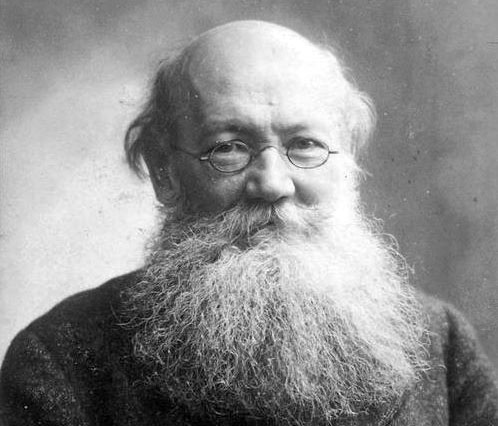
In May 1919 Lenin met Kropotkin in the Kremlin. Lenin admired Kropotkin, especially for his book The Great French Revolution, but the conversation revealed how the anarchist leader was more interested in this or that cooperative being set up and had lost the general picture of where the revolution was going.
After the February Revolution, on June 12th 1917, P.A. Kropotkin returned to Russia from England, to Petrograd, where he wanted to live. Soon, however, he changed his mind and moved to Moscow.
One day - it was the year 1918 - a relative of Pyotr Alexeyevich Kropotkin - his daughter if I remember correctly, together with her husband - applied at my office at the Committee of the Soviet of Peoples Commissars (Sovnarkom) and she told me about the problems he had to endure in his search for a residence. It was clear that this was the result of a gigantic misunderstanding since Pyotr Alexeyevich, as a veteran of the revolution, obviously had the right to a residence, also during this stormy revolutionary period. So I got in touch with P.A. Kropotkin again, whom I knew from the past. I immediately notified Vladimir Ilyich and he at once ordered me to issue a residence permit in the name of Pyotr Alexeyevich, which I acted upon immediately. Shortly thereafter I paid him a visit to find out how he was doing and our encounter was extraordinarily cheerful and cordial. Pyotr Alexeyevich was living very modestly; in his room were many books and everything in sight indicated that he was arduously busy with literary work.
Immediately after our reunion he mentioned his attitude to the October Revolution. The Bolshevik revolution had surprised him at an already advanced age and in his opinion only people under forty could actively participate in a revolution. When I objected that the whole underground part of our party that had revolutionary experience was already above that age, he replied: "That is the case in Russia. Indeed, we have here outstanding revolutionaries of fifty years and older. But as far as my age is concerned... that is another matter..." The events of our complicated life at that time, however, were keeping him very busy, and when the Whites and the Soviet enemies surrounded Soviet Russia he sympathised completely with the fate of the great proletarian movement.
He once told me:
"During all the activities of the present revolutionary political parties we must never forget that the October movement of the proletariat, which ended in a revolution, has proved to everybody that a social revolution is within the bounds of possibility. And this struggle, which takes place worldwide, has to be supported by all means - all the rest is secondary. The party of the Bolsheviks was right to adopt the old, purely proletarian name of "Communist Party". Even if it does not achieve everything that it would like to, it will nevertheless enlighten the path of the civilised countries for at least a century. Its ideas will slowly be adopted by the peoples in the same way as in the nineteenth century the world adopted the ideas of the Great French Revolution. That is the colossal achievement of the October Revolution."
I should not forget to mention that in the summer of 1920, as Lebedev mentions, Pyotr Alexeyevich was visited by a delegation of English workers.
Kropotkin handed a long letter to the delegation, addressed to the "workers of Western Europe". In this letter he wrote that "first, the workers of the civilised world and their friends in other classes ought to prevail on their governments to abandon entirely the idea of armed intervention in Russia whether openly or secretly, both in the form of armed aid and of support to different groupings, and it is high time that the nations of Europe enter into direct relations with the Russian nation."
Of course, being a dedicated anarchist, Pyotr Alexeyevich did not recognise the government of our Soviet state. He was completely opposed to all parties and to a state. However, when you talked to him about practice and not theories, he understood that without state power it was impossible to consolidate the gains of the revolution. At our first encounter Pyotr Alexeyevich told me:
"I was told that Vladimir Ilyich has written a wonderful book about the state, which I have not seen or read yet, and in which he stipulates that the state and state power will wither away in the end. With this audacious revelation of Marx's teachings alone Vladimir Ilyich has earned the greatest respect and interest and the proletariat of the world will never forget this. I see the October Revolution as an attempt to bring the preceding February Revolution to its logical conclusion with a transition to communism and federalism."
Life was hard in Moscow in 1918. Pyotr Alexeyevich accepted the offer of his friend Olsufiev to live in his house in the city Dmitrov. In the spring of 1918 Pyotr Alexeyevich moved with his family to Dmitrov and took up residence with Olsufiev, who had a large house with four rooms. From Dmitrov he came to Moscow every once in a while, and I always met him. He also wrote letters to Vladimir Ilyich and me about the most diverse questions. Although his health was always a struggle, Pyotr Alexeyevich still tried to participate in local public life. He spoke at a teachers' congress, participated in the congress of farmers' cooperatives and he vehemently supported the idea of the establishment of a regional museum. I constantly kept Vladimir Ilyich informed about Kroptokin's living conditions and also about my conversations with him. Vladimir Ilyich had a great respect for Pyotr Alexeyevich. He held him in great esteem, particularly as the author of the book about the Great French Revolution and he discussed at great length the qualities of this remarkable book. He pointed out to me that Kropotkin had been the first to look at the French Revolution through the eyes of a researcher, to focus the attention on the plebeian masses, and to continually underline the role and meaning of the craftsmen, the workers and other representatives of the working people during the French Revolution. He saw this work by Kropotkin as a classical work and he recommended reading it and circulating it on a large scale. He said it was certainly necessary to republish this book with a wide circulation and to distribute it free of charge to all libraries of our country. During all of our conversations Vladimir Ilyich expressed the wish to meet Pyotr Alexeyevich and to talk to him. At the end of April 1919 I wrote him a letter, whose original is kept in the Kropotkin museum in Moscow.
"Dear Pyotr Alexeyevich, I heard from Miller that you intend to come to Moscow. That is a splendid thought! Vl [adimir] Il [yich] sends his regards and told me he would very much like to meet you. Could you telegraph me when you are coming to Moscow, I would also like to meet you. With comradely regards, yours, Vlad. Bonc-Brujevic."
Soon after when Pyotr Alexeyevich came to Moscow, he informed me at once. I looked him up and he said that he had received my letter and that obviously he would like to arrange a meeting with Vladimir Ilyich. "I have a lot to discuss with him", he added. We agreed that I would tell him by telephone the day and time of the meeting; I intended to arrange it in my flat in the Kremlin.
This talk took place in the year 1919 - it must have been 8, 9 or 10 May. Vladimir Ilyich had decided that the meeting would take place after his working day at the Sovnarkom and he told me that he would be at my place by 5 in the afternoon. I informed Pyotr Alexeyevich of this over the phone and sent a car to him. Vladimir Ilyich was there earlier than Pyotr Alexeyevich. We were talking about the works of revolutionaries of earlier epochs. Vladimir Ilyich said that without a doubt there would be a time when we would publish the works of the Russian revolutionaries who had lived abroad. Vladimir Ilyich flipped alternately through the books in my library by Kropotkin and Bakunin, which I had in my possession since 1905, and he quickly browsed through them. At that moment Kropotkin was presented. I walked towards him. He was slowly climbing our relatively steep stairs. Vladimir Ilyich quickly walked towards him through the corridor and greeted Pyotr Alexeyevich with a big smile. Vladimir Ilyich took him by the arm and very politely and very carefully, as if he was guiding him into his study, led him to a chair and sat himself down on the opposite side of the table.
Pyotr Alexeyevich was radiant and he said:
"How glad I am to see you, Vladimir Ilyich! You and I have different views. We have different points of view about a whole series of problems, both as far as the execution and organisation is concerned, but our goals are the same and what you and your comrades are doing in the name of communism, pleases me very much and makes my already ageing heart happy. But now you are making life hard for the cooperatives and I am in favour of tcooperatives!"
"But we are also in favour of them!", Vladimir Ilyich exclaimed loudly, "only we are opposed to cooperatives behind which kulaks, big landowners, merchants and private capital hide. We only want to tear off the mask of these pseudo-cooperatives and give the opportunity to big layers of the population to participate in a real cooperatives!"
"I do not want to dispute that," Kropotkin replied, "and where that is the case it obviously needs to be combated by all means, just as lies and mystification need to be combated everywhere. We do not need veils, we have to uncover every lie without mercy, but there in Dmitrov I have seen that more than once members of the cooperative are being persecuted who have nothing in common with those you were talking about a minute ago, and that is because the local authorities - who were perhaps the revolutionaries of yesterday - just like all other authorities have become bureaucratised, have been transformed into officials who wish to do with their subordinates whatever they want, and who think that the whole population is subordinate to them."
"We are always and everywhere against officialdom," Vladimir Ilyich said. "We are against bureaucrats and against bureaucracy, and we have to eradicate this ageing mess completely if it grows up in our new society; but surely you understand, Pyotr Alexeyevich, that it is very difficult to change people, since the most inaccessible fortress is surely - as Marx used to say - the human skull! We take all kinds of measures in order to be able to face this struggle, and life itself obviously teaches us a lot. Our lack of culture, our illiteracy, our backwardness are of course noticeable, but nobody can blame us, as a party, as a state power, for all that is going wrong in the institutions of power and much less for what happens far away somewhere in the countryside, at great distance from the centre of the country."
"Of course, that is no consolation for all those who are exposed to the exertion of power of that backward kind of authority," P.A. Kropotkin exclaimed, "and that authority in itself is already a terrible poison for anyone who exercises it."
"But there is nothing we can do about that," Vladimir Ilyich added, "you cannot make a revolution with velvet gloves. We know very well that we have made a great many mistakes and that we will make a great number of mistakes; everything that can be corrected we correct; we admit our mistakes and often our greatest stupidities. Despite all mistakes we are carrying our socialist revolution to a successful end. But please do help us, share all of the mistakes that you see with us, and rest assured that every one of us will look at it with the greatest attention."
"Neither me, nor anyone else," Kropotkin said, "will refuse to help you and your comrades wherever that is possible... We will tell you about all the mistakes that are happening, which cause loud groans in many places..."
"No groans, but screams from resisting counterrevolutionaries, whom we are and remain utterly opposed to..."
"Now you are saying that we cannot do without authority," thus Pyotr Alexeyevich started to theorise, "but in my opinion it is possible... You should see how such an anti-authoritarian beginning flares up. In England for example - I was just informed about this - dockworkers in one of the ports have established a wonderful, completely free cooperative, where workers of all other factories come and go. The cooperative movement is important to a great extent, yes, it is of the essence..."
I looked at Vladimir Ilyich. His gaze contained an element of irony and amusement: listening very attentively to Pyotr Alexeyevich, he was clearly amazed that while the revolution of October had expanded so enormously, it was still possible to talk only about cooperatives and yet more cooperatives. And Pyotr Alexeyevich kept talking and talking, he told us how somewhere else in England another cooperative had been established, and how somewhere else, in Spain, some other little (cooperative) federation had been established, and how the syndicalist movement in France was developing... "That is very harmful," Lenin, who could not restrain himself any longer, interrupted, "by not devoting any attention to the political side of life and by splitting up the working masses, one distracts them from the direct struggle..."
"But the professional movement unites millions, and that in itself is already a colossal factor," Pyotr Alexeyevich said excitedly. "Together with the cooperative movement that is a big step forward..."
"That is all very nice," Lenin interrupted. "Of course, the cooperative movement is important, but if it is only of a syndicalist nature, it is harmful; but is that really the essence? Can only that lead to something new? Do you really think that the capitalist world will pave the way for the cooperative movement? Capitalism will try to take power over the cooperatives by any means necessary. This 'anti-authoritarian' cooperative group of English workers will be crushed in the most ruthless way possible and will be made into servants of capital. They will depend on capital via a thousand threads so that the newly created trend, which you sympathise so much with, will be caught as in a spider's web. Pardon me, but all of that is unimportant! Those are all details! What is needed is direct action of the masses, and as long as that is not happening, nothing can be said about federalism, communism or social revolutions. Those are all children's toys, prattling without any firm ground under our feet, without power, without means, and it does not bring us any step closer to our social aims."
Vladimir Ilyich was standing up now and said all of this by raising his voice in a clear and vivid way. Pyotr Alexeyevich was leaning backwards and listened very carefully to Vladimir Ilyich's flaming words and did not speak about the cooperatives any more after that.
"Of course, you are right," he said, "without struggle you cannot get there, not in a single country; without the most desperate struggle..."
"But only massively," Vladimir Ilyich exclaimed, "the struggle and attempted murders of individual people serve to nothing, and it is time the anarchists understand that. Only in the masses, only by the masses, and only with the masses... All other methods, including the anarchist ones, have already been filed in an archive by history. They are useless, they serve for nothing, they attract nobody and they are only a distraction for people seeking their salvation on this long beaten path..."
Vladimir Ilyich suddenly went silent, smiled very engagingly and said: "I beg your pardon, I am letting myself go too much and I am tiring you, but we Bolsheviks are all the same, that is our problem, this is our pet subject, and it is so dear to us that we cannot speak about it without getting excited."
"No, no," Kropotkin replied, "if you and your comrades think in this way, if the power is not going to their heads, and if they feel that they will not be going in the direction of oppression by the state, then they will achieve a lot. Then the revolution is truly in good hands."
"We are doing our best," Lenin replied good-heartedly. "We need developed masses," Vladimir Ilyich continued, "and I would so much like to see that book of yours, The Great French Revolution, printed in an edition as large as possible. For that book is useful for everybody."
"But where would I have it printed? It is not possible to print it at the state publishing house..."
Pyotr Alexeyevich nodded approvingly.
"Well," he said, clearly pleased with this approval and this proposal, "if you consider the book interesting and useful I am prepared to print it in a cheap edition. Maybe we will find a cooperative publishing house that would accept it..."
"That won't be a problem," Vladimir Ilyich said, "I am sure of that..."
After this the conversation between Pyotr Alexeyevich and Vladimir Ilyich receded a bit. Vladimir Ilyich looked at his watch, got up and said that he had to prepare for the meeting of the Sovnarkom. He said farewell to Pyotr Alexeyevich in a most cordial way and said that he would be happy to receive every letter of his. Pyotr Alexeyevich bode us farewell too and went outside. We showed him to the door together.
"How old he has become," Vladimir Ilyich said to me. "Now he is living in a country that is bursting with revolution, where everything has been completely turned upside down, and he cannot think of anything else but to talk about the cooperative movement. There you have the poverty of ideas of the anarchists and all other petty bourgeois reformers and theoreticians, who at a moment of massive creative activities, at the time of a revolution, are never able to come up with a good plan or with good practical advice. For if we did what he says for but a minute, then tomorrow we would have the autocracy back in power and we would all, including himself, be chatting around a streetlamp, and he only because he calls himself an anarchist. And how well he wrote, what wonderful books, how refreshing and how precisely did he formulate and did he think, and now that is all in the past and nothing is left... But of course he is very old and we must surround him with care and help him with everything he needs as far as possible, but that needs to be dealt with very delicately and very carefully. He is very useful and precious for us because of his whole terrific past and because of everything he has done. Please do not lose sight of him, take care of him and his family and keep me informed about everything, then we will discuss it together and help him."
While we were continuing our talk about Pyotr Alexeyevich and the people of his generation, Vladimir Ilyich and I were walking across the Kremlin in the direction of the Sovnarkom building, where in a quarter hour the next session of our government was to start.
Source: V. D. Bonc-Brujevic. Collected Works in three parts, part 3: Reminiscences of Lenin 1917-24. It concerns a written report by the Bolshevik Bonc-Brujevic of the meeting between Lenin and Kropotkin in the Kremlin.
Translation: from Dutch into English, by Maarten Vanheuverswyn, February 2007
Edited by Ted Crawford and Fred Weston