

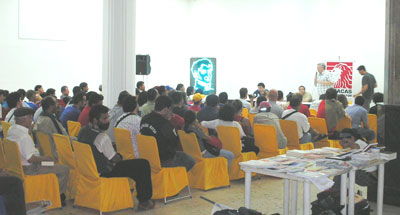
On Tuesday August 16, as a follow up to the spectacularly successful intervention of the International Marxist Tendency in the World Youth Festival, the CMR (Venezuelan Revolutionary Marxist Current) and the JSR (Revolutionary Socialist Youth) organized two public meetings in the Caracas Mayoral Offices (Alcaldía Metrpolitana). These meetings were mainly intended to gather together some of the contacts made at the Festival. They were well attended, with over 120 people present. There was a keen interest in the ideas of Marxism and a very lively debate, especially in the second meeting.
Most of those present were young people, many wearing the red shirt that is the uniform of the Bolivarian movement. But there were also quite a number of older comrades, veterans of the workers’ movement, trade union militants and communists. Amongst others present on the first day was Jorge Paredes, the leader of the occupied CNV factory (now expropriated) and on the second day, there was the well-known Venezuelan television actor, Simón Pestana.
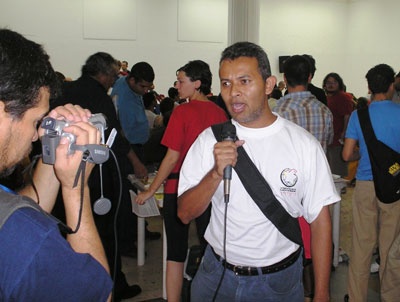 |
Inveval workers' leader Jorge Paredes |
The subject of the first meeting was the Meeting of young Marxists with Alan Woods and the main speaker was comrade Alan Woods, editor of Marxist.com. He was preceded by several of the international delegates to the Festival, who made short speeches, stressing the need for socialism on a world scale and the necessity of a Marxist programme and leadership. Among the speakers was comrade Juanjo López the general secretary of the Spanish Students’ Union, who pointed out that the struggle against bureaucracy in Venezuela was already anticipated by the famous Four Conditions of Lenin:
a) Free and democratic elections of all functionaries with right of recall. b) No official to receive a wage higher than that of a skilled worker. c) No standing army or police force but the armed people. d) Gradually, all the tasks of administration of society and the state to be performed by everybody on a rotating basis.
Alan Woods began his speech by pointing out that wars and terrorism were only the external symptoms of the organic crisis of capitalism on a world scale. Latin America was now at the centre of the world revolutionary process and the people of Venezuela have the honour of being in the front line. He criticised those so-called Marxists who tried to spread pessimism and despondency, putting forward all kinds of “clever” arguments to convince the masses that the socialist revolution was a hopeless task.
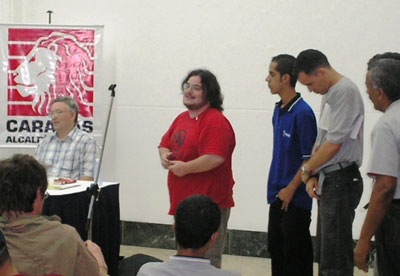 |
Juanjo L�pez, General Secretary of the Spanish Students' Union |
“What would these people have said to Simon Bolivar when he began his revolutionary fight for the independence of Latin America? They would have said: ‘No, it is hopeless, Spain is too strong. We must be careful.’ And so on. And where would we be if Bolivar had listened to these gentlemen? We would still be in the grip of colonial slavery.
In the course of the discussion, somebody asked: “How can we talk about a proletarian revolution in Venezuela, when the working class is in a minority?” Answering this point, Alan reminded the audience of the real situation in Russia before 1917:
“People forget that tsarist Russia was an extremely backward country, far more backward than Pakistan today. Out of a total population of 150 million people, there were only about four million industrial workers, or at most ten million if we include transport and mining. The working class was a small minority, but that did not prevent Lenin and Trotsky from leading it to the seizure of power. The Bolsheviks took power in Russia and then appealed to the workers of Europe to come to their aid.
“There were plenty of people in Russia who gave Lenin the same kind of advice we now hear all too often in Venezuela: we must not take power, we are too weak, we will be crushed, etc. But the Bolshevik Party did its duty. They had an internationalist perspective. They based themselves on the perspective of an international revolution, especially in Europe.
“The sceptics will say this was utopian. But that is false. There was a revolution in Germany in November 1918, when the workers rose up, organized a general strike, the army mutinied and the German fleet entered Kiel and Hamburg flying the red flag. Unfortunately, the German revolution was betrayed by the Social Democratic leaders and the Russian revolution was isolated in conditions of terrible backwardness.”
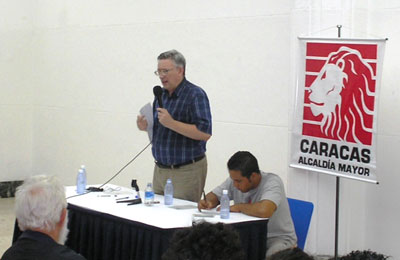 |
Alan Woods at the meeting of Marxist Youth |
Alan cited the words of Marx that were quoted by President Chavez in his speech last Sunday: “Socialism or Barbarism”. The question of the socialist revolution was firmly back on the order of the day. The time for pessimism, scepticism and defeatism was past. He appealed to all present to join the Revolutionary Marxist Current and the Revolutionary Socialist Youth and to intensify the struggle for the socialist revolution in Venezuela and in the whole of Latin America.
On the second day there were two other speakers apart from Alan Woods. One was a member of the cabinet of Juan Barreto, the metropolitan mayor of Caracas, and the other an assessor to the Metropolitan Department of Culture. The subject was: The Bolivarian Revolution and Socialism. It turned into a very lively, and at times, heated debate, with Alan Woods defending the position of revolutionary socialism and the other two defending that of reformism.
Briefly stated, the arguments of the reformists were: Venezuela was not ready for socialism, the masses did not understand socialism and were on a low level of consciousness, the international context was unfavourable, and we had to proceed slowly. The first speaker stated that we “did not have the means” to carry out a full scale agrarian reform. The second, who described himself as an ex-guerrilla and former Marxist Leninist (it is amazing how many of the most belligerent reformists are “ex-guerrilla and former Marxist Leninists”!) hotly protested against what he described as “left wing rhetoric”. Maybe it gave him a guilty conscience to hear the ideas he had once defended turned against himself.
 |
In a truly devastating critique of reformism, comrade Alan quoted the words of Fidel Castro’s introduction to Che Guevara’s Bolivian Diaries:
“There will always be a proliferation of excuses, whatever the time and circumstances, not to fight – and that would mean that we could never obtain freedom.”
He began by asserting that we are engaged in a war, a war between the classes, in which no consensus or lasting agreement is possible. But he pointed out that on many occasions in the history of warfare a big army with brave soldiers has been defeated by a small professional army with good officers. It was absolutely necessary for the revolutionary movement in Venezuela to adopt a correct and unambiguous programme based on the scientific principles of Marxism.
“What is this socialism of the 21st century?” Alan asked. “Nobody can tell me. But it serves a useful purpose for those who wish to water down the idea that the Bolivarian revolution must be transformed into a socialist revolution. This idea has been put forward by President Chavez and like so many other ideas he has defended it is being sabotaged by the Bolivarian bureaucracy.
“There are those who say: we need to develop an entirely new socialism that has never been seen before. But as the Bible says, there is nothing new under the sun. There is no particular merit in advocating something new just for the sake of it. The wheel is very old – even older than Marxism – but what would we say to a man who said: why don’t we invent an entirely new wheel – a wheel of the 21st century? What about a square wheel? Or maybe a rectangular one would be better!” (laughter)
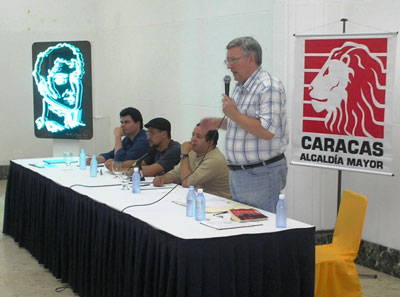 |
Alan Woods speaks on the Bolivarian Revolution and Socialism |
Alan poured scorn over the reformists’ attempt to portray themselves as “realists” and the Marxists as utopians: “What is this so-called realism? It is the realism of a man who tries to persuade a tiger to eat lettuce instead of meat. Naturally, he does not succeed but ends up inside the belly of the tiger.
“We have seen where this ‘realism’ has led in Venezuela. After the 2002 coup President Chavez attempted to conciliate with the oligarchy. He offered to negotiate and compromise. What was the result? Only a second attempt to overthrow the government in the bosses’ lockout. Only the direct intervention of the masses saved the Revolution on both occasions and once again in the referendum.
“Is there anyone present who believes that the aims of the Bolivarian revolution can be achieved while the economic power of the oligarchy remains intact? Let them raise their hand now.” Nobody raised their hand, and the reformist ex-guerrilla shrugged his shoulders as if to say: “We are all in agreement.” Alan turned to him and said: “Well, if you say a, you must say b, c, and d. It is not enough to vote for socialism, it is necessary to take concrete steps to realise it. It is necessary to expropriate the oligarchy, to nationalise the land, the banks and the big industries under workers’ control and management.”
There was a very lively debate from the floor, with people lining up to speak. Without exception, those who spoke lambasted the reformists and defended the standpoint represented by Alan Woods. There were some angry interjections from the floor from workers, one of whom protested against what he called “the dictatorship of the bureaucrats”. “It is high time the leaders began to listen to the voice of the people”, he exclaimed.
 |
The final speeches of the reformists were even poorer than their original efforts. The speaker from the Department of Culture seemed to have lost much of his appetite for debate and confined himself to a few perfunctory remarks, to the effect that it was impossible to have a planned economy in Venezuela. One had the distinct impression that he was sorry he had come.
The ex-guerrilla, however, was in fighting spirit. He launched into a tirade against his critics, implying, among other things, that they had learned nothing from the collapse of the Soviet Union and, moreover, that there was no party to create a one-party state (which nobody had mentioned). He expanded at great length on the ignorance of the masses, which clearly could not be entrusted with the important task of running society. They needed time – evidently a very, very long time – to carry out their reformist strategy (one comrade commented that they should really refer to the socialism of the 23rd century!). In a misplaced attempt to overawe the audience with a display of historical erudition, he exclaimed: “You cannot do these things overnight. Was the Paris Commune set up overnight? Were the soviets in Russia set up overnight?”
Summing up the debate, Alan Woods said that it was very good that different points of view should be debated, and that he had listened with great attention to what the other two speakers had said, but that he was still none the wiser as to the meaning of “socialism of the 21st century”. He then proceeded to demolish the arguments of the reformists one by one.
“Let me make one thing clear. Nobody here has defended a return to the discredited model of Stalinist Russia, as has been suggested. What collapsed in the USSR was not socialism, as our Russian comrade has explained, but a bureaucratic totalitarian caricature of socialism. Nor has anyone here defended a one-party state. That has nothing in common with the ideas of Marx and Lenin.
“Socialism is democratic or it is nothing. But real democracy is impossible under capitalism. In Britain and the USA there is formal bourgeois democracy in which everybody can say (almost) what they like as long as the big banks and monopolies decide what actually happens. We stand for a real workers’ democracy, in which the running of society is in the hands of the majority of workers not a minority of wealthy parasites.
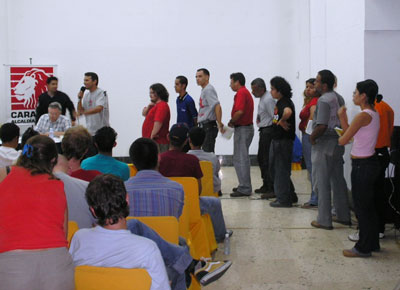 |
People lining up to speak |
“Does that mean a one-party totalitarian state? Not at all. I do not think it will be necessary to deny the former owners their democratic rights after we have expropriated them. But what we cannot accept is that a tiny handful of rich people owns and controls the television and newspapers and uses this monopoly to spread its counter-revolutionary poison and agitate for a coup.
“We should therefore nationalise the media and then provide access to the television, radio and newspapers to groups, parties and organisations in accordance to their real social base of support. So the UNT would have a television station and a couple of daily papers and Mr. Cisneros can have a small duplicated news sheet which he is welcome to sell outside the metro stations, as we now sell El Militante and El Topo Obrero. In other words, the bourgeoisie will be given exactly the same rights that they previously gave to us. What is wrong with that?
“Comrade Pedro says that the level of consciousness of the masses is low. When I hear this kind of thing I scratch my head. Where was this low level of consciousness in April 2002, when the masses came out on the streets with no party, no organisation, no leadership and overthrew the coup? Is that a low level of consciousness? It was a marvellous movement like the movement of the workers of Barcelona in 1936 and shows a very high level of revolutionary class consciousness.
“Who defeated the bosses lockout? The masses. Who defeated the counter-revolution in the recall referendum? The masses. Yet there are people who still talk of the ‘low level of consciousness’ of the masses! What country are these people living in? Not in Venezuela, it seems!
“Comrade Pedro asks: Was the Paris Commune set up overnight? Were the soviets in Russia set up overnight? I answer: yes, the Paris Commune set up more or less overnight, as were the soviets in Russia. Nobody told the Russian workers to set up the soviets. They were a marvellous example of the creativity and the self-movement of the working class, as was the Paris Commune. Comrade Pedro shakes his head. He has forgotten the most elementary facts of revolutionary history.
“A revolution always bases itself on the self-movement of the masses. This is the driving force of any revolution and it is the driving force of the Venezuelan revolution also. Is it not time we placed a little bit of confidence in the masses – just a little bit?” Alan asked the two reformists, who by this time were staring at their shoes.
“There is a serious problem with bureaucracy,” Alan continued. “This can destroy the revolution. Bureaucracy is a cancer that gnaws at the entrails of the revolution and destroys it from within. The other day I was told the following story by the workers of the occupied CNV factory, whose leader comrade Jorge Paredes was with us yesterday. After the workers began the occupation, one day a man appears at the plant who is completely unknown and announces himself as ‘the new Bolivarian factory director’. The workers said to him: ‘OK. Go and sit in the corner and we will tell you what we have decided.’ Of course, I do not mean to say we do not need experts, economists and so on. But they must be under the control of the working class, serving it and not lording it over the workers. (applause).
Alan insisted that the workers must control the leaders, citing the programme of the Bolshevik party of 1917. “A bold revolutionary policy was needed, not timid half measures. The victory of the socialist revolution in Venezuela would lay the basis for the socialist revolution in Bolivia, Ecuador, Peru and throughout the continent.”
He summed up with the following words: “I enthusiastically subscribe to the great ideal of Simon Bolivar, the unification of Latin America. But after 200 years we must ask the question: is this really possible under capitalism? For two centuries the landlords, bankers and capitalists have betrayed the vision of Bolivar. They have divided the living body of Latin America and placed it at the mercy of imperialism. Therefore, we have the right to conclude that the only way to realise the dream of Bolivar is by the working class taking power (applause). The Venezuelan Revolution must be the first step in the struggle for the Socialist Federation of Latin America, and this must be the first step in the struggle for a socialist world.”
These sentiments were enthusiastically endorsed by almost everybody present.