
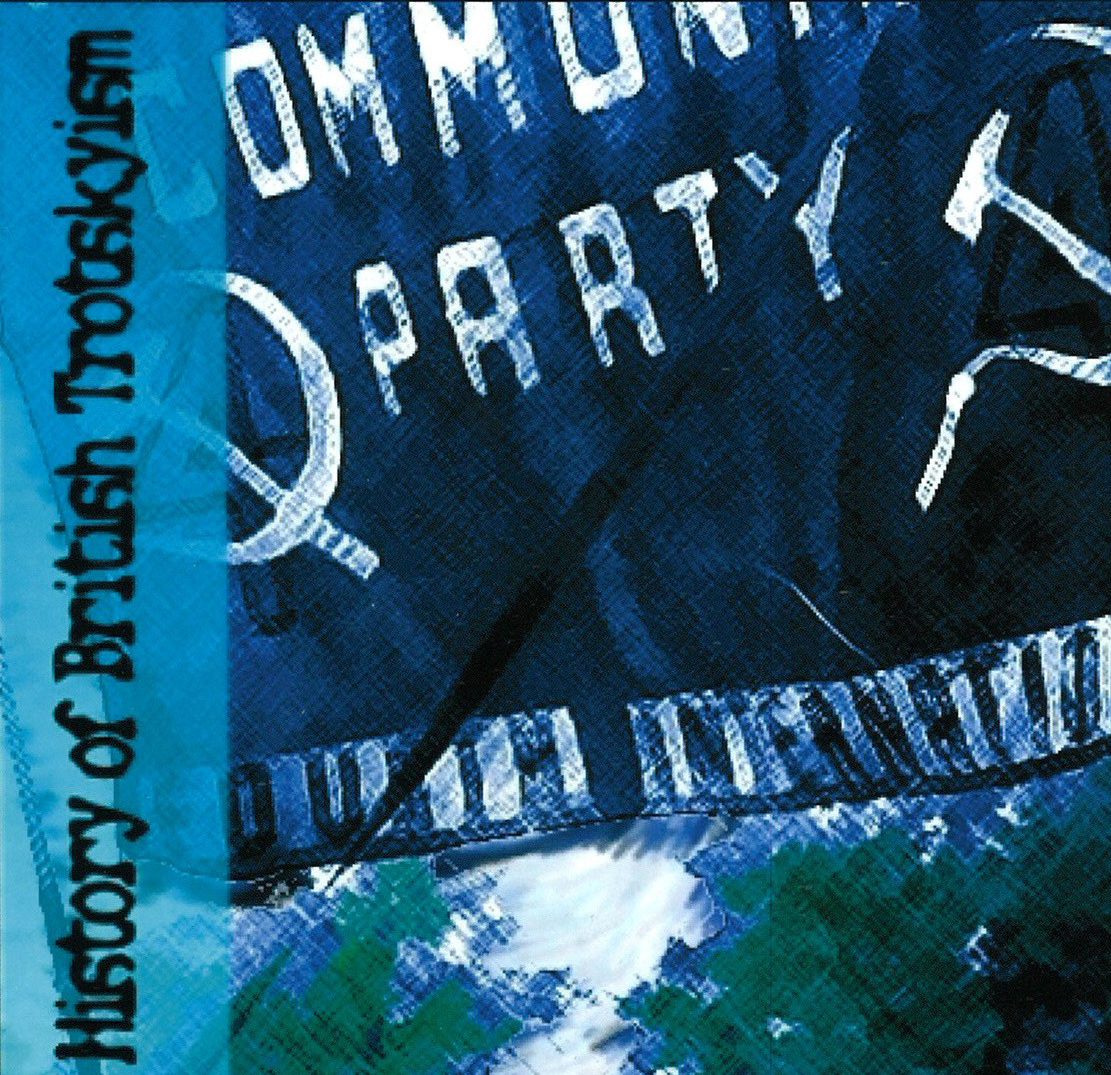
This book by Ted Grant is a unique contribution to the history of British Trotskyism. It begins with the debate on Trotskyism in the British Communist Party in 1924 and ends with the break-up of the Revolutionary Communist Party in 1949 and the beginning of more than thirty years of work within the Labour Party. Ted Grant was the founder and political leader of the “Militant Tendency”, which haunted the Labour leadership, and was eventually expelled along with the Militant editorial board in 1983. A postscript by Rob Sewell, who was the national organiser for the Militant throughout the 1980s, brings this unique history up to date.
By Ted Grant
With an introduction and postscript by Rob Sewell

Click here to buy it online from Wellred Books
This book by Ted Grant is a unique contribution to the history of British Trotskyism. It begins with the debate on Trotskyism in the British Communist Party in 1924 and ends with the break-up of the Revolutionary Communist Party in 1949 and the beginning of more than thirty years of work within the Labour Party. Ted Grant was the founder and political leader of the “Militant Tendency”, which haunted the Labour leadership, and was eventually expelled along with the Militant editorial board in 1983. A postscript by Rob Sewell, who was the national organiser for the Militant throughout the 1980s, brings this unique history up to date.
Introduction
By Rob Sewell
The present work is a unique contribution to the history of British Trotskyism. Ted Grant became the chief theoretician of British Trotskyism during the Second World War, and was responsible for writing all the main political documents of the tendency. Ever since, for a period of something like six decades, he has been a central figure in the Trotskyist movement. This has given him colossal personal experience, which he has drawn upon to produce this book, which spans the origins of British Trotskyism to the break-up of the Revolutionary Communist Party in June 1949. These were tumultuous years of revolution and counter-revolution, depression, fascism and world war, which tested Trotskyism to the limit. The way in which the movement was able to face up to its historic tasks, its successes and failures, is outlined in this book.
Over the last 70 years, Ted has made a lasting contribution to the Trotskyist movement, and he is regarded by many as the foremost Marxist theoretician alive. Today, he remains an active and leading figure within the Socialist Appeal group in Britain and in the international Marxist current associated with the successful In Defence of Marxism website, which is attracting growing support internationally.
The early years
Ted Grant was born in South Africa, just before the First World War in a place called Germiston, just outside Johannesburg. His father had emigrated to South Africa from Russia, while his mother came from Le Marais in Paris. After a long marriage, his parents eventually divorced, and after a six-month stay with his father, Ted went to live permanently with his mother. While she ran a small grocery shop in Johannesburg, Ted was sent off to boarding school and his sisters to the convent to continue their education.
In his youth, he was inspired by events in Russia. But, as is so often the case, his first contact with the revolutionary movement had an accidental character. In order to supplement the family income, his mother took in lodgers, one of whom was Ralph (Raff) Lee, who had been a member of the South African Communist Party since 1922, but was expelled during the first Stalinist purges. A dedicated communist, Ralph had regular discussions with Ted, introducing him to the writings of Bernard Shaw, H. G. Wells, Maxim Gorky, Jack London and others. Within a short time, the reading material graduated to the writings of Marx and Engels, and also Lenin. By the age of fifteen Ted was a convinced Marxist.
Ted’s elder sister Rae vividly remembers how her mother fed the family and friends, including Ralph, at a large household table – French stew seems to have been the favourite dish. Ralph, who became a close friend of the family, was six years Ted’s senior. "Ralph and Ted were inseparable", said Rae. "Once Ralph convinced Ted about Marxism, that changed everything for him," she recalls. "I used to go on long walks with Ralph and he also tried to win me over to Marxism, but I was busy with another circle of friends, so he never succeeded." [1]
He did, however, convince Ted’s younger sister Zena to join the Trotskyist movement. Lee with others, including the fifteen-year old Ted Grant, had made contact with the international Trotskyist movement in early 1929 via the American Militant, which had been dispatched to South Africa by the newly-founded Communist League of America. "It changed our lives completely", says Ted, "and I started on a political road that now spans more than seventy years."
The inspiring story of how the South African Trotskyists began their revolutionary work under the most difficult conditions imaginable is one of the most interesting parts of the present book. Their work in the Johannesburg Laundry Workers Union remains an inspiration today. But the conditions in South Africa made successful revolutionary work difficult, and in 1934 Ted left for England in the company of another young South African called Max Basch. He was never to return. They broke their journey in France where they met Trotsky’s son, Leon Sedov, a member of the International Secretariat and co-ordinator of the work of the International Communist League, who was later murdered by Stalin’s agents.
On their arrival in Britain in December 1934, Max Basch changed his name to Sid Frost and Ted changed his from Isaac Blank to Ted Grant – apparently "borrowed" from two of the ship’s crew. In the same way, Trotsky had taken his name from one of his old tsarist jailors. Ted did this for personal reasons – to protect his family: whatever happened to him, he did not want anything bad to happen to his family back home in South Africa.
In London, they both joined the Marxist Group inside the Independent Labour Party. However, the possibilities for revolutionary work were becoming less and less, and within a matter of months, Ted Grant left the ILP to join the Trotskyists working within the Labour Party’s youth organisation – the Labour League of Youth. From then on, Ted helped to develop the Bolshevik-Leninist Group within the Labour Party, which later became known as the Militant Group, after the name of its paper. At this time, their main work consisted of fighting the growing Stalinist influence within the youth movement. The Stalinists were striving to penetrate the Labour League of Youth and fuse it with the Young Communist League. Their faction was led by Ted Willis, who later became famous as the author of Dixon of Dock Green – a well-known television series in the 1950s portraying the life of a friendly British "Bobby" – and who was made a Lord for his services to the British Establishment. His colleague Jim Mortimer ended up as general secretary of the Labour Party. Ironically, Mortimer helped to expel Ted Grant from the Labour Party in 1983.
Shortly after his arrival in Britain, Ted also became actively involved in the struggle against fascism, engaging together with other comrades in running battles with the Moselyite Black Shirts in the East End of London. Here he participated in the famous battle of Cable Street, when the workers of the East End mobilised to stop the fascists in their tracks. There exists a photograph of Ted on a barricade in Long Lane, Bermondsey, South London, taken in 1937, which was reproduced in the 1948 edition of his pamphlet The Menace of Fascism, published by the Revolutionary Communist Party.
The Paddington Group
Ted Grant’s early years in the South African group had given him a sound theoretical grounding in Marxism which placed him in good stead for the role he was to later play in the Trotskyist movement. After a few years, the failure of the leadership of the Militant Group to develop the tendency in any meaningful way, led to a growing dissatisfaction within its ranks. By the autumn of 1937, Ted’s own branch in Paddington had become the most active section of the Group, selling the bulk of its newspapers, intervening in the wider labour movement, and engaging in extensive public activity.
Towards the end of the year, a row erupted over the election of the Group’s leadership, where slanders were circulated about Ralph Lee. Lee had recently joined the Militant Group after arriving with others from South Africa during the summer. This episode led to a walkout and the formation of a new group, called the Workers International League (WIL).
Engels once remarked that sometimes a split could be a healthy thing. The 1937-38 split certainly came into this category, as subsequent events proved. It constituted a decisive step forward in the development of Trotskyism in Britain. The traditional party-building methods of the old groups – which were really a leftover from the methods of the pre-war socialist groupings – had become a barrier to growth. The cadres of the WIL turned their backs on the failed sectarian methods of the past and turned their faces firmly towards the broader layers of the organised working class. In reality, this marked the real beginning of British Trotskyism. Ted Grant played a leading role in this work, not only within the Workers International League but also within the Revolutionary Communist Party formed in 1944, which is fully covered in this book.
The War Years
The period covering the war years is also well documented in this book. It was a testing time. In the first few months of the war, a part of the leadership went to Ireland to establish a base in case the WIL was banned, leaving Ralph, Millie and Ted to run the organisation. In this period, Ralph Lee almost single-handedly produced a daily Workers’ Diary for use in workplaces. However, by the end of 1940, Ralph had returned to South Africa for personal and health reasons, and the work of building the organisation fell on the shoulders of the other leading comrades.
Above all, the WIL enthusiastically embraced the new proletarian military policy when Trotsky first put it forward. This was in reality a development and deepening of the Internationalists’ position during the First World War, and, while maintaining a principled opposition to the imperialist war, allowed the Trotskyists to connect with the working class. The interpretation of the new policy in Youth for Socialism did, however, lead to a dispute within the leadership in February 1941, with Ted and Healy (the "majority") on one side, and Millie, Jock Haston and Sam Levy (the "minority") on the other.[2] According to Millie, things got quite heated. But after a few articles in the internal bulletin the argument fizzled out. More pressing was the invasion of the Soviet Union by Hitler in June of that year. However, given the fact that the proletarian military policy was a new programme, such disagreements were likely, if not inevitable under the circumstances. In any case, the dispute showed that the WIL leaders could handle differences of opinion in a comradely and mature fashion.
The comrades of the WIL decisively challenged the attacks of the Stalinists, who after June 1941, took on a rabid chauvinist and strike-breaking role. The WIL, in a clear change in orientation, changed the name of its paper from Youth for Socialism to Socialist Appeal. The WIL energetically turned towards the factories, built up their position in industry and developed a national profile. In contrast, the official section of the International, the Revolutionary Socialist League, which rejected the proletarian military policy, collapsed. Eventually, its remnants fused with the WIL to form the RCP in 1944.
Soon afterwards, Jock Haston, Roy Tearse, Heaton Lee and Ann Keen were arrested for supporting a national unofficial strike of apprentices. After their release from prison, the RCP turned for the first time towards the parliamentary plane, and engaged in a by-election contest in the Welsh constituency of Neath. This allowed them to test out their ideas, build their profile and develop their organisation in South Wales. These great events are dealt with in detail in the book, and provide a heroic chapter in the history of our movement.
Without doubt, the WIL and the RCP played an outstanding role in the Second World War. Given their legal status, and correct policies, they were able to take advantage of the possibilities and connect with the advanced layers of the working class. Their success prompted the Home Secretary, Herbert Morrison, to supply the War Cabinet with a secret memo outlining the policies of the RCP, and giving brief biographies of its leaders. Although it was not carried through in the end, it is clear that the capitalist class was seriously considering banning the RCP. Due to their work, the British Trotskyists emerged from the war years with a solidly proletarian organisation greatly strengthened numerically and with important points of support within the labour movement. It can be said without any exaggeration that the WIL/RCP is likely to have conducted the most successful work in wartime of any Trotskyist organisation in the world.
The Post War Period
The immediate post war period opened up tremendous challenges before the international Trotskyist movement. The victory of the Red Army against German fascism greatly strengthened the USSR and the Stalinist parties internationally. They were able to use this dominant position, together with the Social Democrats, to derail the revolutionary wave that was sweeping Europe. Despite the revolutionary crisis, the bourgeoisie was able to save themselves by leaning on the workers’ parties to carry through a counter-revolution in a "democratic form". This provided capitalism with a breathing space, and the political prerequisites for a certain social stability.
This new world situation, not foreseen by the Trotskyists, served to falsify their original war-time perspective of the movement of either a restoration of capitalism in the USSR or a political revolution, and a revolutionary crisis that would undermine the old parties and prepare the way for the creation of mass Trotskyist parties. In the words of Trotsky, "not one stone upon another would be left of the old organisations, and the Fourth International would become the dominant force on the planet." But the Trotskyists were far too weak to take advantage of the revolutionary situation that followed the war. Power fell into the hands of the Stalinist and reformist leaders, who, as in 1918, betrayed the movement and handed the power over to the bourgeoisie.
This new situation urgently required a new perspective to reorientate the international Trotskyist movement. The leadership of the RCP quickly came to an understanding of the new realities and changed their perspective accordingly. Ted Grant played a key role in this reorientation. It was his grasp of the Marxist method that permitted him to understand and explain what was taking place. By contrast, all the "leaders" of the Fourth International behaved like hopeless formalists and empiricists and were therefore incapable of grasping what was going on under their noses. Having completely failed to understand Trotsky’s dialectical method, they simply repeated his past words and statements, which were not applicable to the new situation. Rather than change the original prognosis, they clung to it like grim death.
Of course, the RCP leaders were not the only ones who sought to disentangle and understand what was taking place. In the immediate aftermath of World War Two, other individuals also made a serious attempt to grapple with the new situation – at least to begin with. These included in particular David Rousset in France, and Felix Morrow and Albert Goldman in the United States. The latter two had carried on an intense correspondence with the RCP majority, and clearly helped, to a certain extent, to shape some of the views of Grant and Haston.
Unfortunately they represented minorities within their own national sections. They were forced to fight an unsuccessful rearguard struggle against the ideas of the International leadership. They were either subsequently marginalized or expelled, or both. Their isolated opposition reduced their ability to arrive at a fully worked-out position and they subsequently went off in different political tangents. The same was true of the later Vern-Ryan tendency within the American SWP. The leaders of the RCP had a great advantage. These "dissidents" in the International had the political majority within the British section. They were thus able to work out their views in a comprehensive form and to arrive at an accurate Marxist appraisal of what was developing in Britain and internationally.
As the leading theoretician of the RCP, Ted was able to extend and develop Marxist theory in a whole series of new directions after 1945. These ranged from the Marxist theory of the state to the defence of Marxist economic theory, from the peculiar development of the colonial revolution to Marxist tactics towards the mass organisations and party building. These documents are an important legacy that deserves to be far better known to the new generation of revolutionaries internationally.
The period of Ted Grant’s "memoirs" contained in this book is a unique account by a leading participant and key theoretician of the Trotskyist movement. He examines the issues and difficulties facing the revolutionary tendency, and reveals the different positions taken at the time by its leading participants. However, this book is not simply a history, but an attempt to pass on the rich lessons from this turbulent period to the new generation of Marxists both in Britain and internationally.
Cannon’s manoeuvres
It was inevitable that part of the present work should deal also with the intrigues perpetrated by the so-called leaders of the International against the leadership of the British Trotskyists. Brought out clearly are the key contributions of individuals such as Ralph Lee and Jock Haston, as well as the miserable role of Gerry Healy, James P. Cannon, Michael Pablo, Pierre Frank and Ernest Mandel.
From 1943, Cannon had conspired to remove the leadership of the British section and replace it with a more compliant set of individuals. Cannon was schooled in the methods of Zinoviev and regarded himself as a Zinovievite at least until 1928. He intrigued with Healy, who led a minority within the RCP, to destroy the Haston-Grant leadership. The International leaders supported a split in the RCP, with Healy’s minority entering the Labour Party in late 1947, and the eventual fusion of the two groups in mid-1949, on Healy’s terms.
As the book explains, their support for Healy and their sabotage of the British section – in which Pierre Frank also played a prominent role – resulted tragically in the break-up of the RCP in June 1949 and the destruction of a whole layer of experienced cadres. Cannon’s stooge, Healy, together with their cronies in the leadership of the International, was directly responsible for this criminal state of affairs.
Once the fusion took place under Healy’s leadership, he acted in the most dictatorial fashion, expelling people on the most trivial pretexts. As a result, Jock Haston was by now completely demoralised. The activities of Healy and the clique in Paris effectively drove him out of the movement. Roy Tearse, Jimmy Deane, together with other former leaders of the RCP, were expelled from the so-called fused group, known as the Club. By the end of 1950, the wrecking actions of Healy had destroyed the Party.
Tony Cliff and his supporters, who held to the false position of state capitalism, were never threatened with expulsion from the RCP because of their views. Now Healy unceremoniously booted them out of the Club. Those who failed to vote for the expulsions were themselves expelled! The Cliff group subsequently moved away from Trotskyism and organised themselves as the Socialist Review group. Their "state capitalist" position led them to take a neutral position in the Korean War, failing to defend the deformed workers’ state of North Korea against the aggression of American imperialism.
Despite this and other fundamental disagreements, Ted Grant vehemently protested against the treatment of the Cliff group and the violation of their democratic rights. This was used by Healy as the pretext for Ted’s own expulsion! He was expelled after 22 years membership of the Trotskyist movement. He was also a member of the Executive Committee of the Fourth International, and had his expulsion ratified at the Third World Congress on the motion of Ernest Mandel (Germaine). Scandalously, Mandel described Haston and Grant as "embodying the tendency of British Trotskyism, which obstinately refused to integrate itself into the International, to assimilate the new course of Trotskyism."
The destruction of the British section
A whole layer simply dropped out of revolutionary politics from sheer disillusionment with the "new course". The movement, which showed so much promise, was in ruins. "It now seems clear [sic]," says the then Healy follower Harry Ratner years later, "that Healy and his closest collaborators actually welcomed these defections as removing a threat to their own leadership, so much so that others who did not resign, such as Ted Grant, Roy Tearse and Jimmy Deane, were expelled on various pretexts. For example, when Jock Haston’s expulsion was moved in the Political Bureau of the Club (comrades were not allowed just to resign, they had to be expelled), and Jimmy Deane asked that Haston be given the chance to produce a written statement in his defence before the vote of expulsion was put, he was told that ’it is necessary that you indicate in writing political support for the resolution condemning Haston without reservations immediately’. Refusing to do so, Deane was expelled for ’cryptic sympathy’ with Haston. When Roy Tearse refused to break off personal relations with Haston he, too, was expelled."[3]
The events of 1950, which represented the destruction of the British section of the Fourth International, constituted a watershed in the development of British Trotskyism. This period marks the end of Ted Grant’s "history". The new chapter in the subsequent development of the Trotskyist movement, which brings the story up until the present day, is outlined in the "postscript" at the end of the book.
Marx explained that history is made by individuals. The colossal contribution by Ted Grant in the history of our movement is an inspiration to all those fighting to change society. This book is a valuable part of our heritage and deserves to be studied by the new generation awakening to the ideas of Trotskyism and the ideals of the socialist future.
18 March 2002
Notes
[1] Interview with Rob Sewell, Paris, 2 February 2002.
[2] See WIL Bulletin articles, 28 February 1941, 20 March 1941, and 21 March 1941.
[3] Harry Ratner, Reluctant Revolutionary, pp.144-5.
Part one: Fighting Against the Stream – The Origins and Early Years
"Learning not to forget the past in order to foresee the future is our first, our most important task."
Leon Trotsky, 27 July 1929.
Our movement – the Trotskyist movement – has a very rich history stretching back many decades. An understanding of our history is important from the point of view of appreciating the way in which a revolutionary movement develops. An understanding of the past sheds light on how a Marxist tendency grows and prepares itself for the titanic events of the future. The history of our tendency can be traced back directly to the great work of Leon Trotsky’s Left Opposition in the 1920s and in fact stretches back even further to the heroic days of the Third International under Lenin and Trotsky.
The genesis of our movement in Britain was already rooted in the formation of the British Communist Party of Great Britain (CPGB) in 1920. At that time, the British Communist Party was very inexperienced and, in contrast to its European counterparts, very weak numerically and largely isolated from the broader labour movement. Although made up of courageous people who were inspired by the Russian Revolution, the young party was saturated with ultra-left and sectarian tendencies that had been the hallmark of the propaganda groups that came together to form the CPGB. Under the guidance of the Communist International, the party began gradually to overcome these shortcomings and turn its attention towards mass work and the serious task of building a mass revolutionary party.
This was not achieved without internal difficulty. Lenin had to use his personal authority to persuade the British leadership to abandon their sectarianism and, in order to influence reformist workers, apply for affiliation to the Labour Party. By 1923, significant changes in its approach and orientation had been carried through. The CPGB had gone through a re-organisation and was undertaking serious work in the trade unions through the creation of the Minority Movement, as well as creating points of support within the Labour Party. Everything seemed set for a big advance for the Communist movement in Britain.
However, just at this time, during 1923-4, the bureaucratic reaction within the Soviet Union was rapidly gaining ground within the state and the party. The isolation of the Russian Revolution in conditions of appalling backwardness gave rise to a huge bureaucracy keen to enjoy the fruits of victory. The opposition of the bureaucracy to world revolution had a material basis. The rising stratum of conservative officials wanted a quiet life, without the storm and stress of revolution and freed from the control of the masses. At each setback for the working class, this privileged caste composed of millions of officials – many of them former tsarist bureaucrats – gathered greater power into its hands, elbowing aside the exhausted working class.
This process found its reflection inside the Russian Communist Party where this upstart caste of officials gravitated around the figurehead of Stalin, who, with his narrow administrative and purely national outlook was best suited to reflect their conservative views and material interests. The theory of "socialism in one country", put forward in the autumn of 1924, was a reflection of the bureaucracy’s disdain for the world revolution. They wished to be left alone to "get on" with the task of running the Soviet state - without the irksome interference of workers’ democracy. Lenin was increasingly alarmed at the rise of the bureaucracy in state and Party institutions and formed a bloc with Trotsky to combat it. But from 1922 Lenin was incapacitated through a series of strokes, and behind the scenes the triumvirate of Stalin, Kamenev and Zinoviev was manoeuvring to isolate Trotsky. Lenin’s Testament – in which he demanded Stalin’s removal as general secretary and described Trotsky as the most able member of the Central Committee, was hidden from the Party membership, and a campaign of lies and slander was orchestrated against Trotsky and the Opposition.
After Lenin’s last illness, Trotsky took upon his shoulders the struggle against Stalin and the growing bureaucratic menace, fighting for the Leninist programme of proletarian internationalism and workers’ democracy. He launched the Left Opposition in late 1923 after the failure of the German Revolution in an attempt to defend the fundamental ideas of Lenin which were being systematically revised and discarded. The outbreak of this struggle within Russia between the Opposition and the Triumvirate of Stalin, Zinoviev and Kamenev was first of all contained within the leadership of the CPSU. However, the struggle had a momentum of its own, and with Lenin’s death, the campaign to discredit Trotsky as Lenin’s successor was soon taken into the ranks of the Communist International. As within the apparatus of the Russian Party, where Stalin had used his position to select personnel who were loyal to his faction, so Zinoviev selected leaders in the separate sections who proved more amenable to Moscow. Nevertheless, in these early days of the Communist movement the leadership was forced to allow a pseudo-democratic discussion on the issues raised by the Opposition that had broken out in the Russian Party.
The Stalin-Trotsky clash was first reported to the British Party in early 1924, soon after the death of Lenin. Reports were carried in the party press of the resolution passed at the Thirteenth Conference of the Soviet Communist Party condemning Trotsky’s factionalism and classifying "Trotskyism" as a petty bourgeois deviation. By the end of the year, attacks on "Trotskyism" became more frequent. Tom Bell, the general secretary, introduced a resolution condemning Trotsky at the Party Council on 30 November 1924. Completely ignoring the political issues at stake, he stressed Trotsky’s failure to adhere to party rules as his main argument in condemning the Opposition. "The question of Trotsky, it seems to us, is a question of discipline. We are not arguing or discussing the ideological approach of Trotsky to the question as a whole. Our party is concerned fundamentally with the question of discipline," stated Bell. While there was disquiet at the Party Council with a number of voices challenging the position of the Party leadership, when it came to the vote, the condemnation of Trotsky was carried unanimously.[1]
A report of the Party Council was then given to a 300-strong London Aggregate in January 1925. J T Murphy, despite only having a summary of Trotsky’s views, outlined the case against Trotsky and his violation of the decisions of the Russian Party and the International in reopening the debate on the Opposition views deemed "closed" by the party. In the meeting, Trotsky was defended by Arthur Reade, a member of the London District Committee, who moved a resolution regretting the "hasty vote of the Party Council" in condemning Trotsky and called on the CPGB to support the left wing of the Russian Party. After the discussion, Reade’s motion received, according to the report of the Weekly Worker, 10 votes. (Workers Weekly, 23 January 1925). On 30 January, Reade wrote to the paper complaining that there were only 200 present, and that his motion for adjournment was only defeated by 81 to 65, and in the final vote, his motion received 15 votes.[2] In any case, the leadership won hands down.
The British CP, which had shown little interest in political theory or disputes over "socialism in one country", had fully swung behind the party leaders in Moscow. Around about this time, the Party issued a book, probably in May 1925 although it contained no date, entitled The Errors of Trotskyism, which printed Trotsky’s Lessons of October and a series of replies from Zinoviev, Kamenev, Stalin, Krupskaya (who had initially been close to the Opposition) and others. The book was not intended as an analysis of Trotsky’s ideas, but as the title clearly indicates, was an attack on "Trotskyism". JT Murphy, who was to replace Bell as the British representative on the International Executive Committee, wrote the introduction. At this time, given the prestige of Trotsky in Communist ranks, those who attacked Trotsky had to be somewhat cautious. "It is undoubtedly true", states Murphy, "that it came as a great surprise to the British working class when they saw the Communist International in the throes of a great controversy with Comrade Trotsky."[3]
Murphy was forced to recognise, even at this time, Trotsky’s colossal reputation and authority within the ranks of the Comintern. In his preamble he states: "Comrade Trotsky’s name has always been associated in our minds with Comrade Lenin. ’Lenin and Trotsky!’ These were the names with which we conjured up in all our thoughts and feelings about the Russian Revolution and the Communist International. As the news of the Russian Revolution spread westward, these two figures loomed gigantically above our horizon and we never thought of differences... We saw only leaders, Soviets and masses, and over all the great historical giants, Lenin and Trotsky."[4] Nevertheless, a string of articles, which filled the majority of this book from Comintern leaders, were used to reinforce the myth of "Trotskyism".
It is interesting to note that every one of the people who wrote these anti-Trotsky articles was either expelled or in disfavour with Moscow in the following years. J T Murphy, who had moved Trotsky’s expulsion from the Comintern, was himself ironically expelled on charges of "Trotskyism". But the purge in the Communist International was only an anticipation of the far more monstrous purge whereby Stalin physically annihilated Lenin’s Party. Even Lenin’s wife Krupskaya found herself in danger. When she tried to protest against the expulsion and arrest of Zinoviev and Kamenev, Stalin rudely informed her that he could always find another widow for Lenin. One by one, Stalin murdered the entire Leninist Old Guard. At the end of the Great Purges, only Stalin remained.
The Stalinisation of the Communist International had serious effects in Britain. The British Communist Party, which had every possibility of turning itself into a significant force within the labour movement, was suddenly caught up in this faction fight with the Opposition. Although the British leaders lined up behind Stalin, they were forced to recognise Trotsky’s past achievements. Even as late as the beginning of 1926, they published Trotsky’s book Where is Britain Going? and were forced to defend it. So, in Labour Monthly, Palme Dutt, still not sure which way to jump, took up a robust defence of Trotsky in his review of the book. "Trotsky’s book will be eagerly read, and will give stimulus and help; will help to break the chains of enslavement to old ideas and leadership, to give confidence and clearness and strength, and to show the plain path forward of the struggle", states Palme Dutt. "The English working class has cause to be grateful to Trotsky for his book; and to hope that he will not stay his hand at this short sketch, but will carry forward his work of interpretation, polemic and elucidation, and elaborate his analysis further, which is so much needed in England." (Labour Monthly, April 1926). Any hint of support had, however, completely evaporated by the time of Trotsky’s criticism of the Anglo-Russian Trade Union Committee and his expulsion from the Russian CP in late 1927.
"The book," wrote Trotsky later, "was aimed essentially at the official conception of the Politburo, with its hope of an evolution to the left by the British General Council, and of a gradual and painless penetration of communism into the ranks of the British Labour Party and trade unions."[5]
This was no mere speculation. At the Fifth Congress of the Communist International in 1924 Zinoviev, who was still in alliance with Stalin, after referring to the British CP as the most important section of the International, stated: "We do not know exactly when the Communist Mass Party of England will come, whether only through the Stewart-MacManus door or through some other door."[6] The "other door" was through a "deal" with the left wing of the Labour Party and trade unions, which was to have disastrous consequences in the Anglo-Russian Trade Union Committee and the disorientation of the British CP during the General Strike of 1926.
As a result of the acceptance of Stalin’s policies, which now veered sharply towards opportunism, the British Communist Party increasingly lost sight of its independent role in the scheme of things. After a TUC delegation had visited the Soviet Union in 1925, Moscow looked increasingly towards these left bureaucrats for assistance. They had illusions that the "lefts" could help break Russia’s isolation, and even introduce communism in Britain "by the back door." As a consequence, the Anglo-Russian Trade Union Committee was formed by representatives of British and Russian unions to promote trade union unity and serve as a means of protection against a possible military attack against the USSR. The chairman of the TUC, Purcell, together with Hicks, Bromley and Swales, became highly valued friends of the Soviet Union, and as a result, should be regarded as such by the British Communist Party. Such an approach was to have serious consequences in the 1926 General Strike. When the Strike broke out in May of that year, these "lefts" capitulated before the right wing, who in turn, capitulated before the Baldwin government. The right wing sold out the working class, which came as no surprise to the advanced workers. However, the betrayal of the "lefts" on the TUC, who had the support of the Communists, led to widespread confusion and disillusionment.
In the course of the General Strike, the Communist Party grew to around 10,000 members, but within a short time space of time, the bulk of the new recruits dropped away and left the Party. During the strike, the CPGB had failed to act as an independent revolutionary party, warning of the dangers from the left as well as the right. Despite the demands of the Left Opposition for the Soviet trade unions to break with the British TUC over their betrayal of the strike and resign from the Anglo-Russian committee, the Stalinists instead held on to their coat-tails, until they were unceremoniously dropped by their fair-weather friends. For the advanced workers, it was not only the treacherous actions of the left reformists that were discredited, but also the role of the Communist Party, which acted as a "revolutionary" cover for the fake lefts. This was the result of the opportunist line that was imposed on the British Communists by the Russian leadership.
A few months after Palme Dutt had written his article praising Trotsky, Thaelmann, the German Communist leader, remarked that the British CP was the only major party that had no differences with the Executive Committee of the Communist International (ECCI). It was regarded as the most "loyal" and its leaders, after a period of selection, considered the most pliable by the Kremlin. Pollitt and Co. simply followed every change in the party Line. On all occasions, they were with the "majority". The British Party accepted the official Line from Moscow as a necessary measure to consolidate socialism in Russia. They accepted the idea of the theory of "socialism in one country" without question. In February 1926, the resolution of the enlarged plenum of the Comintern executive praised the "absence of factional struggles in the British Party." It is no accident that Stalin regarded the British party as one of the best sections of the International.
The expulsion of the Opposition
The right-opportunist policy of the Stalinists in appeasing the "lefts" in the British TUC had seriously undermined the British Communists. But this betrayal paled in insignificance beside the terrible catastrophe of the defeat of the Chinese Revolution, which was caused by the policies of Stalin and Bukharin.
Between 1925 and 1927, the unfolding drama of the Chinese Revolution gripped the imagination of the Communist movement internationally. At this time, the Chinese CP was the only mass working class party in existence. It was poised to play a leading role within the revolution and had every chance of carrying through a Chinese "October". However, the opportunist policy pursued by Stalin was also affecting developments in China. His theory of revolution by stages, similar to that put forward by the Mensheviks in Russia, led to the subordination of the Chinese CP to the nationalist Kuomintang. This policy, sharply criticised by the Left Opposition, led to a terrible defeat in 1927 with the bloody suppression of the workers’ movement by Stalin’s one time friend, Chiang Kai-Shek. The defeat led to increased demoralisation within the Soviet working class, and was one of the major factors in the suppression of the Left Opposition at the end of the year.
Trotsky alone had warned against the policy of collaborating with Chiang Kai-Shek. But the defeat in China sealed the fate of the Left Opposition in Russia. The Russian working class, already exhausted by years of war and revolution, was disappointed and tended to fall into inactivity. The workers sympathised with the Opposition’s policies but it was only a passive sympathy, and did not lead to active support. The workers were tired and apathetic, while the bureaucracy was increasingly emboldened by every step back taken by the world revolution. The Opposition was expelled in 1927, the same year that the Chinese working class was crushed. One year later, Trotsky was expelled from the USSR and deprived of Soviet citizenship. As it was still too early for Stalin to have him murdered, he was exiled to Turkey, from where he began to organise the International Left Opposition, dedicated to the fight to reform the Communist International and return it to the authentic ideas of Lenin and the October revolution.
The expulsion of the Left Opposition in November 1927 constituted a defeat for the genuine forces of Leninism within the Communist Parties. This opened the way for the shift to the left by Stalin and his elimination later of the Right Opposition of Bukharin. It marked a further step in the consolidation of the bureaucracy in the Soviet Union, and the elimination of all opposition elements within the Communist International. After the expulsion of the Russian Left Opposition, similar purges were carried out in every section of the Comintern. No criticism of Stalin was permitted. All the foreign Communist Parties were expected to jump when Moscow changed the Line. They learned to dance to Stalin’s tune – or face the consequences.
From 1924 onwards, Stalin repeatedly carried out purges in one Communist Party after another. In France, the leadership of Souvarine and Rosmer, which sympathised with the Opposition, was replaced by the "left" leadership of Treint and Girault, who, in turn were expelled and replaced by Thorez and Doriot. In Germany, Brandler and Thalheimer were replaced by Fischer and Maslow, who, in turn were replaced by Th’lmann and Neumann. In Poland, the Varsky leadership was replaced by Domsky, who was later removed. In China, the leader and founder of the party, Chen Tu-hsiu, was expelled for "Trotskyism". In Spain, leaders like Nin and Andrade were also expelled for "Trotskyism". And in the USA and Canada, Cannon, Abern, Shachtman and Spector suffered the same fate.
This development was in complete contrast to the situation in Britain. The impact of the Russian Opposition proved to have a far smaller effect. Here, the forces of a Trotskyist Opposition were slow to emerge. While there were certain murmurings and unease in the ranks of the Party concerning the internal disputes in Russia and the treatment of Trotsky and the Opposition, there was hardly a ripple compared to other European Parties. This was partly to do with the low political level of the party, and the inability of the Party cadres to understand what was really going on within the Russian Party.
From this time onwards, there was complete and uncritical support by the British leadership for the Stalinist Line. Among the most servile followers of Moscow were Palme Dutt, Harry Pollitt, William Gallagher (the same one who had criticised Lenin from the "left") and the other leaders of the CPGB. Among other things, this reflected the low political level of the British Party, including its leaders. Tom Bell was forced to recognise the ignorance of the British Party "as to what is actually transpiring in the Russian Party." J T Murphy also referred to the "general ignorance of international affairs prevailing amongst the membership in Britain."
This lack of understanding of theoretical issues had long been a hallmark of the British labour movement. As Marx and Engels noted, theory was never a strong point in the British working class, which tended towards empiricism and pragmatism. But without theory there can be no genuine Marxist-Leninist Party. The slavish support for the Moscow bureaucracy ultimately led to the destruction of the CPGB and all the other sections of the Comintern, but not before causing one catastrophe after another for the workers’ movement internationally.
The "Third Period"
By 1927, the balance of forces inside Russia was changing. All along, Trotsky and the Opposition had been warning of the dangers of capitalist restoration posed by the opportunist policy of Stalin and Bukharin of appeasing the rich peasants (the Kulaks). The Left Opposition demanded a reversal of this policy and instead proposed a programme of industrialisation based on five-year plans, the progressive taxation of the rich peasants and gradual collectivisation by example. Stalin and his faction ridiculed this, comparing Trotsky’s proposal for electrification to "offering the peasant a gramophone instead of a cow."
However, by 1927-28 it was clear that there was a real danger of counter-revolution in Russia. The Kulaks, emboldened by the policy of the leadership, launched a grain strike that threatened the very basis of Soviet power. Alarmed, the Stalin faction broke with Bukharin and adopted a programme that was a caricature of that of the Left Opposition. In the process, the Stalinists swung over from opportunism to wild ultra-leftism. This entailed forced collectivisation of agriculture and adventurist targets in the five-year plans, under slogans like "carry out the five year plan in four years." This led to widespread disruption, a catastrophic fall in agricultural production and a terrible famine in which possibly ten million people perished. Nevertheless, the mass of Soviet workers welcomed the turn to industrialisation and five year plans. This provoked a crisis in the Opposition, in which many of its former adherents capitulated to Stalin – a mistake which they later paid for with their lives.
After burning their fingers with the previous right wing policy, the Stalin wing now swung one hundred and eighty degrees to the left and adopted an adventurist policy also on an international scale. Taking their lead blindly from Moscow, the Communist Parties internationally adopted the crazy ultra-left position of the "third period". The Stalinists proclaimed a new (third) period in which the collapse of capitalism was said to be imminent. The world slump of capitalism that began with the Wall Street Crash of 1929 was depicted as the final crisis of capitalism, completely ignoring what Lenin and Trotsky had explained many times – that there was no such thing as a "final crisis" of capitalism, and that capitalism will always manage to extricate itself from even the deepest crisis, until it is overthrown by the working class.
As a corollary to this lunacy, the Stalinists proclaimed that all other parties except themselves were "fascist". In particular, the social-democratic organisations were said to have become fascist – or "social fascist" – in character. "Social democracy and fascism", said Stalin, "are twins and not opposites." Social democracy was therefore considered the main enemy of the working class. As a result, everywhere, the Stalinists split and paralysed the working class movement. The worst results were experienced in Germany, where the ultra-left policies of the Stalinists rendered the working class powerless in the face of the Nazi menace. Instead of adopting Lenin’s policy of the united front to achieve the united action of Communist and Socialist workers against the Nazis, they deliberately set out to split the workers’ movement and thus allowed Hitler to come to power – as he later boasted "without breaking a window pane." The Stalinists collaborated with the Nazis in the Berlin tram strike and even made a bloc with the fascists during the so-called Red Referendum to bring down the Social Democratic government in Prussia. If they had succeeded, it would have meant that Hitler would have come to power two years earlier!
In Britain also we had the ludicrous position of the tiny Communist Party issuing ultimatums to the Labour Party, denouncing the Labour leaders as "social fascists", and even organising the breaking up of Labour Party meetings. They had to be broken up because the Labour leaders were the main enemy of working class, and were even more dangerous than the fascists! In the Daily Worker, Harry Pollitt, the leader of the Party, advocated that no Labour Party meeting should be allowed to take place in the open air. This ultra-left and sectarian line represented a complete abandonment of Lenin’s policies. It served to completely isolate the CP. As a result of this madness the influence of the British Communist Party was completely undermined, and they were reduced to a small sect on the fringes of the labour movement.
The National Government
The second Labour Government, elected in 1929, was a government of crisis. The crisis hit Britain hard. Unemployment was soaring. The Labour leaders, who had fought the election on the issue of unemployment, were powerless to do anything about it. In order to solve the problem they would have had to take over the banks and big companies and instituted a socialist planned economy. Obviously, this was the last thing Ramsay MacDonald had in mind!
In 1931 the crisis manifested itself in the collapse of big banks and industrial concerns in Europe, beginning with the collapse of the Anstalt-Kredit bank in Austria. The American capitalists withdrew their funds from Europe, completing the financial debacle. Unemployment in Germany reached four million. The collapse of Britain’s markets in the Dominions and other primary producing countries resulted in a deepening of the crisis on this side of the Channel. Unemployment, which had already been rising fast before 1930, now soared to intolerable levels. The pettifogging reforms of the Labour Government had no effect.
On the other hand, the ruling class now wanted to get rid of the Labour Government and replace it with a more reliable instrument for carrying out an all-out offensive against the working class. They set out to split the Labour Party, making use of the services of the right wing led by MacDonald. In 1931 they carried out a parliamentary coup that established a National Government, when MacDonald and the right wing of the Parliamentary Labour Party joined forces with the Tories and a section of the Liberals. They then organised a panic election on the "National Unity" ticket, which won an overwhelming majority later in the year.
In this election, the Labour vote fell sharply to 6,648,000, while the Tories got 11,800,000 – almost double the Labour figure – and the total "National" vote was 14,500,000. Labour seats that had been safe for 20 years were lost in the debacle. Every Labour minister lost his seat except for George Lansbury. Only 49 Labour MPs remained in Westminster, while the Tories had 417. Thus, after a severe defeat on the industrial front in 1926, the British workers now suffered a big defeat on the electoral plane. Nevertheless, despite the seriousness of the defeat, the Labour Party was not annihilated. It still had over six and a half million votes, and soon recovered. Moreover, the section which split away to join the National Government was a tiny minority of right wingers, mainly in the Parliamentary Party. At grass-roots level very few joined MacDonald. In opposition, Labour swung to the left and by 1935 it had recovered much of the lost ground.
However, in the short run, the labour movement was in a state of complete turmoil, which expressed itself in the rapid crystalisation of a mass left wing around the Independent Labour Party (ILP). The leaders of the ILP were insistently demanding the right to act as a separate party. In fact, they virtually had this right anyway, since Lansbury, the new leader of the Labour Party, was on the left and inclined to make compromises to keep them inside the Labour Party. However, as typical confused centrists, the ILP leaders made this organisational question into a question of "principle". They were convinced that the Labour Party was completely counter-revolutionary and that to accept its discipline in any way would be "treachery". The Stalinists who were attempting to win the ILP over encouraged this childishness. In actual fact, the programme and policy of the ILP was not qualitatively different from that of the Labour Party, which moved sharply to the left after 1931. By splitting away – which they did in Easter 1932 – the ILP leaders cut the advanced workers off from the mass, which was also moving to the left, but needed time to draw all the conclusions.
Up until this point those who had developed an interest and sympathy in Trotskyism in Britain were to be found in the Independent Labour Party (ILP) and in other radical circles, rather than within the Communist Party. The decline of the CPGB as a result of its ultra-leftism, cut itself off from developments inside the ILP, which was evolving as a mass left wing inside the Labour Party. The crisis that followed the economic collapse in 1929 and the formation of the National Government led to enormous ferment in the Labour Party. However, the Stalinists, blinded by their ultra-left madness, were initially incapable of taking advantage of this situation.
Towards the end of the 1920s, a couple of middle-class intellectuals, Frank Ridley and Chandu Ram, (the same Ridley who later on played a role as an adviser to the ILP leadership) got in touch with Trotsky with a view to founding a Left Opposition group in Britain. But Trotsky, although keen to establish a base in Britain, would not be rushed into an adventure. After examining the hopelessly confused material that they were putting forward Trotsky refused to have anything to do with them.
Ridley and Ram were wildly sectarian and ultra-left and had no idea of how to build a genuine movement. They saw the results of the 1931 general election as a transitional stage between bourgeois democracy and fascism. Trotsky answered their arguments point by point, rejecting their perspective of imminent fascism in Britain, as well as their characterisation of the trade unions as "imperialist organisations", and their premature call for a Fourth International. He simply advised them to "get into the trade unions and do something in relation to the mass movement." Trotsky immediately recognised that they were of little use in developing a real Left Opposition in Britain. At this early stage, therefore, one could only speak of individual sympathisers of Trotsky in Britain – not a Trotskyist tendency in any meaningful sense. The real development of British Trotskyism did not come about until after the experience of the world slump in 1929 and the rise of fascism in Germany.
The international situation had a profound impact on Britain. After the severe defeat of the General Strike, the workers were now struggling to come to grips with mass unemployment and the betrayal of the MacDonald Labour Government. There was a growing radicalisation within the mass organisations, especially around the Independent Labour Party. At this time, Trotsky, from his place of enforced exile in Turkey, was waging an international campaign for a united front in Germany, as a means of achieving the united action of the Communists and Social-Democratic workers to prevent the coming to power of Hitler. Meanwhile, a small group of comrades within the British Communist Party in Balham, South London, began to move into opposition to the party leadership on a number of questions, including the need for united front tactics in Germany. It was from this small group that the first young forces of British Trotskyism were to emerge.
The International Left Opposition
From the small island of Prinkipo in Turkey, Leon Trotsky continued his lonely battle against Stalinism. Despite all the efforts of Stalin and his powerful apparatus to crush the Opposition and silence Trotsky, the voice of the Opposition was getting stronger and gaining new adherents among those Communists who wished to defend the real programme and traditions of Bolshevik-Leninism.
Sometimes, accidents can play an important role in history. Old Hegel long ago said that necessity expresses itself through accident, and what happened at the Sixth Congress of the Comintern was a good example of this dialectical law. In 1928, the American Communist James Cannon and his Canadian comrade Maurice Spector, while attending the Sixth Congress in Moscow, by accident got hold of a copy of Trotsky’s brilliant document entitled the Critique of the Draft Programme of the Communist International, which sharply criticised the erroneous position of Bukharin and Stalin, and especially exposed the anti-Marxist theory of "socialism in one country", which had been put forward by Stalin at the end of 1924. This critique was a landmark in the ideological arming of the Left Opposition internationally. In a truly prophetic statement, Trotsky warned that if this position were adopted by the Communist International, it would inevitably mark the beginning of a process that would lead to the nationalist and reformist degeneration of every Communist Party in the world. Three generations later, his prediction – which was ridiculed by the Stalinists at the time – has been shown to be correct.
Stalin had no intention of circulating Trotsky’s document. But by a strange accident of history, that is what happened. At that time, when the Stalinist regime had not yet been consolidated, the Communist International still had to observe certain norms of democratic centralism, which permitted the circulation of minority opinions. Although Trotsky had been expelled from the Russian Party a year earlier, he took advantage of the Congress to appeal to the Communist International. In the process he submitted his document on the Draft Programme. Through a blunder in the apparatus, they circulated Trotsky’s document to the heads of the delegations, including members of the programme commission. It was here that James Cannon and Maurice Spector first saw and read Trotsky’s document.
"Through some slip-up in the apparatus in Moscow," recalls Cannon, "which was supposed to be airtight, this document of Trotsky came into the translating room of the Comintern. It fell into the hopper, where they had a dozen or more translators and stenographers with nothing else to do. They picked up Trotsky’s document, translated it and distributed it to the heads of the delegations and the members of the programme commission. So, lo and behold, it was laid in my lap, translated into English! Maurice Spector, a delegate from the Canadian Party, and in somewhat the same frame of mind as myself, was also on the programme commission and he got a copy. We let the caucus meetings and the Congress sessions go to the devil while we read and studied this document. Then I knew what I had to do, and so did he. Our doubts had been resolved. It was as clear as daylight that Marxist truth was on the side of Trotsky. We had a compact there and then – Spector and I – that we would come back home and begin a struggle under the banner of Trotskyism." (History of American Trotskyism, New York, 1944, pp. 49-50).
The American comrades James Cannon, Max Shachtman and Martin Abern, who were members of the Central Committee of the American Communist Party, together with Spector in Canada broke with the Stalinists in 1928 and went over to Trotskyism. Within a short time, they were expelled from the Party and they organised themselves into the Communist League of America, together with a small grouping in Canada. This was an historic breakthrough as it served to break the isolation of Trotsky and the Opposition. This was a turning point in the fortunes of the Left Opposition and greatly facilitated the spread of Trotsky’s ideas throughout the world – a fact that played a role in my own recruitment to Trotsky’s International Left Opposition shortly afterwards.
The American Communist League began to publish a newspaper called The Militant in November 1928. Using some good old American enterprise, they got their hands on the Communist Party’s mailing lists and then sent bundles of papers to as many progressive bookshops worldwide as they could, including in Britain, South Africa, and elsewhere. That is how the South African comrades, including myself, got in touch with the ideas of Trotskyism. We saw this material in the bookshop in Johannesburg, got hold of it and read it avidly from cover to cover. It contained all of Trotsky’s criticisms of Stalinism, including his analysis of the aborted revolution in China in 1925-27. We used to wait eagerly for the arrival of each new batch of papers. The same happened in Cape Town. Out of this began, in around 1930, the development of Left Opposition groups in South Africa, in which I first got involved. The same was true in Britain. Material was sent to a left bookshop in London, and the comrades in Balham came across it, and this served to put them in touch with the international Trotskyist movement.
The Balham Group
In 1932, opposition arose in the two branches of the Communist Party in south London, Balham and Tooting. Certain local leaders, Reg Groves, Harry Wicks, Hugo Dewar and Henry Sara, who were on the district committee of the Party, came into political opposition to the CP national leadership. They had got hold of this Trotskyist material from the United States and agreed whole-heartedly with its political position. They recognised that what Trotsky was arguing for was absolutely correct, and that a united front in Germany between Social Democrats and Communists was essential to prevent Hitler’s victory. In contrast to the Trotskyist sympathisers and individuals of the past, the Balham group represented the real genesis of Trotskyism in Britain. The Balham Group, as they became known, raised the question of Germany and the united front within the ranks of the Communist Party. During their interventions, they also raised the issue of applying the united front tactic to the party’s struggle against fascism in Britain. From 1929 to the victory of Hitler in January 1933, the whole campaign of the International Left Opposition was focused on this vital question.
For Trotsky, Germany was the key to the international situation. The struggle in Germany was an elementary question of survival for the workers’ movement. At all costs, the German workers had to prevent Hitler from coming to power. Failure would mean the total destruction of the strongest working class movement in Europe, if not the world. "Germany is now passing through one of those great hours upon which the fate of the German people, the fate of Europe, and in significant measure the fate of all humanity, will depend for decades", stated Trotsky.[7]
When faced with a Trotskyist opposition within the British CP, the leaders of the Party, Pollitt, Gallacher, and Palme Dutt naturally came down hard. They wrote material in The Communist, the theoretical journal of the CP, and in the pages of the Daily Worker, denouncing the united front of workers’ organisations in Germany and Trotsky.
"Question: Cannot the socialist and communists unite? Cannot all workers’ organisations – the Communist Party, the Socialist Party and the trade union and the co-operatives come together and do something to resist the drive to fascism?
"Answer: It is undoubtedly necessary to create working class unity but this must be unity between the workers in the factories and the streets, and not unity between the Communist Party and the Social Democratic Party, which is not a working class party’ For the Communist Party to unite with such a party would be to become an accomplice in the drive to fascist dictatorship." (Daily Worker, 13 August 1932)
On 11 February 1933, the Daily Worker stated: "He [James Maxton, ILP leader] presents the Social Democratic leadership as though it stood for the working class struggle against capitalism and was not in fact the chief support of capitalism. He conceals the fact that building the united working class front is only possible by a steady determined struggle against those whose policy is to split the front and disorganise the working class ranks - viz the Social Democratic leadership." (Daily Worker, 11 February 1933)
And again on 4 May 1933, three months after Hitler’s victory: "The enormous treachery of the social democracy has called forth such a storm of indignation among the workers of all countries that other parties of the Second International have even declined to come forward in their defence.
"But the social democrats have found one ally. And this is Trotsky. As a political cipher in the working class movement he has nothing to lose. He slobbers over the fascist jack-boot, calculating that he can make people talk about him, with the object of reappearing from his political oblivion for even one small hour at any price whatever." (Daily Worker, 4 May 1933)
For these Party hacks, faithfully following Stalin’s Line, the social democrats were the main enemy of the working class, the main agency of capitalism within the ranks of the working class. The Stalinists talked glibly of a united front "from below", as if the rank and file could be easily separated from its leadership. This ultra-left policy lead to disaster. This suicidal policy pursued by the German Stalinists led in the end to the victory of Hitler and the crushing of the German working class, and prepared the way for the Second World War.
Trotsky took a personal interest in these developments in Britain, engaging in correspondence with the Balham comrades. He urged them repeatedly to organise and place their work on a sound footing. "The British Left Opposition must begin systematic work", wrote Trotsky to Reg Groves. "You must establish our staff-centre though a small one. You must build your publication, even on a modest scale’It is necessary to have a steady, uninterrupted activity, to educate our cadres, although in the first stages few. The fundamental power of history is in our favour. When, in Britain, more so than elsewhere, communism in a short time can conquer the consciousness of the wide masses, so can conquer; in the same short time, within the communist movement, the supremacy of the ideas of the Left Opposition, that is, the ideas of Marx and Lenin."[8]
In August 1932, the majority of the comrades in the Balham and Tooting branches of the CP were expelled for "Trotskyism". Excluded from the party, they had no alternative but to form themselves into an openly Trotskyist organisation, campaigning for a return to Leninist ideas. They called their group, made up of a dozen people, the "Communist League" and started to publish in May a monthly paper called the Red Flag. The founding of the Communist League represented a qualitative leap forward in the establishment of a genuine Trotskyist organisation in Britain. Following Trotsky’s advice, they established themselves as an expelled faction of the Communist movement, and sought to fight for the party’s return to its original ideas and programme.
As soon as the Red Flag appeared Trotsky wrote a letter on 22 July 1933 welcoming this "modest step forward", with the advice to study the policy of the CPGB alongside that of the Left Opposition in order to educate their ranks. "While persistently striving to widen our influence among the workers, we must at the same time concentrate on the theoretical and political education of our own ranks", wrote Trotsky. "We have a long and laborious road ahead of us. For this we need first-class cadres."
The expulsion of the Balham Group from the CP resulted in complete isolation from the ranks of the Party. Yet while the road to the communist workers was closed, new opportunities for revolutionary work opened up elsewhere. The world economic crisis and the experience of the Labour Government 1929 -1931 had produced a massive left current within the ranks of the Labour Party. This reflected itself in the sharp swing to the left of the ILP, an affiliated section of the Labour Party with some 100,000 mainly working class supporters. Led by the group of Clydeside MPs, Maxton, McGovern and Campbell Stevens, they had waged a struggle against the capitalist policies of the McDonald government. The ranks of the ILP, under the hammer blow of events, were in ferment and were moving in a revolutionary direction. They were in the process of shifting from reformism in a centrist direction, and were endeavouring to draw revolutionary conclusions from their experience. For Marxism, centrism signifies a confused spectrum of ideas somewhere between reformism and revolution, which is an inevitable stage in the process of radicalisation of the masses.
Trotsky and the ILP
The working class learns through its experience, and especially through the experience of great events that shake and transform the existing consciousness. Gradually, the class begins to draw revolutionary conclusions. But this process is not automatic. The mass cannot proceed immediately to a fully worked out revolutionary programme. In the first place, when the masses move into political action they always express themselves through their traditional mass organisations. In Britain that means the trade unions and the Labour Party, of which until 1932, the ILP was an affiliated part.
The crisis of capitalism therefore expresses itself in the formation of a mass left wing inside the existing mass organisations. This will at first inevitably have a left reformist or centrist character. The task of the Marxists is to participate in the mass left wing, to fertilise it with revolutionary ideas and assist the leftward-moving workers to draw revolutionary conclusions. Trotsky, who wrote in an article on the ILP, very well understood this: "Similar processes are to be observed in other countries. A left wing forms within the social-democratic parties which splits off at the following stage from the party and tries with its own forces to pave for itself a revolutionary path."[9]
At its Easter 1932 conference, after MacDonald’s open betrayal and the formation of the National Government, the ILP took the decision to disaffiliate from the Labour Party. The disputed issue was over Labour’s standing orders and the independence of ILP Members of Parliament. According to Trotsky, this decision to disaffiliate was a mistake, splitting for the wrong reasons, using the wrong methods and at the wrong time. Nevertheless, Trotsky recognised that this split represented an attempted break with reformism, and opened possibilities for the emergence of a mass revolutionary current. After the victory of Hitler, Trotsky entered into an energetic correspondence with the ILP with a view to drawing it closer to the Trotskyist movement. At this time, the ILP leaders had moved close to the Communist Party on the basis of a so-called united front, and were under the influence of Stalinism. Trotsky sought to counteract this pernicious influence in a series of articles written for the ILP press, urging the party to clarify its ideas and join the initiative of the International Communist League in an international venture for a new workers’ international.
"The ILP can save the workers’ movement of Britain from this new danger [from Stalinism]", wrote Trotsky in November, "only by freeing itself from all unclarity and haziness with regard to the ways and methods of the socialist revolution and by becoming a truly revolutionary party of the proletariat."[10]
Trotsky saw in these developments inside the ILP an enormous opportunity for the weak forces of British Trotskyism to overcome their isolation and connect with the mass movement of the working class. He was no stranger to the need for flexible tactics and a bold turn when events required it. Therefore, for the first time, in mid-1933 Trotsky raised the question of the entry of the Trotskyists into the ILP. His advice broadly speaking was that there were a hundred thousand workers moving towards revolutionary ideas, and it was therefore necessary that the comrades should actively participate in this mass movement in order to give it a revolutionary direction. The British Trotskyists should participate and try to win over the best elements if not the majority of the party to the programme of Bolshevism-Leninism, i.e. to the programme of Trotskyism.
Wicks, Groves, Dewar, and Sara largely influenced the newly-formed Communist League. Reg Groves was regarded as the main leader of the group. When Trotsky raised the question of entry into the ILP, it provoked an almighty row in the League. The discussion revealed that the leading lights of the group were very inflexible and had little grasp of revolutionary tactics. They simply stuck rigidly to the idea of an independent party, irrespective of its size or the circumstances. They dismissed Trotsky’s position, arguing they could influence the best elements of the ILP from outside. In the end, their methods proved incapable of seizing the opportunities within the ILP.
Trotsky was scathing in his criticism of the sectarians who proclaim the independence of the party as a "principle" – whether it is a party of one or one million. "A Marxist party should, of course, strive to full independence and to the highest homogeneity", he wrote to the British comrades. "But in the process of its formation, a Marxist party often has to act as a faction of a centrist and even reformist party. Thus the Bolsheviks adhered for a number of years to the same party as the Mensheviks. Thus, the Third International only gradually formed itself out of the Second." He continued, "It is worth entering the ILP only if we make it our purpose to help this party, that is, its revolutionary majority, to transform it into a truly Marxist party."[11]
When it was necessary to have a flexible attitude, the leadership of the British group simply dug in its heels and reiterated the so-called principle of the independence of the revolutionary party. In reply to Trotsky, they maintained that they would build a mass revolutionary party outside of the ILP, and outside of the Communist Party, simply by raising their banner. The argument over this issue lasted almost a year, and therefore valuable time was lost. In the meantime the field was left open to the Stalinists, who had finally realised the possibilities of work in the ILP. Unlike these hidebound sectarians, the Stalinists quickly sent forces into the ILP and established their faction around the Revolutionary Policy Committee.
The dogmatic attitude of the leading comrades was therefore a big obstacle. They refused point blank to countenance entry into the ILP. "Doctrinaire intransigence is an essential trait of Bolshevism, but it makes up only 10 percent of its historic content; the other 90 percent is applying principles to the real movement; its participating in the mass organisations, above all the youth, who ask only for our support", warned Trotsky.[12] Eventually, after a prolonged and heated argument, the issue led to a split in the organisation. While the experienced majority stuck rigidly to their guns, the minority of younger and more inexperienced comrades took Trotsky’s advice and entered the ILP.
The International Secretariat, rather than condemning the minority, under the circumstances urged both groups to see what they could do, once they had freed themselves from the factional atmosphere that had consumed the group over the previous period. For the time being, Groves, Wicks, Dewar and Sara carried on as before. They continued to proclaim their ideas and programme at open-air meetings, appealing to the masses to join them. However, their attempt to influence the ILP from outside led nowhere. They were ignored by the mass of workers, who began to move through the trade union movement, and into political activity.
As could have been predicted, these "principled" leaders, who had so haughtily rejected Trotsky’s advice to enter the ILP, very rapidly performed a complete sommersault and ended up in the Labour Party on an entirely opportunist basis. This is a law with the ultra-lefts everywhere. Their opportunism was only the reverse side of their earlier ultra-left attitude. Very quickly they sank almost without trace. Groves was absorbed almost entirely into the Labour Party milieu, being selected as a Labour parliamentary candidate, while the others buried themselves in the National Council of Labour Colleges and the Labour Party. They had made their contribution in the early stage, but were to play no important role in the future development of the Trotskyist movement.
A small minority of comrades, led by Denzil Harber and Stewart Kirby, entered the ILP in March 1934. They clearly faced an uphill struggle. Valuable time had been lost. The ILP was already in decline, and rapidly losing membership. The Trotskyists were numerically small – no more than a dozen strong. As a result of their political inexperience, but also – it must be said – of their middle-class composition and mentality, they failed to make the gains that Trotsky had thought possible. But not all was lost. Despite the difficulties, they did make certain progress. Their ideas had an effect on the best elements in and around the ILP and they managed to win over some talented individuals, such as CLR James. James was a West Indian who came over to Britain to play cricket, and decided to stay on as a cricketing correspondent for the Manchester Guardian. He came into contact with the group in London, was won over to Trotskyism and joined them inside the ILP. He wrote a book called World Revolution in 1937, and a year later his more famous book entitled Black Jacobins, about the slave rebellions during the French Revolution.
However, the evolution of British Trotskyism was influenced in a decisive way by the participation of new arrivals from South Africa, who pushed the movement in an entirely different direction. At this point it is therefore necessary to say a few words about the origins of Trotskyism in South Africa.
Trotskyism in South Africa
It is difficult now for people to realise the terrible difficulties that faced the workers’ movement in South Africa in those dark days before the War. Even more difficult was the work of the revolutionary wing. It took a special kind of person to undertake such work, and such a person was my friend and comrade Ralph (Raff) Lee, the man who recruited me to the movement when I was still 15 years of age and who remained loyal to the ideas of Trotskyism until his tragic and premature death.
Ralph (or Raff, which is short for Raphael) played an important role in the birth of South African and British Trotskyism. He had been a member of the South African Communist Party since 1922, but was expelled during the first Stalinist purges. Ralph Lee had made contact with the international Trotskyist movement in early 1929 via the American Militant which had been dispatched to South Africa by the newly-founded Communist League of America. It was a revelation that changed our lives completely and I started on a political road that now spans more than seventy years.
Ralph Lee, himself still only in his early twenties, was also closely associated with another young Trotskyist, Murray Gow Purdy, who in turn had been a pupil of the very first South African Trotskyist, Frank Glass - a founding member of the Communist Party of South Africa (CPSA). Glass and his wife, Fanny Klennerman, had established a left-wing bookshop in Von Brandis Street, Johannesburg called Vanguard Booksellers, and it was here that I picked up my first copy of the American Militant. Like many others, Glass left South Africa for greater opportunities elsewhere. He ended up in China in 1930 where he played a pivotal role among the Chinese Trotskyists.
After leaving boarding school at 15, I got a job in a shipping company chasing up invoices. This allowed me to travel around and also gave me free time to read. This I put to full use studying the classics of Marxism. Ralph Lee organised a group of a handful of people – apart from myself there was Purdy, Millie Kahn – who later became Lee’s wife – Raymond Lake, John Saperstein, Max Basch, as well as my sister Zena. In April 1934, we constituted ourselves as the Bolshevik-Leninist League of South Africa, and established links with another newly founded Trotskyist group in Cape Town.[13]
Millie had joined the Trotskyists, having been at first influenced by her mother who was a friend of Fanny Klennerman. Her sister, however, had joined the Communist Party, and they would not speak to one another for years. After joining the group, she moved to live with Lee in Johannesburg. My family also moved to Kerk Street in Johannesburg, where my mother ran the grocery store. Eventually, I left home and moved in with Ralph. From the centre of Johannesburg we were able to develop our political work more effectively.
In June 1934, Purdy had become Organising Secretary of a revived African Laundry Workers’ Union. In an attempt to build a base amongst the black working class, the group turned its whole attention to this work. This was the first practical initiative aimed at recovering the field of black trade union work, which the Stalinists had first wrecked and then abandoned.[14]
After they were married, Ralph and Millie moved into a shack next to the union headquarters, and began to raise funds for the union. "We lived next to the union offices," recalls Millie. "Sure, it was damned uncomfortable, but what did we care? They used to hold the union meetings in our back yard. We tried to raise money in various ways. I remember we collected bottles, cut off the tops, and then painted them. Raff was pretty good at art. But otherwise it was a dud financially."[15]
Within a matter of months, and after a successful recruiting drive, a strike took place towards the end of August, which resulted in the union winning recognition at a number of firms. Millie recalls marching with the black strikers through the streets of Johannesburg. "I was on my own as the other comrades were away I believe, and I got quite a lot of abuse from people shouting from the buildings. But we remained defiant." However, the agreement with the employers was broken, arrests were made and a number of strikers victimised. Purdy himself was imprisoned. It was, nevertheless, an historic struggle and a landmark in the history of the black South African working class. If nothing else, the struggle of the Laundry Workers’ Union left behind an important tradition.
"Broader horizons"
Before the war, the black working class in South Africa was far smaller than today. The possibilities for our work were really very limited. The young South African Trotskyists looked for greater possibilities for socialist revolution in Europe, with its mighty working class and traditions. I took the decision to leave South Africa in the search for broader horizons for revolutionary work in Europe. Given the Commonwealth connections and language, Britain was the obvious choice.
Those who remained behind faced a very difficult time. The terrible problems are alluded to in the correspondence of the time. "The caretaker in the tenement where Mil and I live," wrote Lee, "has objected to the ’Kaffirs’ who visit our room. We have been d’class’ for a long time with our neighbours, the usual riff-raff of billiard room rats, odd jobs gentlemen, canvassers, taxi drivers and trollops that inhabit ’buildings’. So now we pack up and move again."[16]
Purdy, who was an adventurer and somewhat unstable, clashed repeatedly with Lee. "Our personal relations are now strained to the utmost", wrote Lee, "the way he glowers openly at me during branch meetings is ludicrous, and we can hardly exchange a civil word, let alone discuss any questions."[17] To add to the strains, Purdy latched onto the "French Turn" to create a fuss, increasing the internal difficulties of a small isolated group. In May Lee wrote, "I feel quite despondent at this moment about the immediate prospects of the International and the Workers Party of South Africa’ Our immediate pressing task is to discover links with the masses of workers."[18] However in June, Lee wrote to Paul Koston, the secretary of the WPSA, "party affairs are in a hell of a mess here."[19] Eventually, Purdy was expelled and the group reorganised.
Between 1936-37, Lee acted as the general secretary of the WPSA, which was the official section of the International. Known to the Stalinists as "Johannesburg’s chief protagonist and defender of Leon Trotsky", the group was under tremendous pressure. Their turn towards the black working class led them into a close alliance with a number of metal workers, who began to take up some militant demands. In February 1937, the group provided invaluable support to these workers who went on strike for higher wages and better conditions. After ten days, the strike was broken with the connivance of the Stalinists and 16 strikers were arrested. Lee and another comrade, Max Sapire, paid the fines, but the strike had gone down to defeat.
The comrades had provided tremendous financial and moral support to the strike. Lee had "worked tirelessly’ performing a score of tasks, approaching other organisations, collecting funds and even selling his few possessions to do so." The Africans also paid testimony to the support they had received from "coms. Heaton, Frieslich, Kahn, etc."[20]
Purdy, who had developed extreme ultra-left tendencies, went off to Abyssinia, and then on to India where he established a party called the Trotskyist Mazdoor Party. Muddled politically, Purdy developed an erroneous theory that India’s untouchables were the proletarian vanguard. He was however fully involved in the struggle for national independence from Britain, and was sentenced in early 1946 to 10-years imprisonment as a result of a "revolutionary expropriation". On his early release after Independence in 1947, he was deported. Subsequently, in the same year he attended the Second World Congress of the Fourth International, and also visited me in London. But disillusioned with Trotskyism, he subsequently dropped out of the movement.
"Not long after the laundry workers’ strike", writes Ian Hunter, "two of the youngest members of the group left Johannesburg to begin making their way to the centre of world action in Europe. These were Max Basch and Ted Grant. The Cape Town and Johannesburg groups had by then been in contact with each other for some time, and Grant and Basch were able to stop with the Cape Town Trotskyists whilst waiting for a suitable ship. Grant took the opportunity to deliver his first public speech, an account of the events of the laundry strike, to one of the Lenin Club’s open air street meetings outside the Castle Street Post Office, and chaired on this occasion by Charlie Van Gelderen."[21] Unfortunately, as I remember, I didn’t speak too well.
Together with Sid Frost (Max Basch), I took a German-owned passenger-cargo ship, which took about six weeks to reach Europe, stopping at numerous ports along the coast of West Africa. I recall one stop-off at Lagos, where we disembarked for a coffee. We followed the other passengers and ended up in a small coffee place, and we laughed like hell when the other South Africans sat down. They were horrified, being used to "white only" places, when blacks deliberately sat next to them. "Bloody Kaffirs!" they muttered, powerless to do anything about it. Oh, we had some great laughs then!
After a long journey, our ship reached its final destination in France. We took a train to Paris to meet with the French Trotskyists, who had adopted the "French turn" a few months earlier and, following Trotsky’s advice, had just entered the French Socialist Party. Among others, we met Trotsky’s son, Leon Sedov, who was a member of the International Secretariat and co-ordinator of the work of the International Communist League. He was later murdered by Stalin’s agents whilst in hospital. We also met Jeanne Martin, Erwin Wolff, who was murdered in Spain, as well as Pierre Frank, Raymond Molinier and Erwin Bauer. The last-named, who was opposed to the "French turn", and looking for allies, was keen to speak with us. Molinier and Frank were expelled within a year on Trotsky’s insistence, after breaking with the French group.
"I came across to Britain with Ted in the autumn of 1934, arriving in England in December," recalled Sid Frost. "We sailed from South Africa in a ship that was German-owned, which the comrades thought a bit risky at the time, in view of Hitler’s recent accession to power, but we docked safely in France and made our way to Paris in an eight-hour night train journey. We had been given details on how to make contact with the comrades there before we left South Africa. We were to walk along a famous boulevard (Montparnasse, I think) opposite a certain caf’, and after about an hour someone came out and made contact. The Trotskyists used to meet in the caf’ there, and soon we met Leon Sedov, his wife [Jeanne Martin], Erwin Wolff, Pierre Frank, Bauer and Raymond Molinier."[22]
Trotsky was living in France at this time, and we were obviously keen to meet him, but we were doomed to disappointment. The political situation in the country was highly unstable. In February, the fascists had attempted to bring down the government, and the Stalinists were waging a constant campaign against Trotsky. Given the tight security surrounding his household, Trotsky was completely isolated in the mountain village of Domesne, near Grenoble. Under these circumstances, it was not possible for two unknown young comrades from South Africa to visit him.
Instead, Leon Sedov discussed a number of things with us, including the "French turn" and the situation in France and Britain. I had the impression that he wasn’t very happy with the way things were progressing in Britain and in particular with the leadership of the group, who had only recently commenced work within the Independent Labour Party. My later experience showed me why.
The Marxist Group
Sid Frost and myself arrived in London at the end of 1934 and got a place to stay in Kings Cross. At this time, a number of other people in London and elsewhere were also won to the banner of Trotskyism. We had been in correspondence with the British comrades and had received copies of their earlier paper Red Flag. We joined the group straight away, ending up in the Holborn branch of the ILP. I immediately set about speaking for the group at ILP meetings about the "Labour Movement in South Africa", mainly drawing on the lessons of the recent laundry workers’ strike in Johannesburg.
By this time, within the ILP the supporters of the Revolutionary Policy Committee had built up a significant left wing opposition to the leadership. They attempted to pull the ILP in the direction of Stalinism. While this group had some criticisms of the "third period" ultra-leftism, they leaned towards the position of Bukharin and the Communist Right Opposition. Their leading lights, Dr. CK Cullen and Jack Gaster, worked hard to influence the ILP towards a fusion with the Communist Party. These days, the Right Opposition of the Communist International, the supporters of Buharkin-Brandler-Lovestone, are totally unknown to most people even on the left. They have disappeared completely as a political current not only in Britain but internationally. However, at this time, they had quite big forces in the Soviet Union, Sweden and Germany. At one stage, they even had the majority of the Communist movement in America. Yet, as Trotsky had predicted, because they were not based on fundamental principles and a clear programme, they were doomed to disintegrate and disappear. The Right Opposition was only prepared to challenge the Stalinists on their ultra-left zigzag course in the Comintern, but tended to excuse Stalin’s bureaucratic policies and regime within the USSR. Hand in hand with the Stalinists, they participated in the attacks on Trotskyism, and were our main opponents in the ILP, apart from the leadership, of course.
In contrast to the Right Opposition, Leon Trotsky, ever since his expulsion from the Soviet Union in 1929, had worked strenuously to build up a Leninist faction internationally. The Trotskyists saw their prime task as the reform of the Comintern, with the idea of bringing it back onto the road of Leninism as well as the reintroduction of workers’ democracy in the Soviet Union. Trotsky right up until 1933 and the victory of Hitler defended this perspective. The victory of Hitler constituted an historic turning point for Trotsky. The utter failure of the German debacle, which was caused primarily by the ultra-left policies of the Stalinists, to stir up any opposition or criticism within the ranks of the Communist International, meant that the Comintern was dead. Incredibly, the leadership of the Comintern declared their policies absolutely correct. "After Hitler", they said, "our turn!" The actions of the Stalinists were comparable to the betrayal of the social democrats in 1914. Trotsky drew the conclusion that reform of the Comintern was no longer tenable, and that new revolutionary parties would have to be built and a new international prepared. "After the shameful capitulation of the Communist International in Germany", stated Trotsky, "the Bolshevik-Leninists, without hesitating a moment, proclaimed: the Third International is dead!"[23]
At this time, the ILP leadership, true to its centrist position, wanted to maintain its "independent" affiliation to the so-called London Bureau, an international body of centrist organisations. The ILP leaders, who had initially moved closer to the Communist Party, now pulled back in order to maintain their "independence", by which they meant the right of the ILP leadership to have control over their own internal affairs, which they wanted to conduct without any outside interference – including from Moscow. By the time of its Easter conference in 1934, the ILP had severed its links with the Comintern. This constituted a major blow to the Stalinists but it opened a window of opportunity for the Trotskyists to forcefully raise the question of support for a Fourth International.
However, the ILP was determined to maintain their customary centrist stance of a so-called middle road between two "extremes" – that is, to sink ever deeper into the centrist swamp. In the words of Brockway, "The ILP experimented in many directions, at one time approaching the Communist International, at another moving towards the Trotskyist position." For more than two years Trotsky had conducted a vigorous correspondence with the leaders of the ILP, hoping to break the best of them away from centrism and open the way for the development of a genuine revolutionary party. However, the ILP leadership chose to ignore Trotsky’s arguments and led the ILP into a political and organisational blind alley.
Throughout this period, the inexperienced forces of Trotskyism tried their best to influence the ranks of the ILP. However, their lack of authority, as well as their lack of understanding of how to work, made it difficult for these young comrades to make significant headway. Nevertheless, over a period, the organisation managed to get a toehold within the ILP. It was a beginning, but the opportunities within the ILP were disappearing fast.
Bankruptcy of the ILP
The events in Germany fell like a thunderbolt in Britain. The entire labour and trade union movement was in a state of ferment. In the meeting of the TUC that was held after the victory of Hitler, there was uproar. The German labour movement had been one of the most powerful in the world, yet Hitler had been allowed to come to power virtually without a fight. The German unions had not even succeeded in organising a general strike. How could this be explained? Walter Citrine, replying from the platform, said: "If our German comrades would have fought, it would have meant civil war." He tried to frighten the delegates with the spectre of civil war, the streets running with blood and so on.
In reality, it would have been far better for the German workers to have fought – even if they were defeated, which is not at all certain – than to surrender without a fight, which is what happened. In such cases, the effect is total demoralisation. It explains why Germany was the only country on the European Continent where there was no organised Resistance movement against the Nazis. The workers were shattered and demoralised by the surrender of the leaders. Nor did this crime of the Stalinists and Social Democrats avoid bloodshed, as Citrine and the others hypocritically maintained. On the contrary, the victory of Hitler led to the most terrible bloodshed. Millions of communists, socialists, trade unionists and Jews ended up in the concentration camps and within a few years the world was plunged into a war where 55 million people lost their lives. So much for the "realistic" policies of reformism!
In 1934, 1935 and 1936, the British Union of Fascists, led by Sir Oswald Mosley, went onto the offensive, lavishly supplied with money from big business and buoyed up by the victories of fascism in Italy, Germany and Austria. Mosley’s Blackshirt thugs marched into working class and Jewish areas, provoking and beating up the people with no intervention by the police. At Olympia in June 1934 and the Albert Hall in March 1936, they violently assaulted opponents and even peaceful hecklers. Instead of dealing with the fascist bullies, the police instead attacked the anti-fascist demonstrators with baton charges.
Roused by the victory of Hitler, the British workers prepared to fight to defend their organisations. We waged an energetic campaign for a workers’ united front against fascism. Together with workers from the Communist Party, Labour Party, ILP and trade unions, the Trotskyists, including myself, participated in the famous battle of Cable Street, where Mosley’s Blackshirts were confronted by the organised might of the Labour movement and completely smashed. One hundred thousand people built barricades in the street to stop a march by 7,000 fascists. There was s real battle, with lorries upturned and the streets strewn with broken glass to prevent charges by mounted police. Finally, the Blackshirts were physically prevented from marching into the East End of London. It was a tremendous victory for the united front tactic, which Trotsky had advocated from the very beginning.
In October 1935 Mussolini’s fascist troops marched into Abyssinia, provoking war between the two countries. The question of the attitude towards this war immediately assumed a great importance. Without hesitation, Trotsky gave critical support to the Abyssinian people in their colonial struggle against fascist Italy and imperialism. A defeat for Mussolini, noted Trotsky, would also constitute a massive blow against Mussolini and help undermine the Italian fascist regime. At first, the position taken by the ILP was generally positive, which was, in effect, to support workers’ sanctions against Italy instead of the economic sanctions imposed by the League of Nations. However, Trotsky attacked the woolly position of the ILP parliamentary leaders, like McGovern, who wanted to cover up their bankruptcy under the fig leaf of pacifism. In the end the ILP, trailing after their parliamentary wing, took a neutral position, saying in effect that it was a conflict "between rival dictators".
In the run up to the general election of 1935 a dispute broke out within the Marxist Group over which Labour Party candidates to support. There wasn’t exactly a split, but a massive argument over this issue that tended to paralyse the work of intervening in the election. A group of comrades adopted the position of the ILP leadership who only wanted to back those candidates who were against League of Nations’ sanctions. They dressed this up by saying economic sanctions would lead to military sanctions and then to war. In effect, the ILP leadership portrayed these anti-sanctions candidates as the left-wing candidates. "How can we support candidates who support economic sanctions that could lead to imperialist war?" they said. So they ended up abandoning a class position and supporting the muddled position of the ILP leaders.
Trotsky intervened in the discussions to oppose this position. For Trotsky, whether one was for or against sanctions was not of fundamental importance. In seats where the ILP was not contesting, he insisted, the ILP must give support to the Labour Party candidates, whether they supported sanctions or not. It was a class question of supporting a workers’ party against a bourgeois party. "Moreover", stated Trotsky, "the London Division’s policy of giving critical support only to anti-sanctionists would imply a fundamental distinction between the social-patriots like Morrison and Ponsonby or – with your permission – even Cripps. Actually, their differences are merely propagandistic. Cripps is actually only a second class supporter of the bourgeoisie."[24]
The Marxists wanted Labour to win the election in order to put the Labour leaders in power, so that their reformist policies could be put to the test. Here we can see the way in which Trotsky posed matters, very clearly, very soberly, very cautiously, but at the same time, posing a bold theoretical perspective for the movement.
By 1935, the Labour Party had recovered from the crushing blow of the 1931 defeat. The ILP on the other hand, as a result of its centrist politics, began to disintegrate and lose its active membership. Centrism is the most fatal position for a would-be revolutionary tendency. It was a halfway house that sought a middle path between Stalinism and Trotskyism, reformism and revolution. In the beginning, the ILP hankered after the Communist Party, which gave it a revolutionary aura. In doing so, it failed to turn its attention towards the mass organisations – the Labour Party and the trade unions. Trotsky said that the ILP, even with a hundred thousand members, was a very small organisation compared to the Labour Party.
Trotsky advised the ILP firstly to clarify their ideas and adopt a Marxist programme, secondly to face towards the workers in the reformist mass organisations – the unions and the Labour Party, and thirdly, to join the movement for a new Fourth International. He urged them to turn their back decisively on the Communist Party, which had dropped the old "third period" ultra-leftism, but was now leaning towards opportunism, as expressed in the theory of the Popular Front. This represented a serious danger to the leftward-moving workers. Instead, he recommended them to turn towards the Labour Party. The Labour Party, he argued, was based on the trade unions, and the trade unions were composed of millions of workers. He considered that the ILP leaders had split from the Labour Party prematurely – at the wrong time and on the wrong issue:
"The ILP split from the Labour Party chiefly for the sake of its parliamentary fraction", wrote Trotsky. "We do not intend here to discuss whether the split was correct at that given moment, and whether the ILP gleaned from it the expected advantages. We don’t think so. But it remains a fact that for every revolutionary organisation in England its attitude to the masses and to the class is almost coincident with its attitude towards the Labour Party."[25]
Trotsky sharply criticised the ILP leaders for their confused policies, their pacifism and their failure to face towards the Labour Party. Trotsky wrote many letters to the ILP explaining these issues and urging them to reconsider their position. But this advice fell on deaf ears. The ILP leaders simply ignored Trotsky’s advice. "What does Trotsky know of the real position in Britain being so far away in Norway – on the heights of Oslo?" they jibbed. They appreciated his views against Stalinism – which they used to great effect – but completely ignored his revolutionary criticisms of centrism.
Although at the time of the split the ILP may have had the support of around 100,000 workers, they were soon reduced to impotence. The mass of workers could not see any fundamental difference between the confused centrist ideas of the ILP and the left reformist policies being advocated by Lansbury and Attlee, who, under the pressure of the working class, began to talk very "left". Where there are two reformist parties with no fundamental difference in programme and policy, the workers will always tend to support the bigger of the two.
The false policies and orientation of the ILP leaders eventually resulted in a sharp decline in their membership and support. From a large organisation - with the potential of becoming a mass movement – instead, the ILP became a rump. Thousands and thousands of members of the ILP simply drifted into inactivity, and moved out of the movement altogether. All that was left of the ILP in the end was an empty shell – and the enormous property the ILP had built up. They possessed a big apparatus. In every part of the country, in every district, there were ILP rooms and buildings. But that was all. The ILP, which started with so much potential for developing a mass revolutionary party, due to its false policies and sectarian approach, squandered everything. The hopes of hundreds of thousands of revolutionary-minded workers were dashed. Within a measurable space of time the Labour Party recovered and began to move to the left.
As early as April 1935, there were growing doubts about our work in the ILP and also about the functioning of the Marxist Group. Having worked closely with the British comrades for a number of months, we became increasingly dissatisfied with the leadership and the way in which the group was functioning. In April 1935, a joint letter, addressed directly to Leon Sedov, was sent to the International Secretariat (IS) in Paris, signed by myself, Stuart Kirby, Denzil Harber, Sid Frost and a few others complaining bitterly about the situation within the Group:
"Since the 1934 Annual Conference the decline in the membership and influence of the ILP has continued steadily", the letter explained. "A year ago the then secret Bolshevik-Leninist fraction in the ILP had a little under thirty members, almost all active. All these were in London, where some ten branches supported our line at the 1934 Winter Divisional Conference (which, by the way, was held in January, before most of the comrades of the Minority of the old Communist League had entered the party and before the fraction had been organised). At the 1934 Annual Conference held at Easter of last year, 20 branches voted for the Fourth International." A year later, "the vote for the Fourth International was so insignificant that no count was taken."
Regarding the real gains that were made in the ILP, the letter states: "Since the entry of the Minority of the old Communist League into the ILP not one member of the party has been won over to our position in the London Division, all our support having come from either new members (whom, in most cases, we had converted to Bolshevik-Leninism before they joined the ILP), or from old ILPers who had, to a greater or lesser extent, adopted our position before we had entered – in most cases owing to the propaganda carried out by the old Communist League." (Emphasis in original).
The letter then turned to the internal situation within the Marxist Group. "With regard to the internal position of the group of Bolshevik-Leninists, the position is far worse today than it was a year ago." We observed a dangerous growth of centrist tendencies within the group itself. There was a "fetish of doing ILP work and of ’loyalty’ to the ILP leadership and constitution." As an example of this, it says "recently two South African comrades said in a private discussion with comrade [Margaret] Johns, a member of the committee of the Marxist Group, that they thought that under certain circumstances, the Labour League of Youth (youth organisation of the Labour Party) might be found to be a better field for our work than the ILP. At the next meeting of the Holborn Branch of the ILP (of which both comrade Johns and the South African comrades are members), comrade Johns, in the absence of the South African comrades, accused them of disloyalty to the ILP, in as much as they thought the Labour League of Youth a better organisation than the ILP, and on these grounds moved their expulsion from the branch and from the party [sic!]. Certain of our comrades managed to get this matter postponed for a time so that the comrades in question should have an opportunity for defending themselves."
The two South Africans referred to were Sid Frost and myself. We had been in Britain for less than six months before running into the crass opportunism of the leadership of the Marxist Group, who had adapted themselves to the ILP bureaucracy. The letter went on to accuse the leadership of the group of creating "a small clique of perhaps half a dozen, which designs to guide the policy of the Marxist Group and maintain relations with the IS." It informed the IS that the situation within the ILP was so bad, that Kirby and Harber had left the ILP and entered the Labour Party where they have established a Bolshevik-Leninist Group. "They left the ILP individually, since they felt that they could work there no longer, and are now working for Bolshevik-Leninist principles in a new environment." They now considered such individual resignations a "tactical error".
This letter must have influenced the views of the International Secretariat about the situation in Britain, and in particular the exaggerations of the group’s leadership. There can be no doubt such correspondence would have been passed on to Trotsky, who at that time was closely following the situation within the ILP. The letter would surely have influenced his evaluation of the ILP and the question of a turn towards the Labour Party. In fact, towards the end of 1935, Trotsky drew the same conclusions about the ILP and called for a new orientation towards the Labour Party.
Trotsky and the Labour Party
In analysing the movement in Britain, Trotsky showed not only a profound understanding, but also a sensitivity to the mass movement and how it would develop. Above all, he was keen to educate the young forces of Trotskyism against sectarianism and ultra-leftism. Trotsky came to the conclusion that the experience of the ILP must be drawn to a close. There was nothing more to be gained by work in the rump that remained within the ILP. There were clearly more favourable opportunities opening up within the Labour Party, especially the Labour League of Youth. "Since the ILP youth seem to be few and scattered, while the Labour Youth is the mass youth organisation, I would say: ’Do not only build fractions – seek to enter’," advised Trotsky. "The British section will recruit its first cadres from the thirty thousand young workers in the Labour League of Youth."[26] This was the first time in the history of our movement that entry was posed, not into a centrist organisation, but into a reformist organisation.
Trotsky wrote to our comrades in the ILP urging them to make the necessary turn towards the Labour Party. He told them they should prepare the ground by campaigning for the ILP to affiliate to the Labour Party. If the ILP refused to re-affiliate to the Labour Party, or even consider the question seriously, we should call on all revolutionaries to leave with us and join the struggle within the Labour Party. In the process, we would need to explain that the ILP was doomed as a revolutionary force, and we needed to draw all the necessary conclusions. The ILP could not now play the role that they had once hoped it would play, and it was necessary now to take all revolutionary forces into the Labour Party. Above all, in Trotsky’s view, it was from the Labour Youth that the future major forces of British Trotskyism would emerge.
At each historical turn in events, there tends to be a split in the movement. What happened in 1933 would be repeated again in 1936. Trotsky raised this question of entry into the Labour Party, but the majority of the ILP comrades, including the leadership, were opposed and not prepared to follow his advice. They had, in effect, adapted themselves to life within the ILP. They were again determined to cling to the corpse, maintaining that black was white and the ILP offered the only way forward. For them work in the ILP was a "principled question", when in reality it was a question of tactics, as the Old Man pointed out:
"It is not enough for a revolutionist to have correct ideas", wrote Trotsky. "Let us not forget that correct ideas have already been set down in Capital and in The Communist Manifesto. But that has not prevented false ideas from being broadcast. It is the task of the revolutionary party to weld together the correct ideas with the mass labour movement. Only in this manner can an idea become a driving force’
"To conclude: the Koran says that the mountain came to the prophet. Marxism counsels the prophet to go to the mountain."[27]
Denzil Harber, as we have already pointed out, had entered the Labour Party in early 1935 to set up the Bolshevik-Leninist Group. I had joined the Labour Party myself, following the line of Trotsky at that time. CLR James, Arthur Cooper and other comrades who were the leadership of the ILP faction completely rejected entry into what they regarded as a reformist swamp. As I was in touch with both groupings, I had discussions with James, but he had developed other ideas. James and Cooper had illusions that they could influence Brockway and build a big movement inside the ILP. They failed to recognise that years of centrism had produced a certain ossification within the party. For the centrist ILP leaders, it had become an organic way of life. To a certain extent, this outlook had even affected the ILP rank and file. So the best way to influence the ranks of the ILP, as Trotsky explained, was to go into the Labour Party and build a revolutionary tendency there. They had to show by deeds what could be done and the way in which such a movement would develop. "I deem it absolutely necessary", wrote Trotsky in the summer of 1936, "for our comrades to break openly with the ILP and transfer to the Labour Party where, as is shown especially by the experience in the youth, much more can be accomplished."[28] Again, "the most important thing is to get in", urged Trotsky impatiently.[29]
Trotsky’s arguments produced a massive crisis within the Marxist Group. There was a split and over a period a growing minority drifted into the Labour Party and began the task of building the "Bolshevik-Leninist Group". Unfortunately, once again valuable time had been lost. Trotsky was very critical of this time-wasting. "In Spain, where our section is carrying out a miserable political line, the youth, who were just becoming interested in the Fourth International, were handed over to the Stalinists", he said. "In England, where our people were too slow to get involved, the Stalinists have become the most important force among the Labour Party youth and we are in second place."[30] The failure of Nin and the Spanish Trotskyists, in the name of "independence", to enter the Socialist Youth was to contribute directly to the defeat of the Spanish Revolution. "The lads who called themselves Bolshevik-Leninists", wrote Trotsky, "and who permitted this, or better yet, who caused this, have to be stigmatised forever as criminals against the revolution."[31]
In Britain, the new group inside the Labour Party began the publication of a monthly journal called Youth Militant, aimed at members of the Labour League of Youth. Already operating in the Labour Party was the Marxist League of Wicks and Dewar. They had entered on an opportunist basis. Ironically, this seems to be a social law. Those individuals who take an ultra-left attitude tend to swing from one extreme to the other. Because they do not possess a balanced attitude and a Marxist understanding of the processes that take place within the mass organisations, they burn their fingers at every stage, jumping from ultra-leftism to opportunism and back again.
The question of how revolutionaries should work within the mass organisations was dealt with many times by Trotsky, and not only in relation to Britain. Just as Dewar had entered the Labour Party on an opportunist basis, so had Naville in France entered the Socialist Party, having previously opposed the idea as "capitulation" when Trotsky had first suggested it. Both started out bitterly against entrism in "principle", then somersaulted to the other extreme. Trotsky commented bitterly:
"He [Naville] called the entry ’capitulation’ because basically he was frightened by the prospect of a ferocious battle against a powerful apparatus", states Trotsky. "It is much easier to defend ’intransigent’ principles in a sealed jar’. Since then Naville has entered the Socialist Party. But he abandoned the banner of the organisation, the programme. He does not wish to be more than the left wing of the SP. He has already presented motions in common with the left wing, confused opportunist motions, full of the verbiage of so-called centrism."[32]
CLR James, who was a key leader of the Marxist Group, and had been expelled from the ILP for publishing Fight, suddenly, without any real preparation, discovered the "principle" of the independent party. Like so many others before and since, he became hooked on this so-called principle. So, James, together with Arthur Cooper, organised his supporters into an independent Marxist Group, which continued to publish the Fight as its paper. James moved closer to Wicks, who assisted him in the writing of his well-known book World Revolution. In early 1938 they fused the two disintegrating groups to produce the Revolutionary Socialist League. Naturally, this fusion was predictably to prove completely barren.
When Trotsky later reviewed James’ World Revolution he commented on it in a generally favourable way, but then pointed out that its main failing was the lack of a dialectical method, an arbitrary and formalistic approach to history. The same undialectical formalism can be seen in the attitude towards tactics and party building, not only on the part of CLR James but also of all the others who rejected Trotsky’s advice on the Labour Party. They all had the same defect – formalism instead of Marxist dialectics.
In late 1937, the Militant Labour League was set up by the Bolshevik-Leninist Group, as a front organisation for its work inside the Labour Party. The Bolshevik-Leninists had by this time become known as the Militant Group, after the name of their paper. The Militant Labour League was supposed to be a left-wing organisation, not completely Trotskyist, aimed at organising the left inside the Labour Party. But it proved to be a dead letter. Our position in the Labour Party was confused with the contradictory position of an outer organisation and an inner organisation. This was bound to lead to friction as all members of the Militant Labour League, the open organisation, realised that the inner group was taking all the decisions. It also meant a duplication of apparatus, because nine-tenths of the members of the Militant Labour League were also members of the Militant Group. There was only a tiny periphery in the Militant Labour League who was not already members. The whole thing proved to be an extra burden with no results.
Therefore, this Militant Labour League was stillborn and destined to play no practical role. It had one or two centrists, and one or two left reformists looking for a platform, but it had no real importance. On the other hand, the Militant Group had won over a considerable portion of the Marxist Group. They had managed to grow inside the Labour Party, and had won over a layer of supporters in London, Leeds, Liverpool, and Glasgow. This also included Starkey Jackson and Jock Haston. Jackson, a very able man, had joined the Labour League of Youth at the age of 14. He lost his job as a result of his activities during the General Strike, and in the same year was elected to the first Youth Delegation to the USSR. He then joined the YCL, but was soon disillusioned with Stalinism and joined the Trotskyists. He soon became a leader and secretary of the organisation. He lost his life at sea during the war. Jock Haston was an ex-seaman and he had been looking around for a revolutionary tendency. He was a disillusioned member of the Communist Party and he ended up joining our Militant Group with a group of others who were won from our activities in Hyde Park. Excellent recruits were also made in Liverpool, such as Gertie and Jimmy Deane.
The Deane family had a long and proud revolutionary history. Gertie’s father had been a member of the old Social Democratic Federation, the original British Marxist organisation, and was Labour’s first councillor in Liverpool. The Irish revolutionary trade union leader, Jim Larkin, a good friend of the family, made frequent visits to the Deane household. Gertie also knew James Connolly, Hyndman and Harry Quelch. She was an active suffragette, and later become a Marxist. Through her son Jimmy, she was won over to Trotskyism, and remained a committed revolutionary until the end of her life. Her other sons, Arthur and Brian also became members of the Workers International League and the Revolutionary Communist Party. Jimmy, an exceptionally talented man who was a model of a proletarian revolutionary, is now unfortunately in very poor health, but he remains a committed Marxist to this very day. He has always had a great feel for workers, especially the youth, and is a source of inspiration to all those who have ever known and worked with him.
In relation to work in the Labour Party, Trotsky rejected entry into the left reformist Socialist League, which was a remnant of the ILP that had remained in the Labour Party under the leadership of Stafford Cripps. Trotsky regarded it as a grouping composed of mainly middle class elements. He argued that we should turn our back on the Socialist League and concentrate the bulk of our work on other possibilities in the Labour Party and especially in the Labour League of Youth. In the course of this discussion, Trotsky made a remarkable prediction that Stafford Cripps, the leading left reformist, who at that time was demagogically talking about revolution, the abolition of the monarchy, and so on, would inevitably betray the movement and end up on the right wing. This was the case. Sir Stafford Cripps, as he later became known, was one of the most rabid right wing ministers in the post-war Labour government.
This is no accident. Inherent in reformism, explained Trotsky, is betrayal. As a consequence, it would be a profound mistake to put any faith in the "left" leaders of the Labour Party, any more than the right wing leaders. In fact, said Trotsky, the real danger to the movement is more often from the left than from the right, because they will sow even greater illusions. However, it is not a question of the bad faith or lack of sincerity of this or that individual. It is a political question. Both the right and the left wing of reformism accept capitalism. The difference is that the Lefts want a kinder, more humane capitalism with reforms and class peace. They do not understand that, if you accept capitalism, then you must also accept the laws of capitalism. In the end that must mean attacking the wages, jobs and conditions of the working class. As the Bible says: you cannot serve two masters; you cannot serve God and Mammon.
Needless to say, while maintaining complete independence from the left reformists, our arguments with them are never posed in the lunatic way of the sectarians who imagine that hysteria and abuse are a good substitute for argument. Our criticism of the reformist leaders is aimed at convincing the honest reformist workers, and is always put forward in a friendly fashion. We do not make concessions to reformism on principled questions. We always put forward a sharp and penetrating criticism of their policies based upon facts, figures and sound arguments.
On this question too, we follow the advice of the Old Man: "The greatest patience, a calm, friendly tone, are indispensable", said Trotsky.[33] Only in this way can you get the ear of the reformist workers and win them to a consistent revolutionary position.
The Paddington Group
In July 1937, Ralph Lee and his wife Millie, Heaton Lee (no relation to Ralph) and Dick Frieslich, who were members of the Trotskyist movement in South Africa, emigrated to Britain. Ralph was a very talented writer, a very talented speaker and a very talented organiser. He had been, together with Millie, the driving force in the Johannesburg group. He was the comrade, as we have seen, who won me over to Marxism in South Africa. He was certainly widely read, but not perhaps as theoretically developed as he could have been. But he had a great capacity in all other regards. He had been the general secretary of the Workers Party of South Africa, the united party of South African Trotskyism before leaving for Britain. I had been in correspondence with him and Millie while they were in South Africa and we had discussed in depth all the key questions of the movement. Ralph was a great personal friend of mine and he and Millie looked us up as soon as they arrived. I had left my digs at Kings Cross and was now sharing accommodation with Haston in Paddington, and so introduced him to the new arrivals.
Ralph wanted to see at first hand the different Trotskyist groups that existed in Britain. Of course, I urged him to join our group in the Labour Party, but Ralph hesitated and wanted to see things for himself. He didn’t just take as read what I told him, or Jock Haston for that matter, who also went to discuss with him and Millie. First of all, Ralph wanted to discuss with James and all the people in his group. He even had discussions with Reg Groves. Apparently, Groves told him, "Don’t publish any more material. There’s too much material being published already... all you seem to want to do is use the duplicator, you know, turn the handle. You should stick to the material that was already turned out".
This was the typical sort of over-weaning remark of Groves, who had always had a reluctance to publish Trotsky’s material. Groves’ organisation had disappeared and he had lost the little rank and file he once had. At the time, Groves, Wicks and James were considered "the three little generals without an army". Their sectarian and opportunist attitudes and their inflexible approach, could have no attraction for these South African comrades who had worked hard to connect with the black working class back home in Johannesburg. So Ralph and Millie, and the other comrades who came from South Africa soon joined the Militant Group, and our political work became concentrated in the Paddington area of London.
Popular frontism
The Stalinists had by now abandoned the old discredited policy of "social fascism". Nevertheless, their policy of "fighting fascism" was thoroughly opportunist, although the ordinary CP workers were obviously sincere in their desire to fight fascism. At first the Stalinists raised the slogan of the united front, which they had so cavalierly rejected when Trotsky urged them to implement it in Germany. However, their version of the "united front" had nothing in common with Lenin’s united front policy. In the struggle against fascism, the CP insisted in including all and sundry: pacifists, vicars, bishops, Liberals and even "progressive Tories". They attempted to put on a respectable and "patriotic" image. On demonstrations they carried the Union Jack flag. On several occasions we had the ludicrous spectacle of Mosley’s fascists and the Stalinists confronting each other in rival demonstrations, both waving the Union Jack – and both sides singing "God Save the King"! In other words, the CP had entirely abandoned a class position and became the most fervent advocates of a class collaborationist policy.
This fitted in with Stalin’s policy, which after about 1935 consisted in appeasing the "Western democracies" – particularly Britain and France - allegedly as a means of defending the Soviet Union against Hitler. At one stage, they even included Mussolini’s Italy in this putative anti-Hitler coalition. Apparently, it was a case of "good" Italian fascism against "bad" German fascism. When the Stalinists were pushing for a "Popular front", they used to sing a song (I think it was called the "United Front Song") which went:
Then left, two, three,
To the work that we must do.
March on to the workers’ united front,
For you are a worker too.
To which we used to answer:
Then zig-zag-zig,
Then zig-zag-zig.
There’s a place, duchess, for you!
March on to the bourgeois united front.
For we are bourgeois, too!
However, their opportunism did not get them very far. The attempts of the Stalinists to unite with the Labour Party – having previously denounced the Labour Party as "fascists" – obviously met with a dusty answer. Herbert Morrison, who had been the target of the attacks in their ultra left period, subjected them to merciless mockery and carried the Labour conference easily. The Labour Party conference in effect threw out the Communist Party’s proposal for a "united front" by 2,116,000 votes to 331,000.
Their opportunist policy was too much even for the ILP, which up till then had been flirting with Stalinism. As GDH Cole recalls: "Following the new Moscow policy of close alliances with all nominally democratic parties, and of throwing aside programmes which might antagonise them, the Communists were more eager to collaborate with Liberals than ILPers."[34] The antagonisms between the two became especially bitter at the time of the Spanish Civil War, when Stalin’s GPU were murdering members of the POUM – the ILP’s sister party in Spain. At this time the Stalinists even started calling the poor old centrists of the ILP "Trotskyists".
From 1935, Stalin had been preparing to move against all potential opposition within the party. With the murder of Kirov (by Stalin), a key Stalinist bureaucrat in Moscow, wheels were set in motion that would lead to the murder of all the Old Bolsheviks in notorious Purge trials extending over more than three years. These Old Bolsheviks faced horrendous charges of aiding the counterrevolution and even the attempted murder of Lenin! All this was supposedly organised by a terrorist centre abroad, led by Trotsky and his son Leon Sedov. Not only the leaders of the Party, but millions of suspected Trotskyists were tortured and murdered in the prisons and labour camps of Stalin’s GPU. By means of these monstrous trials, the Stalinist bureaucracy consolidated its position over the corpses of Lenin’s Party.
In 1936 Stalin began his purge of the Old Bolsheviks with the trial of Kamenev and Zinoviev. During the show trial, the defendants "confessed" to plotting the murder of Kirov and of conspiring with Trotsky and Hitler to overthrow Stalin and carry out a capitalist counter-revolution in the Soviet Union. Vishinsky, the State Prosecutor – and a former Menshevik opponent of Bolshevism – demanded the death penalty for two men who had been Lenin’s close colleagues for many years. In the official court record we could Vishinsky’s ravings: "contemptible, base, vile, despicable murderous scoundrels, not tigers or lions but merely mad Fascist police dogs, humanity’s dregs, the scum of the underworld, traitors and bandits." He ended with the cry: "Shoot these mad curs, every one of them."
The Daily Worker followed the same theme under the editorial The Malice of a Renegade.
"The revelations of the terrorist plot to assassinate the Soviet leaders, a plot instigated by Trotsky and engineered in all its details by Zinoviev and Kamenev will fill all decent citizens with loathing and hatred.
"These people long ago abandoned every socialist principle, they worked energetically to retard, hinder and destroy socialist culture, they conspired to murder George Kirov, a Bolshevik leader beloved of the whole country, they accepted political responsibility for the murder, abjured their own view and deeds at their trial only in order to cover up the actual machinery of their murder organisation.
"Crowning infamy of all this is the evidence showing how they were linked up with the Nazi Secret Police which provided false passports for their agents. So they stand revealed as tools of a world fascist attack." (Daily Worker, 17 August 1936)
Having been framed and forced to confess, the defendants were then shot. The Stalinists immediately applauded this monstrous frame-up internationally. Taking its cue from Moscow, the Daily Worker carried a heading in big letters: "Shoot the reptiles!" They described the accused in the vilest terms: "They are ’a festering, cankering sore’ and we echo fervently the workers’ verdict: Shoot the reptiles!" (Daily Worker, 24 August 1936)
Prominent British Stalinists like Campbell and Pritt wrote whole books, attempting to show that the Moscow trials were completely legal and fair. In fact, the victims were convicted purely on the basis of confessions which were beaten out of them by Stalin’s GPU. They were not allowed any defence lawyers. And all the accusations made against them were proven to be false by the Dewey Commission. (See the two volumes The Case of Leon Trotsky and Not Guilty.)
The Purge Trials were a kind of one-sided civil war that Stalin and the bureaucracy waged against the Bolshevik Party. Stalinism and Bolshevism are completely incompatible, and Stalin could only consolidate his bureaucratic regime over the dead body of Lenin’s Party. One crime led to another. The Trial of the Sixteen was followed the next year by the Trial of the Seventeen, including Radek, Sokolnikov and Piatakov. Later Stalin arrested the hero of the Red Army Tukhachevsky and other prominent Soviet generals, who were all executed. Pravda exulted: "The reptile of Fascist espionage has many heads but we will cut off every head and paralyse and sever every tentacle." In reality, by destroying the finest cadres of the Red Army, Stalin encouraged Hitler to attack the USSR and gravely weakened its defences – a fact that became all too clear in 1941.
The Spanish Revolution
One of the reasons for the murder of the Old Bolsheviks was the revolution that had broken out in Spain in July 1936. The uprising of Franco had created a revolutionary wave throughout Spain, and in Catalonia in particular. There, power was in the hands of the workers and the Republican government was suspended in mid-air. Stalin feared that a successful revolution in Spain would re-enthuse the masses in the USSR, and any of the Old Bolshevik leaders could become a pole of attraction under these circumstances. This could lead to the death-knell of the Stalin regime and the rebirth of workers’ democracy in Russia. As a result, Stalin pursued a counter-revolutionary policy in Spain designed to betray the revolution and divert it into simply a military struggle with Franco. He supplied arms to the Republicans – at a price – and forced a policy upon the government to eliminate the revolutionary elements within their ranks. The Spanish CP became an open tool of counter-revolution under the slogan "First Win the War!"
The policy of the Stalinists – reflecting the Moscow Line – was openly pro-bourgeois and anti-revolutionary. In Spain, this led to the defeat of the revolution, although, as Trotsky pointed out, the Spanish workers could have made not one revolution but ten. They were betrayed by the leadership – not only the Stalinists but also the Socialists, the Anarchists and the centrists of the POUM – all of which played a fatal role. The supporters of Trotsky led by Andres Nin, broke from the Trotskyist movement in 1935 to enter an alliance with Catalan left nationalists around Maurin. This alliance produced the POUM, a centrist organisation, which veered between reformism and revolution. Despite breaking with Trotskyism and entering the Catalan government, they were regarded by the Stalinists as "Trotskyist". They became their main targets for elimination. After the May 1937 events, the POUM was declared illegal and its leaders arrested and murdered. This defeat in Spain laid the basis for the victory of Franco and prepared the way for the Second World War.
The Spanish events greatly intensified the antagonism between the ILP and the Stalinists. In May of that year the Spanish Stalinists staged a provocation in Barcelona where they seized the telephone exchange that had been captured from the fascists in 1936 by the CNT and the POUM. The Stalinists resorted to armed force to crush the revolution in Catalonia, where they kidnapped and murdered Andres Nin and other leaders of the POUM. Yet Pollitt had the brazen cheek to describe the actions of the POUMists in Barcelona as a "fascist counter-revolution". In his speech to the 1937 congress of the CPGB, Harry Pollitt was practically foaming at the mouth:
"In opposition to the People’s Front in France and Spain, its refusal to appreciate the difference between certain democratic states and open fascist states, its foul slanders against the Soviet Union, its support of the POUM which daily stabs the Spanish people in the back – all this forms clear evidence that certain elements inside the ILP have, while disclaiming the name of Trotsky, fully developed the whole stock-in-trade of the Trotskyists.
"The support of the fascist rising in Barcelona by the New Leader, carried out under the flag of the POUM to whom the drunken fascist general de Lano wirelessed a message of support and sympathy, is a shameful episode.
"[’] The Trotskyist criminals in Barcelona acted as the tools of the fascists, carried out the rebellion that the fascists wanted, and only by the steadfastness of the Catalan people [sic!] was this rebellion defeated.
"It was this foul policy which received the support of a section of the ILP leaders."[35]
The British Trotskyists not only rallied to the support of the Spanish Revolution, but also denounced the counter-revolutionary role of the Stalinists. In particular, we waged a campaign to expose the Moscow Trials as the biggest frame-up in history. The ILP leaders played a scandalous role in refusing to support our initiative of an international committee of inquiry into the Moscow Trials. In May 1937, Fenner Brockway, in the name of the London Bureau, rejected the invitation to endorse the American Inquiry, because, he said, it was set up by a "partisan" Committee for the Defence of Trotsky. This hypocritical stance was even more scandalous since the London Bureau supported the centrist POUM in Spain, which was now being exterminated by the Stalinists. Wherever possible we raised this issue within the labour movement, and countered the lies of the Stalinists about "Trotsky-fascists".
The Paddington group
In the Paddington branch of the Militant Group, we had nine members. One of the new recruits at this time was Gerry Healy, who ended up a complete gangster. One amusing episode was the way in which Haston recruited Gerry Healy. Healy was a member of the Communist Party at that time, and he came across Trotskyism when he met Haston selling the Militant paper at Hyde Park. Gerry Healy introduced himself to Haston by saying "you bastard Trotskyist", and punched Haston on the jaw. Haston got hold of him, and, since he was twice the size of Healy, could have given him a really rough time, but instead of this he calmed him down. "Look, come and have a cup of tea and we’ll discuss the question", said Haston. Sad to say, he managed to convince Healy to accept Trotskyism and he also became a member of the Paddington Group.
Although there were only nine of us in Paddington, out of a national membership of about fifty or so, we were by far the most active members of the organisation. Out of the 800 copies of the paper that were sold, 500 of them were sold by our group in Paddington. It may sound amazing but it is an actual fact. We sold at Speakers Corner and in Hyde Park. We sold in the local working class areas and around the housing estates every Sunday morning. We went out assiduously selling the paper on the doorstep. Sometimes we went out with a loudhailer, the whole lots of us, selling the paper and trying to win people. We succeeded in building up a regular sale in the working class areas around Paddington. So this one small group of comrades, with an abundance of energy and enthusiasm, was selling more papers than the rest of the organisation put together.
As a result of our energetic work and the extraordinary ability of Ralph Lee, it soon became obvious that the Paddington tendency, as you might call it, was playing the leading role in the organisation. Recognising this, Lee was co-opted onto the Executive Committee of the group. Haston was also elected to the EC. Given his leading role in South Africa, Ralph had in fact been proposed as secretary of the group. However, in the winter of 1937, when the elections for the leadership of the group were being held, we discovered by accident that there had been an intrigue by the existing leadership against him. An incredible fairy-tale had been spread around the organisation that Ralph had come from South Africa because he had allegedly stolen the funds of the Laundry Workers Union. This slander was all the more disgusting because, in fact, the exact opposite was true. Ralph and Millie had subsidised the union out of their own pockets as far as they were able, at considerable cost to themselves. Not a word of this allegation came out into the open. The story was simply spread behind our backs, which was a real scandal in a so-called Marxist organisation.
It was later established that the rumour had originated from the South African Stalinists. It had been picked up by Hermann Van Gelderen, a member of the Trotskyist group in Cape Town, and relayed by him to his brother, Charlie Van Gelderen, in London. He in turn stupidly passed the allegations on to the leadership who used them for its own purposes to discredit Lee. You must remember that this was late 1937, at the height of the Frame-up Trials in Moscow. There was a tremendous hate campaign being conducted by the Stalinists world-wide against us, using all kinds of disgusting slanders - "Trotsky-fascists" and such like. The Trotskyists were vigorously campaigning against the frame-ups and slanders at this very time. Ralph Lee had been a target for the South African Stalinists for a long time. They accused him of "counter-revolution" and all manner of things. Unscrupulous elements could easily acquire some of this dirt manufactured against Lee by our enemies.
Of course, as soon as we discovered this scandal we went through the roof. We demanded that the matter be raised openly at the next aggregate. So at the following aggregate in December, the allegations were brought out into the open and Lee raised charges of "irresponsibility" against the officers of the group. This, as expected, caused a terrible row. Lee demanded that there should be an inquiry into what had taken place. Immediately Harber and Jackson, who felt their positions threatened, launched a vicious attack on us, saying we were splitting, undermining and disorganising the movement by raising this question. In reality, they were responsible for the mess. In sheer disgust Haston walked out of the meeting in protest, and as a gesture of solidarity we all walked out. That is all we intended to do. There was no question of a split. We were absolutely disgusted, and that was all. But as soon as we had walked out the door, Harber moved that we should be expelled and in our absence this was passed! The very people, who accused us of being splitters, themselves split the organisation by immediately expelling us. This completely poisoned our relations with the old group.
Some time later, the truth came out. The secretary of the Workers’ Party of South Africa condemned Van Gelderen as "an irresponsible person". The Johannesburg group’s secretary, Max Sapire, wrote to exonerate Ralph, "Comrade RL had many enemies in this country – as have all genuine revolutionaries in all countries. It is only to be expected. And that these enemies should seize every opportunity to besmirch the past record of a revolutionary by lies, deceit and falsifications innumerable should also occasion no surprise. The disastrous blunder committed by your organisation by allowing itself to be tricked and side tracked by falsehood and intrigue is utterly indefensible.
"The negligent manner in which this whole matter has been handled by responsible members of your group is thoroughly unbecoming a revolutionary organisation and we trust that you will give this communication the widest publicity in an endeavour to clear comrade RL’s name of the slanders cast upon him. We also hope that you yourself will regard this communication in a very serious and sober light and will thereby avoid repetition of such catastrophic errors in the future."[36]
A letter was also received from RTR. Molefe, member of the Committee for the African Metal Trades Union, and signed by ten former strikers which outlined Lee’s tremendous role in helping the union. "During the strike comrade RL and comrade Sapire worked their duties satisfactorily. Our secretary RL shall never be forgotten in our minds. Even today our members wished him back. Comrade RL left for England in June when the strike was three months over. Now comrades only lies you have been told there."
Even the IS condemned Harber and Van Gelderen. But while this cleared Lee’s name, the whole atmosphere within the group had been thoroughly poisoned by the affair. How could we have any trust in such leaders in the future? The damage had been done.
The Workers International League
The question was immediately raised of what to do. We discussed this continually for three or four nights that week, and the discussions lasted for a full week or more. We knew that if we waged a struggle for re-entry into the organisation that we would be allowed back. But we asked ourselves, what would that accomplish. We came to the conclusion that the organisation at that stage represented only the embryonic stage of the Trotskyist movement. We needed to break out of that type of immature politics. We also knew that every great revolutionary movement in the beginning tends to attract mainly middle class types. The social composition of the Militant Group was pretty bad. It was composed to a large degree of bohemians and people of that sort. There were people who wore cloaks and sandals, and grew beards, which, at that time, was a sort of exotic fashion in certain "intellectual" circles. You can just imagine the type of individuals. They were your typical Bloomsbury bohemians.
We came to the conclusion that it would be pointless to return to the old group. Certainly, comradely and personal relations had become impossible and there was a huge amount of distrust as a result of the intrigue. If we re-entered this group, we would have a long and perhaps fruitless struggle to transform the internal life. So after considerable deliberations, we finally came round to the view expressed by Old Engels, that sometimes a split, even on an apparent organisational question, can reflect certain underlying major differences and tendencies. For example, the Bolshevik split from the Mensheviks in 1903 initially had nothing to do with political questions. There were no fundamental political differences at that stage. But the split revealed a difference in outlook, a difference in approach, and attitude. It was only later that fundamental political differences emerged between Mensheviks and Bolsheviks. Therefore, we concluded that a split from a dead organisation could give an impulse to the movement.
Trotsky also thought on similar lines. In dealing with the French Trotskyists five years earlier he favoured separating out the healthy elements from those who held the organisation back.
"A revolutionary organisation cannot develop without purging itself, especially under conditions of legal work, when not infrequently chance, alien and degenerate elements gather under the banner of revolution. Since, in addition, the Left Opposition formed itself in the struggle with monstrous bureaucratism, many quasi-oppositionists have concluded that inside the Opposition ’everything is permitted’. In the French League and on its periphery prevail practises that have nothing in common with a revolutionary proletarian organisation. Separate groups and individuals easily change their political position or in general are not concerned about it, devoting their time and effort to the discrediting of the Left Opposition, to personal squabbles, insinuations and organisational sabotage’
"To be able to cope with the new tasks, it is necessary to burn out with a red-hot iron the anarchist and Menshevik methods from the organisations of the Bolshevik-Leninists.
"We are making an important revolutionary turn. At such moments inner crises or splits are absolutely inevitable. To fear them is to substitute petty-bourgeois sentimentalism and personal scheming for revolutionary policy’ Under these circumstances, a splitting off of a part of the League will be a great step forward. It will reject all that is unhealthy, crippled and incapacitated; it will give a lesson to the vacillating and irresolute elements; it will harden the better sections of the youth; it will improve the inner atmosphere; it will open up before the League new, great possibilities. What will be lost – partly only temporarily – will be regained a hundredfold already at the next stage."
There was only one thing to do. It was impossible for us to return to the poisoned atmosphere of the Marxist Group. We weren’t going to abandon the movement, so we had no alternative but to organise a group of our own. And this we did – all nine of us. We gave the new group the name of Workers International League. Perhaps at a later stage even the question of unity between the two groups might arise. We did not discount it. But for the time being, we branched out on our own, determined to develop a healthy Trotskyist movement in Britain. Some have attacked us for our stand. We have even been called "unprincipled" for the split. It has been said that there was no political basis for it. The "Lee affair", as it became known, has been presented as a purely personal schism. This became Van Gelderen’s position. But these critics could not see, or refused to see, the real situation. And events - which are decisive – were to prove who was correct.[37]
As an interesting aside, one of those to walk out of the meeting and protest against the actions of the leadership of the Militant Group was a young musician by the name of Michael Tippet. He had joined the Militant Group after leaving the Communist Party before the war. He later joined the WIL, but developed pacifist leanings, for which he was expelled in 1940. I know we were still in touch with him up until his imprisonment for refusing to go into the army in 1943. Tippet later became a world famous composer. He was knighted and become the Master of the Queen’s Music. He died a few years ago, and very few people suspected that Sir Michael Tippet was a one-time Trotskyist! Looking back on it, we may have been a bit hard on him.
At the time, Tippet protested energetically against the shenanigans of the leadership around Harber. "Why are GMM minutes to be declared correct or incorrect by an EC? And then by an EC which declared itself unconstitutional? What a further muddle and confusion! Is this going to be cleared up?" He went on, "They (the EC) deferred the original issue for a month, and proceeded to initiate censure and expulsion against the original sufferer of the provocation and his associates. The commencement of the proceedings to elect an EC were eminently revealing, and not being able to contain my disgust, I left."[38]
The International Secretariat had condemned the Militant Group’s leadership for the mess they had created, but also attacked our split and called on us to return. The WIL replied that we had not split, but were expelled and rejected the advice of the IS. We wrote back to them:
"If the comrades of our group accepted the expulsion and did not appeal to the ’national membership’, it was because:
1) The national membership is fictitious
2) Because the actions of the leadership after our expulsion reinforced the conclusion we formed before the expulsion that both leadership and membership were irresponsible’"[39]
In late December 1937 the Workers International League came into being. At the start there were myself, Ralph and Millie, Jock Haston, Betty Hamilton, Heaton Lee, Jessie Strachan, Dick Freislich and Gerry Healy. We were confident of the ideas and the responsibility that rested on our shoulders. With the world war looming, we engaged in an energetic campaign to build up our forces. The old methods had proved ineffective. It was time to cut a new path.
Notes
[1] See "The Comintern and its Critics", Revolutionary History, vol.8, no.1, pp.34-39.
[2] See idid., pp.40-43.
[3] The Errors of Trotskyism, p.5.
[4] Ibid.
[5] Trotsky, My Life, p. 527.
[6] Abridged Report, 17 June – 8 July 1924, quoted in MacFarlane, History of the British Communist Party, p. 142.
[7] Trotsky, The Struggle Against Fascism in Germany, New York, 2001, p.152.
[8] Trotsky’s Writings on Britain, volume 3, London 1974, p.64.
[9] Ibid., vol. 3, p. 68.
[10] Ibid., vol. 3, p.72.
[11] Ibid, pp. 87 and 89, emphasis in original.
[12] Writings of Leon Trotsky supplement 1934-40, p. 540.
[13] See Ian Hunter, "Raff Lee and the Pioneer Trotskyists of Johannesburg", Revolutionary History, Volume 4, no. 4, Spring 1993, pp. 60-65.
[14] Ibid.
[15] Interview with Rob Sewell, London, 19 January 2002.
[16] Lee to Koston, 12 April 1935.
[17] Ibid.
[18] Lee to Koston, 17 May 1935.
[19] Ibid.
[20] Quoted in Hunter, op. cit. p.76
[21] ibid, p.65
[22] Quoted in Bornstein and Richardson, Against the Stream – a History of the Trotskyist Movement in Britain 1924-38, London 1986, p.169.
[23] Trotsky, Whither France, London, 1974, p.85.
[24] Trotsky, Writings on Britain, vol. 3, p.119.
[25] Ibid., p.107.
[26] Writings of Leon Trotsky 1935-36, p.203.
[27] Ibid., 1934-35, pp.33 and 38.
[28] Ibid., 1935-36, p.366.
[29] Ibid., p.379.
[30] Ibid., p.322.
[31] Ibid., p.368.
[32] Ibid., supplement 1934-40, p. 553.
[33] Ibid., 1935-36, p.268.
[34] GDH. Cole, The Common People, p. 605.
[35] It Can be Done, Report of the Fourteenth Congress of the CPGB, p. 61.
[36] From the archives of Revolutionary History.
[37] Trotsky, op. cit. 1933-34, pp. 90-91.
[38] Quoted in Revolutionary History, vol.7, no.1, pp. 185-6.
[39] Quoted by John Archer in his unpublished Ph.D. thesis on Trotskyism in Britain 1931-37, chapter 6, p.242, dated September 1979.
Part two: Trotskyism of a New Type
We began first of all to publish a monthly called Workers International News, and our orientation was towards the Labour Party as Trotsky had urged. Britain was entering a pre-pre-revolutionary situation, and the British ruling class was making preparations not for war, but civil war. The development of such events, would lead to a crisis within the Labour Party and open up possibilities for the revolutionary tendency. However, while we conducted work in the Labour Party, we were at that same time energetically trying to promote our material everywhere we could, and attempting to influence people in the direction of Trotskyism. In this way, we managed to recruit members of the Young Communist League and the ILP. These new recruits then assisted our work inside the Labour Party, and in particular our work in the Labour League of Youth, where we were engaged in an almighty battle with the Stalinists.
When we began the work in developing our tendency, we decided, consciously and deliberately, to turn our back on the little squabbling sects, the Militant Group, the Marxist Group, and other remnants. Instead, we would face towards the mass movement. We would face towards the working class, and begin the real process of constructing of a strong Marxist organisation. Although we originally had only nine members, these nine were very dedicated people. Millie had private funds from South Africa and so both she and Ralph were able to work full-time for the new organisation. The other members were mainly unemployed, with only a couple of comrades actually working. Gerry Healy, I recall, had a job. The rest of us managed to get by on unemployment benefit. Well at least we got a meagre subsistence from the state for the purpose of revolutionary activity! As full-time professionals, we got about fifteen shillings a week. Those on national assistance got a rise to about seventeen shillings a week, which at that time, if you didn’t drink or smoke, you could just about manage to live on.
So the nine of us began an energetic campaign to build the WIL. The first task was to publish our material. It was too expensive to get stuff printed commercially as we didn’t have the money. However, Ralph managed to pick up and repair a battered old Ardena printing machine for next to nothing. Those of you who are familiar with such machines, which specialise in turning out small cards, will know that is more like a toy rather than a printing press. Anyway, we got a little Ardena and we found a typesetter to do the typesetting. We managed to do the compositing ourselves. Both Lee and Haston possessed some mechanical skills, so we soon learned how to do the printing work. But to say the least, the Ardena printing was a backbreaking job!
We wrote the articles, proof-read them, prepared them for printing, worked the printing machine and sold the magazine. As I recall, till perhaps one, two or three in the morning, we were busy, in Groves’ words, "turning the handle". In this way we turned out the Workers International News every month, devoted largely to republishing Trotsky’s material and articles from the international movement. Our first issue of Workers International News came off the press in January 1938, with a front-page article by Trotsky, entitled GPU Stalks Abroad – Open Letter to All Working Class Organisations. It was a proud moment for us, and an essential task in building the organisation.
We selected certain spots to sell the magazine: Hyde Park, Tottenham Court Road and Piccadilly, where we sold regularly every Saturday and Sunday. In that way we made contacts both nationally and internationally, as many people who visit London inevitably travel to Hyde Park and Speakers Corner. Also workers from London and the rest of the country going on a jaunt to the West End inevitably passed through either Piccadilly or Tottenham Court Road. Therefore, we made quite a number of contacts and actual members from our sales at that time. We intervened wherever possible in all the strikes that took place, and we made contact with industrial workers, and very slowly a trickle of workers began to join the organisation. Right from the beginning our tendency was working class in its composition. Industrial workers in particular were won from the engineering factories and we built a basis within the Amalgamated Engineering Union. We ignored completely the old sectarian tendencies, with their overwhelming petty-bourgeois composition, engrossed in their armchair politics, and began the work of rebuilding the movement.
After some time, we scraped together the money to buy a second-hand treadle-printing machine that was foot-operated. We manage to pick one up very cheap – about twenty pounds, I think. I am sure it would be very antediluvian by modern standards! But it was a tremendous leap forward when compared to the little handle-cranking Ardena machine. This treadle machine allowed us to publish a bigger size than the small magazine format. We also printed the bulletin of the Paddington branch of the Labour League of Youth, called Searchlight. Our comrades actually started this publication as a duplicated paper for the socialist youth as we politically controlled the Paddington youth branch. Later this became Youth for Socialism, which we maintained until 1941.
One of the first pamphlets we produced was The Lessons of Spain by Trotsky, in July 1938, for which Ralph and myself wrote the introduction. We sent Trotsky a copy, and he sent back an enthusiastic letter congratulating the WIL on this great achievement, and particularly the fact that we had got our own printing press. We felt we were on our way, and had grown within six months to 30 comrades. Although mainly based in London, we won over comrades in other areas, and in the end took about a third of the members of the Militant Group. We began to construct an organisation that was mainly working class in composition, young and very energetic.
I must say, even at that early stage we had already attracted the attention of the Special Branch. Although we had only a small group they became interested in our activities. Later on, MI5 actually sent people to penetrate our organisation, but even at this time they started sniffing around. I remember one chap called Jones who came along and said he was a gas worker and wanted to join our organization. Later, quite by accident, we found out he was a Detective Inspector Jones. But we had our suspicions straight away. We just took one look at the size of his feet and it was quite obvious where comrade Jones came from! At this time the headquarters of the organisation was in the basement of Ralph and Millie’s house. As he said he had a job at the gas works, we made it our business to find out the truth. We fobbed him off, and for a few days we watched the gas works and asked the workers what shift Mr. Jones worked on. The workers were bemused. They had no knowledge of this Mr. Jones. He told us that he was a member of the CP – in fact he had a CP card in his possession – so he was obviously also doing work for the police in the Communist Party!
We continued to put him off from joining with one excuse or another. Firstly, before joining, we told him that he had to show his revolutionary integrity by giving money to the organisation. Of course, being a good agent we got money out of him. Then, having a sense of humour, we decided to play a trick on D.C. Jones. He showed a great interest in getting copies of every paper and leaflet we had published. He had to get his hands on these leaflets! We had just issued the first issue of Searchlight, when he got in touch with us. So we decided to skip issue number 2 and just put number 3 on the second issue. Poor old Detective-Inspector Jones was in a terrible panic over trying to trace the phantom issue No. 2! He must have been hauled over the coals at Scotland Yard for this failing, because he tried frantically to get hold of the missing number. For months he tried and, of course, failed miserably!
Having failed with him, the Special Branch next sent along a woman undercover detective. We also sized her up as just another agent and we told her the same story: "if you want to join the organisation you have to make a financial sacrifice." At that time we wanted to publish Trotsky’s Transitional Programme, which cost ’12 and 10 shillings. So she dutifully produced the ’12 and 10 shillings, but, of course, we gave her the run-around as well. Afterwards, when Haston was arrested and being questioned by Detective Whitehead - the head of the Special Branch dealing with the Fourth International - Whitehead asked: "Where do you get your money from?" Haston replied: "Well, as far as I remember, you paid for the Transitional Programme!" which of course shut him up. Anyway, having given us the ’12 and 10 shillings, she also failed to get into the organisation.
The role of Cannon
In the middle of 1938 plans were being laid by the International Secretariat in Paris for the first World Congress, the founding congress of the Fourth International. Since 1933, Trotsky had raised the idea of a new International to replace the bankrupt Internationals of the Stalinists and reformists as a weapon for world revolution. Throughout the 1930s, Trotsky sought to prepare the ground for its launch. However, whereas the other Internationals were born in a period of working class advance and revolution, the Fourth International was being formed in a period of colossal defeats and retreat for the working class. Nevertheless, the founding of the Fourth International in 1938 was directly linked to the perspective of world war and revolutionary upheavals. On the basis of this perspective, Trotsky forecast that within ten years not one stone upon another would be left of the old organisations, and that the Fourth International would become the dominant force on the planet.
As a prelude to the founding Congress of the Fourth International in Paris, James Cannon, the leader of the American Trotskyists and delegate to the World Congress, came over from the United States to prepare the ground for a unified Trotskyist organisation in Britain. He imagined that he was going to brush away the differences and unify the movement in one fell swoop. At that time, there existed three separate groups claiming Trotskyist roots in the London area, and one in Scotland. There was the Militant Group, the Revolutionary Socialist League, the Revolutionary Socialist Party, and ourselves, the WIL. The RSP was a split-off from the Socialist Labour Party, a largely sectarian organisation in Scotland, with remnants in Glasgow, Edinburgh and a few individuals in Yorkshire, which had moved in the direction of Trotskyism.
So this was the state of things when Cannon came to this country. We looked up to Cannon, who had a long revolutionary history in the movement. He was the leader of the SWP and was in regular contact with Trotsky in Mexico. The comrades held him in very high regard. When we met Cannon he told us that his task was to unify the British groups before the founding congress of the Fourth International in September. That was the deadline and we couldn’t wait until everything was right in everybody’s head before carrying through this unification. For our part, we told him that we were in favour of unity, but it must be on a correct principled basis. At that time, given the fundamental differences between the groups, you had to face up to the immediate problem of how to work: entry or non-entry, independent work or work in the Labour Party. We told Cannon that before we could get unity we had to agree on one clear policy. Any united organisation would have to agree either a policy for entry or a policy for independent work. Added to this were, of course, the rights of the minority to put forward their position completely freely and to try and convince the majority within the framework of the organisation.
Cannon said, "Yes, but the RSP tendency and the James tendency would never accept that." So we countered: "If they’re not prepared to accept that then, of course, there won’t be any unity as far as we are concerned". Cannon tried to persuade us but failed to convince any of our leading comrades. We told Cannon that we would give him every opportunity to speak to the rank and file of our organisation, and we invited him to speak at our monthly aggregate meeting. He accepted the invitation and asked us how many members did we have? We told him we had thirty members. He looked at us, and figured American-style, if you had thirty members, you simply doubled it and say you had sixty; if you had sixty, you doubled it and say you had 120, and so on. So when we said we had thirty members, Cannon said, "you mean fifteen". This was clearly the method used elsewhere in calculating the membership. Cannon continued, "Well, I understood from others you had ten or fifteen members". This was probably the figure he had been told by Harber and Jackson, who had no idea of how fast we had grown. As usual, they were completely out of touch. So we said firmly, "No, we have 30 members", and Cannon, who clearly didn’t believe us, just nodded.
Our membership meeting was held in a room in Jock Haston’s house in Warwick Avenue, where the print machine was also kept. Before the meeting, we proudly showed off the treadle machine to Cannon, and he was suitably impressed. Cannon sat down at the table at the front of the meeting. It was exactly half-past seven when the meeting was due to start. There were ten people present in the room, so Cannon asked if we should begin. We said, "No, hang on. Give us a few more minutes until all the comrades arrive." Cannon just smiled and said nothing and looked at his notes. Then after about ten more minutes there were twenty people in the room, so again Cannon asked if we should start the proceedings. Again, we said, "Hang on, give us a few more minutes." At a quarter to eight, to Cannon’s surprise, there were thirty people in the room. So we told Cannon we could now start. He must have thought that we were very na’ve or something. "They say they’ve got thirty, and they’ve actually got thirty", he must have said to himself in bemusement.
Cannon spoke forcefully to our members, arguing for unity at all costs. However, his arguments fell on stony ground and he failed to convince a single comrade. The WIL membership was homogeneous, firm, and clear on the unity question, both the leadership and the rank and file. We pointed out to him the weaknesses of the other groups. We said, "You haven’t had a meeting with the rank and file of the Militant Group, or with the rank and file of the RSL. Only our tendency is prepared to let you meet with the membership and discuss things out openly." We told him that the reason for this was that the other tendencies were very loose, petty bourgeois and politically woolly.
In our discussions with Cannon, he told us that on the tactical questions, he could see we were not sectarian in relation to the trade unions, or in our attitude towards the Labour Party. According to him, our general approach was correct. We were just sectarian on this question of unity! We told him that on the contrary, we took a Marxist principled stand on the question of unity. After seeing he was getting nowhere, he asked if we would at any rate attend the Unity Conference that was about to take place. We said, "Certainly we’ll come to the Unity Conference, and we’ll put our position there". We had no objection to that, and neither did Cannon. In fact, we presented our own document on perspectives and tactics. The only ones to offer a clear and full political explanation.
The Unity Conference took place in South London, somewhere in Clapham. Our thirty comrades appeared, as well as large numbers of others, even the "political corpses" – those who had long dropped out of political activity. They had even fished out Harry Wicks and Henry Sara. I do not remember exactly how many were there, but the place was full. Sara took the chair of the meeting. He had been in the original Trotskyist tendency, the Balham Group. And therefore, despite their poor record in building the Trotskyist movement, a certain leniency and good will was extended towards them. As usual at these proceedings, the conference didn’t start on time and there was a lot of shuffling about the place. Ralph Lee, who was a great wit, remarked, "It’s like a French bedroom farce, with people moving all around, one door opening and the other door closing... its difficult to know what is going on". As expected, we were like pariahs at the Unity Conference. No one was talking to us. We were completely ignored. We ended up simply discussing among ourselves, waiting patiently in the hall for the conference to start.
Eventually it started about an hour late. They were still going round and round in circles from one room to another, trying even at that late stage to patch up an agreement that could be acceptable to everybody. At any rate they succeeded after an hour or so in getting the other groups together. Then, if you can believe it, it only took them about twenty minutes to patch up an agreement between the leaders. We heard afterwards that Cannon had persuaded James to come to America, promising him a position in the American SWP building up the black movement. He also managed to persuade Henry Sara of the benefits of a united organisation. On that basis they managed to arrive at some sort of compromise. The compromise was that both tactics would be legitimate, that they would carry out an open party tactic and an entrist tactic simultaneously. Of course, it was sheer madness, and we knew it.
The session was introduced by the young American, Nathan Gould, the IS representative in Europe. Rather than deal with the concrete differences and orientation, he spoke about the Transitional Programme. There was no political discussion on the tactics and strategy that separated us. When we saw the proposed Unity Agreement, we were amazed, and said openly, "How the hell can this work?" We made it clear we would have nothing to do with an unprincipled agreement like the one proposed. Lee gave a speech in which he said, "Cannon is like the man who tied the tails of the two Kilkenny cats together, and they will end up tearing each other to pieces." He predicted that by joining these three groups together, what you would be doing would be to "unite" three organisations into ten. That would be the upshot of it all. There was only a limited amount of resources, only a limited amount of money and comrades, and if both tactics were employed, it would destroy the organisation. The people in favour of the entrist tactic would say that the resources should go to them, and they would point to the conference resolution, the open group would do the same. It was therefore a formula for paralysing the organisation. Cannon was furious because we refused to accept the Unity Agreement. He got up and said, "We crush splitters like beetles". And Sara chipped in: "This is a scandal. Here is our guest comrade from the United States, and he is being treated shamefully!"
We rejected this assertion. At this point, I intervened. "Even if Comrade Trotsky himself had come here we would have acted no differently. The need to state differences clearly is a principle of our movement, as opposed to the Stalinists. Each comrade should be allowed to say what he or she honestly believes." And I concluded, "If Comrade Trotsky himself stood before us and put forward a position we did not agree with, we would have every opportunity of putting forward our case. And he would have been in favour of that." After that, the whole argument was dropped.
Cannon then got up again to put a stop to this infantile line of argument - I’ll give him credit for that – and said that he didn’t object to these attacks. He continued, "we can take it, but we can also dish it out". He then proceeded to "dish it out" to us, but without having any effect on our membership. We weren’t the least bit bothered because we knew what was going to happen. The new united organisation, which claimed 170 members, took the name of Revolutionary Socialist League. However, the Militant Group was committed to entrism; the old RSL was for independent work, and the RSP was against entrism in principle. It was a dog’s dinner, and would be shown to be so by events. Meanwhile, the 30-strong Workers International League, which refused to endorse the Agreement, continued to pursue its work within the Labour Party, as well as having a flexible approach to opportunities outside.
Haston and myself, but Haston in particular had a number of discussions with Cannon. He was clearly impressed with the WIL. After the conference he asked if we would see him and we agreed. Cannon told us frankly: "Well, you haven’t joined the organisation, but I hope you will have good relations with the RSL." He asked us if we would send a delegate to the Founding Congress of the International on the condition that relations between ourselves and the united tendency would be harmonious. Obviously, we had absolute agreement with the programme and policy of the International. We agreed fully with the Transitional Programme, written by Trotsky, which put forward the idea of the International conducting mass work on the basis of transitional demands. We said that we agreed completely with the ideas, the methods, the policies and the programme of the International. We explained we would like very much to apply, at least for sympathetic affiliation to the International. So he asked if we would send a delegate to the World Congress, and we told him we would discuss the question, and do our best to send someone. If we could raise the money, which was always a stumbling block, we would certainly be represented. In his discussions with us, Cannon was emphatic that we should be present at the Congress. He must have wanted us to attend, as he probably thought that the Congress would have exerted sufficient pressure to push us into unification with the other groups. Anyway, that was probably the idea in the back of his mind.
However, when we came to discuss the question in our Executive Committee, we realised that we didn’t have the money to send anyone to Paris. We were mainly unemployed and living on the breadline. We simply couldn’t afford it. We were bitterly disappointed, but we decided instead to send a letter explaining our position and requesting sympathetic affiliation to the International. We drafted a letter and, in order not to duplicate the typing, Millie put the statement straight onto a stencil, which we copied to circulate to our comrades. We thought nothing of it and simply did it out of convenience, so it could be circulated widely inside our ranks. In fact, the letter was approved at a general members’ meeting before being sent in a sealed envelope which Denzil Harber, who was attending the Congress for the RSL, was supposed to deliver.
The founding congress of the Fourth
At the World Congress in early September, the report of the British Section was presented. This contained a sharp attack on the WIL for refusing to unite with the other groups. I understand it was one of the French delegates who moved that we be treated as a sympathising group of the Fourth International. Then Cannon launched a vicious attack on us, accusing the "Lee group" of splitting on "purely personal grievances", obstructing unification, and refusing to send a delegate to the World Congress. He told a whole lot of lies, saying that our letter to the Congress was a statement to "the world at large", an open statement to our enemies, purely on the basis that it was duplicated and not typed. As a result of Cannon’s attack on the WIL, sympathetic affiliation was rejected. From that time onwards, Cannon was to nurture a deeply held grudge against the WIL and its leadership, which was to have serious repercussions in the future.
Shortly after the Congress, on 12 October, Cannon wrote a report to Trotsky which referred to the "Lee Group".
"The Militant Group in the past six months had suffered from an unfortunate split led by Lee which resulted in the creation of another group without any principled grounds for the split (the Workers International News). This could only introduce confusion and demoralisation – the more so since both groups work exclusively in the Labour Party. At the same time the Liverpool branch had withdrawn from the Militant Group on opportunistic grounds. They wanted to work in the Labour Party simply as a left wing without any international connections..."
At the Unity Conference in London, "We carried on a strong crusade against irresponsible splits and made it clear that the international conference would do away with the possibility of a multiplicity of groups, and recognise only one section in each country’
"The Lee group consists of about thirty, mostly youngsters, who have been deeply poisoned with personal antagonism to the leadership of the Militant Group. They attempted to obstruct the unification but were pounded mercilessly at the Unification Conference, and their ranks were badly shaken. Their attitude was condemned by the international conference.
"Shachtman, during his visit in England, also had a session with this group. His opinion is the same as mine – that they will have to submit to the international decision and come into the united British section or suffer a split. It is only necessary for the British section to take a firm and resolute stand in regard to this group, and in no case to acknowledge its legitimacy.
"Unfortunately, this is easier said than done. The English comrades, alas, are gentlemen. They are not accustomed to our ’brutal’ (i.e. Bolshevik) treatment of groups who play with splits. However, I think they learned something from our visit, at least they said they did.
"I will not attempt to prophesise the outcome of the British experiment in unification. Friction undoubtedly exists, and still worse, there are undoubted differences in conception. Some of the members of the James group were still debating the French turn from the point of view of Field-Oehler."[1]
As Cannon’s report mentions, following the Congress, Max Shachtman arrived back in Britain to ask us to reconsider our position. He was quite indignant when he met us, asking why we had deliberately broken with the International in this manner. But when we heard a report of what had happened at the Congress, we were furious at Cannon and the others for spreading slanders about us. We then gave poor old Shatchman a roasting over the issue. I will say this for Shachtman; he was genuinely surprised when we told him what had really happened with Cannon over the Unity Agreement. Shachtman listened to what we had to say and he agreed to speak to our membership. We denounced the manoeuvres of Cannon at the meeting, but Shachtman defended him as best he could. "Well, it was a manoeuvre", he said, "but it was a good manoeuvre. Cannon wanted unity. He wanted to bring the tendency together", and so on and so forth. As if that was sufficient reason to stab us in the back. Although even at that time, there must have been frictions between him and Cannon that overshadowed the faction fight of 1939-40, he still defended Cannon.
As could be expected, Shachtman got a cool reception from the members, who were totally unconvinced by his arguments. After he left for America, we took the view that we were, in fact, the illegitimate child of the International. We would still continue the work of the International. In fact, we considered that we were the real Fourth International in Britain. Our view of the development of pre-war Trotskyism was summed up in a document produced by the WIL in late 1942. We saw it as a necessary preliminary stage in our development. But we regarded the formation of the WIL as a decisive break with the past, and the creation of the real beginnings of a genuine Trotskyist tradition in Britain.
"The initial cadres of the Left Opposition in the Communist Party of Great Britain, were in the main petty bourgeois", stated the WIL document. "While accepting the ideas and principles of the International Left Opposition, they made no attempt to concretise these ideas and apply them to the British movement. The spirit of a petty bourgeois discussion circle was fostered in the early meetings. No real attempt was made to acquaint the youth members and sympathisers of the theoretical differences between the Bolshevik-Leninists and the Stalinist bureaucracy nationally or internationally, or with the programme of the Left Opposition. The leadership showed the greatest incapacity to train the younger elements or to conduct any decisive political action.
"During the period of the campaign of the Left Opposition for re-entry into the Communist Parties, it was possible for a loose collection of individuals to hold together, for in this country it enabled them to appear in public as "critics" while binding them to no real programme of activity. However, when the German betrayal impelled the Left Opposition to consider the reform of the Comintern no longer possible and adopt the perspective of orientation towards the new Fourth International, the basic weakness of the British Bolshevik-Leninists was revealed.
"The directive given to the British comrades was to turn towards the centrist organisations as the main field of work. This perspective worked out by comrade Trotsky, was fundamentally correct. But due to the complete incapacity of the Trotskyists to carry out this tactic, the outcome resulted in failure. This turn towards the centrists marked the first of what was to be a series of splits. Incapable of acting as a unified body, the opposition burst asunder, one group entering the ILP, the other at first remained independent and later entered the Labour Party. This initial split took place without any thorough discussion or preparation, the factional lines running parallel to the personal alliances of the various individuals.
"From 1934 until 1938 a continuous series of splits took place. The political lines were as a rule, not fundamental in character, but on questions of tactics, which were raised to immutable principles. The factions were characterised by a core, which generally speaking, broke along lines of personal affiliation. The few who remained on the periphery of these factions – mainly fresh elements turning to the Trotskyist viewpoint – moved aimlessly from one group to the other seeking a lead.
"The French Party’s turn to the Socialist Party and the Oehler split in America over the question of entry into the Socialist Party, created a new basis for the various factions. The ’principle’ of the ’independence of the Bolshevik Party’ became the centre of the new and ’higher’ forms of political discussion.
"During the whole of this period, the International Secretariat was completely misinformed as to the real situation in the British movement – its strength, the forms of work it conducted, its support among the workers, and in every other aspect of its activities. The loose connection between the IS and the British movement facilitated this.
"The Trotskyist groups which evolved and disappeared were myriad. The Communist Left Opposition, the Marxist League, the Marxist Group, the Militant Group, the Chelsea Action Group, the Revolutionary Socialist League, the Unified Revolutionary Socialist League, the Militant Labour League, the Revolutionary Workers League, Workers International League – all these in the London area alone, and others emerged from time to time in the provinces.
"By September 1938 there were three distinct groups in existence in the London area as follows: (the names of the leaderships of those organisations are given to identify them as subsequently the names were changed). The Revolutionary Socialist League (James, Duncan, Lane – Wicks, Dewar), the Marxist League (Wicks, Dewar) had just entered into a unification with the RSL on the basis of the independent tactic. The Militant Group (Harber, Jackson) which was an entrist group in the Labour Party. Workers International League (Lee, Grant, Haston) – an entrist group in the Labour Party.
"There also existed the Revolutionary Socialist Party of Edinburgh, which was moving towards the Fourth International and was about to affect a unification with the RSL on the basis of the independent tactic. The leaders of this group were Maitland and Tait.
"Each year – and sometimes twice a year – a ’unity’ Conference was called, but without any serious preparation or intention. The soft elements that had proved themselves incapable of any continuity of organised work, who had dropped out of the movement from time to time, appeared on the platform and played a predominant role in the ’discussions’. Each year it became more and more obvious that a genuine unification among the old elements was absolutely precluded, because of the determination of the ’leaders’ to retain their independence and resist any encroachment on their positions, and most important, because of the absence of a genuine rank and file. It was evident that unification would only take place on the basis of a common programme of action, on the basis of common work.
"Such was the position in the British movement when the ’Peace and Unity Conference’ took place in September 1938. In the bulletin circulated for pre-conference discussion, there were three theses submitted for discussion by the WIL, the RSL and the RSP. Representatives of these three groups, as well as a representative of the Militant Group attended the Conference. At this conference, the ’Peace and Unity agreement’ was drawn up by and presented by the American comrade. There was no political discussion on the differences of tactics and perspectives for Britain, which had separated the groups for years. Only this ’Peace and Unity Agreement’ which the groups were given twenty minutes to sign. All groups signed except WIL."[2]
We had turned our back decisively on the so-called united tendency, the RSL - as we had done with the old Militant Group. And, just as we expected, as soon as Cannon and Shachtman had gone back to America, the fun started. Within weeks of this so-called Unity Conference, the first splits appeared, and the organisation began to dissolve into its constituent parts. The RSP walked out when they saw what was happening. Henry Sara and Harry Wicks left, and a deep split took place at its conference where the majority of the old RSL split away to form the Revolutionary Workers League, followed by a series of individual resignations. The group that was left suffered from the formation of rival factions, especially with the outbreak of the Second World War, and their attitude towards the proletarian military policy advocated by Trotsky.
The RSL, seeing us as an enemy group, immediately declared war on us. We in turn went onto the offensive. Our wings weren’t clipped and our hands weren’t tied by any agreement, so we got stuck into a vigorous campaign to win over the best elements in the RSL branches, which were in a state of crisis. Very quickly, in the early part of 1939, we won over the comrades in Liverpool. We took the big majority of the Liverpool branch, including Jimmy Dean and Tommy Birchall and other key comrades. The same thing happened in Leeds, where we won over the majority of the RSP. We left Frank Maitland and Tommy Tate, who were the leaders of that tendency, almost completely high and dry. We soon won the majority of the RSP in Edinburgh, which had been their stronghold, and they entered the Labour Party under our guidance.
Up to the onset of the war, we had begun a systematic publication of Trotskyist pamphlets. For example, as I have already mentioned, we issued the Lessons of Spain by Trotsky with our own introduction. "The experience of Spain is a warning and a lesson to the workers of the world, above all to the British workers", we wrote. "Yesterday’s drama in Spain is being rehearsed today in Britain. Tomorrow it will be enacted if the British workers have failed to realise the nature of the tasks which history has placed before them. And in preparing to tackle those tasks, the working class has need above all, of ’a party, once more a party; again a party’."
On re-reading it after many years, I must say, it was a very good introduction. Trotsky sent us a very enthusiastic letter in response. Although it wasn’t very well printed, the Old Man was very encouraged by our small efforts. We were not the official section of the international, but Trotsky could see from the introduction that we had a very healthy approach and were a genuine Bolshevik-Leninist tendency, and not a sect. It is significant that the only split in the whole of our history in which Trotsky did not intervene, or denounce was our split with the Militant Group. We believe that this was for two reasons. Firstly, Trotsky knew the limitations of Cannon and didn’t accept all his opinions at face value. Secondly, he was not prepared to pass judgement on groups until he was certain of how the different tendencies were developing. He would not intervene prematurely in Britain until things had crystallised sufficiently. In any case, he must have despaired about the way the RSL was splitting into fragments. For the moment, he left things alone in Britain, and concentrated on events in America, and the developing faction fight between Cannon and Shachtman.
We made sure Trotsky got our material, and I am sure he would certainly have compared it very favourably with the material of the RSL. Trotsky was waiting, if you like, to see which way the wind was blowing in Britain. This view is partially confirmed in the reply to questions put to Trotsky by CLR James in April 1939. James outlined a brief history of the British section, including the Unity Agreement. "The pact for unity and peace stipulated that each group was to continue its own activity and after six months a balance sheet was to be drawn", James told Trotsky. However, James went on to explain, "The last news is the friction has continued [sic] and that the Labour Party group is now dominant." This is diplomatic language for saying the "unity agreement" had fallen apart. James then goes on to inform Trotsky, "There is also another group – Lee’s group in the Labour Party – which refused to have anything to do with fusion, saying that it was bound to fail. The Lee group is very active." Significantly, Trotsky in reply to James’ points, made no reference to the Lee group, or its decision not to take part in the fusion. Trotsky preferred to wait and see.
British Trotskyism in the Second World War
Stalin’s foreign policy – which was supposed to avoid war and defend the USSR - actually placed the Soviet Union in great danger. His betrayal of the Spanish Revolution made war inevitable. The attempt to woo Britain and France failed utterly. The "democracies" that Pollitt lauded so enthusiastically in 1937 were in fact allowing Hitler to build up his army and expand his borders in the belief that he was going to attack Russia.
The feebleness of Chamberlain in the face of Hitler at the time of the Czechoslovakia debacle was dictated by the weakness of British capitalism at the time. It is a fact that Britain was unprepared for war with Germany. In reality, the ruling class was more afraid of the British Labour movement than German fascism, which they saw as a bulwark against Bolshevism. Churchill, that great "democrat", had been an ardent admirer of Mussolini. A big section of the British ruling class had been sympathetic to the Nazis right up until the war. During the first days of 1939, Chamberlain and his minister Halifax were in Rome, feasting with Mussolini and raising their glasses in tribute to the new emperor of Abyssinia. Halifax told the Italian foreign minister Ciano that he hoped Franco would soon "settle the Spanish question". So much for the "British democrats"!
Finally, after the British imperialists had handed Czechoslovakia and its huge arms industries to Hitler on a plate, Stalin dropped the idea of a pact with the "democracies" and instead did a deal with Hitler. In August 1939 Germany and Russia signed a non-aggression pact. This made a European war inevitable, but ensured that Hitler would first strike westwards not eastwards. The USSR established friendly trading relations with Germany. In effect, as Trotsky said, Stalin assumed the role of Hitler’s quartermaster. While it was permissible for the Soviet Union to manoeuvre between different capitalist powers to safeguard itself, Stalin’s policy was a complete betrayal of the elementary principles of a Leninist foreign policy. After the signing ceremony was over, Stalin proposed a toast – to Adolf Hitler: "I know how much the German people love their Fuehrer", he said. "I should therefore to drink a toast to his health."
Shortly after this, the Germans and Russians occupied Poland and the Red Army moved into the Baltic States and Finland, where the Russians got a hotter reception than they had bargained for. They suffered terrible casualties in the Karelia campaign in the beginning of 1940 – perhaps a million were killed or wounded. The problems experienced by the Red Army in Finland showed the terrible damage that had been inflicted by Stalin’s Purges. It was this more than anything else that made Hitler decide to attack the Soviet Union, believing - wrongly – that it would be easy to conquer.
These events caused considerable shock internationally. Ordinary members of the labour movement were shocked and disquieted by Stalin’s Purges and scandalised by the Hitler-Stalin Pact. We made life as difficult as we could for the Stalinists, of course. And although these events were of a deadly serious character, we never lost our sense of humour. After all, humour also has a place in working class propaganda and agitation, and is especially effective in the British labour movement. I remember we lampooned them mercilessly in a song set to the music of "Oh my darling Clementine", which went like this:
Leon Trotsky is a Nazi.
Yes, I know it for a fact!
First I read it, then I said it,
Before the Stalin-Hitler Pact.Chorus:
Oh my darling, Oh my darling,
Oh my darling Party Line.
Never break thee or forsake thee
Oh my darling Party Line.In the Kremlin, in the Kremlin,
In the Fall of thirty nine,
Sat a Russian and a Prussian,
Working out the Party Line.In Siberia, in Siberia,
Where the Arctic son doth shine
Sat an old Bolshevik
Who they called a dirty swine.Party comrade, Party comrade,
What a sorry fate is thine!
Comrade Stalin does not love you
’Cause you left the Party Line.
To this, we added a couple of lines to the tune of Auld lang syne:
And should old Bolshies be forgot
And never brought to mind,
You’ll find them in Siberia
With a ball and chain behind.A ball and chain behind, my dear,
A ball and chain behind,
For Stalin shot the bloody lot
For the sake of old lang syne.
Britain in war
In the second half of the 1930s there were signs of an upturn in the class struggle in Britain. After almost a decade of passivity on the industrial front following the defeat of the General Strike, trade union militancy was on the increase again. There was a spate of unofficial strikes, which the union leaders were powerless to control. The London bus strike of 1937 showed a high degree of militancy. The Times was warning the union leaders that if they could not keep their house in order, other methods would have to be found. This was a veiled threat of dictatorship. The army manoeuvres in the period before the war were, based not on the assumption of war with Germany but rather civil disturbances in Britain itself. For the first time the insurance companies were refusing to insure against the risk of civil war.
In September 1939 Britain declared war on Germany. Within a short space of time, Scotland Yard raided the WIL premises. This set the tone for the whole of the war period. Interestingly enough, the RSL were left untouched by the Special Branch. Due to their lack of activity and their sectarian approach, they were not considered as a potential danger nor given the slightest importance by the state. The raids only affected organisations that were active and posed some kind of threat to the war effort. Scotland Yard detectives came to our headquarters, which was in Haston’s house, and searched the place from top to bottom. They were there almost all day, going through our material, every document, and every scrap of paper. They also questioned us repeatedly. We told them of our political position towards the war and other questions, and then they left. After that it became a regular thing that once a month we would have a visit from Scotland Yard. Sometimes, they became so familiar that we joked with them. "Come on", we said, "why raid us like this? If you’d only let us know, give us your address and we’ll send you notices of the meetings". Despite this good humour, they disrupted our activity and turned everything upside down. Of course, in opposing the war we were considered a damn nuisance, but there was nothing they could do about it. In those days, the security forces were mainly interested in the CP and the fascist organisations that openly supported Germany.
As an anecdote, just after the war began, we were surprised by the sudden appearance in Britain of Pierre Frank. He was considered a political opponent, as he had broken with the Trotskyist movement in France, and Trotsky had sharply criticised his actions. He had came to Britain as a representative of the Molinier group – the PCI – that had split from the International. Whereas Trotsky had not attacked or criticised us for our split, he had denounced the Molinier/Frank tendency in the sharpest possible terms. With his customary wit Trotsky said that Molinier was like a cow that gives lots of milk and then kicks over the bucket! He characterised both Molinier and Frank as rotten opportunists and adventurers. A resolution written by Trotsky himself stressed, while his supporters would be welcomed back, any question of Molinier returning to the Trotskyist movement was entirely ruled out.
Frank had escaped to Britain to avoid capture by the French authorities. He attempted to promote the Molinier group in Britain and create an axis between this group and the WIL. We explained to Frank in no uncertain terms that although the WIL had been dealt with unfairly at the Founding World Congress, we nevertheless considered ourselves a loyal part of the Trotskyist movement and were not prepared under any circumstances to attack the International. We were confident that over time we would be recognised as the legitimate British section of the International. Therefore, we refused to have anything to do with Pierre Frank, who went away with his tail between his legs. He failed to convince a single comrade of the need to turn our back on the International or of trying to create some new sort of rival group. The British authorities later interned him. Of course, the WIL protested vigorously about his internment, but when he was released he caused us some bother for a while, when he provided a prop for Gerry Healy’s factionalism.
Having failed to convince us on unity with Molinier, Frank tried every means possible to organise some sort of faction inside our group. He managed to convince one of our comrades, Betty Hamilton (who ended up with Healy), that we had an unhealthy internal regime within the WIL. This was supposedly due to the fact that we didn’t have any real differences within our ranks. For Pierre Frank that was unhealthy! Frank, who was staying at her place, convinced her that an organisation without factions was un-Bolshevik. Even if there were no political differences, he argued, you must have factions within the organisation! In the end, we were not prepared to countenance this nonsense and we expelled Betty Hamilton for intriguing with a hostile grouping.
As a further aside, Healy, just a month or two before the war, announced he was starting a new career in Lever Brothers. He worked for them in some sort of scheme where leaflets were distributed round the houses, and he was about to net an important supervisor’s job in the company. So he began to drift out of activity and was preparing to leave the movement altogether. Perhaps I shouldn’t really confess this, but I managed to persuade him to stay! "Now look here, you can get a job as a supervisor. You might even go higher up. But what would be the use of it?" I told him. "The war is coming in a few months and what happens to your job then? Your job won’t last. So the plan is a stupid idea." After the discussion, he chose to remain in the movement. At that time, Healy did positive work as an industrial organiser for the tendency. But that was not to last long.
Trotsky’s military policy
From Mexico, Trotsky advanced the slogan of unconditional defence of the Soviet Union in the war. This brought to a head the crisis that had been simmering inside the American SWP. A minority led by Max Shachtman and James Burnham were opposed to Trotsky’s position. They considered that the regime in the USSR had degenerated to the point where it was no longer a deformed workers’ state – as Trotsky maintained – but was "state capitalism". This provoked a debate in which Trotsky intervened with some of his most brilliant and profound articles and documents, which were published as a book, In Defence of Marxism.
Needless to say, we were in complete agreement with Trotsky’s position, which formed the basis for our later development and deepening of the idea of proletarian Bonapartism.
WIL opposed the imperialist war from the start. In the September 1939 issue of Youth for Socialism, I wrote an article under the banner heading of Down With the War. However, unlike the drawing room "Marxists" of the RSL, who were effectively paralysed by the war, we took our agitation to the factories and workplaces in an attempt to connect with the working class. Just before the fall of France in June 1940, in some of his last writings, Trotsky wrote some of the finest political material of his entire life. He was examining the attitude of the revolutionary movement towards imperialist war in general, and the Second World War in particular. As I pointed out at the time, "the Old Man gave the finest theoretical exposition of the Marxist-Internationalist attitude to imperialist war in general, and the present imperialist war in particular. These fragments will remain for all time the classical exposition of the Marxist approach to the problem and of the dialectical method as a means for determining the policy of the revolutionary party."
Trotsky pointed out that Lenin in the course of the First World War had laid down the Marxist attitude towards war. However, if the truth is to be told, because the revolutionary movement had been caught by surprise by the betrayal of August 1914, Lenin and the other leading internationalists had tended to pose things in a slightly ultra-left manner. The internationalists defended the ideas of internationalism, class solidarity and raised the question of revolutionary defeatism. They put forward the idea that in war, the defeat of your own ruling class is the lesser evil. Posed in a crude and unqualified way – which is exactly what the sectarians have been doing for the last 80 years – this policy can be interpreted as support for the foreign bourgeoisie. The ignorant sectarians have no idea of the concrete circumstances that determined Lenin’s stance in 1914.
The reason why Lenin expressed himself in such a way was to draw a clear line between the revolutionary vanguard and the social patriotic traitors of the Second International. The betrayal of the leaders of the Second International was entirely unexpected – even by Lenin and Trotsky. It caused tremendous disorientation and confusion. For this reason, Lenin tended to bend the stick in one direction. However, his emphatic policy of revolutionary defeatism was aimed at the cadres of the International, and not the broad masses. Revolutionary defeatism was not the means whereby the working class would be won to the revolutionary party. Far from it. In 1917 the masses in Russia were won over with the slogans of peace, bread and land, and "All Power to the Soviets". Revolutionary defeatism could never have won the masses to the programme and banner of the revolution. That is why Lenin changed his views on slogans regarding the war when he returned to Russia in the Spring of 1917. He adapted his slogans to concrete circumstances. That is what ensured the success of the Bolshevik Party.
While the Second World War was an imperialist war, not qualitatively different to the war of 1914-18, nevertheless the concrete circumstances were different and this had to be taken into account as far as tactics and slogans were concerned. As Trotsky explained in an unfinished article, dictated just prior to his assassination in 1940:
"The present war, as we have stated on more than one occasion, is a continuation of the last war. But a continuation does not signify a repetition. As a general rule, a continuation signifies a development, a deepening, [and] a sharpening. Our policy, the policy of the revolutionary proletariat towards the second imperialist war is a continuation of the policy elaborated during the last imperialist war, primarily under Lenin’s leadership. But a continuation does not signify a repetition. In this case too, continuation signifies a development, a deepening and a sharpening. We were caught unawares in 1914.
"During the last war not only the proletariat as a whole but also its vanguard, and, in a certain sense, the vanguard of this vanguard was caught unawares. The elaboration of the principles of revolutionary policy toward the war began at a time when the war was already in full blaze and the military machine exercised unlimited rule. One year after the outbreak of the war the small revolutionary minority was still compelled to accommodate itself to a centrist majority at the Zimmerwald Conference. Prior to the February Revolution and even afterwards, the revolutionary elements felt themselves to be not contenders for power but the extreme left opposition. Even Lenin relegated the socialist revolution to a more or less distant future...
"In 1915 Lenin referred in his writings to revolutionary wars which the victorious proletariat would have to wage. But it was a question of an indefinite historical perspective and not of tomorrow’s task. The attention of the revolutionary wing was centred on the question of the defence of the capitalist fatherland. The revolutionaries naturally replied to this question in the negative. This was entirely correct. But this purely negative answer served as the basis for propaganda and for training cadres but it could not win the masses who did not want a foreign conqueror.
"In Russia prior to the war the Bolsheviks constituted four fifths of the proletarian vanguard, that is, of the workers participating in political life (newspapers, elections, etc). Following the February revolution the unlimited rule passed into the hands of the defencists, the Mensheviks and the SRs. True enough, the Bolsheviks in the space of eight months conquered the overwhelming majority of the workers. But the decisive role in this conquest was played not by the refusal to defend the bourgeois fatherland but the slogan: ’All power to the Soviets!’ And only by this revolutionary slogan! The criticism of imperialism, its militarism, the renunciation of the defence of bourgeois democracy and so on could never have conquered the overwhelming majority of the people to the side of the Bolsheviks..."[3]
While it was necessary to maintain a principled and inflexible attitude of irreconcilable opposition towards the imperialist war, it was necessary to put our attitude towards the war in a way that would be understood by the broad masses. It was out of this approach, that the proletarian military policy of the Fourth International, put forward originally by Trotsky, was developed by the Trotskyist movement. Of course, the war was an imperialist war, and a continuation of 1914-18. As such, we were opposed to imperialism, capitalism and its war. In the words of Clauswitz, which Lenin was fond of quoting, "War is the continuation of politics by other means."
The Allied powers were simply using anti-fascist propaganda to cover up their war aims. Nevertheless, we had to take into consideration that the mass of workers genuinely wanted to defeat Hitler fascism. That is why they supported the war against Hitler. We also wanted to defeat Hitler, but with our own means and programme. This could only be achieved by the carrying through of a revolutionary war against fascism, which meant the working class taking power. The proletarian military policy was based on the conception that the capitalist class could not fight a real war against fascism. The British bourgeois had supported fascism before the war in its struggle against the socialist revolution. Only the working class could fight fascism, and so they would have to expropriate the ruling class, take over the country and conduct a genuine revolutionary war.
The Stalinists and the war
The Communist Party carried out a number of somersaults in the first period of the war. When the war broke out in 1939, the CPGB was still on the "popular front" Line. So in the first six weeks of the war, they supported the "just war" against fascism. Then soon afterwards, when Stalin signed his infamous Pact with Hitler, the Line was hastily changed. The CP leaders were taken completely off guard by the signing of the Hitler-Stalin Pact. Therefore, for a time, Harry Pollitt continued to push his "patriotic" Line with the usual vehemence, calling on all true patriots to support the war against Hitler and so on.
Within a few days, following orders from Moscow, the CP changed its Line to one of opposition to the war. Poor old Pollitt, who did not jump fast enough for his masters in the Kremlin, fell into disgrace and was replaced as general secretary of the British Party by Palme Dutt, an even more slavish stooge. Given the existence of the Stalin-Hitler Pact, and the carve-up of Poland between Russia and Germany, Moscow now regarded the "democracies" of Britain and France with hostility. Soon the CP was calling on the British workers to recognise "Churchill and Daladier, Attlee and Blum" as their main enemies. The British Communist Party now took a position against the imperialist war. But this was an anti-war position of a peculiar character. It was not a genuine anti-war opposition, based on a Leninist internationalist position.
Pollitt and Campbell were forced to make a humiliating recantation and confess to their "social patriotic" mistakes. They were lucky. In France, where the CP initially sought an agreement with the Germans, and even sent a delegation to request permission to publish L’Humanite in occupied Paris, CP leaders, who opposed the policy of the Party, were actually betrayed to the Gestapo. As reliable mouthpieces for Moscow’s foreign policy, the Communist Parties dutifully attacked the "democratic" imperialist powers. In practice their position was "peace – on Hitler’s terms". In other words, instead of being an agency for British imperialism they became, due to the Hitler-Stalin pact, the apologists of German imperialism. So abrupt a turn naturally provoked a certain amount of unease within their ranks. Actually they made the transition without too much difficulty, since the more proletarian elements saw the abandonment of popular frontism as a left turn. However, it meant that the best elements of the CP that we came across were more amenable to our ideas.
The way in which they changed gave rise to some amusing incidents. Dudley Edwards, a marvellous old comrade who at one time had been the secretary of the ILP’s Revolutionary Policy Committee and who joined us in the 1960s, was at the time a young CP shop steward in the car factory in Oxford. He was supposed to give a speech on the war at a public meeting, and was prepared to deliver a speech on the lines of the old policy, supporting the war. Minutes before he was due to speak, someone tugged at his sleeve and whispered: "Comrade, you can’t give that speech. The Line’s been changed!" And in two minutes, Dudley had to improvise a different speech, putting exactly the opposite position!
The abruptness of the change of Line caused a crisis in the Party for a short time. It was not easy to explain to the workers why the enemies of yesterday had suddenly become allies, or why British "democracy" had suddenly become transformed into British imperialism. The Party lost a lot of support at this time. When Harry Pollitt presented their programme to a working class electorate at the Silvertown bye-election in February 1940, he was rejected by a vote of 12 to 1. Nevertheless, the Party held onto most of its workers, who were relieved by the abandonment of the old policy of open class collaboration. The new policy was an ultra-left caricature of a real communist policy. Most of those who left the CP were middle class types.
The CPGB had organised a "People’s Convention", that was supposed to be an alternative to Parliament. We participated and sent delegates because layers of trade unionists were involved in this convention. We managed to send delegates through the trade unions to put our position. We counterposed our position against their pacifist, or semi-pacifist, peace position put forward by the Daily Worker. Although our position got relatively few votes, given the character of the Convention, we had a relative success and we made a certain number of CP contacts as a result.
But events were to plunge the CP into crisis yet again. On June 30 1941 Hitler’s armies attacked Russia. The Germans had massed 100 army divisions on the Russian border, which struck with devastating force. Hitler’s attacks on the USSR compel the Stalinists hastily to change the Line. Labour Monthly had called an industrial conference with the aim of fomenting strikes. The conference went ahead, but its content was changed. Instead of discussing how to organise strikes, they placed on the agenda the issue of how to raise productivity in industry! For the remainder of the war the Stalinists pursued an openly strike-breaking policy.
At the 1942 CP conference, the general secretary of the CPGB, Harry Pollitt delivered a real hymn in praise of all strike-breakers: "I salute our comrade, a docker from Hull, who was on a job unloading a ship with a cargo urgently wanted’ When the rest of the dockers struck work, he fought against it because he believed that the course of action he recommended would get what was wanted without a strike. What courage, what a sacred spirit of real class consciousness, to walk on the ship’s gangway and resume his job’. This is not strikebreaking. That is striking a blow against fascism as vital as any blow a lad in the Red Army is striking at the present time. It sounds peculiar. It can be misunderstood. The Trotskyists and the ILP charge the party and me in particular with being strike breakers. We can face that from people whose political line is consciously helping the development of fascism." (1942 Conference CPGB)
The WIL and the war
When we received the material by Trotsky on the proletarian military policy, we were enormously enthused. Applying the policy to British conditions, our programme called for Labour to break with the wartime National Government, and for Labour to power on a socialist programme. In a socialist Britain, while we would fight fascism militarily, we would also conduct class propaganda and extend the hand of friendship to the ordinary German workers, calling on them to overthrow Hitler. The military policy also included the election of officers by the soldiers, the training of officers by the trade unions, the need for a workers’ militia, the establishment of committees in the armed forces, for the workers to be trained in arms, and so on. In other words, it aimed to raise the class questions in relation to the army and the war. It attempted to show that, despite all their talk of defeating fascism, the imperialists were not in the least interested in fighting fascism, after all, and it was they who helped Hitler to power in the first place. The only class that could fight fascism was the working class, but in order to do this effectively, it was necessary to conduct an irreconcilable struggle against the ruling class in the so-called democratic countries as well as the ruling class in the fascist countries. As opposed to pacifism and conscientious objection, we were in favour of comrades going into the armed forces to conduct revolutionary work.
After the German invasion of France, the Labour Party entered a coalition government with the Conservatives and Liberals, headed by Churchill. The Labour leaders declared an electoral truce for the duration of the war. This action was endorsed by the Party conference by a massive 2,413,000 votes to 170,000. This reflected the mood of the times. The Nazi armies were already in Holland and Belgium. The Dutch had been crushed in just twenty days. The Belgian king had surrendered. The British army in France was trapped on the beaches at Dunkirk, hard pressed by the advancing Germans. Nine days later, Italy entered the war on the side of Germany. Nine days later the French bourgeoisie capitulated to Hitler without a fight. The position was desperate.
GDH Cole expressed the mood of the British workers at that time: "Momentarily, there was no time for dissention or recrimination. The workers in all essential industries worked, after Dunkirk, all hours that physical powers would permit – often many more than were wise. Gradually, some order was introduced into the organisation of the industrial war effort. The ARP services were enthusiastically performed, often by men and women who went back to work after nights spent in rescue. When the War Secretary asked for 150,000 volunteers to act as ’parashots’ to watch for parachute troops, 750,000 men joined what afterwards became the Home Guard."[4]
During 1940, through the pages of Youth for Socialism, we tried to orientate ourselves along the lines advocated by Trotsky, explaining the role the ruling class was playing in the war in a way that would be understood by ordinary workers. We had to take into consideration the attitude of the workers towards fascism. In the factories, at that time, the working class was working 18 or even 20 hours a day for the purpose of turning out war armaments. As we were immersed in the mass movement, we instinctively understood that this approach by Trotsky, which was a development of Lenin’s position, was absolutely correct. As we had the correct orientation and approach to the workers, we enthusiastically took up the position of the proletarian military policy. To give them credit, the position was also immediately taken up by the American SWP. Cannon made a number of speeches on the question, which we printed in our paper as well as in the Workers International News. However, in other sections of the International there was opposition from the sectarians to this policy. They simply wanted to repeat the position of Lenin in 1914 and the policy of revolutionary defeatism. This reflected a sectarian approach divorced from the real working class movement. They were not able to relate to the real situation on the ground in a flexible, but principled fashion.
The WIL took up Trotsky’s position energetically. I wrote a Socialist Appeal editorial outlining the policy:
"The British workers want to see a real end made to Hitlerism of all varieties and to the domination of one nation by another", stated the article. "They want to win the peoples of Europe to their side in a common struggle against these evils. They want to see the Soviet Union give the full measure of real assistance that will save it from destruction and enable it to reclaim and rebuild all that has been lost. They want to see China victorious over Japanese militarism. They want a genuine international ’united strategy’ that will enable these tasks to be performed and bring about a truly democratic and lasting peace. But while imperialism sits in the saddle there can be no such thing.
"These aims can only become a reality, that is transferred from the realm of words to that of deeds, when the workers take effective measures against imperialism. Such measures would necessarily include the granting of immediate freedom to India and the colonies, the nationalisation under workers control of the banks and all heavy industry and the armaments industry; the election of officers by the soldiers and the merging of the armed forces into the armed people. Only when such measures have been taken would Britain’s war be transformed into one genuinely being fought for national liberation and in defence of the Soviet Union. Only a government of the workers can take such measures. Only a workers’ government can lay the basis for a genuine ’united strategy’ of a global nature. For the only force that cuts across national frontiers and continental barriers is the common interest of the working masses against capitalism." (Socialist Appeal, November 1942)
It was necessary to take into account the real situation of the working class in Britain. At the time of Dunkirk, when Hitler’s armies swept through Norway, Netherlands, Denmark, Belgium and France, the British Army was shattered and on the retreat. This raised alarm in Britain of the danger of an immediate invasion. Under these circumstances, we raised the slogan in Youth for Socialism of the need to arm the British working class. If the ruling class was serious about defending Britain – which they weren’t – then they must arm the population.
The French ruling class allowed Paris to fall to the Germans without a struggle. The Nazis occupied France and established a puppet government under Petain at Vichy. There was an interview by a French general in the Daily Telegraph at the time, in which he admitted that they could have defended Paris. However, that defence could only have been undertaken if they had armed and organised the population. That policy was considered too dangerous, with the memory of the 1871 Commune still fresh in their minds. The prospect of a new Paris Commune was a nightmare facing the French ruling class, and so, rather than risk the possibility of the working class taking power, they capitulated, revealing their complete rottenness and incapacity. Rather than take that chance of arming the working class, they preferred to surrender Paris to the Nazis.
When the defeated British forces in France were being evacuated from Dunkirk in 1940, an enormous wave of fear and panic – it is hard to imagine it now - swept through the working class. We argued in Youth for Socialism that the same thing would happen in Britain as in France if there was an invasion by Hitler. We explained that Britain could be defended, and could be an impregnable fortress against fascism, if there was the arming of workers under the control of the trade unions. Instead of the Home Guard, the workers should be armed factory by factory. On that basis, it would be entirely possible to defend Britain and render it impossible for Hitler to invade. However, as we explained, rather than risk arming the working class, the British ruling class would prefer to sell out to the Nazis if it came to the crunch. Our agitation on this question was a means of exposing the sham position of the British ruling class. We managed to get an echo for our position, which allowed us to extend our influence in the advanced sections of the working class.
Meanwhile, in early 1940, Pierre Frank, having failed to get a response from our organisation, got in touch with a tiny little grouping of Oehlerites. This was a minuscule splinter group led by a man called Hugo Oehler, which had split from the American Workers Party when they entered the Socialist Party. As in Britain, these sectarians always have an inflexible ultra-left attitude on the question of the independence of the party. Of course, the American Trotskyists were not a large party, far from it. They had a few thousand members at most. If the American SWP had been a large party, then things may have been different, and the principle of the independent party may have been correct. But as always, seeing things in terms of "principles", the sectarians lacked any sense of proportion.
There was a little fragment of this grouping in Britain, led by two chaps, called Ernie Rogers and Denis Levin. They eventually left the movement altogether, and Levin later did quite well in the business world. But at the time, they were in Coventry working in the aircraft industry, and Pierre Frank was in touch with them. He was looking round for some points of support and he gave them some brilliant advice: he told them that they should issue a leaflet demanding that the workers seize the factories! Now just imagine it. The workers, faced with the imminent prospect of an invasion by a Nazi army, were working up to twenty hours a day in arms firms, and Frank says this is the time to seize the factories. That is what you might call impeccable timing! But the ultra-lefts Levin and Rogers thought this was a brilliant idea. It appealed to them enormously. So they secretly distributed their Open Letter to British Workers leaflet. The leaflet, which was completely anonymous, without any publisher’s name or address, was passed around.
A couple of days later, there was a knock on the door of the digs where Rogers and Levin were staying. In a very conspiratorial fashion, they peeped out from the top floor to see who was there. To their alarm, down below they saw a policeman clutching a copy of their leaflet. Predictably, the two heroes panicked, dashed out of the back door and went "underground". They beat it out of Coventry and came to us, asking for assistance, money, and so on. They said they were on the run from the police and everybody was after them. Well, in the meantime, the landlady got in touch with Sam Walters who was a member of the tendency also working in Coventry, and told him: "you know a policeman called around to see your friends. He said your friends had forgotten to print their name, address and authorisation on the leaflet." And that was all. The whole episode was over a small technical detail. Predictably, the sectarians got the wrong end of the stick.
Of course, we did not have the hysterical position of the ultra-lefts, but nevertheless we did pay serious attention to the question of security. When the war broke out, it wasn’t at all clear within the first few weeks what was going to happen. The police had raided us before, so we weren’t sure which way events were going to develop. Nobody knew whether the organisation would be declared illegal or not. As a result, in case of illegality, we decided to send certain comrades to Dublin to establish a base in Ireland for the organisation. Ireland was a neutral country, so if we had become illegal we could produce and send revolutionary material from there through sympathetic seafarers. If necessary, we would be able to set up some kind of a radio station that could broadcast to workers in Britain.
It was decided to keep Ralph, Millie and myself in Britain, and to send Jock Haston and a few other comrades to Ireland. They made contact with the left wing of the Irish Labour Party, especially with Nora Connolly O’Brien, the daughter of James Connolly. They also came into contact with the youth of the IRA. Gerry Healy without any discussion or consultation with the leadership of the tendency, unilaterally declared he was leaving Liverpool, where he was working at the time, and going back to Ireland. He was originally from Donegal. Soon afterwards, he resigned after a quarrel, the second resignation that year, but was persuaded to come back. But at any rate we managed to establish an organised group that was oriented towards the Irish Labour Party. So a base was prepared in Ireland to assist, if necessary, the movement towards socialist revolution in Britain.
"We decided that Ralph Lee and Ted Grant would be sent to produce the paper and to train the group that we sent over and we decided to send four or six of the younger people to Ireland with them for that purpose", recalled Haston. "In the event Ralph Lee decided he wouldn’t go and we took the view that Ted couldn’t do the job on his own. I was sent in place of Lee and Grant to head the group that went to Ireland’
"We faithfully followed the entrist line. We had contact with the left wing of the Irish Labour Party in Dublin. Our principal contact was Norah Connolly O’Brien, who was the daughter of Jim Connolly, and she was one of our best contacts then, and she fed us when we were bloody hungry from time to time’
"At the same time we made contact with the youngsters in the IRA who were fairly active. In the Dublin IRA, the leadership tended to be right wing, as the youngsters tended to be socialist or labour party orientated and we made contact with them and won some of them over to the Trotskyist movement. We kept them in the IRA as a faction until they were finally thrown out, but that was part of our activity."
Asked about what the IRA leadership thought about this, Haston replied, "They didn’t like it very much at all. In fact, there was a classic occasion when I was running a class in Liberty Hall, which was the headquarters of the Transport Workers’ Union, when a score of armed IRA guys came in and started drilling in the hall. The result was that the trade union asked us not to meet there anymore, because they were afraid there might be repercussions on them. Eventually they [the IRA] told us to ’get out, or else’, and I was given forty-eight hours to get back to England or they would blow me up!"[5]
At this time we published a small daily duplicated bulletin, called Workers Diary, which was mainly down to the efforts of Ralph Lee, and some help from myself. This was then circulated among our members throughout the country and used effectively to supplement Youth for Socialism and Workers International News. In case we became illegal and were forced underground, we at least would have been able to turn out duplicated material. Every branch of the organisation had a silk screen printing outfit, made by the indefatigable Ralph Lee, so that they would be able to turn out stuff if the leadership at the centre was arrested, and all connections were broken off.
At this time, our work, in the Labour Party, including the youth work in the Labour League of Youth (LLY), was dramatically tailing off. Nothing much was taking place in the Labour Party at that stage. The political truce had choked off life within the Party, and more and more we were forced into independent open work. The Labour League of Youth almost completely disappeared in 1939 as a result of the sabotage of the Stalinists. The young Ted Willis, who later became Lord Willis, had done a very good piece of fraction work for the Communist Party. The Stalinists had sent hundreds of youngsters into the League of Youth and had practically taken it over. As we had only small forces, we weren’t in a position to defeat them. They succeed in taking the majority of the Labour League of Youth into the YCL, but of course, subsequently lost most of these people. In the process, the LLY was practically destroyed.
By 1940, those who were still left in the League of Youth were either conscripted into the armed forces or working long hours in the armament factories. The League of Youth had for all intents and purposes practically disappeared. All political activity ceased in the youth organisation. As for the adult party, the ward branches and constituency parties were hardly functioning at all. The trade union branches still remained and had some life during the course of the war, but this was mainly older workers and a layer from the armaments industries who were in reserved occupations.
Increasingly during 1940, we were being forced to do more and more open work. The ILP, on the basis of its anti-war activity and its pacifist stance, began to grow somewhat so we paid a certain attention to it. We were always very flexible on the question of tactics. Although we recognised the importance of the mass organisations, we never had a fetish about them. Tactics are a question of flexible attitudes, rather than principles on which one must always remain intransigent. During that period, we used our Youth for Socialism and Workers International News to turn not only towards the ILP but also towards the ranks of the Communist Party.
Tactical flexibility
Our turn towards the ILP shows the flexible way in which we dealt with things. In a review of tactics, and to show how they were developed, Jock Haston wrote a piece that is worth quoting.
"There are no short cuts to the leadership of the working class. Nevertheless, a correct application of tactics can assist the process of penetrating the ranks of the workers and in this way hasten the process of gaining the leadership; mistakes in tactics can condemn the revolutionary party to sterility and isolation and dissipate the energy of its cadres in fruitless activity. With every shift in the movement of the workers, the tactical tasks of the revolutionaries alter and assume new emphasis. This is particularly true of WIL. Precisely because of its lack of historical background and lack of support within the ranks of the working class, as well as the youthful and inexperienced composition of its cadres, it has had to impinge itself from the outside upon the labour organisations. But here our very weakness allowed of extreme mobility of tactics which rapidly changing events deem it necessary to review as the need arises.
"Nevertheless, the change in organisational tactics always arouses differences of opinion within the ranks of revolutionary organisations. These differences arise from the appraisal of the political situation; from the conservatism which arises through established routine and reluctance to alter one’s habits over a period; as well as from the genuine political differences ranging from ultra-left sectarianism to centrist capitulation. These are not always clearly demarcated in their lines of divergence.
"As a pre-requisite for our next step it is necessary to review our past tactics in the light of our experiences. From the time of its formation, our organisation has adopted the tactic of entry into the Labour Party. In our document entitled Tasks of the Bolshevik-Leninists in Britain presented to the 1938 Unity Conference, this position was summed up in the slogan ’Full Strength at the Point of Attack.’ Here we proposed to throw the full weight of our membership into the Labour Party.
"Our argument was simple: the main task confronting us was to break down the isolation of our cadres; this could only be done by entry into the mass organisations. The British workers would enter, and were entering a new phase of radicalisation. Though delayed, this movement would be even more revolutionary than the movements of the continental workers. The mainstream of the working class would follow the historical law and pass through the Labour Party. The voluntary isolation of our comrades from the mass organisations as proposed by the lefts who raised the principle of the ’independent organisation’ and the open party, was criminal at this stage. If we worked correctly for a period and dug ourselves into the mass organisations, when the swing came we would be in leading positions within the Labour Party. We would have a base among the workers who had entered in the course of their radicalisation; it was at this point that we would break down our political isolation and reap the results of consistent fraction work; it was at this point that we could contend for the leadership of the working class.
"Objectively the situation did not materialise as we expected it would. The war cut across the movement of the workers. In the ensuing period we were forced to modify our ideas.
"What were the gains of that period? What lessons are to be learned from that episode? These are the two important questions which must be answered now.
"As a prelude to answering them, it is necessary to state that in practise we did not carry out our own tactic; on the contrary, we even contradicted it to a large degree. The publication of WIN and Fourth Internationalist documents as well as the running of independent Trotskyist study circles, became the main axis of our work. Youth for Socialism, in its initial stages attempted to base itself on the entrist tactic. But when the Stalinists broke with the Labour League of Youth leaving only the husk of an organisation, Youth for Socialism became more and more of an open propagandist journal, finally evolving into the Socialist Appeal. For every ounce of energy put into the Labour Party, ten were put into direct open work for the Fourth International. At no time did we allow the work in the Labour Party to interfere with our open work. And it was from the open field that we recruited most of the fresh members into WIL. While it is true we did make a few organisational gains from the Labour Party, we did not succeed in embedding ourselves into its structure as we visualised. From the broader aspect of our accepted tactic, we gained nothing at all. Not a single member of our earlier cadres occupies a leading position from which to influence the local Labour Party in any area. Furthermore we have never been represented at Labour Party National Conferences where our voice could be heard. In this sense our tactic completely failed. Nevertheless, the general basis of our ideas at that period remain true. The workers have not yet broken with the Labour Party and will turn to it yet. This is the background to our transitional slogan that Labour takes power.
"The main achievements of our ’turn towards the Labour Party’ lay in the field of approach and outlook. It was responsible for creating that serious attitude among our membership that we must be with the workers, that we must not isolate ourselves and make the classical blunders of the ultra-lefts in the past. It innoculated the group against the sterile sectarianism, which has isolated the British Trotskyists for years from the bloodstream of the working class.
"Eighteen months ago we substituted the conception of party in place of group in our draft constitution. This was introduced to break down the semi-conspiritorial atmosphere which pervaded our organisation as a hangover from the tactic of entry, as well as the incorrect estimate of the repression we expected would take place when war broke out which resulted in the actions taken by the organisation in preparation for ’illegality’. It also reflected the growth of the group from a local to a national organisation and corresponded to the need to broaden and co-ordinate the scope of our activity...
"But to proclaim ourselves as an independent party is not sufficient. All the arguments levelled against the ultra-lefts are as applicable today as yesterday. While it is necessary to present our tendency before the workers under the independent Trotskyist banner around a propaganda group, it is necessary at the same time to understand the limitations which our present forces impose upon our ’independence’."[6]
The death of Trotsky
During the summer of 1940 for personal and health reasons, Ralph Lee had decided to go back to South Africa. Haston and the other comrades had not long come back from Dublin. Lee’s departure was certainly a blow to us at the time. He was without doubt the most important leader of the tendency, but nevertheless, despite his absence, we continued to develop the organisation. When Ralph returned to South Africa, he resumed his revolutionary work, and established a new group also called the Workers International League. The South African WIL was engaged in a number of struggles, which ended in defeat and resulted in the collapse of the organisation in 1946. Ralph, who was already ill, was terribly worn down by all these setbacks. Having spent his last penny on the revolutionary movement, he fell on extremely difficult times. Unfortunately, we, who at least could have given him some assistance, knew nothing about it until it was too late. Tragically, Ralph Lee took his own life. It was a sad end for such a giant of a man, my comrade and friend, whose historic contribution will always be remembered by our movement.
In the summer of 1940, I was called up to serve in the Pioneer Corps. This posed a dilemma. Our policy towards the armed forces was in complete opposition to the pacifist view of conscientious objection. We held to the position that revolutionaries should go with their class, and if called-up, they should go into the armed forces to conduct revolutionary work. This correct revolutionary policy, nevertheless, threatened to undermine the organisation as the call up spread. If the leadership of the organisation were called up, this would be a severe blow to the tendency. However, fortunately, you might say, I was involved in a vehicle accident and suffered a fractured skull, and was invalided out of the Forces. Haston was also relieved from the call up on medical grounds. This situation allowed us to continue to play a full role within the leadership of the organisation.
While I was recovering in hospital, I heard on the radio the fateful and heart-breaking news of Trotsky’s assassination in Mexico. The comrades were all devastated by the news. Although we never raised it publicly at the time, we were deeply critical of the leadership of the American SWP, which was responsible for Trotsky’s security in Coyoacan. After the first assassination attempt in May, why was Trotsky left alone in his study with a complete stranger? But we didn’t raise or pursue the matter as it now served no real purpose – Trotsky was dead. It now fell on our shoulders to carry on the struggle for the socialist revolution. As a prolific writer, Trotsky had left behind a rich legacy of writings and experience from which we could draw to build a genuine revolutionary movement. In Britain, Trotsky’s death and the start of the world war served to provide us with a new sense of urgency to develop and build the Workers International League. We took his last words to heart – "Go Forward! I am convinced of the victory of the Fourth International!"
The exact reverse seemed true for the RSL, the official section, which had ceased publishing any public material. In 1939, the Labour leadership had proscribed the RSL’s front organisation within the Labour Party, the Militant Labour League, and it vanished immediately. It just disappeared without making a squeak. The RSL people were "intransigent revolutionaries" within the four walls of their bedroom. There, they could convince each other of their great revolutionary integrity, as opposed to the "social chauvinists", as they called us, who were putting forward a revolutionary military policy. Such a "chauvinist" policy, they claimed, was a betrayal of Lenin and a capitulation to bourgeois nationalism. The RSL were incapable of understanding anything, especially the vital question of how Lenin’s position on war was to be applied to the concrete condition faced by the working class. Our genuine revolutionary opposition towards the war gave us the opportunity of working among the masses. For the RSL, such a state of affairs only existed in their heads.
After 1940, the remnants of the RSL very rapidly split into three factions. Denzil Harber, which was the centre faction, led one, another led by John Robinson was on the left, and lastly, John Lawrence led the so-called right. The Americans dubbed the latter faction the "Trotskyist Opposition" as it largely followed the correct line of the International. The proletarian military policy had been rejected by the RSL in September 1941, and this rejection had even been made a condition of membership of the organisation! Only the "Trotskyist Opposition" adhered to the official military policy. The Robinson tendency accused Lawrence and the leadership of the International of chauvinism, and true to their views, even opposed the demand for deep underground bomb shelters – as this was seen as a "defencist" policy! Nothing should be supported that assisted the war effort, including deep shelters. The fact that deeper shelters would help protect workers from Hitler’s bombs was not the point! Clearly, they did not get much support in the working class for these crazy ideas. On the other hand, the WIL, having nothing to do with this ultra-left nonsense, did not hesitate to call on workers to force open the London Underground stations for use as air raid shelters.
From their comfortable armchairs, the RSL attacked the WIL for our alleged "chauvinism". "We must state that the basis for all the main political mistakes of WIL is to be found in the defencist position it has adopted with regard to the imperialist war since the fall of France first made the defeat of British imperialism a real possibility", stated the RSL. "Defencism rarely shows itself in its open form especially in a left-centrist organisation. Concealment is especially necessary in an organisation still professing to stand upon the principles of revolutionary defeatism..."[7] WIL was characterised as "an organisation, not moving politically in our direction, but moving away from us." Unfortunately for the leaders of the RSL, the International Secretariat could no longer go along with their blatant sectarianism. The International Secretariat, recognising the insane delusions from which the RSL was suffering, wrote on 21June 1942: "In our opinion your attitude towards the WIL is utterly false. Without ignoring personal differences inherited from the past, it is necessary to recognise that your false attitude flows directly from a false political appreciation of this group. You see in it a centrist group ’moving away from us’. This is an opinion which we can by no means share."
I wrote an extensive reply to the criticisms and misrepresentations of the RSL in mid-1943, which is worth quoting in order to show where we stood politically:
"Our policy in relation to the problems of the epoch remains on the granite foundation laid down by Lenin. Our attitude towards imperialist war remains that of irreconcilable opposition. We continue the traditions of Bolshevism. But in the epoch of the decline and disintegration of capitalism a continuation, as Trotsky points out, does not mean a mere repetition. In the quarter century that has passed, the objective conditions for the socialist revolution have reached maturity and the decay and disintegration of capitalism have revealed themselves in the abortive attempts at revolution on the part of the masses, in fascism, and now in the new imperialist war. All the objective conditions of the past epoch render the proletariat responsive to the posing of the problem of the conquest of power by the working class.
"As distinct from 1914-18, the cadres of Bolshevism have been trained and educated in the Leninist approach towards imperialist war. The social-chauvinism on the part of the Social Democrats and the Stalinists was anticipated and predicted by the Trotskyists long in advance. The theoretical exposure of social chauvinism is not a live issue for Bolshevism today. We build and construct our party on the Leninist internationalist basis, not least on the fundamental question of war.
"As Trotsky once pointed out, war and revolution are the fundamental test for the policy of all organisations. On both these questions we continue the Leninist tradition. But Marxism does not consist in the repetition of phrases and ideas, however correct these may be. Otherwise Lenin could not have developed and deepened the conceptions first formulated by Marx. And Trotsky could not have propounded the theory of the Permanent Revolution. If all that was required of revolutionaries was to repeat ad nauseam a few phrases and slogans taken from the great teachers of Marxism, the problem of the revolution would be simple indeed. The SPGB would be super-Marxists instead of incurable sectarians. As Trotsky remarked of the ultra-lefts, every sectarian would be a master strategist.
"In the last analysis, the basic principles of Marxism, as developed theoretically by Marx himself, have remained the same for nearly a century. The task of his successors consists, not at all in repeating a few half-digested ideas, parrot fashion, but of using the method of Marxism and applying it correctly to the problems and tasks posed at a particular period. It is now necessary to approach the problem of war, not only from its theoretical characterisation by Lenin, but in the task of winning the masses to the Leninist banner. For the past epoch the cadres of the Fourth International have been educated in the spirit of internationalism. We look at the war from the principled basis established by Lenin, but now from a more developed angle. We do not conduct our propaganda from the standpoint of analysing the nature of the defence of the capitalist fatherland alone but from the standpoint of the conquest of power by the working class and the defence of the proletarian fatherland.
"As Trotsky posed the problem:
’That is why it would be doubly stupid to present a purely abstract pacifist position today; the feeling the masses have is that it is necessary to defend themselves. We must say ’Roosevelt (or Wilkie) says it is necessary to defend the country: good, only it must be our country, not that of the sixty families and their Wall Street.’ (American Problems, August 7, 1940)
"Only hopeless formalists and sectarians, incapable of appreciating the revolutionary dynamic of Marxism, could see in this a chauvinist deviation or an abandonment of Leninism. Our epoch is the epoch of wars and revolutions, militarism and super-militarism. To this epoch must correspond the policy and approach of the revolutionary party. War has come as a horrible retribution for the crimes of Stalinism and reformism. It came through the fact that the traitors in the workers’ leadership frustrated the striving of the masses in the direction of the socialist revolution. It is a reflection of the blind alley in which imperialism finds itself, and of the historical ripeness and over-ripeness for the socialist revolution.
"The last world war was already an expression of that fact that on a world scale capitalism had fulfilled its historical mission. This objective fact leads rapidly to the subjective position where the masses of the workers are ripe for the posing of the problem of the socialist revolution, that is the problem of power. The events of the past epoch have left the working class with a psychology of frustration and bewilderment. They regarded with apprehension and horror the coming of the second blood bath in which they would expect nothing but suffering and misery. In this war, right from its inception, among the British workers, especially among the Labour workers, there has been an absence of hatred towards the German people. Even in America, where the masses are far less politically conscious than in Britain, in a recent Gallup Poll, two thirds of the people interviewed differentiated between the German people and the Nazis on the question of responsibility and punishment after the war. This, despite all the propaganda of the bourgeoisie. If this is the case in America, it is a hundred times more true of Britain.
"It is perfectly true, however, that especially among the working class there is an unclear, but deep-seated hatred of Hitlerism and fascism. But with all due respect to the leadership of the RSL, this hatred is not reactionary and chauvinist but arises from a sound class instinct. True, it is being misused and distorted for reactionary imperialist ends by the bourgeoisie and labour lackeys. But the task of revolutionaries consists in separating what is progressive and what is reactionary in their attitude: in winning away the workers from their Stalinist and Labour leaderships who misuse these progressive sentiments. And there is no other way than that mapped out by Trotsky in his last articles, of separating the workers from the exploiters on the question of war.
"The decay and degeneration of British imperialism render the masses responsive to the posing by the revolutionaries of the problem of power; to the problem of which class holds the power. Every issue which arises must be posed from this angle. Our position towards war is no longer merely a policy of opposition, but is determined by the epoch in which we live, the epoch of socialist revolution. That is, as contenders for power. Only thus can we find an approach to the working class. On paper, and in the abstract, the RSL accepts the Transitional Programme as the basis for our work in the present period. Trotsky points out that the objective situation demands that our day to day work is linked through our transitional demands with the social revolution. This applies to all aspects of our work. The plunging of the world into war does not in the least demand a retreat from this position, but on the contrary gives it an even greater urgency. But the same theoretical conception which forms the basis of the Transitional Programme and dictates the strategical orientation of all our activists forms the basis of the strategical attitude towards war in the modern epoch.
"War is part of the life of society at the present time and our programme of the conquest of power has to be based, not on peace, but on the conditions of universal militarism and war. We may commiserate with the comrades of the RSL on this unfortunate deviation of history. But alas we were too weak to overthrow imperialism and must now pay the price. It was necessary (and, of course, it is still necessary) to educate the cadres of the Fourth International of the nature and meaning of social patriotism and Stalino-chauvinism and its relation towards the war. Who in Britain in the left wing has done this as vigorously as WIL? But we must go further. The Transitional Programme, if it has any meaning at all, is a bridge not only from the consciousness of the masses today to the road of the socialist revolution, but also for the isolated revolutionaries to the masses.
"The RSL convinces itself of the superiority of its position over that of Stalinism and reformism. It comforts itself that it maintains the position of Lenin in the last war. This would be very good...if the RSL had understood the position of Lenin. However, for Trotsky and the inheritors of Bolshevism, we start (even if the RSL correctly interpreted Lenin, which it does not) where the RSL leadership finishes! We approach the problem of war from the angle of the imminence of the next period of the social revolution in Britain as well as other countries. The workers in Britain, as in America ’do not want to be conquered by Hitler, and to those who say, "let us have a peace programme" the workers will reply: "but Hitler does not want a peace programme." Therefore we say, we will defend the United States [or Britain] with a workers’ army with workers’ officers, and with a workers’ government, etc.’ (Trotsky, ibid)
"Those words of the Old Man are saturated through and through with the spirit of revolutionary Marxism, which, while uncompromisingly preserving its opposition towards the bourgeoisie, shows sympathy and understanding for the attitude of the rank and file worker and the problems which are running through his mind. No longer do we stop at the necessity to educate the vanguard as to the nature of the war and the refusal to defend the capitalist fatherland, but we go forward to win the working class for the conquest of power and the defence of the proletarian fatherland."[8]
Completely remote from public life, the only activity open to the RSL was this eternal in-fighting between the different factions. This is what passes for political activity in a sect. Of course, this did not affect the WIL, as we weren’t bothered about what they were doing. The RSL was of no importance in the Labour movement, and of no importance to our tendency. After all the other splits, these new divisions with their ranks effectively paralysed them as an organisation. They were busy putting forward one internal bulletin after another and discussing among themselves as to who was holding up the true banner of internationalism, of revolutionary defeatism that had been developed by Lenin during the First World War. Meanwhile, real life passed them by completely.
The RSL maintained – behind the scenes of course – that Trotsky in the last months of his life had become a centrist, had returned to his position of the August block of 1912, and had abandoned Lenin’s position of opposition to the imperialist war. As an amusing indication of the great success of this policy, John Robinson, the leader of the Left faction within the RSL (who at least should be given credit for trying to carry out their policy) gave a speech at the time of Dunkirk to one of the very few Labour Parties that was still functioning. He lectured them on the following lines: "Comrades, the victory of Hitler is a lesser evil than to support our own ruling class." He then wondered why he was immediately expelled from the Labour Party – with the full support of the rank and file! As a good sectarian, he consoled himself that he had been expelled because of his revolutionary intransigence and perhaps these workers would eventually come to understand the error of their ways.
That was the sort of policy and approach being put forward by the RSL. This policy of an absolute out-of-this-world sectarianism and ultra-leftism on the question of war was linked to an intransigent need to continue work inside the lifeless Labour Party! This gave them the opportunity in the privacy of each other’s homes of carrying on what they imagined was political activity: debating the contents of internal bulletins. Whereas, in our tendency, the two things went together: activity in the working class and theoretical clarity. One without the other being useless and completely barren. This situation led to their rapid decline as a tendency.
Very quickly the WIL had come to the conclusion that entrism did not correspond to the objective situation in Britain. With the Labour Party in a national coalition government, there was no activity in the Party at all. The activity of the working class, in so far as it existed, had begun to shift towards the industrial front. Strikes began to break out after 1941, and we intervened in them with as much drive as possible. Towards the end of 1940 and the beginning of 1941, we became convinced that the main area where we could get results was in the trade unions generally, among the members of the CP where we could get a certain response, and also in the ILP, which had gained an audience thanks to its pseudo anti-war activity. As they seemed to be the only anti-war opposition, the ILP began to make gains during the course of the war. So we paid attention to it.
We were forced to answer the RSL on the question not only of the war, but also of entrism. They saw working in the Labour Party in a completely rigid fashion, and not a tactical question.
"Making a fetish of the tactic of entrism, converting it into a mystic principle standing above time and place, sometimes lands the RSL into fantastic positions", wrote the present author. "For example, the insistence of the RSL in ’critically’ supporting Labour candidates against the Stalinist and ILP anti-war candidates. By this stand they, the principled and implacable revolutionaries, found themselves in a position of critical support for the National Government, because of the coalition of Labour with the Tories! A vote for the Labour candidate could only be interpreted as a vote for the Government and thus for support of the war. Thus they placed themselves in a thoroughly opportunist position on the question of the war. (Here we may say that WIL gave critical support to the Stalinist and ILP anti-war candidates; at no time have we supported pacifist candidates as the RSL lyingly informed the IS in a letter of 7 July 1942.)
"The main idea of entrism, the necessity to operate on a single field in a given set of circumstances, is summed up as in our 1938 document, in military terminology: ’Full strength at the point of attack.’ Posed in this way the situation and the tasks become clearer. It is not without significance that the RSL has not posed the question to WIL from this angle: Why are we not concentrating our forces ’full strength at the point of attack’ in the Labour Party at the present time? For it would raise the reply: It is ridiculous to concentrate one’s army in war on a sector of the front where there are no results to be achieved. Today the ’point of attack’ is the industrial field. But favourable results can be achieved by the adoption of guerrilla tactics. Owing to the development of events, magnificent opportunities for work open up before us in every direction – the trade unions, the ILP, the factories, shop stewards’ movement, and... even the Labour Party.
"To concentrate work inside the Labour Party...the least important field at the present stage, would be suicidal. In politics, as in war, a commander who fails to make the necessary changes in the strategic and tactical disposition of his men when the relationship of forces has changed, leads his army to defeat. Such are the commanders of the RSL."[9]
So we soberly came to the conclusion that nothing much could be gained by maintaining the position of entry into the Labour Party at that stage. The question of entry would inevitably arise at a certain stage in the future as events developed. But for the moment our main activity would have to be on an independent basis. This position was particularly accentuated in June 1941 when the Russians were involved in the war, and the CP did another 180-degree somersault and came out for 100 percent support of the war. They then turned into the chief strikebreaking forces for the capitalist class within the ranks of the working class. "Coal production in the industry can be increased by regular working of all shifts available", said a CP statement, "eliminating all avoidable absenteeism, continuation of work after fatal accidents, and the relaxation of overtime restrictions to ensure that all faces are cleared daily..."
Stalinist slander campaign
The Stalinists had become the loudest war-mongering chauvinists within the ranks of the working class. We therefore decided that we would have to go for open activity under our own banner, as a Fourth International tendency. As a result, we changed the name of our paper from Youth for Socialism to Socialist Appeal, not simply a youth paper but an adult paper, while continuing to publish a theoretical journal, Workers International News. We came forward publicly under the banner of the WIL, as an independent tendency within the working class. The pro-war stance of the Stalinists now provided us with great possibilities for an open Trotskyist tendency.
With this pro-war attitude, large numbers of the best workers in the armament factories, who had been supporting the CP, as well as those within the ranks of the CP, were starting to question the line and move into political opposition. They couldn’t stomach the strikebreaking role and the ultra patriotism that the CP was developing at that time. So we devoted a lot of attention to the CP and we began to win some of their best members. While explaining the imperialist nature of the world war, at the same time we consistently argued, despite Stalin, for the defence of the Soviet Union. Within a short space of time, the bulk of our new members were coming from the CP. In Nottingham, for instance, we won the convenor of the Royal Ordinance Factory, John Pemberton, and then a group of shop stewards around him were won to our organisation, including Claude Bartholemew and Jack Nightingale.
At the Royal Ordinance Factory at Dalmuirs in the West of Scotland we won Alec Riach, the deputy convener, who participated in the Invergordon mutiny, and joined the Communist Party afterwards. When we met Alec, we managed to arrange a debate between himself and Jock Haston over the CP policy in the war. Feeling a bit out of his depth, he asked Campbell or one of the other CP leaders to come and debate instead. But he was told to handle it himself. The CP leaders refused to come and it was left to Alec to take on the task of trying to defend the position of the CP. At least the poor bloke was courageous. He admitted later he’d had a terrible political hammering. At any rate, we won him over and with him a number of shop stewards in the factory. So out of this approach, the WIL had begun to establish an industrial foothold in Scotland, where we later established the Clyde Workers Committee.
We had developed a base in Glasgow at that time, as well as in Edinburgh, where the communists had still stayed in the Labour Party. Of course, we still maintained a fraction in the Labour Party. We didn’t have this lunatic position like all the ultra-left tendencies of leaving the Labour Party, without leaving behind reserves in case it was necessary to make a turn back to Labour Party work. Even at that time, where the Labour Party was viable, and you could get some results, our comrades still continued to work there. But that was extremely limited at this stage. Wherever possible, we saw to it that in these Labour Parties one of our comrades would try to become the political education officer. As part of this, our comrade would have responsibility for organising literature sales. So in every meeting, there was a table for literature that would have Labour Party and working class literature, and of course, copies of the Socialist Appeal. So even then, our newspaper was being sold openly within the Labour Party.
However, even at this stage, we always had an orientation and approach towards Labour workers, as well as towards the workers in the trade unions. With such a sympathetic approach, free of sectarianism and ultra-leftism, we were able to win the best elements to Marxism. In fact, it would be wrong to think that even when we worked in the Labour Party that our recruits to the tendency came from the ranks of existing Labour Party members. That is completely false. While we maintained this orientation to the mass organisations, our recruits were made from fresh workers and youth, which were then taken into the Labour Party. That is the paradox, but it also contains the secret of how to build the tendency when working in the mass organisations, which our tendency alone understood.
We became a thorn in the side of the Communist Party, especially after June 1941 when Hitler invaded the USSR and they hastily changed their policy yet again. The Stalinists were getting very worried about our activity and the high profile of WIL. They began to pay serious attention to our tendency and publish articles and even pamphlets about us. They denounced us as "fascists" and "counter-revolutionaries", and spread all sorts of slanders and lies about us. One such CP pamphlet was called Clear Out Hitler’s Agents, by William H. Wainwright. It said the Trotskyists were Hitler’s agents and that we had to be physically driven out of the workers’ movement.
"There is a group of people in Britain masquerading as socialists in order to cover up their fascist activities", stated Wainwright. "They are called Trotskyists. You’ve heard of the fifth column. The Trotskyists are their allies and agents in the ranks of the working class...The Home Guard has been taught a quick way to deal with enemy paratroopers and spies. You must train yourself to round up these other, more cunning enemies on whom Hitler depends to do his work for him in Britain. This book is a simple training manual. It will explain to you the tactics of the strange war Hitler is waging in your factory."
Wainwright continued: "Trotsky was a Russian who gathered around him an unscrupulous gang of traitors to organise spying, sabotage, wrecking and assassination in the Soviet Union...They wormed their way into important army positions, working class organisations, even Government posts. They plotted with the Nazis to hand over large tracts of their country once they had weakened it sufficiently to make its defeat quite certain...Trotsky’s men are Hitler’s men. They must be cleared out of every working class organisation in the country."
The pamphlet then concluded: "Be on the alert for the Trotskyist disrupters. These people have not the slightest right to be regarded as workers with an honest point of view. They should be treated as you would a Nazi. Clear them out of every working class organisation."
And finally, advice on What to do with the Trotskyists:
"First: Remember that the Trotskyists are no longer part of the working class movement. Second: Expose every Trotskyist you come into contact with. Show other people where his ideas are leading. Treat him as you would an open Nazi. Third: Fight against every Trotskyist who has got himself into a position of authority, either in your trade union branch, local Labour Party or Co-op. Expose him and see that he is turned out."
Other articles accused us of acting as fascist agents within the factories, attempting to sabotage the war effort. They said that our militant demands, however reasonable, were a cover used to disrupt production and help Hitler. According to them, our agitation for the working class was simply to undermine their patriotic stand against fascism, and so on and so forth. The Stalinist pamphlets were small, but to answer them would have required books, because on every page there were so many lies. So we discussed the question of how to frame such a reply, whether we should deal with it in the detailed manner Trotsky dealt with these slanders, or use some other way. We came to the conclusion that it was not necessary under these circumstances to deal with them in such detail. We decided to choose a different tack.
In the end we found a very effective way of dealing with the Stalinist attacks which silenced the Stalinists in the factories. We published a well-produced little leaflet, entitled Factory Workers: Be on your Guard: Clear Out the Bosses’ Agents. We intended to distribute them in tens of thousands in all the factories where we had people, and in as many workplaces as possible where the CP had an influence. And this is what we did. I must say the campaign was very effective. It really hit them where it hurt and served to throw them onto the defensive. The leaflet answered the Stalinist’s lies point by point, and at the end of the reply we put out an offer of a reward: "Ten Pounds Reward!" it read. This was a great deal of money in those days, possibly a few hundred pounds in today’s money. "Ten pounds reward to any member of the Communist Party who could show a single page of their pamphlet that didn’t contain at least five lies", read our statement.
When we gave it out, and the workers read it, they would just laugh at the CP and their propaganda. As soon as the CPers raised their slanders, workers would ask: "Have you applied for the 10 pounds yet?" The Stalinists were mercilessly ribbed, as you can imagine, by the other workers. We of course published it not only as a leaflet, but also as a feature in the pages of the Socialist Appeal. And by that simple means, these lies and slanders, all this crude poison pumped out by the CP, was being cut across. Needless to say, the reward was not claimed, and we had a jolly good laugh.
Given the effect we were having, the CP had to put Wainwright, one of its leaders in charge of following our material, especially the Socialist Appeal. He not only wrote the pamphlet already mentioned, but most of the other stuff in the Daily Worker attacking our position. At the beginning of the war, the Daily Worker had been banned, but now as they were taking a patriotic Line, and waging a campaign in favour of the war, they were allowed to publish their paper again. In the Daily Worker as well as in International Press Correspondence they denounced our material with great hostility. Wainwright twisted and distorted our arguments, but found it increasingly difficult to peddle the nonsense about the WIL being pro-Hitler and all the rest of it, because obviously we were having an effect on the advanced elements of the working class.
The slander of the Stalinists having proved to be a flop, they decided to seek assistance from the worst jingoistic elements within the Tory Party, the die-hard elements in the Monday Club, and so on. They got in touch with Sir Jocelyn Lucas-Tooth the Tory MP from Portsmouth South, who I believe was also a Colonel. They gave him the April issue of the Socialist Appeal that was published just after Japan had entered the war. At this time, with Japan’s entry, there was a tremendous campaign about the monstrous crimes of these fiends, how they cut the heads off babies, strung them up, and so on. These were the stories about the atrocities that the Japanese had committed in Hong Kong, Singapore and elsewhere. The CP held a demonstration in Trafalgar Square, under the slogan "Remember Hong Kong". So we published a special edition of Socialist Appeal with the heading "Remember Hong Kong – and all the rest too". The Appeal carried a picture of the British troops in Burma, holding up the severed heads of Burmese guerrilla fighters. It was a repulsive and monstrous thing, of course. And it showed that the Japanese imperialists did not have a monopoly on such atrocities. The Army tops had to brutalise the British troops in order to get them to do things of this sort. We intervened in the CP demo and were selling papers like hot cakes.
Obviously, when Willie Gallacher gave Sir Jocelyn a copy of this issue of Socialist Appeal, he must have nearly burst a blood vessel. He sent a copy to Morrison and raised the matter in Parliament. "In view of the fact that this paper attacks our allies, and war aims, and is entirely subversive, can the Right Hon. Gentleman state any good reason for allowing it to continue?" he asked of Herbert Morrison the Home Secretary. Perhaps we were fortunate that it was Morrison who was Home Secretary in the coalition government, as he replied: "The House knows that these matters require a great deal of careful consideration, and I think it would be best that I should consider all the circumstances before intimating any decision." (Hansard, 30 April 1942). It was rumoured at the time that in the corridors of the House of Commons, Morrison was overheard saying, "If I do have to take action against the Trotskyists, then I’ll certainly have the warm support of Mr. Gallacher." Gallacher apparently was in earshot, and said agitatedly, "What do you mean?" And Morrison replied, "You know and I know what I mean."
Not long after, in July 1942, the activities of the WIL in the British coalfields were discussed in Parliament. According to the Daily Telegraph, "Capt. Crowder raised the issue by asking Mr. Morrison what action he proposed to take regarding the distribution of subversive literature among Yorkshire miners." It was reported that "Mr. Gallacher, the Communist member, asked facetiously whether Mr. Morrison would inquire into the effect the Daily Worker would have. Mr. Morrison caused a laugh by remarking. ’I ask my Right Hon. Friend not to be too keen on suppressions. This organisation is only pursuing the same political policy as he and his political friends pursued up to some time ago." (Daily Telegraph, 17 July 1942).
Morrison, the Labour Home Minister in the wartime coalition, was clearly concerned about the Trotskyists. He made this clear in a private conversation with James Maxton, the left-wing Scottish MP, who passed the information on to us. However, Morrison had said that he knew we were misguided but honest types. Although he fundamentally disagreed with our views, he saw that we were consistent – unlike the Stalinists – and that we were anti-fascists, and that we had taken a principled position on the war. Later, a full report by Morrison about the WIL appeared in the Cabinet papers (See appendix). They must have even examined our dental records as well as everything else to try and find a way of getting rid of us! But for the moment, Morrison wasn’t prepared to take action. He told Maxton to tell us that we should watch our step, but, despite the Tories pressing him hard, he hung back.
Who knows what went through Morrison’s mind? He had held a pacifist anti-war position during the First World War, though he was now on the right wing of the Labour Party. Maybe he had a bit of a guilty conscience! But I do know that some years before in Hyde Park, Morrison had to have police protection because the CPers – still peddling the old social-fascist Line – attacked him and tried to beat him up. The hooligan tactics of the Stalinists must have made a lasting effect on Morrison and now he decided to get his own back on them. He knew of all the Stalinists’ twists and turns in relation to the war, and that they were dictated by Moscow. He therefore regarded them with contempt. On the other hand, as a result of our clear internationalist position, we had become a thorn in the side of the CP. Needless to say, Morrison didn’t like us, but while we were politically embarrassing the CP and hammering them on every possible occasion, he must have taken malicious pleasure in the belting we gave them.
The industrial front
As the war continued, the mood of the class began to change. In 1943 there were more individual strikes in the mining industry – all of them unofficial - than in any year since the beginning of the century. If we bear in mind that the war was on and that the CP was vehemently opposed to all strikes, it is obvious that a deep mood of discontent was building up. Strikes broke out especially in the Yorkshire and South Wales areas. The exact numbers involved was not published at the time, but there were certainly far more men on strike than at any time since 1926. One hundred and twenty thousand miners were officially out in Yorkshire, one hundred thousand in Wales and several thousand more in Lancashire, Staffordshire, Durham and Scotland. Eventually the government had to back down and agree to a complete overhaul of the wage structure in the industry - which partially appeased the miners.
The strikes were blamed by the right wing President of the miners’ union, William Lawther, on the Trotskyists. This was immediately taken up by the yellow press. The Daily Mail published a sensational "exposure" by one of its reporters who claimed to have formed a team of special investigators all over the country tracking down the Trotskyists. Ernest Bevin the ex-trade union leader who was now Minister of Labour took up the theme, accusing the followers of Leon Trotsky who, he claimed, not only had plenty of members and money, but "more influence among certain sections of the workers than His Majesty’s Government and the trade union leaders combined." In his biography of Aneurin Bevan, Michael Foot recalls the panic in the trade union leadership at the time:
"Ernest Bevin naturally watched the strike movement with growing alarm. Some other smaller unofficial strikes were taking place in other industries, among engineering apprentices and gas workers. Newspapers reported that bands of Trotskyists, who rejected the Communist Line of full support for the war effort, were among the instigators. Bevin said later that the nation was living on the edge of a volcano, which might affect three million workers. On April 5 he attended a luncheon where he underlined the peril – but chiefly the peril in the mines. The stoppage in the Yorkshire coalfield, he said, was far worse than if Sheffield had been bombed. That morning he had attended the Cabinet and that afternoon he called in at a meeting of the General Council of the TUC. He told them that as a result of the strikes, which, in his opinion, were being incited by persons outside the industry concerned, a paralysis was developing in some of the major industries in the country. Under the existing law he had no powers to deal with incitement to strike. That was the power he must have."[10]
Of course, the strikes that were taking place were not caused by "outside agitators" – either the RCP or anyone else. They were caused by the growing discontent of the miners and other workers at the bad conditions in industry, the profiteering of the employers and so on. Nevertheless, the RCP was the only organisation that supported strikes in defence of wages and conditions, while the "Communist" Party was playing a completely strike-breaking role. Therefore, Bevin’s remarks were clearly directed against us. Despite our small size, they took us very seriously and we were regarded as a threat.
Bevin got his way. With the backing of the TUC, the government introduced the notorious Regulation 1AA. Its essential clause reads as follows: "No person shall declare, instigate, or make any other person to take part in, or shall otherwise act in the furtherance of, any strike among persons engaged in the performance of essential services, or any lock-out of persons so engaged." This was a draconic, catch-all piece of legislation, which effectively removed the right to strike. The penalty for violating it was five years’ penal servitude or a five hundred pound fine (a fortune in those days) – or both. But in the end it proved to be a dead letter. No-one was ever prosecuted under Regulation 1AA.
We had our headquarters in a room in Millie Lee’s place in Chichester Road, near Paddington. The printing press was originally stored in Jock’s place in Warwick Avenue, not far from Millie’s. We had used the basement for the purposes of the organisation. We then moved to a loft, at 61 Northdown Street, in Kings Cross. We considered it a great step forward at that time. When the strikes were taking place during the war we had a great deal of press coverage. If you read the pages of the capitalist press at that time, it was full of stories about this loft headquarters. We had reporters coming up to the place, from the backyard near Kings Cross Station and reporting how the class war was being waged from this dingy hide-out. They wrote spine-chilling stories in a conspiratorial and exaggerated style, as you can imagine. They were accompanied by pictures of the office taken from the road. From there, they conducted interviews with Jock Haston, Millie Lee and myself.
With each succeeding crisis during the war, we had had the press coming to see what was going on. For instance, when the miners went on strike in the Yorkshire coalfields in the middle of 1942, Joe Hall, the president of the Yorkshire miners, launched an attack on the WIL, saying that these Trotskyist agitators were being paid ’10 a week, which was a fortune in those days – for the purpose of stirring up agitation. Of course, this had no effect on the miners, but merely frightened the middle classes who were looking for reds under the bed. The capitalist press played it up and we challenged them to produce the evidence.
The Daily Mail reporter came around to gather material about our activities and to write an article about WIL and Joe Hall’s allegations. He interviewed Haston and myself. The next day the story appeared with the heading: "Class War is Waged from Loft HQ." The article opened up: "In a bare loft above a builder’s yard near Kings Cross, London, I found yesterday the home of the Trotsky organisation which has been accused by miners’ leaders of subversive and pro-Nazi activities in the coalfields." (Daily Mail, 15 July 1942). When the Daily Express turned up at the loft, I showed the reporter my discharge papers and my true wage of ’2/10 shillings a week. The Express described me as "’shock-headed, getting a salary of one pound a week, which is made up to two pounds ten shillings by comrades who subscribe from their own wages." I was reported as saying: "We used to have to produce the paper from our private homes but now we are getting support, membership at about 500, we have been able to take over this office for a rental of 27 shillings a week. Our sales like all other papers are on a quota basis from the Ministry of Supply and it has been cut back like all other papers. But fortunately we had in a supply." (Daily Express, 15 July 1942). These facts served to undercut Hall’s allegations.
Between mid-1941, the time of the CP’s pro-imperialist war stand, and 1944, we developed the activity of our tendency to an enormous extent. We maintained a small group in the Labour Party, as explained, ready to take advantage of the situation when it changed. However, in these years, the ILP had developed, and was a far more important field for us. We therefore maintained a fraction in the ILP, and succeeded in winning over people such as Roy Tearse, who became the Industrial Organiser of the WIL and the secretary of the Militant Workers Federation.
We also recruited T. Dan Smith, the notorious T. Dan Smith on Tyneside, who ended up on the right wing, became Labour leader in the North East of England and was subsequently jailed for corruption. Bill Hunter also came from the ILP, and after a period of good work, ended up after the break-up of the RCP as a hatchetman of Healy. Other comrades recruited from the ILP, also from the North East, were Ken Skethaway, Jack and Daisy Rawlings and Herbie Bell, all of whom remained life-long comrades of our tendency. Throughout the North East, we controlled two divisions of the ILP, in Durham and in Cumberland, which we attempted to use to maximum effect.
Herbie Bell deserves a special comment. Herbie was a courageous fighter for the working class. Born in 1885 in Northumberland, he became a farm labourer. He joined the British army and Christmas 1915 took part in the fraternisation between British and German troops. Herbie told many a tale of the victimisation and punishment he received for spreading disaffection and "mutinous" ideas among the ranks. In 1920 he joined the Independent Labour Party, and during the 1926 General Strike he was a dispatch carrier for the No.2 Central Joint Strike Committee. He was sent to Durham prison for his activities. In 1945, in protest at the expulsion of Trotskyists from the ILP, he resigned and joined the RCP. In the same year he stood as the RCP candidate for Wallsend Borough Council, his election agent being Bill Landles, who continues to support the tendency to the present day. Herbie was an active trade unionist and shop steward, and used to sell 100 copies of every issue of our paper Militant [established in 1964] around the pit villages until well into his retirement. He was a man very widely read and with a profound interest in Marxist theory - which he never lost. Even in his last days he was reading Anti-D’hring and Hegel. His dedication was a tremendous inspiration to those who knew him and his death in July 1978 at the age of 83 marked the loss of an outstanding working class revolutionary.
Important as the ILP work was, it was not our most important field of activity. Our main area of work was in the industrial field and in the main trades unions where we were beginning to recruit more and more workers. The WIL, while relatively small with around 300 members, was overwhelmingly – maybe about 90 percent – industrial working class in composition. In August 1942, the WIL held its first national conference, where for the first time we saw collected together a galaxy of working class talent. The conference sent greetings to the Fourth International and requested that WIL be accepted as the official section in Britain.
"This, the first National Conference of the Workers International League, held under the conditions of semi-legality imposed upon us by the present war politics of the British bourgeoisie, sends greetings to the International Secretariat, expressing our solidarity with it and through it to all sections of the Fourth International throughout the world. In addressing ourselves to you, we once again express, by the unanimous vote of our membership, the desire to be acknowledged as an official section of the Fourth International.
"The International Conference of 1938 rejected the appeal of the Workers International League (then only a small minority group) to be accepted as an official section of the Fourth International, or to be recognised as a sympathetic section. This decision on the part of the conference was based on an entirely incorrect estimation of the British movement and its various components. The Conference placed its trust in the ’Unified Revolutionary Socialist League’, in the hands of CLR James, of Maitland and Tate, of Starkey Jackson and DD Harber. Today the ’unified’ organisation has splintered into no less than five fragments; CLR James is now with the Burnham-Shachtman revisionists (his deviation had been noted by the WIL comrades in 1937); Maitland and Tait have adopted the stand of ’Conscientious Objectors’ to the imperialist war on ’ethical grounds’ and have decisively broken with Bolshevism; Jackson and Harber have almost completely disappeared from the political horizon of the revolutionary workers. Meanwhile, despite the loss of comrade Lee who returned to South Africa due to illness, and contrary to the prediction of the Conference that the WIL would splinter into fragments and finish in the mire, the WIL has attracted to its ranks all the genuine militants of our tendency in Britain and stands today as the only representative of the Fourth International with a voice among the British working class."
The statement recorded the fact that the RSL had "to all intents and purposes" collapsed. The last issue of its paper Militant appeared more than a year ago. It had produced no publications. It held no meetings. It conducted no discussion circles. "In name it retains the status of the British section of the Fourth International, in fact it has completely collapsed."
"In contrast to this the WIL has moved slowly but steadily ahead. We have produced every important document of our international movement and sold them in thousands. The semblance of a genuine national organisation has been formed. Militants from our ranks play leading roles in workers’ struggles in many parts of the country – in the trade union and shop stewards movement, particularly in heavy industry the voices of our comrades are heard at conventions of the working class. This is a new feature in British Trotskyism. Our publications have appeared with regularity under the most adverse conditions and today they are the acknowledged publications of Trotskyism in Britain."
"Preparing for power"
As the political secretary of the WIL, I was given the task of drawing up the perspectives document, which was entitled Preparing for Power. It is an important document, which was printed in the WIN, and deserves today to be reprinted and made available to a wider audience. There are those who said that the document, and its title, was out of step with the real situation. But this is false. Our task was the building of a revolutionary proletarian party, whose task was the organisation of the working class to take power. This was based upon the perspective of great revolutionary events that would arise from the war. In 1942, this remained the most likely path in front of us. Our aim was to draw out all the revolutionary possibilities inherent in the situation and to raise the sights of every member to the tasks posed by history. That was the purpose of the perspectives outlined in Preparing for Power.
By its very nature, the document was very optimistic as it outlined the growing upsurge in industrial militancy, and the developing mood for social change. It deals with the international situation, then analysed developments in Britain, especially in the ILP, CP and the trade unions. Together with this, it highlighted the vital role of the subjective factor, the party, as the most decisive factor.
"In Britain, more perhaps than in any other country in the world, a correct policy towards the trade unions and factory committees is necessary for a young revolutionary party", stated the document. "Without a correct attitude on this question, our organisation would doom itself to vegetate in sectarian isolation. This is especially the case today when the workers are beginning to stir and awaken – from the period of relative ’peace’ in industry which followed the debacle of the Labour Party in 1931, and when the whole of the working class is undergoing a transformation in its outlook.
"This awakening of the working class is shown by the number of strikes that are taking place in formerly backward areas which were only partially organised before the war. Commencing with Betteshanger Colliery, the unrest among the miners – always a barometer of the temper of the British workers – has been followed by strikes in one coalfield after another. Small strikes have taken place among the dockers, railwaymen, engineers and ship-building workers. All these have for the present been limited to a local scale. But they are the first rumblings that give warning of the coming eruption.
"The bourgeoisie and the Labour bureaucracy are looking with alarm on these signs of discontent among the workers, and have been compelled to retreat and compromise. They are afraid that by too stubborn opposition, they might release forces beyond their power to control. This process, however, is developing in a contradictory fashion. It can be seen, for example, that despite the terrific discontent among the highly class conscious workers in South Wales and Clydeside, no big movement is taking place in these traditional storm centres. The reason for this has not been unwillingness on the part of the workers to fight. It is the stranglehold exercised by the Stalinists over the shop stewards and leading militants in these districts. Undoubtedly, but for this feature, there would already have been a general strike on the Clydeside, at least among the shipbuilding workers. Had the Stalinists been pursuing their pseudo-left line of the ’people’s government’ period, they would today be at the head of a mass movement throughout the country. It is no exaggeration to say that they would probably have captured the rank and file militants in every union in industry. But the changing of the party Line after Hitler’s attack on Russia, revealed the true face of Stalinism: the Communist Party has come forward as the principal strike-breaking force at the service of the ruling class.
"This offers a tremendous opportunity to the Fourth International, and one which must be utilised to the fullest possible extent. Once again it must be emphasised – face to the factories, the unions, the factory committees!"
Preparing For Power went on to analyse the perspectives for the war and then concluded with great optimism for the future:
"The possibility exists for an unprecedented growth in influence and numbers in the shortest possible time. Today the problem consists mainly in preparing the basis for a rapid increase in growth and influence. The Workers International League will grow with the growth of the left wing. It is necessary to break sharply and consciously, as the group is already doing, with the psychology and perspectives of the past. The most difficult period is in the past – isolated membership and the hostility or indifference of the masses. Big movements and big events which we can influence are on the order of the day. The group must not be caught unawares by the development of events.
"It is necessary that the membership systematically face the workers and penetrate among the masses. Above all, it is necessary to bring the Fourth International before the masses of the workers as an independent tendency.
"It is necessary that the organisation face up critically to the most vital of all factors: the leadership and the organisation are lagging behind the development of events. Objectively, conditions are developing and have already developed, which make for the speediest and most favourable growth and entrenchment of our organisation. But the basic weakness lies in the lack of trained cadres. The membership is for the most part young and untrained and lacks theoretical education. The organisation, despite the leap in influence, still maintains for the most part the habits and attitude of mind of the past - that is, of propaganda circles rather than of branches for agitation among the masses. The difficulties and tasks of the past period of the group’s life are still reflected in its ideas and work. On the basis of the new perspective a sharp break must be made with the past.
"It can be stated without exaggeration that the decisive question of whether the organisation will be able to face up to events will be determined by whether the leadership and membership can base themselves thoroughly in the shortest space of time, on these perspectives and face up to implementing them in the day to day work of the organisation. To develop deep and firm roots and to become known as a tendency and organisation throughout the country, and above all, among the advanced workers in the factories is the basic task of the organisation.
"The disproportion in the situation in Britain lies in the lack of relationship between the ripeness of the objective situation and the immaturity and weakness of our organisation. Prospects of a swift impulsion of the masses leading to a spectacular growth of the organisation on the lines of the POUM in the Spanish revolution are rooted in the situation. But only if we realise the scope of the tasks and possibilities which history has placed before us. We will rise to the situation only if in the interim, skeleton cadres are built throughout the country. These cadres would serve as the bones on which the body of a powerful organisation could be built up from the new and fresh recruits who will come towards us as the crisis develops.
"These tasks must be accomplished. Our untrained and untested organisation, will, within a few years at most, be hurled into the turmoil of the revolution. The problem of the organisation, the problem of building the party, goes hand in hand with the revolutionary mobilisation of the masses. Every member must raise himself or herself to the understanding that the key to world history lies in our hands. The conquest of power is on the order of the day in Britain – but only if we find the road to the masses.
"Revolutionary audacity can achieve everything. The organisation must consciously pose itself and see itself as the decisive factor in the situation. There will be no lack of possibilities for transforming ourselves from a tiny sect into a mass organisation on the wave of the revolution."
Our work in the armed forces
With many of our comrades conscripted into the armed forces, the organisation conducted energetic revolutionary activity within the army. The army was made up overwhelmingly of young conscripts. We had refused to take the pacifist position of the ILP and support the conscientious objectors. On the contrary, we had insisted that all our comrades, except for those needed for the functioning of the organisation, would have to go with their class into the forces. When they were called up they linked their fate with that of their class. This policy of revolutionary activity in the army gained really important results. The past arguments of Lenin and Trotsky had demonstrated the absolute falsity of pacifism and the tactic of conscientious objection as a method of fighting war. The main problem with conscientious objection was that the best elements, the more self-sacrificing, the more courageous elements, would simply separate themselves off from the movement of the working class and those they wanted to influence. Such a policy would leave the working class to the mercy of the reactionary officers and generals of the ruling class.
Our comrades who went into the army very quickly got a great response wherever they were stationed. The military establishment, for example, in order to boost the morale of the soldiers, organised what they called The Army Bureau of Current Affairs or ABCA. This was used by the officers to explain to the conscript soldiers exactly what was happening at the different fronts, educate them about current political events and so on, and to inspire them for their military struggle against fascism. In many cases, where our comrades were stationed, together with other lefts, we took over a number of these ABCAs. Our comrades participated in the Forces’ Parliament in Cairo to such effect that the army chiefs were forced to close it down. In Cyrenaica, Arthur Leadbetter was elected Prime Minister and Home Secretary of the Benghazi Forces’ Parliament, but he was posted back to Cairo and the experiment with "parliamentarism" in the armed forces terminated.
We always insisted that our comrades should be the best workers in the factories, that they should be punctual and conscientious, otherwise workers would not be prepared to listen or take you seriously. Taking the advice of Trotsky, we extended this analogy to work in the army. That is to say, in times of war we should also be the best soldiers, and demonstrate our technical capacity and proficiency in arms. At the same time, our comrades would fight for the improvement in conditions of their fellow soldiers and link this to the establishment of Soldiers’ Committees and a rounded-out revolutionary position.
This tactic was very successful. So successful in fact that the officers in charge usually wouldn’t know what to do with our comrades. The colonel would grumble that he couldn’t have this Bolshie chap ruining the morale in his unit. So he would look around for another officer who he did not particularly like and say: "I think I’ll give Percy a little present." So they would post our comrade to old Percy, or whoever, with the message: "I’ve got a good bloke for you, very conscientious." So they would be posted all round the place. And wherever they went, carrying on our revolutionary agitation, they succeeded in "Bolshevising" the troops, to the dismay of the officers. As a result of this revolutionary work, soldiers were getting in touch with us from all sorts of places.
A classic example of this was what happened with Frank Ward, who unfortunately later ended up on the right wing where he acted as the Labour bureaucracy’s ’expert’ on Trotskyism. Nevertheless at that time he did marvellous work for us in the air force. Frank, a very capable comrade at that time, was an engineer in the RAF where he created waves with his political agitation. On one occasion when Frank was busy tying the officer in charge up in knots, the officer suddenly threw up his hands and said to our comrade: "Very well then, you conduct the bloody classes." Seeing an opportunity, Frank stepped in and gave four lectures on the programme of the Fourth International – and got an amazing response from the soldiers into the bargain! Using these methods, we managed to win over whole number of soldiers to our ideas.
Finally, the bigwigs in the War Office must have got wind of what was happening. They decided that there was only one thing to do. They gave Frank Ward an "honourable discharge" from the air force and sent him home! This was not a dishonourable discharge, of course, because they had no grounds for such an action. Frank’s service record was impeccable, and they didn’t want any trouble. He was informed that he was "no longer suitable to requirements." Of course, we wouldn’t let it end there! We waged a campaign concerning this scandalous affair. This man was healthy, we explained, and there was absolutely nothing wrong with him, mentally or physically, and yet the military bosses were kicking him out of the forces. We kicked up a terrible scandal. After his discharge, he became a professional full-time worker for the organisation.
Our revolutionary agitation within the armed forces was having a great response. It was around this time that one of the great myths was created about the alleged "chauvinism" of Ted Grant – which was peddled around by some of the sects. This arose from our attitude towards the Eighth Army stationed in North Africa. The Eighth army – or the "desert rats" as they were popularly known – was responsible for inflicting the first serious defeat on the German army in North Africa at the battle of Alamein in 1932. This is held up by British military historians as a turning point in the war. But this should be kept in proportion. At Alamein the British defeated fifteen enemy divisions. The Russians were facing one hundred and seventy six enemy divisions on the eastern front.
Anyway, the Eighth Army was regarded as the flower of the British Army, but at that time there was an enormous revolutionary ferment developing among these soldiers. In the Forces’ Parliament in Cairo, as I have already mentioned, our comrades were actually elected to the positions of Prime Minister and Home Secretary. Obviously, they put forward a Trotskyist position. From the reports of our soldier comrades, the Eighth Army soldiers were saying that after the war they would refuse to disarm, and return to Britain with their guns to ensure that things would change. This was the mutinous mood that was developing amongst these troops. At the 1943 conference of our tendency, I made the point, to illustrate the thing graphically, that the military establishment though it their army, but in fact, the soldiers of the Eighth Army were in rebellion. This reflected the revolutionary developments in the army. It was our Eighth Army in that it was being transformed. It was becoming revolutionary and in the process of moving over to the side of the working class. That was the precise meaning of my remark and no other:
"We have a victorious army in North Africa and Italy, and I say, yes", I stated to the WIL conference. "Long Live the Eighth Army, because that is our army. One of our comrades has spoken to a number of people who have had letters from the Eighth Army soldiers showing their complete dissatisfaction. We know of incidents in the army, navy and other forces that have never been reported, and it is impossible for us to report. It is our Eighth Army that is being hammered and tested and being organised for the purpose of changing the face of the world. This applies equally to all the forces."[11]
"Books have their own fate", the Romans used to say, and speeches also have a fate unintended by those who make them. The above remarks were taken completely out of context by the sectarians and twisted in order to give some credence to the false allegation concerning our supposed "chauvinism".
Militants in industry
We made great advances in the army, and we made important gains in industry. In the engineering industry we were developing an important position, particularly in the Amalgamated Engineering Union. In this union we had established a small but important influence. We had set up a network throughout the country based on key activists. Gerry Healy was our industrial organiser, but we had numerous difficulties with him. This resulted in Healy either resigning or being expelled on several occasions from the WIL. Every time Haston and myself brought him back into the leadership, against the wishes of most of the membership. We managed to convince the comrades of his organisational capacity, and we brought him back. This proved to be a big mistake. The last time this happened, in February 1943, he walked out saying he was joining the ILP. Given his track record, when we brought him back this time, we refused to bring him back into the leadership. We told him he would have to work his way back into a position of trust, which served to push him into organising an opposition to the leadership on any question he could lay his hands on. This was the start of Healy’s factionalism within the WIL, which was later encouraged by the connivance of Cannon and Pablo.
Given the importance of the industrial work, and our need to sink deep roots in industry, we had no alternative but to replace Healy. Roy Tearse became our national Industrial Organiser. Tearse, who was an outstanding comrade, had a great feel for the work, and applied himself with great energy and ability. We set up the Militant Workers Federation to draw around us the best militants in industry. Tearse became its secretary and its offices were based in Nottingham near the ROF factory. It quickly involved shop stewards committees and even District Committees, especially of the engineering workers union. Wherever there were strikes, anywhere in the country, the WIL was there. As Roy Tearse stated later:
"Essentially my basic job as the secretary of the Militant Workers Federation was to keep these militants in contact with each other. It was a question of trying to build an alternative base from the Communist Party inside industry. This is what it really meant. There was no secret made of the fact to positively push Trotskyist ideas and to support genuine militant activity on the part of the working class. For instance, this Barrow strike, which is often mentioned, the Militant Workers Federation assisted in the organisation by sending out circulars for support and so on, and collected a considerable amount of money for the strike. In those days, what was collected I don’t remember exactly now, but it was a considerable amount, and it was a question of workers getting assistance, of maintaining contact, where workers needed assistance and so on, and of course arguing all the time for our point of view. This is what it all really amounted to. Its biggest activity was its involvement in the Tyneside Apprentices strike in 1944."[12]
Under wartime conditions, all strikes were unofficial and illegal. Workers had not been involved in struggle for quite a period and so our assistance was invaluable. We gave them the idea of connecting with other sections of the working class, and explained how to set up committees and how to conduct the struggle. During the Barrow engineering workers’ strike of 1943, which was a solid strike affecting the shipbuilding industry, we sent over Jimmy Dean from Liverpool and Roy Tearse, who were subsequently co-opted onto the strike committee. These comrades assisted with the detailed strategy and tactics of the strike throughout its duration, and countered the barrage of attacks from the Communist Party and the government.
The strike was taking place as we held our second national conference. There was great optimism throughout our ranks at the progress we had made, and the developing situation in Britain and internationally.
"Wonderful day, wonderful possibilities open up in front of us", stated the present author to the assembled 150 or so delegates and visitors. "You can feel revolution in the air. That attitude must permeate our conference. The correctness of our viewpoint should give us confidence in preparing ourselves for our role in the coming revolution. Whatever its fate may be, it is certain that we can, we must, we will play our part, and stamp our tendency as an influence, as a serious factor in the situation, as an organisation that will play its part in the revolution. When, twelve months ago, we called our thesis ’Preparing for Power’, this was not a mad gesture. That is the serious problem with which we are faced."[13]
After the Conference, the Barrow strike had been victorious, and was a militant example to workers everywhere. Of course, the press was nosing around the Trotskyists to see what they could dig up, but they couldn’t find anything. Nevertheless, there were campaigns in the press waged by the Sunday Dispatch, the Sunday organ of the Daily Mail, and by other newspapers, with big front page headlines about these ’outside agitators’, and so on. But this had little effect. When the Stalinists attempted to slander our comrades Jimmy Deane and Arthur Farrager, the whole thing backfired. Asked why they weren’t doing their bit for King and Country, they replied: "I’m doing my utmost – I’m a blood donor", to cheers of delight form the workers.[14] Hundreds of Socialist Appeal papers were sold in the dispute.
The WIL was also involved in a number of other strikes, which were regularly covered by the Socialist Appeal. In the report on the WIL drawn up by Herbert Morrison, it outlines some of these interventions:
"Trotskyists also took some part in the strikes at the Rolls Royce aircraft works, Glasgow, in August 1941 and July 1943, in a strike at the Barnbow Royal Ordnance Factory in June 1943 and in the Yorkshire Transport strike in May 1943, but their activity has consisted in advising and encouraging the strike leaders rather than in provoking the strikes."
As the resolution on industrial perspectives for our 1943 national conference explained, 1942 saw the largest number of strikes for 16 years, and in the first five months of 1943 there were one-and-a-half times as many disputes as in the same period of 1942. It highlighted the possible development of workers’ committees or soviets as the industrial struggle deepened, and especially the role of the Militant Workers Federation. The resolution stated:
"It is now possible to perceive, not only a broadening out, but a general transformation in the nature of the struggle. Whereas previously the workers who were involved in disputes were isolated, the nationwide support given to the Neptune Engine works on the Tyne, the solidarity of the miners in the South Yorkshire and South Wales coalfields over recent disputes affecting single collieries in the given areas, or the strike of 23,000 Nottinghamshire miners over the imprisonment of a lad – these are demonstrations that the workers are closing their ranks in solidarity. But the latter strike in particular, is an indication of the political character that the struggle is assuming.
"Already the workers are realising the necessity of linking up with, and gaining support of, workers in other parts. The Committees that were established as the directing centres in these disputes are not as yet soviets, but they point to the centres in which the workers, through the efforts of the local leaders, will create fighting committees or soviets on a national scale in the future. All these factors demonstrate that the main strategy of the revolutionary socialists in the field of industry must be to raise consciously in the minds of the industrial workers the necessity to end the industrial truce.
"All the objective conditions for tremendous explosions are maturing in the factories, mines and transport of Britain. Arising out of the struggles that have already taken place, the question of leadership is being raised more and more sharply in the minds of the working class. The workers have learned, whenever they have been forced to stand and fight, that the Labour and trade union leadership, together with the Communist Party and the National Council of Shop Stewards, have deserted them, and indeed, sabotaged their struggle at every turn."
Demise of the Comintern
In the same year, in June 1943, Stalin wound up the Communist International as a gesture to the Allies, and to demonstrate that he was not interested in world revolution. According to the Stalinist writer William Z. Foster, who was chairman of the American Communist Party:
"It is significant that the historic decision was taken right at the most crucial moment of the fight to establish the second front. This front was very greatly needed for a quick and decisive victory; but the Western reactionaries (who also believed Goebbels’ lies about the Comintern) were blocking it. Undoubtedly the favourable impression all over the bourgeois world made by the dissolution of the Comintern helped very decisively to break this deadly log-jam. It was only a few months later (in November-December 1943) that there was held the famous Teheran conference, at which the date for the second front was finally decided."[15]
In a special issue of Socialist Appeal, a manifesto addressed to working class internationalists was issued. I wrote an analysis in the June edition of WIN entitled The Rise and Fall of the Communist International, outlining the history of the International, from a revolutionary body under Lenin to a counter-revolutionary body under Stalin, for use by comrades in discussions with CP militants. It concluded:
"This policy of Stalin and the ’stinking corpse’ of the Comintern suffered irretrievable ruin when the Nazis invaded the Soviet Union. The Comintern had to execute a right about turn and convert itself once again into a doormat for Roosevelt and British imperialism. But with the increased dependence of Stalin on American and British imperialism, has come the increased pressure on the part of the capitalist ’allies’. American imperialism especially has demanded the ending of the Comintern as a final guarantee against the danger of social revolution in Europe after the downfall of Hitler.
"The long drawn-out pretence is over. Stalin has dissolved the degenerate Comintern. In doing so he openly announces his stepping over to the side of the capitalist counter-revolution as far as the rest of the world is concerned. But the imperialists, in forcing Stalin to make this trade in return for concessions and bargains on their part, have not understood the consequences this will have. It cannot and will not prevent the coming of new revolutions throughout the world. In the less than two decades since the beginning of its degeneration, the Comintern has ruined many favourable situations in many countries.
"The coming decades will witness many revolutions with the breakdown and collapse of capitalism. Even the violently disturbed epoch of the period between the wars will seem comparatively tranquil compared to the period which lies ahead. On this background of storms and upheavals a real instrument of world revolution will be created. What the workers lacked in the last decades, outside Russia, was a workers’ Bolshevik Party and a Bolshevik leadership. The great days of the Comintern of 1917-23 will live again. The growth in support for the ideas of Marxism internationally, based on the traditions of Bolshevism, the rich experience of the past, and learning the lessons of defeats of the working class, can once again lead the oppressed to the overthrow of capitalism and to the world socialist republic."
The WIL had really come into its own. We had established a modest apparatus. I was the national secretary, Jock was the national organiser, and Harold Atkinson was our national treasurer. We had four full timers at this stage: myself, Jock, Andrew Scott, who was the assistant editor of Socialist Appeal, and Millie Lee. It was a very good team, although Scott dropped out after being called up. Our offices in Kings Cross were very modest, but they suited our purposes. By this time we must have had 300 members. Things were certainly going in our direction.
In contrast, as we explained in our statement, the official section of the International, the RSL, was in a terminal state and split into three warring factions. Its meagre forces were disintegrating before their very eyes. By the summer of 1943, the 170 members who made up the RSL at its foundation had dwindled to 23. Their paper ceased publication and they had no paid full timer. In 1943, one of their factions, the Trotskyist Opposition (TO), the so-called right wing, got in touch with us with the aim of fusing with our organisation. The Healy faction had been in regular contact with the TO, hoping, under the guidance of Cannon, to construct a stronger faction with the TO. However, just at this point when the right wing was preparing to join us, the leadership, which had become a minority in the RSL, pulled a brilliant manoeuvre by expelling the majority! That is an actual fact! They managed to pull off this trick with Harber joining up with Robertson to expel the ’social chauvinists’, as they called the Trotskyist Opposition. As soon as that was complete, Harber then turned around and immediately expelled the supporters of Robertson into the bargain! So by that means the minority succeeded in expelling the majority. At any rate, the TO got in touch with us and were getting ready to enter our organisation and, at that very moment, who should arrive on the scene but Sam Gordon of the American SWP. By this time, the headquarters of the International had moved to New York as the Nazi occupation of Europe made it almost impossible for it to function. Its existence now depended completely on the American SWP. So Gordon arrived in reality as an emissary of James Cannon.
Cannon couldn’t have this terrible mess in Britain. The official British section was an absolute embarrassment. It was a disaster, and they knew it. The Americans had been republishing articles from our press in the American Militant, particularly on our application of the military policy as well as intervention in industry. They reprinted a lot of our material because they could see the enormous progress that was being made on the basis of the policy of Trotskyism. Cannon and the rest of the leaders lamented this position and said: "It’s terrible. It’s unprecedented that an unofficial organisation had the official policy of Trotskyism and the official organ, the RSL, has nothing to do with Trotskyism. The RSL is completely sectarian, completely ultra-left and also completely opportunist in their attitude towards the Labour Party". So the Cannon leadership of the International sought a way out of this dilemma, but of course, in their own inimical fashion.
Firstly, they pulled back the TO from fusing with us, convincing them that their task was to re-establish the RSL, which was in ruins. So they convened a conference of all the factions of the RSL in January 1944. An IS resolution was proposed, and after some arm twisting, accepted as a means of reconstituting the RSL, which could then formally enter fusion talks with the WIL. The job of the IS was simply, as they saw it, to unify their rump grouping with the successful WIL. The International leadership forced the remnants of the RSL at gun-point to come together by threatening to expel them from the International if they weren’t prepared to accept this decision. In the words of Don Corleone in The Godfather, they made them an offer they couldn’t refuse. But before the International leadership was prepared to recognise us as the official tendency in Britain, we had to go through a farcical unification procedure. We didn’t object to unification. But as we said at the time, if there is to be unity in the movement, it will not add up to much. The WIL will simply swallow up what was left of the RSL. That was our open and frank position.
We insisted that if there was going to be a unification of the organisations, then this could only take place on a principled basis. Tactical, strategic and political positions had to be laid down firmly in advance, then discussed on a democratic basis between both tendencies. This would be followed by a unity conference where the decisions would be made. The minority, whoever the minority might be, had the right to develop and put forward their position, and the organisation as a whole would consider it. But once the conference decided, then that would be the policy of the organisation. Otherwise there couldn’t be any unification. We would never again allow a unification such as took place in 1938 - an unprincipled unification, which, we said, was a sure formula for future splits. In this, we were proved absolutely correct.
So they sent Sherry Mangan, another American, over to Europe to oversee the fusion. He was the correspondent for Life and Time magazines, and was in a position to travel quite extensively. He was very well off, probably earning a few thousand dollars a year, which was a lot of money in those days. He came to Britain with the purpose of getting unification at any cost. To his horror, he found we had been in touch with the Harber tendency, the old leaders of the RSL, who had informed us of the real situation in their ranks, in terms of numbers, and so on. We explained the position to Mangan and he quickly realised that we were in a very strong position. In the end, they were quite prepared to accept unity on our terms and so a conference was arranged.
Of course, before the unity conference we published all the documents. The RSL published documents on the military policy, which described us as having a chauvinist policy. We put forward our position of supporting the proletarian military policy based on the policy of Trotsky and Lenin – developed by us and applied to the present situation. This position was in complete contrast to the barren and ineffective caricature of "revolutionary defeatism" as put forward by the RSL.
On the question of entrism, we explained that in the long term, even if we had thousands of members, it would still be necessary to enter the Labour Party at a certain stage – but only under the classic conditions that had been laid down by Trotsky. These were: a pre-revolutionary situation, a ferment within the party of social democracy and a developing mass left wing opposition within the party. We explained that although this would provide a golden opportunity, it was nevertheless regarded as a short-term expedient. That was our position at that time, and that was the position of Trotsky. Events in the post war period forced us to modify this position, and, with the break-up of the RCP, we were forced to enter the Labour Party for a very lengthy period indeed. But at that time, entrism was not a viable tactic in building the organisation. It was necessary to maintain an open independent party.
Notes
[1] From James P. Cannon, The Internationalist by Joseph Hanson, New York, July 1980, pp.27-28.
[2] Discussion/Education Documentary Collection, 1944.
[3] Writings of Leon Trotsky, 1939-40, pp. 411-12.
[4] GDH Cole, op. cit., p. 662.
[5] Haston interview with Al Richardson, 30 April 1978.
[6] WIL Internal Bulletin, 12 March 1942.
[7] Criticism by the RSL of the WIL pamphlet Preparing For Power, 22 December 1942.
[8] Ibid., pp.11-12.
[9] Ted Grant, Reply to the RSL, pp.18-19.
[10] Michael Foot, Aneurin Bevan, vol. 1, p. 388.
[11] Quoted in War and the International by Bornstein and Richardson, London 1986, p.89.
[12] Roy Tearse interview by Al Richardson, 6 July 1978.
[13] Quoted in War and the International, pp.77-78.
[14] Quoted in War and the International, p.73.
[15] Quoted in The Communist Movement, Fernando Claudin, London 1975, p.23.
Part three: Marking Our Mark – The Revolutionary Communist Party
As a result of the fusion, the Revolutionary Communist Party was founded in March 1944. At this founding conference, all the factions were allowed to put their case. Firstly, we discussed the question of the proletarian military policy, moved by myself. Harber, and then Robinson put forward their positions, but were heavily defeated. Haston moved the resolution on entrism, which was opposed by John Archer and Robinson, but won by an overwhelming majority. Tearse then moved the industrial resolution that was passed with only the "Left" voting against. Finally, the present author moved the WIL perspectives document, The World Revolution and the Tasks of the Working Class. Again only the "Left" were opposed.
After a debate, the name Revolutionary Communist Party was chosen. Following elections to the Central Committee, all factions, except the Left faction of Robinson, which soon split from the party, announced their dissolution. Arthur Cooper got up as a speaker for the Trotskyist Opposition and said: "We have absolutely no political differences whatsoever with the leadership". And this was true at that time; there were no political differences. He concluded, "therefore, we can’t continue as a faction and so we’re dissolving the faction." This remark was greeted with laughter and jeers on the part of the delegates. The comrades had known these people for a number of years and knew the value of such speeches. Mangan, the representative of the International Secretariat, and a stooge of Cannon, stood up, holding up his hands in holy horror: "Comrades," he pontificated, "when good comrades give an undertaking like this, it is unprecedented that they should be treated in this way." Of course, we just laughed and left it at that. Nobody even bothered to reply.
Although the conference had taken very clear decisions, we didn’t force everybody into line. We were never advocates of the "big stick" approach of Cannon, but were always flexible in internal Party affairs. Those who had been in the Labour Party could remain in the Labour Party for the time being. We wouldn’t insist that they leave the Labour Party. On the contrary, we said they should participate in our LP fraction, which in any case had two or three times as many members in the Labour Party as the RSL had! Although they styled themselves the "Labour Party fraction" they had collapsed, for reasons I’ve already explained, whereas we had developed a modest base in the Labour Party in certain areas. Thus, even though we were overwhelmingly outside the Labour Party, we had succeeded with our methods where the others had failed. As long as the official position was put publicly, we accepted that these opposition comrades had the right to hold their views, continue their activity, and publish articles in the internal bulletins if they so wished.
Despite all the talk about "unity", that very same night Sherry Mangan held a secret faction meeting in his room in the Dorchester hotel. Present at the meeting was John Lawrence, Gerry Healy, John Goffe and Arthur Cooper – the leaders of the Trotskyist Opposition. And what was the purpose of this gathering? It was to decide how best to get rid of the ’anti-internationalist’ leadership of the RCP, headed by Haston and Grant. Without a single political difference they were already organising an anti-leadership clique, because that is what it amounted to. Hand-in-glove with Cannon, they wanted to get rid of a leadership that had demonstrated its viability, and political correctness during the course of the war and had demonstrated that it could build a real Trotskyist movement. We had shown in practice that we were conducting possibly the most effective wartime revolutionary work of any Trotskyist organisation. But they weren’t concerned with that. They were only concerned with settling personal scores. Lenin once remarked there is nothing more destructive in politics than spite.
During the war, Cannon had developed a swelled head. After the death of Trotsky, he and the other SWP leaders thought that they must control the International movement, as they had controlled the American Trotskyist movement. They therefore needed pliable people who would follow their line. They had forgotten that with these methods, the methods of Zinoviev, and later the methods of Stalin, they would build nothing. They had forgotten the main principle that Lenin had tried to teach Bukharin: that if you demand unconditional obedience from the different tendencies within the International, you will get obedient fools. Not only that, but – as we predicted in relation to Cannon and CLR James – when it comes to the first big conflict, the stooges will end up on the opposite side of their erstwhile "Leader". That actually happened with the SWP on a number of occasions.
In the 1938 unity negotiations prior to the Founding World Congress, Cannon had brought over with him a couple of young comrades from the youth organisation of the SWP, Frank Denby and Nathan Gould. We predicted at the time that the cynical manoeuvres of Cannon would have a bad effect on these youngsters, who would be completely mis-educated and start to behave in a similar fashion. We predicted that at the first serious test of opposition, they would come into collision with Cannon. And that is how it turned out. Gould entered into a bloc with Shachtman against Cannon and became a leader of the rival American Workers Party. In Britain, we saw that Cannon was spawning a monster in the person of Healy. Although Healy became an obedient tool of Cannon and Pablo, ending up as a complete political zombie and quizling, we predicted that he would come into violent opposition and the 100 percent support would turn into 100 percent opposition. As we know, after a period, that is what happened.
We deliberately took the name of the Revolutionary Communist Party – in complete contrast to the strike-breaking patriotic "Communist" Party. We wanted to contrast the genuine unblemished revolutionary programme of Trotskyism with the criminal role of Stalinism. The RCP had begun on a firm basis, continuing the revolutionary tradition of the WIL. Haston was elected general secretary of the RCP, and I was made the political secretary. Five-sixths of our membership were working class. We had a tried and tested leadership, and we had no real political rivals. It seemed that the future of our tendency and the future of the working class was assured. On the surface of it, we had solved all the problems of factionalism. We had become the official section of the Fourth International in Britain. We could now turn our attention to the really important task of building the movement. It seemed as if the situation was very favourable, and we could now begin to move forward at a rapid pace.
After the formation of the RCP, we took out a lease on a new headquarters in 256 Harrow Road, again in Paddington. Unfortunately, we didn’t have the money to buy it and we didn’t have a printing press. But it marked a new step forward and a new beginning for the RCP. In the Harrow Road office, we had a meeting hall that we used for party meetings. We had separate rooms for all the full-timers and some of the full-time comrades actually lived in the premises, including myself. Of course, the wages of our professionals were very small. We were earning less than one pound a week in the early stages of the war, which later went up to thirty bob and even the princely sum, in the last years of the RCP, of about ’2 and 10 shillings, which was just about enough to live on.
As an amusing aside, in the early days of the RCP, the "Left" John Robinson used to say that he slept on the floor in the East End of London, and that all revolutionaries should do the same, as that is how workers lived. Well, I do not know about the workers, but we were forced to sleep on mattresses on the floor in 256 Harrow Road, not by choice, but because we didn’t have the money to buy furniture! It certainly wasn’t a question of so-called working-class credentials. Of course, we had Cliff Stanton of the old RSL, who became a very successful businessman, who in those days used to go round saying that he didn’t take a bath, because the workers do not bath! That was the type of people who were in the old RSL – middle-class elements who had a completely false and lumpen-proletarian view of the working class.
The apprentices’ strike
There was a serious shortage of coal, reflecting the lack of investment of the coal owner for a period of decades and an aging workforce. In an attempt to solve the problem in 1943 the government introduced what was known as the "Bevin boys" – a system whereby a body of young men chosen by ballot from those conscripted to serve in the army would instead be sent to the mines. This was extremely unpopular, and was aggravated by the bad conditions that the young apprentices had to put up with. The discontent surfaced in the Tyneside apprentices’ strike.
In March 1944, in the middle of the founding conference of the RCP, 100,000 miners went on strike. Haston wrote a front-page article for the Socialist Appeal: 100,000 Miners Can’t be Wrong – Horner Selling Out. Almost within a matter of months, we had a new industrial upsurge, which reflected a new mood developing not only in the working class, but also within the army. First of all, we had the apprentices’ strike in the engineering and shipbuilding industries, and particularly in the shipbuilding on Tyneside. They were striking over the introduction of the Bevin ballot scheme for conscripting youth into the coalmines. We intervened in this strike of apprentices and helped to spread it nationally. It took on a widespread character, but was especially solid in Newcastle and in the Tyneside area.
Of course, our comrades, led by Heaton Lee and Ann Keen, gave them support and assistance, and even provided important guidance to the strike through Bill Davy, the apprentices’ leader. Roy Tearse explained:
"The first contact with Bill Davy had been made by the members of Workers International League on Tyneside. It was purely a political contact at first. Bill was a political animal, at that time he was in the YCL as well as being an apprentice in industry, and the first contact that was made, was made by the comrades in Newcastle, like Heaton Lee, Jack Rawlings and so on. My first contact was really through them. By this time the apprentices’ committee had been formed, Bill had become chairman of the apprentices’ committee, and a possibility of a strike was in the offing. But once having made contact as secretary of the Militant Workers Federation that this meant an important link was being established. For instance, I was invited to speak to meetings of apprentices in Sunderland and elsewhere, and so the Militant Workers Federation, fairly rapidly had a considerable influence. What we were able to do as well, was that the apprentices on the Clydeside, with whom we were in contact at the same time. We put them in touch with the Tyneside people, also there were people in Huddersfield and elsewhere and so the Militant Workers Federation really had some effect in connecting these people together."[1]
As the strike spread, the actions of the apprentices were gaining enormous sympathy amongst the older engineers in Tyneside and throughout the engineering industry. With this, the Tories and their kept press were screaming about the effects of Trotskyist agitators in the dispute. The Home Secretary, Morrison, was under pressure from the Tories to take action against these "subversives".
As always, the mouthpieces for the ruling class attempted to blame so-called subversives for the developing militancy in the working class. So, true to form, the Special Branch, MI5, swung into action, using all the information they had gathered by phone tapping, spying and the like. In the early hours of the morning, simultaneously, in a military operation, every important RCP branch in the country was raided: London, Manchester, Nottingham, Newcastle, Wallsend, Glasgow, Leeds, and elsewhere. Even smaller branches were raided. The homes of branch secretaries had visits by police at two and three in the morning and were searched from top to bottom. The police were looking in particular for documents, or any incriminating evidence that could be used in a trial of RCP leaders. Heaton Lee, the local RCP branch secretary, and Ann Keen who was also in Newcastle, were arrested. Then Roy Tearse, who was the industrial organiser of the Party, was picked up. Jock Haston, who was deeply involved in the strike, was in Edinburgh at the time on a lecture tour.
Haston knew they were looking for him when the news came on the radio and decided to play a little game of hide-and-seek with the police. So he managed to dodge them and went to a cinema to hide out. As the police searched all around Edinburgh for him, he was watching a show. In the meantime, they raided his mother’s house, as well as the house of the Edinburgh branch secretary. Haston waited in the cinema until the evening. After that, he went and gave himself up at a police station with witnesses to show that it had been entirely voluntary. This was important from the point of view of possibly getting bail in the future.
Those arrested were all charged with evading the provisions of the Trades Disputes Acts of 1927, and of assisting an illegal strike. It was the very first time that this piece of vicious anti-labour movement legislation, brought in by Baldwin after the defeat of the General Strike, had been used - and scandalously used by a Labour minister into the bargain. The action was taken by the Coalition government, in which Herbert Morrison was Home Secretary. When the Tory Stanley Baldwin pushed through the Trade Disputes, he laid the onus for any action on the Attorney General. No prosecution could be taken without his permission. Of course, he would have to get clearance from the Cabinet before invoking any powers. Baldwin made sure that if the legislation was to be used, it could only be implemented with the say-so of the government.
While these arrests and attacks on our organisation rained down, our ranks stayed absolutely firm. They had been well trained and well prepared to meet these difficulties head on. There was not a single defection from the old comrades of the WIL. The majority of the old RSL membership that still remained active, also remained firm. However, there were some resignations from amongst the ex-members of the RSL. These great people of "revolutionary" principles tended to run for cover at the first shot. Ironically those defections were from the same r-r-revolutionaries, who had this intransigent policy of "revolutionary defeatism", and not at all from the ranks of the "chauvinist" Workers International League.
With the Tory anti-union laws being used against us, we immediately set up an Anti Labour Laws’ Victims Defence Committee. We got in touch with Maxton, McGovern and the other ILP MPs, and through them with Nye Bevan, SO Davies and the Labour left. We succeeded in setting up a solidarity committee to raise support and money for the defence of our comrades. At the launch meeting in Conway Hall, London, there were speeches by WG Cove MP, John McGovern MP, V. Sastry, the RCP Midlands organiser, James Maxton MP, and myself. Although some of the Labour leaders, and even the left Labour leaders, supported the war, they sympathised with our support of the apprentices’ struggle. Despite this, we proceeded from the contradictions of reformism and of left reformism, and sought to drive a wedge between them and the bourgeois, between them and the capitalist state. We had no puritanical ultra-left qualms about this question.
The Anti-Labour Laws Defence Committee and its campaign had an immediate success within the trade union and Labour movement. Thousands of pounds were collected to fight our case and to pay for the legal defence. We conducted a campaign above all within the trade union movement, sending speakers around as many branches and shop stewards committees as possible. We circulated nationally all the trade union branches we could reach, which amounted to thousands of branches, and the support and money actually poured in. It was quite significant that the Stalinists within these branches had to keep their mouths firmly shut when this question came up, otherwise, they would have received short shrift from the workers. It was extremely difficult for them to oppose our class appeal and come out with their poison about fascism and all the rest of it. Even the Daily Worker after initial stories about "saboteurs" had to tread carefully. This didn’t stop the Labour MP, DN Pritt, QC, a Stalinist fellow traveller, and the other hardened Stalinists howling for our blood. "As for Grant", snarled the Daily Worker, "all he knows about the British working class movement in his native city, could be put on the back of a penny stamp." Tearse, in turn, was branded a "third-rate inefficient shop steward."
Despite all their sound and fury, the Stalinists were in a difficult position and were forced onto the defensive by our Anti-Labour Laws Victims Defence Committee. We took maximum advantage of the publicity surrounding the case to launch a tremendous campaign, involving every section of the organisation. Our comrades were imprisoned and we would not rest until they were released. Although those arrested were initially denied bail, on appeal they were released as long as they reported to the police station on a daily basis. This allowed them to participate in the Defence Campaign, which was of enormous benefit. Nye Bevan and the other lefts became heads of the Defence Committee, which was of great help and assistance to us in approaching Labour Parties and trade unions nationally. The Defence Campaign really put the organisation on the map. We already had a basis in the trade unions, and on the basis of these attacks by the state, our support was extended further. The influence of the RCP began to grow, and we sunk deeper roots into the working class.
The comrades were tried in camera, under the pretext that the police had not had time to complete their investigations into the alleged offences. Meanwhile, the press whipped up a tremendous hate campaign against us, spreading all manner of scare stories. They actually committed contempt of court on a massive scale, but this was war – so who cared? The Stalinists joined in the chorus against "Trotskyist wreckers" who were allegedly betraying our boys at the front. But they got their answer from the soldiers of the Eighth Army who passed a resolution pointing out: "It is the right to strike that we are fighting for."
The case itself was very important as it was the only time that the Trades Disputes Act was ever used, before its repeal by the post-war Attlee Labour Government. The comrades received a sympathetic response from the jury, and especially from the spectators attending the court hearing. True to form, the comrades took a very dignified and firm approach to the proceedings, and took full responsibility for all their class actions. Without any hesitation, they gave full support to the struggle of the apprentices. They refused to knuckle under, or bend under the pressure of the prosecution or the bourgeois state. However on the day, unfortunately for the authorities, the jury found them guilty only on two counts.
"In so far as the trial and imprisonment was concerned, what was important was the political attitude of the apprentices," recalled Roy Tearse. "Now what happened was that I was, according to the judge and the press, the main defender involved, and the prosecution called the strike committee as prosecution witnesses. The entire strike committee was called as prosecution witnesses. What they had to do during the trial was to declare every witness, except one, as hostile witnesses. They were absolutely 100 percent in solidarity with the Trotskyists during the trial, and the stand made by Bill Davy was really exceptional. He was only nineteen at the time. If you look through the transcript of the proceedings, you can see how really able he was, and I think that was most important.
"On the question of the trial, when I was first charged, I was charged with acting in the furtherance of a trade dispute, in the magistrates court. When we got to the assizes there were thirteen charges. If they can’t get you on the swings, they will get you on the roundabouts. They introduced ’conspiracy’ to add to ’the furtherance’. ’Aiding and abetting James William Davy to act as furtherance’. ’Conspiring to aid and abet James William Davy to act as furtherance’. By the end of it, there were thirteen counts."[2]
In the end, Mr Justice Cassels passed sentence, and Haston got six months and Roy Tearse and Heaton Lee got a year each. Ann Keen was immediately released having already served her 13-day custodial sentence. The comrades launched an immediate appeal, but in the meantime, were forced to serve their sentences while it was being considered.
"I remember what was staggering, when the jury came back, as far as I was concerned, that the first eleven were ’Not Guilty’ and I thought, Jesus, what’s going to happen?", recalls Tearse. "But on the last two they found us guilty. And of course, we won the appeal, and the reason why we won the appeal was because the jury had actually been contradictory, so the convictions were actually quashed, but Heaton Lee and I got a year each of two counts to run concurrently, Jock Haston got six months and Ann Keen got thirteen days which meant that she was released because she had been inside."[3]
One amusing footnote: when Haston and the other comrades went to Durham prison, they were asked to state their religious affiliation, as is normal practise in British prisons. So they answered mischievously "Dialectical Materialist". As the prison officer couldn’t spell this strange-sounding religion, he simply put down "DM" as their faith!
"On another occasion", recalled Jock Haston, "it was the anniversary of Trotsky’s assassination, I made an application to see the governor to have a commemoration meeting with the other two [Heaton Lee and Roy Tearse]. He denied the application and I pointed out he couldn’t deny the application because it was a religious meeting, and we had a very philosophical discussion about what was meant by ’religion’. My argument was the regulations were that if there were three or more members of any denomination they had to be given opportunities to meet together. In the end, he denied the actual application, but he said, ’I’ll see that you get together during the course of the day’, which he subsequently did. So we actually had a commemoration meeting in jail."[4]
While in prison, Haston spent time studying law, which allowed him to give some sound advice to his lawyers. He was so diligent that he gave the lawyers the technical information relating to previous cases, where similar points of law applied. Especially as a general principle in law, you couldn’t act in furtherance of something before it actually happened. The case against them had been ill prepared. That was a fact, and shows the superiority of Marxism, even on these questions!
At the Appeal Court, which we all attended, the scene was full of amusing side issues on points of law. The prosecution lawyers, for example, indignantly produced an issue of the Socialist Appeal which they hoped would strengthen their case. It had a picture of Ernest Bevin, right wing leader of the TGWU, on his way to catch his train and behind him a very small porter, overloaded with huge baggage. The caption underneath was something along the lines of: look at this – two men in the same union, but Bevin is getting so many thousands a year as a cabinet minister, while the porter is on three or four pounds a week. Very indignantly, the prosecutor handed it up to the judges, evidently hoping that their Honours would be similarly outraged. However, the photo was so amusing that in spite of themselves, the judges let out a chuckle.
At the Appeal Court, our defence council argued that all the acts with which our comrades were charged concerned the period before the apprentices’ strike, but "furtherance" could only apply to a strike that had already broken out. Therefore, the jury had been misdirected and the sentences should be quashed forthwith. Obviously, the point sunk home as far as the judges were concerned. At any rate, Mr. Justice Wrottesley then turned round to the prosecutor, who was obviously preparing for a long and involved speech, and asked him: "Mr. so-and-so, if we accept your submission on such and such, will you rest your case?"
The prosecutor, who was supremely confident, was beaming with satisfaction at such a request. The appeal was surely about to be rejected out of hand! On the other hand, our legal counsel had a long face – and so did we. We thought the day was totally lost and that they had already made up their minds. So the prosecutor said, "certainly, your Lordships, I accept the submission. I rest my case." When he had sat down, Justice Wrottesley turned round and said the judges did not accept his submission on this case and that they would give a full judgement in writing later. But in the meantime, they dismissed the charges on the point of law that in acting in furtherance of a strike, before the strike had taken place, was not in breach of the Act. We had won! The convictions were quashed, and our comrades were released forthwith.
The Neath by-election
After the acquittal, which was a great victory for the RCP, we won over the leader of the apprentices, Bill Davy and a number of young strikers. As soon as this battle had finished, another opportunity opened up for us. This was in a totally new area for us: the parliamentary front. South Wales remained a weak area for Trotskyism. Then, out of the blue, a by-election was called in the small mining town of Neath in South Wales as a result of the death of the Labour MP. In early 1945, after considering things fully, we took the decision to put up a candidate. The election was in a Labour stronghold that had an enormous majority, and allowed us to build upon the support we had achieved in South Wales for the Defence Committee from various miners’ lodges. There was talk of an independent Communist candidate, but this did not materialise. So, we decided to use this opportunity to outline our programme and establish a base for the RCP in this important industrial area where the CP was still very strong. We had a few ILPers who were sympathetic to us in the area, but we didn’t have a single member before we started the campaign.
It was a foregone conclusion that Labour would win the Neath seat. However, as there was an electoral truce, the Tories obviously wouldn’t oppose a Labour candidate. So we decided to put up a candidate, standing on a programme to end to the Coalition and explaining the revolutionary alternative. Given the sluggish way things worked in the by-election process, it allowed us a few months of energetic revolutionary campaigning within the Neath constituency. All the comrades who could take their holidays arranged to take them during the campaign. Comrades came from all over the country and we waged a tremendously successful campaign. It kicked off with a meeting, addressed by Jock Haston, our candidate, at the Miners’ Welfare Hall in Gwaun-cae-Gurwen. We began with small meetings, ten or fifteen people, gradually building up towards the end of the campaign with meetings of a hundred, two hundred and three hundred throughout the constituency. Miners, tin-plate workers, steelworkers, transport workers and others came to hear what we had to say. We began to get a mass audience for our ideas.
To answer the attacks of the Stalinists, who raised the question of so-called "Trotsky-fascism", we challenged them to a public debate, but at first, this challenge fell on deaf ears. We conducted an energetic electoral campaign, which had nothing in common with the kind of ultra-leftism and opportunism which is always the hallmark of the sects when they engage in electoral politics. Lenin explained long ago that ultra-leftism and opportunism are head and tail of the same coin. The sects are totally incapable of approaching the labour movement, or speaking the language of the rank and file workers. They appear as something totally alien to the labour movement. But this was not at all the case with the RCP that had its finger on the pulse of the working class and knew how to present its ideas in a way that ordinary Labour workers could appreciate.
Our campaign was waged openly as an anti-war campaign. While explaining that we were opposed to Hitler and the Nazis, we put forward a class position, that we had no confidence in the British ruling class to wage the war. We also explained that the German workers were not our enemies and that it was the duty of the working class of all countries to struggle for socialism. We argued for Labour to break the Coalition government with the Tories, and for Labour to fight for power on a socialist programme to transform the situation nationally and internationally. It was an entirely internationalist case, and it connected with the mood of the workers in this solid Labour constituency. So solid was the Labour majority that they used to say that in an election in those parts they did not count the votes – they weighed them! Yet so successful was our election campaign in Neath that the Labour candidate actually started to panic. He became alarmed because, with no real campaign by the Labour Party, his own meetings were a fiasco – three men and a dog – while our meetings were the best attended in the whole campaign.
The Communist Party, of course, was foaming at the mouth. We were influencing their supporters and threatening their position in the area. True to form, they were putting forward their slanders about the Trotskyists being agents of fascism, agents of the Nazis, stooges of Hitler and all the rest of it. They constantly raised the slogan: "A Vote for Haston is a Vote for Hitler!" Of course, it had no effect at all. They only succeeded in damaging and discrediting themselves in the course of the campaign. In their delirium, they even denounced the Labour candidate, DJ Williams, who had previously been an NCLC organiser, as a "counter-revolutionary Trotskyist"! In reality, Williams was a fairly left semi-pacifist type. The Welsh Nationalists were also standing. But they also failed to get the high attendance at meetings that we were getting.
We hired an office in the centre of Neath, a building with a shop front in the middle of the town. We had to put in a load of bed bunks so that the visiting comrades could have somewhere to sleep. There were all sorts of rumours going round the area, spread by right wingers, about these bed bunks... and strange Trotskyist agitators coming into the town from all over the country. During the campaign, we made contact with members and ex-members of the Communist Party, as well as members of the ILP. We even managed to draw a layer of ILP members around us, which we recruited and, as a consequence, formed a branch of the RCP in Neath. In the Amman Valley, in the mining village of Gwaun-cae-Gurwen, and in one or two of the other areas, we probably won about thirty new comrades in the course of that campaign. These were mostly young people, ready to fight for our ideas against all the odds.
In G-C-G, we recruited half a dozen miners, with Johnny Crown Jones as the local branch secretary. He and his three brothers, all miners, joined the organisation. He was a fine self-taught writer, and contributed often to the Socialist Appeal. Years later he recalled what it was like in the Trotskyist movement at the time: "Selling the Socialist Appeal at the pit head always ended in a punch-up with the Stalinists, who were very strong in this area. But we were tough lads", remarked Johnny.
After a gap of more than twenty years, one of those miners, Olwyn Hughes, rejoined the tendency in South Wales. He attended a Workers Educational Association class in Ammanford where Alan Woods was speaking, and introduced himself by saying "Do you know Ted Grant?" When he came back after all those years he made some very interesting remarks about the tendency. It was like coming home, after a long absence. He was absolutely delighted when we managed to contact him, thus retying the knot of history. He said that the ideas, perspectives and approach were the same as he had heard when he first joined the RCP in 1945. And that is perfectly true. The tendency has been consistent and true to itself always – right up to the present day.
The same was true of Olwyn Hughes himself, who remained true to the ideas of Trotskyism and the tendency until his death a few years ago. This was testament to the theoretical training of worker comrades in the RCP. We always understood the importance of theoretical education and of the importance of raising the political level of the workers who are drawn into the tendency. An avid reader and self-taught man, this Welsh miner never forgot the education that was given him. Thus, despite being formally separated from the tendency for many years, he was soon able to regain his bearings, to involve himself in our ranks and play an important role in attempting to re-establish a branch in the Amman Valley.
The Neath by-election campaign was pursued with great vigour and was getting a significant response. The main election leaflet distributed everywhere appealed to Working men and women of Neath. It outlined the nature of the war, the reactionary foreign policy pursued by Churchill, and called for the Socialist United States of Europe. It ended with a rallying call:
"In this election you can play your part; you can give a lead to the workers in the rest of the country by rejecting the policy of class collaboration and voting for class independence and class struggle.
"Down with capitalism and its bloody wars and unemployment!
"Free the colonial people from imperialist domination and brutality!
"For the unity of the workers of Britain with the workers of the world against the capitalists!
"Down with the Churchill Government!
"End the Coalition!
"For a Communist Britain as part of a Communist Europe and a Communist World!"
The Communist Party poison about "Trotsky-fascism" fell completely flat with the workers. A leading miner in the West Wales area was a man called Trevor James. He was a fine public speaker and a committed class fighter. He was the miners’ agent and a member of the Labour Party, and an anti-Stalinist into the bargain. He later confirmed that although he was a member of the Labour Party, he was very sympathetic to the RCP. In fact, he was the possible independent communist candidate that was originally mooted, but he declined. He recalled that the Labour candidate complained to him: "You never attend our meetings. You are always attending meetings of the RCP. What is the matter Trevor?" He replied, "Well, they’re putting forward the socialist case. You are putting forward nothing like it." This really indicated the mood of Labour workers in the area, at least the active elements in the Labour Party and the unions. It was this mood that we were connecting with. This was not only due to our approach, which was important, but our programme which was connecting with their aspirations for a better life, and the need for a fundamental change in society. Consequently, we were selling on average some 2,000 copies of Socialist Appeal every fortnight within the constituency.
The only argument that these active people in the unions and in the Labour Parry could come up with for refusing to vote for the RCP was, "Well, we agree with you, but you should be in the Labour Party. Your candidate should be our candidate. Haston should be the candidate of the Labour Party. We should have the same socialist ideas. They should be the ideas of the Labour Party." Generally these people were very sympathetic, even though we were standing against the Labour Party. They said quite openly that they were delighted that we came to Neath. "You have put forward a full socialist campaign, which has served to revive all the socialist aspirations of the area, not only this area, but as far as Merthyr, Swansea and other areas."
We sold over 7,500 copies of a special election issue of the Socialist Appeal, putting our full case in relation to the war, in relation to Germany, in relation to the Coalition, and so on. Every point was dealt with fully. It would be certainly worthwhile reproducing those issues of Socialist Appeal to show the way, the flexible way, the non-sectarian way we approached the working class and the Labour movement, even in an election campaign of that sort.
As a result of the campaign, we managed to establish a firm base in the West Wales area. The campaign also had repercussions nationally. The Communist Party was on the defensive and we challenged them repeatedly to debate on all the questions they raised. Of course, they were not keen about this, fearing a political roasting in front of the workers. Nevertheless, there was a crisis of confidence within their own ranks and pressure was mounting for them to do something about it. On the last day before the election, we organised an eve of poll meeting in the Gwyn Hall, where we were expecting a meeting of 800 or even a thousand. At the very last minute, the Communist Party finally took up our challenge. They would have to go through with a public debate if they were to maintain any credibility at all. We learned afterwards that the Wales CP had phoned King Street to get Pollitt, Campbell or Gallacher or some other leader to come down to debate. But again, Campbell replied, "You can handle the situation. There is no need for us to come down." In reality, they didn’t want to get a public belting.
So under those last minute conditions, the CP was forced to accept the challenge. When the time came, the Town Hall was absolutely jam-packed. There may have been two thousand workers trying to get in. They had come from all around to hear this debate. In the end, given the limits of the Gwyn Hall, many were turned away at the doors. The debate took place between the CP organiser, Alun Morgan and Jock Haston. The debate ranged over a whole series of questions from the Moscow trials, the question of fascism, the nature of the war, and, of course, our whole programme for the working class. Although I wasn’t speaking, I was there to assist Jock at the top table with bundles of quotes from the Communist publications, Lenin and Marx, ready to hand them to him, as they arose in the debate. "I can just remember Ted on the end of the table", recalls Frank Ward, "diving down every time the CP put the point over, and kept coming out with some selected counter-quotation..."[5] By the end of the night, the overwhelming majority of workers in the audience undoubtedly supported us as against the position that was put forward by the Communist Party.
"We challenged them to a debate, and we spoke to the leader of the Communist Party in the area, and we slaughtered their Line on the public platform", stated Haston. "They were standing on the windows, there was an overflow meeting of a couple of hundred, and outside were even more trying to get in. It was quite an unusual thing at that stage, and we debated with him and we absolutely shattered him."[6]
While the Labour candidate was panicking, we ourselves realised that Labour would win overwhelmingly. Paradoxically, this was the result of our campaign. We had stirred up political interest for the election. If it wasn’t for our campaign, there would probably have been a very low turnout. But as a consequence of our activity in the area there was a great political interest, which served to give the Labour Party a record vote of over 30,000. That the workers were sympathetic to the ideas we put forward was evident from the turnouts at our public meetings, but we recognised in advance that the result of this heightened interest in socialism would be that the vote for the Labour Party would be very high. Nevertheless, we polled a respectable 1,781 votes. If one bears in mind that these votes were cast for a revolutionary internationalist programme during the war, this was a tremendous achievement. Moreover, this was in an area where we didn’t have a single member before the campaign. The electoral field is also a very difficult arena for a small revolutionary tendency. However, out of this work we established branches of the RCP in Neath, G-C-G, Pontypridd and also strengthened our position elsewhere. It was a great step forward for us.
Our whole approach and activity was in complete contrast compared to the sterile approach of the earlier Trotskyist groups. We had different methods and a different approach, a non-sectarian approach to the working class in the area. Under the prevailing conditions, we were really pleased with the result as well as the recruits we made. It was really astonishing given the fact that polling day took place a few days after Victory in Europe was announced. One would have thought that this would have provoked an enormous patriotic outburst. But this wasn’t the case. Of course, the war continued in Japan, but the main brunt of the war in Europe was over. Germany was defeated. A general election was in the offing. So it was an astonishing achievement and a success for our sober internationalist attitude, and our revolutionary military policy. Above all, it was our programme of the working class taking power into its hands that contributed to our achievement. Victory in Europe didn’t have the effect of swamping us, as might have been expected. The Welsh Nationalists got about five or six thousand votes, so in comparison, and under those conditions, we had done very well indeed. We had engaged in mass work and managed to connect Trotskyism with a whole layer of advanced workers.
In the Organisation Report in the Socialist Appeal (mid-August 1945), we read:
"During the Neath campaign the Party distributed over 100,000 leaflets. We put up 8,000 posters and sold 15,000 copies of the Socialist Appeal and some hundreds of assorted pamphlets. 70 indoor public meetings were held, the two outstanding ones attracting 750 and 1,500 workers respectively.
"From having practically no base in Wales at the Fusion Conference we now have three proletarian branches composed almost entirely of miners and steel workers.
"The name of the Party has proved to be one of our best assets. The workers who were turning to Communism sensed that there was something wrong with the Stalinist version of ’communism’ and we were able to demonstrate their role with the Stalinists on the defensive throughout."
It concluded, "the result 1,781 votes for the Trotskyist programme in face of V Day, the chauvinism of the mass organisations, the first incursion into the territory by the Party – was a very fine vote."
The turn of the tide
The German army was defeated by the Soviet Union. This is proof of the colossal potential and superiority of a nationalised planned economy. When Hitler invaded the USSR in 1941 the British military strategists thought the Soviet Union would be defeated within weeks. This was a serious miscalculation. After the initial defeats, the Red Army fought back like tigers. The Soviet workers rallied to the defence of the gains of the October revolution - the nationalised planned economy. Even the peasantry, once they saw the reality of Nazi barbarism, fought heroically. At Stalingrad the German army lost 100,000 men in one week of ferocious fighting. Following this defeat, the Red Army began the biggest advance in military history. The front moved 200 miles in less than three months.
The most decisive battle of the war was fought in Kursk in July 1943. On the vast flat expanse of cornfields south of Moscow, the greatest tank battle of all times unfolded. Hitler threw everything into this titanic conflict. The Russians captured a copy of his orders: "This’[is] an offensive of such an importance that the whole future of the war may depend on its outcome. More than anything else, your victory will show the whole world that resistance to the German army is hopeless." In fact, the Wehrmacht suffered a shattering defeat at the hands of the Red Army.
Up to this point the British and Americans had been mere onlookers of the war in Europe. Apart from the bombing of German cities they played no role. The British were fighting to defend their interests in North Africa. The USA was fighting Japanese imperialism for control of Asia and the Pacific. The real war against Hitler was being fought on Russian soil.
To show the real attitude of the British imperialists, we can cite one little-known incident. While the battle of Stalingrad was raging, there was a sizable British army stationed in Persia (now called Iran). The purpose of this was to protect British oil interests. Stalin asked Churchill why he did not send these troops to fight the Germans in Stalingrad. With typical cynicism, Churchill counter-proposed that Stalin should withdraw his troops from the Persian border and send them to fight in Stalingrad, while the British army looked after the frontier with the USSR! Naturally, the "generous" proposal was refused and right throughout the war British and Soviet troops were facing each other on the Persian frontier. The real reason for Churchill’s attitude was that he thought the Red Army might be defeated in Stalingrad, and he would then be able to send the British army into Soviet Azerbaijan to seize the oilfields in Baku.
In July 1943 Mussolini was overthrown by a coup in the fascist grand council, involving the king and marshal Badoglio. Churchill hastily expressed his support for Badoglio. But the overthrow of Mussolini opened the door to revolution. The workers came out onto the streets all over north Italy. Whereupon the RAF bombed hell out of the northern Italian cities of Milan, Turin, Bologna, etc., in January, February and March. Nevertheless, the power was really in the hands of the Italian CP and the partisans who set up revolutionary committees hostile to Badoglio.
The British and American landings in Sicily were hastily organised as a reaction to this. Churchill wanted to give backing to the king and Badoglio and stressed that "all surviving forces of Italian life should be rallied round their lawful government". In August the Allies again bombed Milan and other northern Italian cities, ostensibly to speed the armistice negations with the Badoglio government. But on 9 September, the king and Badoglio left Rome for Brindisi, allowing the Germans to take over.
The reactionary character of British imperialism – and also Stalinism – was shown in Greece in December 1944. At the Yalta conference, Churchill and Stalin had arrived at a cynical agreement to carve up Eastern Europe into spheres of influence. According to this deal, Greece was to be part of Britain’s sphere of interest. Churchill wanted to have control of Greece because of its strategic position in the Eastern Mediterranean. The central question was control of Egypt and the Suez canal, which linked Britain to India, which was still under British rule.
The cynicism of both Stalin and Churchill was revealed with astonishing frankness by the latter in his book Triumph and Tragedy: "So far as Britain and Russia are concerned," he said to Stalin, "how would it do for you to have ninety per cent predominance in Rumania, for us to have ninety per cent predominance of the say in Greece, and go fifty-fifty in Yugoslavia?" A paper with these percentages was passed to Stalin, who wrote a tick on it and passed it back to Churchill. "It was all arranged," says Churchill, "in no more time than it takes to set down." But Churchill was concerned that this might be seen as "rather cynical" and wanted to burn the piece of paper. "No," said Stalin. "You keep it."
The Greek partisans, having fought bravely against the German invaders, were effectively in control in Athens. The most powerful group was EAM-ELAS, which was made up of left and centre forces but effectively led by the Communists. As in Italy, Churchill wanted to support the counter-revolutionary forces and particularly the monarchy. Because of the leading role of ELAS in the struggle against the Nazis, the king was compelled to make concessions to them, while plotting a coup.
Having reached his secret deal with Stalin, Churchill decided that it was time to act. On returning from Moscow in October 1944, he commented that the moment was "apt for business" to "settle our affairs in the Balkans".[7] British troops were landed in Greece in October 1944 and were greeted by the people as liberators.
On 7 November, some three weeks after the arrival of the British force, Churchill sent a message to Anthony Eden: "In my opinion, having paid the price we have to Russia [sic!] for freedom of action in Greece, we should not hesitate to use British troops to support the Royal Hellenic Government under M. Papandreou’.I hope the Greek Brigade will soon arrive, and will not hesitate to shoot when necessary’. I fully expect a clash with EAM and we must not shrink from it, provided the ground is well chosen."[8]
The last phrase shows that Churchill was preparing a provocation. The British forces acted as a cover for right wing royalist troops under the fascist Colonel Grivas. Churchill sent instructions to General Scobie: "Do not hesitate to act as if you were in a conquered city where a local rebellion is in progress’We have to hold and dominate Athens. It would be a great thing for you to succeed in this without bloodshed if possible, but also with bloodshed if necessary."
On 1 December, the EAM representatives left the government and called a general strike and a mass demonstration, which led to the massacre on Constitution Square. On the same day, the provocation was staged when the police opened fire on antigovernment demonstrators in Constitution Square, Athens. Eleven demonstrators were killed and sixty-six wounded. The Times correspondent wrote: "Seeds of civil war were well and truly sown by the Athens police this morning when they fired on a demonstration of children and youths."
When Churchill reported the events to the British parliament he stated that the demonstrators had "collided with the police". This was a lie. The police, backed by the government and the British army, had deliberately fired on unarmed demonstrators and kept firing when they were on the ground. The aim was clearly to provoke civil war in which British troops would be used against the partisans. Between them, Stalin and Churchill plotted the downfall of the Greek revolution.
Ever since 1941, Stalin had insistently demanded that his British and American "allies" should open up a second front against Hitler. This was ignored – until events in Italy forced their hand. However, the Italian campaign was in fact a sideshow aimed at preventing the Italian workers from taking power. Only when it became clear that the Red Army was advancing into Europe with breakneck speed did the British and Americans decide to launch the invasion of France in 1944. Had they not done so, they would have met the Red Army on the English Channel instead of in Germany.
The 1945 Labour government
At this time we had a perspective, in common with the entire International, and based upon the prognosis of Trotsky, that the world war would create a revolutionary wave in Europe. This in turn would expose the counter-revolutionary role of the old organisations and lead to the creation of mass parties of the Fourth International. This perspective was based on the assumption that developments after the Second World War would be similar to the situation that arose after the First World War, when a revolutionary situation developed in Britain as in many other European countries. The short slump of 1920 prepared the way for an enormous radicalisation on the part of the working class. It was a period of tremendous upheavals and class struggles that lasted, with ebbs and flows, right up to 1939.
We believed that similar conditions would occur after 1945, and that the post-war period would be very favourable for the building of a revolutionary tendency. We also had the perspective of a Labour Government as the next stage, and we knew the masses would need to go through this experience before they would begin to draw revolutionary conclusions. We envisaged that this government would be a government of crisis as in 1929-31. Under conditions of deep capitalist crisis, there would be the crystallisation of a left wing, or a centrist current within the ranks of the Labour Party. We also understood that under those conditions, the RCP would have to enter the Labour Party and, on the basis of its ideas, win over a sizeable section of the radicalised workers. This would prepare the way for the creation of a mass Trotskyist tendency in Britain, and prepare the ground for winning the majority of the working class to the programme of socialist revolution. Unfortunately, this perspective was falsified by events, and the new situation, rather than being very favourable for our growth, produced a whole series of difficulties and problems for the revolutionary tendency.
By 1944 the mood had become more radicalised, and the coalition government was losing support among the workers and soldiers. This was reflected in the 1944 Labour Party conference, which passed very radical resolutions, including the nationalisation of the land, large-scale building, heavy industry, fuel and power and all forms of banking. The Labour leaders were mostly in favour of continuing the wartime coalition, and the CP was enthusiastically in favour of this. But the rank and file of the Party was resolutely opposed to any such proposal. The slogan of the RCP – Labour break the coalition, and carry out a socialist programme – accurately reflected the mood of the workers at that time. The mood of radicalisation, which we had detected in the armed forces, was now clear to all.
Shortly after Victory in Europe Day, the Labour Party broke with the wartime Coalition and a General Election was called for July 15. At this point, the CP was still calling for the continuation of a government of National Unity, which should include themselves! In the run up to the General Election, they had to drop that idea like a hot potato. Of course, we supported the election of a Labour Government – but based on a Socialist programme – and threw ourselves into the campaign. It is interesting to see the reaction of workers at that time. Winston Churchill, the "great" war leader put himself forward as the great statesman, the man who had won the war and could lead Britain in peace time. This was the ultimate card that was being played by the Tories and the capitalist press. They paraded Churchill all around the country as "the man of the people".
Despite the fact that Churchill had been built up as a "great war leader", his posters were everywhere and he was given four times more time on the radio than Attlee the Labour candidate, he was overwhelmingly rejected. Sure, there were tens of thousands of people who turned out, mainly out of curiously, to see the "Great War Hero". The problem was, these tens of thousands had turned out not to support Churchill but to oppose him! In London, huge crowds of hostile workers were meeting Churchill, who went round in a jeep. As expected, we participated in these protests, selling papers and so forth. Angrily, he lashed out against these "Friends of Hitler" as he put it. But that didn’t save him. The Labour Party won a landslide victory, reflecting the desire for revolutionary change.
On 26 July the results of the election were announced. Labour had won 393 seats (or 397 if we add those of the ILP and Common Wealth) out of a total of 640. It had a total of 11,992,292 votes against 9,960,809 cast for the Conservative-Liberal National Alliance. True, the Party won an even higher vote number of votes in the 1951 election, but in percentage terms, the Labour Party got over 48 per cent of the vote. The Conservatives had lost 200 seats and Labour had gained as many. It was an absolute landslide.
The Labour leaders were almost as astonished as the Conservatives at this result. The stain of the defeat of 1931 was now completely wiped away. For the first time the Labour Party had a parliamentary majority. The same result was repeated a few months later in the local elections in November. The masses desired a fundamental change and expressed this by voting Labour. Had the Labour leaders wanted it, they could have carried through the socialist transformation of society through parliament. Nothing could have stopped them. But, of course, they had no intention of doing anything of the sort.
Ironically, the Labour Party organisation prior to the election was an absolute shambles. The Tory Party organisation existed simply on the basis of their paid agents. But the Labour Party, during the Coalition period was extremely weak in most areas of the country. Labour Party wards didn’t meet. The Constituency Parties weren’t meeting, or if they were, it was only in a skeleton form. In reality, there was hardly a Labour organisation at all. The Tory Party thought that if they could precipitate an election before the Labour Party was back on its feet, they would gain a quick victory. But they completely miscalculated. The mood of the masses was such that despite the lack of Labour organisation, the mass of workers turned out enthusiastically to vote for the Labour Party, which reflected a colossal radicalisation of the working class.
The soldiers returned home in the same militant frame of mind that we had already observed in the Eighth Army – 90 per cent of the soldiers voted Labour. This was indicative of the revolutionary mood that existed in the armed forces. The ruling class was alarmed. Churchill made demagogic speeches urgently demanding that the soldiers be demobilised as quickly as possible. When this was done, he then made speeches accusing the Labour government of leaving the country defenceless.
In August 1945 the RCP held its second Conference with over 200 delegates and visitors present. We recognised that the election of the Labour Government marked "the first wave of the radicalisation of the masses," and noted that "for the first time in any of the important capitalist countries of the West, the reformists have been returned to power with an overwhelming majority." A full-page report appeared in the Socialist Appeal about our conference, which concluded by saying that "the Second National Conference marked a great step forward in the history of the British Trotskyist movement, as of the working class. Despite our small forces in relation to the mass organisations of the Labour and Communist Parties, the growth of the Party and of the Trotskyist tendency in the course of the war, during which period our Party established itself as the revolutionary wing of the working class, was a heartening sight of the change which was taking place in the advanced sections of the working class’ Our comrades went back to their districts with renewed determination and vigour to participate in the daily struggles of the workers and to apply the principles of our International programme which alone is the guide post for the emancipation of our class." (Socialist Appeal, mid-August 1945).
In September, our building worker comrades organised an unofficial mass demonstration through the Building Workers’ Shop Stewards Committee over pay and conditions, which attracted 100,000 workers in Hyde Park. Jock Milligan, an outstanding worker comrade, instigated this. The Stalinists in the union succeeded in taking away his shop stewards credentials for "acting against the union", but he was reinstated within a matter of days after workers in Lewisham threatened an all-out strike over the issue. Jock had a tremendous history. He was despatched to Archangel to put down the Bolshevik Government and picked up a leaflet containing an appeal to British troops signed by Lenin and Trotsky, and drafted by the famous English author, Arthur Ransome. On his return, Jock became a founding member of the British Communist Party. Becoming disillusioned with Stalinism, he joined the Trotskyist movement. Later he joined the WIL and then the RCP. He played a key role in the union, and remained with our tendency until his death in the late 1950s.
As I have explained, we had the perspective that with the coming to power of a Labour Government, on the basis of a deep economic crisis, the situation would develop on the same lines as outlined by Trotsky before the war. Namely, once the reformists were in power, given their incapacity to deliver real reforms, they would begin to expose themselves in the eyes of the masses. However, before dealing with that perspective, I would like first to deal with the differences that had developed from 1944 in relation to the International leadership.
Our differences with the International
The period after 1945 was characterised by new developments on a world scale that had not been foreseen by the Trotskyist movement. The Stalinist and reformist leaders of the working class betrayed the mighty revolutionary tide that swept Europe from 1943 onwards. This provided the political preconditions for a revival of capitalism. Instead of the economic crisis that had been predicted by the Trotskyists, there was a period of post war reconstruction, during which the United States, which had emerged from the War with its productive capacity intact, effectively underwrote European capitalism through the Marshall Plan. This prepared the ground for a new boom and a period of relative social stability, and demanded a drastic revision of our original perspectives.
We discussed the situation within the leadership of the RCP and soon realised that important changes were taking place, which rendered the old perspective obsolete. Arising from these discussions, we amended our analysis and perspectives accordingly. The leaders of the International, however, were blind to the new developments. With the assassination of Leon Trotsky in August 1940, the leaders of the Fourth were left to their own devices, and proved woefully inadequate of analysing the new period and reorienting the Trotskyist movement. Unlike the RCP, they utterly failed to rise to the level of the tasks posed by history. James Cannon and the other leaders of the Fourth International clearly never grasped the method of Trotsky, the method of dialectical materialism. They simply repeated Trotsky’s words and formulations parrot-fashion, and clung to them even after they had been falsified by events. Of course, this led them to make one blunder after another.
First of all, they refused to face facts. They refused to recognise the war was over! "We disagree", said Cannon, "with some people who carelessly think that the war is over’ The war is not over."[9] Then they said there would be no economic recovery, only an economy "bordering on stagnation and decay", when all the facts indicated the opposite![10] "It is necessary to abandon right now any juggling with a boom that has not existed and that British capitalism will never experience again", wrote Ernest Mandel.[11]
Then they insisted that there could only be military dictatorships in Europe, when in reality, as the RCP pointed out, the ruling class was carrying out a counterrevolution in a "democratic form." E.R. Frank, the official spokesperson for the SWP National Committee, talked about the "perniciousness of the theory of the renaissance of bourgeois democracy", and, in a clear reference to the RCP, that "the imperialists have succeeded beyond their wildest dreams. By covering up their military dictatorships with a little – very little – democratic veneer, they have succeeded in fooling even a few Trotskyists."[12]
Lastly, they held to the view that the USSR had emerged weakened after the war, and not strengthened as the RCP had maintained. They went so far as to state in their resolution to the International Conference (1946) that diplomatic pressure would be sufficient to overthrow the USSR: "Failing a mass movement capable of coming actively rallying to its support, the USSR incurs the risk of being destroyed in the near future", states the resolution, "even without direct military intervention, but simply through the combined economic political and diplomatic pressure and the military threats of American and British imperialism." (RCP internal bulletin, 12 August 1946, my emphasis). Again, "only the intervention of the proletarian revolution can save the Soviet Union from an early and fateful end."
Not one of the "leaders" of the Fourth – James P. Cannon, Michael Pablo and Ernest Mandel – proved capable of recognising reality, and this fact was to have profound consequences for the future of the International. There was not a single major question on which they did not make a fundamental mistake. Pierre Frank, for instance, advanced the "theory" that only Bonapartist regimes could exist in Europe. Frank took his own nonsense so seriously that he decided to go underground and live illegally without papers, and moreover caused the French PCI after the war to operate underground for fear of future repression! This outrageous idea was answered many times by myself and other RCP leaders. But the arguments of the British section fell on deaf ears.
Just compare this confusion to the positions adopted by the British Trotskyists, which can be read in numerous documents that we intend to make public. From a reading of this material it will immediately be clear that the RCP was able to understand and apply the Marxist method to the new situation and able to reorientate the Trotskyist movement. Unfortunately, this fact has never been recognised, and most people are completely unaware of it, since the relevant material has been unavailable for decades. Moreover, there are many people who have a vested interest in concealing the truth in order to hide their own mistakes and boost their personal prestige – a very pernicious tendency in politics.
Cliff’s distortions
Tony Cliff was a second-line leader in the RCP who later became the chief proponent of the erroneous theory of state capitalism. In a recently published pamphlet entitled Trotskyism after Trotsky, Cliff blatantly ignored the great achievements of the RCP. In a typically dishonest fashion, he remains totally silent about the role of the main leaders of the Party – Jock Haston and myself – and our fight against the positions of Cannon and the other leaders of the Fourth International after the War.
For the readers of Cliff’s account, the principled stance of the RCP simply never existed. He gives the impression we all supported the policies of the International, which is completely untrue – although, with astounding hypocrisy, the same author pontificates about the need to be "truthful"! According to Tony Cliff, it was only "the few comrades who started the International Socialist tendency" (i.e. his own group) who "in the years 1946-48" had to "wrestle with very difficult questions."[13] Nothing could be further from the truth!
"Spite plays a terrible role in politics", Trotsky once wrote. Cannon had never forgiven the Lee-Haston-Grant leadership of the WIL, for having opposed him in 1938, when it had refused to accept his terms for the unification of the Trotskyist groups in Britain. He took it very personally and from 1943 onwards secretly organised a concerted campaign to undermine and remove the British leadership. In this campaign he established an unprincipled bloc with Gerry Healy, who, for his own reasons, carried a grudge against the leadership of the organisation.
As we have seen, although Healy was an energetic organiser, he had been expelled or walked out of the WIL on six or seven occasions. On one of these occasions, in early 1943, he stormed out of a WIL central committee meeting saying he was joining the ILP. According to the CC minutes, after Healy’s resignation was accepted unanimously, Ajit Roy, a CC member stated: "He was a menace to the organisation. But if he worked with us, with his energy and ability, he was of some use to us. A breach was certain in the future, but it was possible to harness him." (6 February 1943) He subsequently reapplied for membership and was once again accepted back as a member. But he returned not as a loyal member but as an incorrigible intriguer, always looking for allies in his struggle against the WIL leadership. These he found in the unscrupulous leadership of the International.
In October 1945 at a meeting of the SWP National Committee, Cannon led a verbal assault on the SWP minority led by Albert Goldman and Felix Morrow. In this Cannon linked an attack on the British RCP: "You are helping Haston and Grant to fight Healy right now. You are sending personal letters to Haston to help them in the fight against Healy – to utilise against Healy’ we will fight it out and see what happens in the International."[14]
Of course, Cannon had been helping Healy from 1943 but that was not mentioned. The American SWP majority was constantly intriguing against the RCP majority, using Healy as its stooge. "The SWP members were especially helpful to us during the period between 1943 and 1949 in the struggle against the Haston clique", Healy admitted much later. "This group, which comprised a majority of the English Trotskyist organisation, was led essentially by Haston, his wife Mildred Haston and Ted Grant."[15]
In April 1953, Cannon revealed his real attitude towards the leadership of the RCP – and the reasons for it – in a private letter to Farrell Dobbs: "All the crimes and mistakes of this rotten-to-the-core Haston faction are directly traceable to its origin as an unprincipled clique in 1938. When I was in England a little later that year, on the eve of the First World Congress, I denounced the Lee-Haston faction as tainted by unprincipledness at its birth. I never had a bit of confidence in them throughout all their subsequent development, regardless of what theses they wrote or voted for at the moment."[16]
Alien methods
As far as "the theses they wrote or voted for", these were a closed book for the membership of the International. The positions of the RCP were either suppressed by the International, systematically distorted or ignored. "Early in the post-war period", states Cannon, "the Haston gang became captivated by the expansion of Stalinism and thought they saw in it ’the wave of the future.’ They bestowed the honorific title of ’workers’ states’ on every strip of territory the Red Army occupied the moment this occupation took place. Haston and Co. are the real godfathers of the Vern tendency which currently pollutes the atmosphere of the L.A. Local."[17]
These lines – both in form and in content – are quite typical of Cannon’s methods. They are a complete distortion from the first word till the last. As far as I can see from the documents of the Vern-Ryan group within the SWP, they did not hold the position that workers’ states were created as soon as the Red Army had occupied Eastern Europe. This seems to be a misinterpretation by Cannon. But we can say with certainty that this was not the view of the RCP, as Cannon knew very well. In Eastern Europe after the occupation of the Red Army, capitalist property relations remained intact. The "Peoples Democracies" that were set up were bourgeois regimes, although the Stalinists had made sure they controlled key ministries within the government, particularly interior and defence. It was only later in 1948, after the attempted introduction of the Marshall Plan, that the Stalinists leaned on the population, Bonapartist-fashion, to carry through a social overturn.
Cannon’s intolerance of minority views is clearly expressed in his vitriolic tone towards the "polluter" Vern. Whether the Vern tendency was right or wrong, and they were certainly confused, Cannon’s attitude was simply monstrous. It was a reflection of his whole approach to political opposition, in the USA and elsewhere. As his writings clearly show, he always tended to treat things in an organisational manner, rather than dealing with the political issues. This was reflected in the faction fight of 1939-40 with Shachtman and Burnham. Cannon’s approach contrasts sharply with Trotsky’s approach to internal differences.
Trotsky always dealt with things in a political fashion, including organisational issues. He always displayed the greatest tact and patience when correcting erroneous views in other comrades. His attitude to the faction fight in the American SWP was a case in point. While maintaining a firm position on the principled question of the class nature of the USSR, he never approved of Cannon’s treatment of the opposition in the SWP, and was even prepared to reach an accommodation with the Shachtman/Burnham minority in 1939/40 – an "accommodation" that was sabotaged by Cannon, if the truth is to be told.
Eastern Europe
The RCP understood the nature of the changed world situation well before the so-called International leadership. The RCP recognised the strengthened position of the USSR after its victory in the War, and especially its dominant position in Eastern Europe. However, following the "Prague Coup" in February 1948, we deepened our initial analysis. Dealing with the unfolding processes in the June issue of Socialist Appeal, I showed that the Stalinists had leaned on the workers to carry through the expropriation of the capitalists and establish a deformed workers’ state.
The same process subsequently took place throughout all the so-called Peoples Democracies. Washington attempted to use the extension of Marshall Aid to Eastern Europe to pull these states back into the orbit of world imperialism. Understanding the threat to their position, the Stalinists in Eastern Europe swept away the "shadow of the bourgeoisie" and took power into their hands, nationalising the economy and setting up regimes in the image of Moscow - not the Moscow of Lenin but of Stalin. The revolution in Eastern Europe began where the Russian revolution had ended: as a monstrous totalitarian-bureaucratic caricature of socialism.
A similar process took place in China after the victory of Mao’s peasant armies and in Yugoslavia under Tito’s partisans. However, the leaders of the International failed to see these revolutionary developments unfolding under their very noses, and continued to characterise these regimes as "capitalist" right up until 1951. It took until 1955 for the American SWP to characterise China as a deformed workers’ state, as opposed to state capitalism. Then, they went from one extreme to another. They developed illusions in Mao as an "unconscious Trotskyist", and they remained ambivalent as to whether a political revolution was absolutely necessary to introduce workers’ democracy.
At the time of the Stalin-Tito clash, these great "leaders" of the Fourth jumped overnight from a position that Yugoslavia was ’capitalist’ to one where Tito was seen as the head of a relatively healthy workers’ state. They capitulated to Tito and became cheerleaders for the Yugoslav regime. In an Open Letter to Tito, the American SWP wrote: "The confidence of the masses in it [your party] will grow enormously and it will become the effective collective expression of the interests and desires of the proletariat of its country."
The protests of the RCP, to the effect that the Tito regime was still Stalinist in nature were conveniently ignored. In a statement written in 1950 just after I was expelled by Healy, I listed as the first of three reasons for the collapse of the Fourth International in Britain, its "capitulation to Tito-Stalinism internationally." At the same time Pierre Lambert, the leader of the French PCI, was reporting enthusiastically: "I believe that I saw in Yugoslavia a dictatorship of the proletariat, led by a party which passionately seeks to combat bureaucracy and impose workers’ democracy"![18]
Degeneration of the Fourth
This degeneration and collapse of the Fourth International after Trotsky’s death was partly due to objective factors – the mighty economic upswing of world capitalism, and the renewed illusions in reformism and Stalinism. This meant that, for a whole period, the forces of genuine Marxism could not expect big gains. However, the subjective factor played a crucial role. In times of war, during periods of advance, good generals are important. But in a period of retreat, they are more important still. With good generals you can retreat in good order, with a minimum of losses, keeping your forces intact, to prepare for a more favourable situation. Bad generals turn a defeat into a rout. The so-called leaders of the "Fourth" directly contributed to the undermining and destruction of the Trotskyist movement.
This is not the place to go into the details of the disastrous policies pursued by the "leaders" of the so-called Fourth International. Suffice it to say, that their personal actions and policies spelled disaster for the International, which under the leadership of the epigones, was stillborn.
The International is first and foremost a programme, perspectives, traditions and method. Only secondly is it an organisation to carry through these policies. The so-called Fourth International repeatedly trampled on these principles. In the end, nothing was left of the Fourth International founded in 1938 – except for those who kept the genuine traditions and programme alive. It was the leaders of the British section, who waged a battle to defend these principles of Trotskyism. After the destruction of the RCP, it was our tendency that kept the flame alive.
Rather than correct their mistakes or reply politically to the criticisms of the British leadership, Cannon, Mandel, Frank, Pablo and the others resorted to organisational manoeuvres and intrigue in order to undermine the British section. It was a classic case of Zinovievism, of using organisational methods to deal with political questions. First, the material of the British section was suppressed or distorted. Then the International leadership organised a secret faction inside the RCP around Healy in order to undermine and remove the leadership. These disastrous methods played a fatal role, which eventually undermined and destroyed the International movement. Obsessed with the attempt to undermine and destroy the Haston-Grant leadership at every opportunity, Cannon, Healy, Pablo, Frank and Mandel, played a wrecking role in relation to the British Trotskyist movement.
Counter-revolution in a democratic form
Up to that point, there had not been even a dot or a comma of a difference between us and the International, except the disagreement in 1938 when we refused to enter into a rotten fusion despite Cannon’s insistence – an issue where we were proved to have been absolutely correct. But the situation was now different. Trotsky was no longer alive to give guidance. Moreover, because of the Nazi occupation of Europe, the International Secretariat had been transferred to America, and was in effect run by Cannon and the SWP. With the end of the war, differences began to develop in regard to the perspectives for Europe.
Pierre Frank, who had rejoined the International at the end of the war, gave a false report to the IS about the August 1945 Conference, saying the RCP was facing "grave difficulties", and, "moreover, the main responsibility for these difficulties rests with the leadership which has shown great concern, not to clarify political questions [sic], but to maintain an uncontested hold on the organisation." Soon afterwards, Haston wrote a letter to the European Executive Committee: "For our party, we did not think too highly of his capabilities." Although an understatement, it certainly must have stung Frank.
It is no accident that – despite the fact that in the World War the RCP was the largest and most important section of the Trotskyist movement in Europe – in Frank’s potted "history" of the Fourth International there is not a single mention the WIL or the RCP, let alone its political views. All he says is, "After the war, the International had come out in favour of the British Trotskyists entering the Labour Party."[19] Which meant, in effect, backing Healy.
This is typical of the methods by which the leaders of the Fourth attempted to falsify the history of the International and conceal the role of the RCP. They were solely motivated by the desire for personal prestige, and laid claim to papal infallibility. The Leaders must not make mistakes! This is a recipe for the destruction of any revolutionary organisation. Lenin and Trotsky were always honest in relation to mistakes and prepared to admit them and learn from them. But Cannon and Co. could not tolerate the fact that the British Trotskyists pointed out their errors and – even worse – were consistently shown to be in the right.
Actually, Trotsky never had a good word for Pierre Frank, and wanted him expelled. "We have fought constantly against the Pierre Franks in Germany and in Spain", wrote Trotsky, "against the sceptics, and against the adventurers who wanted to perform miracles (and broke their necks in the process)."[20] This sharp criticism is a devastating comment, not just on Pierre Frank, but on the qualities of all the other leaders of the International who saw fit to promote him after the death of the Old Man.
Nevertheless, Frank, as well as his co-thinkers in the SWP, "sought to clarify political questions" by stating that what were developing in Europe were military police states. According to them, after the fall of Hitler, the only viable way the ruling class could continue its rule in Europe was through military police regimes, or Bonapartist regimes like the Petain dictatorship, that had been established after the fall of France. The argument of Frank and Cannon was that the Anglo-American imperialists in Italy in 1944 had tried to install the dictatorship of Badoglio to replace that of Mussolini.
On behalf of the RCP leadership I wrote a reply to the arguments of Frank:
"Frank attempts to equate all regimes in Western Europe to ’Bonapartism’. His generalisations go even further: he argues that there have been Bonapartist regimes in France since 1934; that it is impossible to have any but Bonapartist or fascist regimes until the coming to power of the proletariat in Europe. This, if you please, in the name of ’the continuity of our political analysis for more than ten years of French history’! Such complacency reduces theory to formless abstractions and conceals inevitable and episodic errors, thus making them into a system. It has no place in the Fourth International".
"Comrade Frank indiscriminately mixes the terms bourgeois democracy with Bonapartism, not explaining the specific traits of either. He interchangeably speaks of ’Bonapartism’, ’elements of Bonapartism’ and he contrasts democratic liberties with ’a regime, which one can correctly define as democratic.’ Yet the reader has to seek in vain for a definition of his ideal ’democratic regime’ as distinguished from the very real bourgeois democracy. He denies the existence of democratic regimes in Europe today because ’there is literally no place for them.’"
The analysis of the RCP leadership explained that, as a result of the movement of the masses in Europe, and the class balance of forces, there would be a period of bourgeois democracy, or to give it its correct name, a period of democratic counter-revolution in Europe.
"The British RCP has characterised the regimes in Western Europe (France, Belgium, Holland, Italy) as regimes of counter-revolution in a democratic form. Comrade Pierre Frank claims that the idea of ’democratic counter-revolution’ is ’devoid of all content.’ He would then be hard put to explain what the Weimar Republic organised by the social democracy in Germany was. He would be compelled to argue that what took place in Germany in 1918, was not the proletarian revolution which was betrayed by the ’counter-revolution in a democratic form’ (by the undemocratic and bloody suppression of the January 1919 uprisings), but was a democratic revolution which overthrew the Kaiser and replaced his regime by one of ’pure’ bourgeois democracy! The fact that this regime was ushered in by martial law and the conspiracy of the social democratic leaders with the General Staff of the Reichswehr, the Junkers and the bourgeoisie, validates entirely the conclusion of Lenin and Trotsky that there was a ’democratic’ counter-revolution, with the bourgeoisie using the social democrats as their agents.
"In advance Trotsky foresaw and prepared theoretically for a similar situation with the collapse of fascism in Italy, when he wrote in a letter to the Italian comrades in 1930:
’Following the above comes the question of the ’transitional’ period in Italy. At the very outset it is necessary to establish very clearly: transition from what to what? A period of transition from the bourgeois (or ’popular’) revolution to the proletarian revolution is one thing. A period of transition from the fascist dictatorship to the proletarian dictatorship is another. If the first conception is envisaged, the question of the bourgeois revolution is posed in the first place and it is then a question of establishing the role of the proletariat in it. Only after that will the question of the transitional period toward a proletarian revolution be posed. If the second conception is envisaged, the question is then posed of a series of battles, disturbances, upsets in the situation, abrupt turns, constituting in their ensemble the different stages of the proletarian revolution. These stages may be many in number. But in no case can they contain within them a bourgeois revolution or its mysterious hybrid: the ’popular’ revolution.
’Does this mean that Italy cannot for a certain time again become a parliamentary state or become a ’democratic republic’? I consider – in perfect agreement with you, I think – that this eventuality is not excluded. But then it will not be the fruit of a bourgeois revolution but the abortion of an insufficiently matured and premature proletarian revolution. In case of a profound revolutionary crisis and of mass battles in the course of which the proletarian vanguard will not have been in a position to take power, it may be that the bourgeoisie will reconstruct its power on ’democratic’ bases.
’Can it be said, for example, that the present German republic constitutes a conquest of the bourgeois revolution? Such an assertion would be absurd. There was in Germany in 1918-19 a proletarian revolution which, deprived of leadership, was deceived, betrayed and crushed. But the bourgeois counter-revolution nevertheless found itself obliged to adapt itself to the circumstances resulting from this crushing of the proletarian revolution and to assume the form of a republic in the ’democratic’ parliamentary form. Is the same – or about the same – eventuality excluded from Italy? No, it is not excluded. The enthronement of fascism was the result of the incompletion of the proletarian revolution in 1920. Only a new proletarian revolution can overturn fascism. If it should not be destined to triumph this time either (weakness of the Communist Party, manoeuvres and betrayals of the social democrats, the freemasons, the Catholics), the ’transitional’ state that the bourgeois counter-revolution would then be forced to set up in the ruins of its power in a fascist form, could be nothing else than a parliamentary and democratic state.’ (Problems of the Italian Revolution, 14 May, 1930)
"Events in Italy have demonstrated the remarkable foresight of Trotsky. The bourgeoisie has been compelled to allow the jettisoning of the king and the Stalinist-socialist traitors have headed off the developing proletarian revolution into the channels of a ’parliamentary and democratic state’. This of course, will not attain a stable base, but will be subject to crises and upheavals, movements on the part of the proletariat, and counter-movements of monarchists and fascists. Would Frank now deny the correctness of Trotsky’s conceptions and assert that we have had a Bonapartist state since the fall of Mussolini?
"Nothing saved the capitalist system in Western Europe except the betrayal of social democracy and Stalinism. When the bourgeoisie leans on its social democratic and Stalinist agencies for the purpose of counter-revolution, what is the ’content’ of that counter-revolution? Bonapartist, fascist, authoritarian? Of course not! Its content is that of a ’counter revolution in a democratic form.’
"Of course, the bourgeoisie cannot stabilise itself for any length of time on the basis of the democratic counter-revolution. Where the revolution is stemmed by the lackeys of the bourgeoisie, the class forces do not stay suspended. After a period, which can be more or less protracted according to the economic and political developments internationally and within the given country, the bourgeoisie shifts to Bonapartist or fascist counter-revolution."
Our argument was not the same as was argued by Morrow and Goldman in the SWP - who were now in opposition to Cannon – and who argued that we were in for a period of democracy, a period of "democratic revolution" in Europe, as they put it. But at least they were groping in the right direction in comparison to the rest. The differences on this question were not secondary, but of fundamental importance. It raised point blank the question of the orientation of the Trotskyist movement. How you pose questions decides your attitude, as Trotsky had explained many times. If you pose the problem correctly, you will usually get the right answer. If you pose the problem incorrectly you will invariably get the wrong answer. We pointed out that the workers in Europe were trying to make a socialist revolution, and if the Communist Party and the Socialist Party were revolutionary organisations, then inevitably the revolution would have been carried out. However, these organisations, the Communist Party in particular, but also the Social Democrats, were playing the same role now as was played by the Social Democrats between 1917 and 1920 when they betrayed the revolutionary wave that existed in Europe.
We further explained that because of a) the enormous power of the Socialist Parties and Communist Parties, and b) the revolutionary wave that was sweeping the Continent at the time, it would be impossible for the bourgeoisie to impose Bonapartist military regimes in Europe. On the contrary, for a longer or shorter period – the time scale of such events is difficult to calculate – the class balance of forces would favour the working class – and therefore, would also favour the Stalinists and Social Democrats.
In Europe, there was a movement in the direction of socialist revolution, with revolutionary developments in one country after another – Italy, Denmark, Greece, France, and even Britain – from 1943 onwards. But, as in 1918 in Germany when the Social Democrats had betrayed the revolution and carried through a counter-revolution in a democratic form, resulting in the Weimar Republic, so in the same way, the Communist Party and the Social Democrats would betray the movement. The Communist Party in particular, thanks to the role that it had played in the resistance movements in France, Italy, Belgium and Holland, would use its authority to rescue capitalism and carry through a counter-revolution. This would usher in a period not of democratic revolution – as was incorrectly put forward by Goldman and Morrow – but on the contrary, a period of democratic counter-revolution. This was due above all to the weakness of the revolutionary forces, which had been a decisive factor in 1917-1920 in Europe, and was an even more decisive factor in the situation that was developing in Europe after 1945.
From this false perspective of Bonapartism, the International leadership began to make one mistake after another. A whole series of disagreements between ourselves and the IS, which was symptomatic of the later degeneration that was to take place, soon opened up. I am not going to deal in detail with these questions because they are dealt with more fully elsewhere (See appendix and Programme of the International). However, it is necessary to explain in outline the differences that now began to appear.
Notes
[1] Roy Tearse interview with Al Richardson, 1978.
[2] Ibid.
[3] Ibid.
[4] Jock Haston interview, op.cit.
[5] Quoted in War and the International, p.139.
[6] Jock Haston interview, op. cit.
[7] Quoted by Michael Foot, op. cit. p. 417.
[8] Ibid., p. 418.
[9] Cannon, Writings and Speeches 1945-47, p.201.
[10] See resolution on The New Imperialist Peace and the Building of the Parties of the Fourth International, April 1946.
[11] Quoted in The Unbroken Thread, p.372
[12] Fourth International, December 1944. See also The Changed Relationship of Forces in Europe and the Role of the Fourth International, by Ted Grant, March 1945
[13] Tony Cliff, Trotskyism after Trotsky, The Origins of the International Socialists, p.23, London 1999.
[14] Cannon, op. cit., p.183, New York, 1977.
[15] Trotskyism versus Revisionism, volume 4, p.298, London 1974.
[16] Cannon, Speeches to the Party, pp.296-7, New York, 1973.
[17] Ibid., p.297.
[18] Quoted in Yugoslavia, East Europe and the Fourth international: the Evolution of Pabloist Liquidationism by Jan Norden, New York 1993, p.13.
[19] Frank, The Fourth International: the long march of the Trotskyists, London 1979, p.85.
[20] Trotsky, The Crisis of the French Section [1935-36], New York 1977, p.107.
Part four: In Defence of Trotskyism – Our Struggle with the International
From 1945 onwards, a whole new series of differences began to appear between the International leadership and ourselves. Firstly, they arose on the assessment of the world situation. We understood that a fundamental change had been taking place in the relationship of forces internationally. The victory of Russia in the war constituted a decisive change. After the occupation of France, the world war was really a European war between fascist Germany and Stalinist Russia, with Anglo-American imperialism as onlookers. In effect, Britain and the US were sitting on the sidelines watching this Homeric struggle between Nazi Germany and the Soviet Union. Anglo-American imperialism had calculated – or rather miscalculated – that Russia and Germany would exhaust themselves in the war, and become so debilitated, that the American and British imperialists could then step in, subjugate them both and decide the fate of the world. This miscalculation on the part of the imperialists had completely changed the world situation
In 1945 the United States had a reservoir of fresh troops, while Russia’s armed forces had suffered 25 million casualties. However, the Red Army, having defeated the Germans almost single-handed, was now stationed in the heart of Europe and had occupied half of Germany. Thus, the strategic position had fundamentally changed. As a warning to the Russians, the American imperialists dropped the atom bomb on Japan. This was nothing to do with defeating Japan, as Japan was already defeated and suing for peace before the bomb was dropped. The real reason for dropping the atom bomb was fear of the Soviet Union.
Not many people realise this, but the Red Army, having smashed the Wehrmacht in the West, had gone onto the offensive against Japan in the east. Against the wishes of Anglo-American imperialism the Red Army entered Manchuria threatening to defeat the Japanese army within ten days. The American imperialists found themselves in a very difficult situation. Although their military forces were intact, and they had huge reserves of soldiers and two thirds of the world’s gold supplies, they were incapable of intervening militarily against their Russian "allies". The revolutionary ferment throughout Europe, Asia and other parts of the world, as well as the general war-weariness of the Allied troops, stayed their hand. If the imperialists had attempted to intervene, their armies would not have accepted it and they would have faced a series of mutinies.
However, the IS was blind to all these developments. In a document presented by the IS to the first International Pre-Conference after the war in April 1946, it stated that as a result of the weakness of the USSR, the imperialists, by diplomatic means alone could restore capitalism in Russia. So weak was Russia supposed to be, that counter-revolution could be carried through "in the near future, even without military intervention, through the sole fact of economic, political and diplomatic pressure of American and British imperialism, and its military threats", we read in the IS document. They actually wrote such an absurdity! We were horrified when we received this material because it showed a complete lack of understanding, politically, diplomatically, and strategically. It was a completely false evaluation of the situation of the Soviet Union, which had emerged vastly strengthened, and not weakened, as they imagined.
Disagreements now opened up on a whole range of questions: perspectives for the Chinese revolution, disagreements about the world economy, disagreements over the character of the regimes that would emerge in Europe; and of the tactics and strategy that the class should pursue throughout this period. If you examine the material of the International at this time it is a catalogue of bankrupt ideas. They saw slump everywhere. Of course, if it hadn’t been for the billions of dollars handed out in Marshall aid, as people like GDH Cole pointed out at the time, the standard of living of Britain would have dropped to the level of the middle of the nineteenth century. Certainly, that would have produced a revolutionary situation in Britain. But, of course, American imperialism had no alternative but to try and save capitalism in Europe and in Britain. They saw Britain as the solid anchor for its plans in Europe. If the American imperialists were compelled to intervene against the revolution in Europe, they needed Britain as a bridgehead. So they first gave some 1,500 million dollars to Britain to help prop up the economy. Soon afterwards, Marshall aid was given to West Germany, France and then the rest of Europe for the purpose of putting their economies back on their feet.
In the meantime – as is typical of this tendency – they were accusing us of all sorts of things. We were denounced as being "revisionists", "neo-Stalinists" in relation to our perspectives and characterisation of Eastern Europe, as "reformists" because we had predicted the economic boom, and as "petty-bourgeois pessimists", for failing to be as r-r-r-revolutionary as themselves! They accused us of everything instead of actually analysing and arguing on the basis of the material itself. True, in polemics it is sometimes legitimate to use terms such as "revisionist", "reformist", provided they are used in a scientific manner, and not as terms of abuse. One must argue against the ideas of an opponent, and do so honestly and loyally, showing the arguments to be false. But for these people, they were simply terms of abuse and a substitute for political argument.
What they could never forgive was the fact that on all these vital questions we were shown to be correct. Having burned their fingers with ultra-leftism, the International leadership swung over completely to opportunism, and then to an adventurist course. When the break between Tito and Stalin took place in June 1948, they argued that Yugoslavia was now a healthy workers’ state – at least as healthy as the Soviet state between 1917-1921, with perhaps a little wart here and there. According to these "great Marxists", here was a transition from a capitalist state to a healthy workers’ state! How this was possible, nobody knew. But that is what they now argued. The RCP leadership took a different line. We explained that the regime in Yugoslavia was a deformed workers’ state that did not differ in any fundamental way from the USSR under Stalin. While of course we were prepared to give critical support to the Yugoslav people in their fight against Russian Stalinism, we had no illusions in Tito. In a pamphlet by Haston and myself, written in June 1948 entitled Behind the Stalin-Tito Clash, we explained:
"The importance of the present conflict lies in the fact that it is the first important crack in the international front of Stalinism since the end of the war. It is bound to have profound effects on the rank and file members of the Communist Parties throughout the world, especially in Western Europe and Britain. It is the beginning of a process of differentiation within the Communist Parties, which in the long run will lead to splits.
"The extension of the power of the Russian bureaucracy further west from the Russian borders creates new problems for them. While temporarily strengthening them, in the long run it will undermine their position.
"It is clear that any Leninist must support the right of any small country to national liberation and freedom if it so desires. All socialists will give critical support to the movement in Yugoslavia to federate with Bulgaria and to gain freedom from direct Moscow domination. At the same time the workers in Yugoslavia and these countries will fight for the installation of genuine workers’ democracy, of the control of the administration of the state and of industry as in the days of Lenin and Trotsky in Russia. This is impossible under the present Tito regime.
"For an Independent Socialist Soviet Yugoslavia within an independent Socialist Soviet Balkans. This can only be part of the struggle for the overthrow of the capitalist governments in Europe and the installation of workers’ democracy in Russia."
The Chinese Revolution
Meanwhile in China, the most earth-shattering events were taking place. Mao Tse-tung was leading a peasant war against the rotten, reactionary bourgeois regime of Chiang Kai-Shek. Despite the huge amounts of money and weapons given to Chiang by the Americans, the Red Army was advancing rapidly, while Chiang’s army had the biggest rate of desertion of any army in history. Mao’s army was made up of more than a million troops, with maybe twice that number of guerrillas in the countryside. The Chinese Red Army sliced through Chiang’s armies – armed and trained by the USA – like a hot knife through butter. The feeble attempt by British imperialism to intervene by sending four warships to China ended in a humiliating defeat. The Red forces shelled the ships, which were compelled to flee under cover of darkness. The British – who are experts at making a defeat look like a victory – presented the escape of HMS Amethyst as a great triumph!
For Marxists, the Chinese Revolution was the second greatest event in human history, after the Bolshevik Revolution of 1917. A correct attitude to it was therefore absolutely essential. But here too the leaders of the Fourth failed miserably. They merely repeated Trotsky’s pre-war position, when he thought that Mao would betray his peasant base capitulate to Chiang Kai-Shek and fuse with the capitalist elements in the cities, resulting in a "normal" capitalist development.
Their whole approach was ridiculous in the extreme. At an International Conference Cannon and the others still maintained that Mao would never cross the Yangtse river. By the time the conference was over, Chiang had crossed the Yangtse and smashed Chiang Kai-Shek’s army. Max Shachtman, who had broken with the Fourth earlier, had his supporters rolling about laughing, when he joked about Cannon’s "perspectives" for China – "Yes, Mao wants to capitulate to Chiang Kai-Shek. The only problem is Mao can’t catch him!" Even after Mao came to power, the leaders of the Fourth said the regime was still capitalist. They actually kept that position up till the mid-1950s!
In January 1949, before Mao came to power, we predicted what would happen. Given the world balance of forces, the bankruptcy of Chinese capitalism, and the USSR in the background, Mao was able to win a victory by granting land to the peasants, and resting upon them to carry through, in a distorted fashion, a social revolution. Given the passivity and repression of the working class, the only road was the creation of a regime of proletarian Bonapartism. As I wrote at the time:
"While supporting the destruction of feudalism in China, it must be emphasised that only a horrible caricature of the Marxist conception of the revolution will result because of the leadership of the Stalinists. Not a real democracy, but a totalitarian regime as brutal as that of Chiang Kai-Shek will develop. Like the regimes in Eastern Europe, Mao will look to Russia as his model. Undoubtedly, tremendous economic progress will be achieved. But the masses, both workers and peasants, will find themselves enslaved by the bureaucracy.
"The Stalinists are incorporating into their regime ex-feudal militarists, capitalist elements, and the bureaucratic officialdom in the towns who will occupy positions of privilege and power.
"On the basis of such a backward economy, a large scale differentiation among the peasants (as after the Russian Revolution during the period of the NEP) aided by the failure to nationalise the land: the capitalist elements in trade, and even in light industry, might provide a base for capitalist counter-revolution. It must be borne in mind that in China the proletariat is weaker in relation to the peasantry than was the case in Russia during the NEP owing to the more backward development of China. Even in Czechoslovakia and other Eastern European countries similarly, where the capitalist elements were relatively weaker, nevertheless the danger of a capitalist overturn existed for a time. The fact that the workers and peasants will not have any democratic control and that the totalitarian tyranny will have superimposed upon it the Asiatic barbarism and cruelties of the old regime, gives rise to this possibility. However, it seems likely that the capitalist elements will be defeated because of the historical tendency of the decay of capitalism on a world scale. The impotence of world imperialism is shown by the fact that whereas they intervened directly against the Chinese revolution in 1925-7, today they look on helplessly at the collapse of the Chiang regime."
Given the development of an independent nationalist bureaucracy in China, we predicted that it would also come into conflict with Stalin. "However, it is quite likely that Stalin will have a new Tito on his hands", continued the article. This was to come about in the Sino-Soviet conflict that developed in the late 1950s.
And the article concluded: "The shrewder capitalist commentators are already speculating on this although they derive cold comfort from it. Mao will have a powerful base in China with its 450-500 million population and its potential resources, and the undoubted mass support his regime will possess in the early stages. The conflicts which will thus open out should be further means of assisting the world working class to understand the real nature of Stalinism."
A little later in February 1949, David James, a member of the Central Committee of the RCP, questioned our analysis of what was taking place in China and Yugoslavia, and issued an internal document titled Some Remarks on the Question of Stalinism. This discussion served to clarify the characteristics of proletarian Bonapartism and answer some doubts about the position of the leadership. I wrote a reply to James on this question:
"Where comrade James makes the mistake here, is in assuming that once the class basis has been decided, the problems are simple, and that all tendencies which are manifest must be a direct reflection of the interests of opposing classes. But he has only to ask himself the question: what class does Stalin represent in the struggle against Tito? And what class does Tito represent when he has already agreed by definition that the class basis of the regimes are ’basically identical’? Is there a struggle between the Yugoslav working class and the Russian working class? Clearly there is something wrong here.
"First, we want to take up James’s reference to Trotsky in this connection. It is true that Trotsky argued that different sections of the bureaucracy would tend to reflect class interests, one faction going with the proletariat and the other with the bourgeoisie. Butenko went over to the fascists in Italy. He did not represent any social grouping within Russia, but was merely an isolated case with no roots. Reiss represented the proletarian wing and as such found himself in the Fourth International. Trotsky did visualise the development of strong capitalist currents, as well as the strong proletarian currents at a time of crisis – that there would be a split in the bureaucracy under the pressure of class forces. But the differentiation that he expected, particularly during the war, did not take place. But Trotsky did produce arguments which were far more to the point in explaining clearly what forces are represented in the struggle within the bureaucracy, or as in the present discussion, between the two different workers’ bureaucracies. We refer here to the Ukraine.
"The Old Man pointed out that in the Ukraine after the purge of the Trotskyists and Bukharinites, nine-tenths of all Stalinist officials in the heads of the departments of government in the national republic were imprisoned, exiled and executed. Did they represent a different class from Stalin? Of course not! They reflected the pressure and discontent of the Ukraine masses against the national oppression of the Great Russian bureaucracy. The Ukrainian masses were oppressed not only as workers and peasants by the bureaucracy, but as Ukrainians. Hence the struggle for national liberation in the Ukraine. This was not confined to the Ukraine. The same process took place in all the national republics of Russia, oppressed by the Russian bureaucracy. The Stalinist officialdom in all these were, to one degree or another, affected by the prevailing mood of hatred against the bureaucratic centralising tendencies of Great Russian chauvinism centred in Moscow. According to Colonel Tokaev, writing in the Sunday Express, there were national uprisings during the war in the Crimea, the Caucasus and some of the other national republics. After the war, the great Russian bureaucracy punished this ’disloyalty’ by banishing the entire populations of some of the national republics of the Crimea and others and dissolving the republics, in violation of even the paper constitution of Stalin. Clearly this was intended as a warning against disaffection in other republics.
"This is the analogy with Yugoslavia. In the purge in the Ukraine, Trotsky showed that here it was not a case of different classes involved, but of different nations oppressed by the bureaucracy. The Ukrainian Stalinists did not represent the fraction of Butenko, nor did they represent the fraction of Reiss. What they wanted was more autonomy and more control for the Ukrainians (which meant themselves) over the national destiny of their republic. The fact that a national struggle of this character can take place after the proletarian revolution, is merely an indication of how far the revolution has been thrown back under Stalinist domination. (Here let us add that Lenin, with his far-sighted national policy, surprisingly raised in advance the possibility of clashes between different nationalities even after the abolition of capitalism. National cultures and aspirations will remain long after the proletarian revolution has taken place, even on a world scale and will constitute an important problem.)
"One can say that in Yugoslavia and Eastern Europe, Stalin has attempted to carry through a similar bureaucratic policy as in the republics in Russia. The only difference in Yugoslavia is that the Russian bureaucracy did not have as firm control over the state machine as they had in the other satellite states. This was, of course, due to the fact that while in the other countries it was the entry of the Red Army which smashed the bourgeois state and precipitated the movement of the masses, in Yugoslavia, Tito had a mass base and built up a machine which he had under control, even under the Germans. The Red Army assisted in the liberation of Belgrade, but undoubtedly Tito had a far more popular base among the masses than in the other satellite states. In the eyes of the Yugoslavs, their liberation from German imperialism was achieved under the leadership of Tito and the Yugoslav CP. Thus, Stalin’s attempt to completely subordinate Yugoslavia to the Moscow bureaucracy met with resistance from the local bureaucrats, who felt confident that they would have the backing of the masses. As distinct from this, the regimes in the other satellite states felt the need to lean on the Moscow bureaucracy, owing to a fear of the difficulties at home in the event of a conflict.
"Stalin encountered difficulty in applying in Yugoslavia a Ukraine solution, or even a pseudo-independent solution as in Poland, where the joke circulates that Cyrankiewicz phones the Kremlin to find out if he can take the night off to go to the cinema. Stalin’s attempts to intervene in Yugoslavia resulted for the first time, in the arrest of his stooges instead of vice versa. It was as if the Ukrainian Stalinists had had their own state forces and the backing of the masses, separate and powerful enough to oppose the Russian MVD [secret police], etc. On that basis, they could have resisted the demands of complete subordination to the Moscow bureaucracy.
"This explained why Trotsky considered the national question to be of such importance that he put forward the demand for an independent socialist soviet Ukraine. At first sight this would appear to come into conflict with the strategy of the unification of all Europe in a socialist united states. From a purely pedantic point of view it would appear that the enemy of the Ukrainian and Great Russian masses is the same and the task is a simple one of unifying their struggle for control in one unified state. Merely to find the class basis does not supply the answer. The class basis of the Ukrainian bureaucrats is no different from that of the Russian bureaucrats. Yet they come into conflict with one another and the victorious section savagely executes the other.
"Similarly, it is clear that the mere fact that Tito is, for the time being, victorious, no more turns him into an unconscious Trotskyist than the Ukrainian bureaucrats.
"Through the dictatorship of the Stalinist bureaucracy is expressed indirectly the rule of the proletariat. For the Soviet Union to return to a healthy basis, a new revolution, a political revolution, is necessary. The economic basis will remain the same, though of course the social consequences will result in profound changes in the overall plan, the division of income, the culture, etc. As in the case of France – where a regime of bourgeois autocracy required revolution before it could become bourgeois democracy, so in Russia, revolution will be required to transform the bureaucratic totalitarian regime into a really democratic one. The political revolution in France resulted in profound changes in its social consequences – different division of income, freer development of the productive forces, culture, etc. But the fundamental structure of the system remained the same. So in Russia, the class basis will remain: the superstructure will change. On this there is common agreement with James. But what of Yugoslavia?
"What was an unconscious process in the early stages of Stalinist degeneration in Russia, is a semi-conscious or even conscious process in Yugoslavia. The regime of Tito is very similar to the regime of Stalin during the period of 1923-8. After the experience of Russia, it is clear that where there is no democracy, where no opposition is tolerated, where a totalitarian regime exists, then developments will proceed on the same pattern as in Russia. Here precisely it is not a question of the psychology of Tito or Stalin, but the relentless interests of the differing tendencies at work within society.
"The state, as a special superstructural formation standing over society, of necessity tends to form a grouping with habits of thought, used to command, with privileges of education and culture. The tendency is to crystallise a caste with an outlook of its own, different from the class it represents. This is accentuated where the state takes over the means of production; the sole commanding stratum in society is the bureaucracy. Not for nothing did Marx and Lenin emphasise the need for the masses to retain control of the state or semi-state, because without this, new trends and tendencies are introduced which have a law of motion of their own.
"If one would assume theoretically (abstracting the Stalin regimes for the moment from the world relationships and the internal social contradictions) that such a caste could maintain itself indefinitely (the modest estimate of a leading Siberian Stalinist was 1,000 years) – it could not lead to an amelioration of the social contradictions or to the painless withering away of the state into society. All the laws of social evolution, of the development of the classes and castes in society speak against this. Far from developing in the direction of communism, such a society, if it depended on the will of the bureaucracy, would inevitably develop into a slave state with a hierarchy of castes such as visualised by Jack London in his picture of the oligarchy under the Iron Heel.
"Socialism does not arise automatically out of the development of the productive forces themselves. If it were purely a question of the automatic change in society once the productive forces are developed, revolution would not have been necessary in the changes from one society to another. As has been explained many times, the nationalisation of the productive forces alone does not abolish all social contradictions - otherwise there would be socialism in Russia. Once the bureaucracy gets a vested interest of its own, it will never voluntarily relinquish its privileged position. A further development of the productive forces will merely create new needs and open new vistas for the bureaucracy to dispose of the surplus in their interests. This is already shown by the development of the bureaucracy as a more and more rapacious and hereditary caste, instead of less and less with the development of the productive forces in Russia. (Here we are not dealing with inevitable movements of revolt on the part of the masses, the contradictions engendered by bureaucratic misrule, which must lead to explosions, etc. This whole problem requires further elaboration).
"The degeneration of Russia was not accidental. Where the proletariat has control, its position in society determines its consciousness and determines the evolution of that society in the direction of the liquidation of the state and the establishment of communism. Where the bureaucracy has control, its position in society determines its consciousness and determines the evolution of that society not towards its voluntary liquidation and communism, but to its own reinforcement. Conditions determine consciousness. And the methods, the organisation, the outlook and ideology of Tito and Mao are the same as those of the Russian Stalinists: not democratic centralism, but its opposite – totalitarian bureaucracy is what they base themselves on. The Cominform criticism of the ’Turkish terror’ is well founded. All that Tito could reply in answer to the accusation that the discussion for the Party Congress was a farce, that no-one dared to oppose the resolution of the Central Committee, or even vote against it for fear of immediate arrest, that there was a dictatorship in the party and in the country – all that he could reply was to liken the criticism of the Cominform to that of the Left Opposition at the 1927 Congress of the CPSU.
"Almost word for word the description of the situation was the same, except that in Russia in 1927 there was more democracy as a lingering survival of the past than there is in Yugoslavia today. At least before their expulsion, the Opposition was allowed to put forward its position at the Congress, and Stalin had not yet evolved the complete totalitarian technique of suppression. There was still the faction of Bukharin, etc, in the party. Stalin still had no idea of which way he was going. Tito has taken over in toto, the organisation, the ideology, the technique of Bonapartist rule.
"The only difference between the regimes of Stalin and Tito is that the latter is still in its early stages. There is a remarkable similarity in the first upsurge of enthusiasm in Russia where the bureaucracy introduced the first Five-Year Plan, and the enthusiasm in Yugoslavia today.
"While Stalin can only rule through more and more unbridled terror, Tito, for the present, probably retains the support of the big majority of the population of Yugoslavia. But this is not a fundamental difference, it is a question of tempo and the experience of the masses."
And further:
"Stalinism, leaning on the proletariat can, under given conditions, balance between the opposing classes to strengthen itself for its own ends", stated the reply. "We have seen how this was accomplished in Eastern Europe. We now have a similar development taking place before our eyes in China. Whereas it would he impossible for the revolutionary Marxist tendency to make a coalition with the bourgeoisie, precisely because of the need to ensure the independent self-mobilisation of the masses in the struggle to overthrow the bourgeoisie, Stalin has no need for such inhibitions. Stalinism makes a coalition under conditions where the back of the bourgeoisie has been broken, in order to play off the bourgeoisie against the danger of an insurgent proletariat. Thus the coalition which the Stalinists are proposing in China will not mean the victory or even the survival of the bourgeoisie. It will be used in order to gain a breathing space for the organisation of a Stalinist, Bonapartist state machine on the lines of Moscow. Not at all a state or a semi-state on the lines visualised by the Marxists – as the free and armed organisation of the masses, but a state machine separate and apart from the masses, entirely independent and towering over them as an instrument of oppression.
"It is evident that the Chinese movement draws its viability from the ’innermost needs of the economy’. However, while a genuine revolutionary, Trotskyist leadership in a backward country would draw its strength from the proletariat, welding the peasant masses behind it, Mao rests on the peasantry and not only bases himself on the passivity of the proletariat at this stage, but ruthlessly suppresses any proletarians who dare to take measures against the bourgeoisie on the basis of independent class action. At a later stage, Mao will lean on the proletariat when he needs it against the bourgeoisie, only later to betray and ruthlessly suppress it. In this it would be far more correct to say that Mao, as Tito, is a conscious Stalinist, adopting consciously many of the Bonapartist manoeuvres which Stalin was forced to adopt empirically.
"While the armies of the Kuomintang have melted away under the revolutionary agrarian programme and propaganda of the Stalinists – ’land to the tiller’ – one thing is clear: the programme of propaganda of Mao has not been directed to the revolutionary mobilisation of the proletariat and the organisation of soviets. Nor has it been directed to the overthrow of the Kuomintang regime in the towns through the conscious initiative and movement of the workers. On the contrary, it is his policy to ruthlessly crush any move in this direction. This refusal to mobilise the masses is not accidental. It expresses the fear of a mass movement in the cities at this stage. The difference between Trotskyism and Stalinism is no more strikingly illustrated than in this fact. There is an unbridgeable gulf between Marxism, which bases itself on the conscious movement of the masses, above all the proletariat, and Bonapartist Stalinism which manoeuvres between the classes and utilises the revolutionary instincts of the masses in the interests of this new caste.
"Mao’s regime will follow the pattern of the other Stalinist regimes. Having consolidated itself, it will become a military-police dictatorship with all the other malignant aspects of the Russian regime. The signs are already visible."[1]
The "theoreticians" of the International were tying themselves up in knots on the question of the class nature of the new regimes in China and Eastern Europe. According to them there was a healthy workers’ state in Yugoslavia; capitalist states in the rest of Eastern Europe – and a deformed workers’ state in Russia. This position was absolutely hopeless. It was totally incoherent even from the standpoint of formal logic, let alone Marxism. For the so-called leaders of the Fourth, however, lack of consistency presented no problem. They simply changed their position without any explanation. It was a completely dishonest method that failed to show any process of reasoning. At one conference in 1946, when we raised the question of Trotsky’s prediction that in ten years not one stone upon another would be left of the Stalinist and Social Democratic organisations with one of the representatives of the SWP, he said: "Don’t worry, comrades! Trotsky wrote that in 1938. There are still two years to go." That was the level of their understanding of events.
If it had been handled properly, an honest discussion on these questions could have raised the political level of the cadres of the International. But that would have undermined the prestige of the leaders. The fact that they sacrificed theoretical principle to considerations of personal prestige demonstrated the complete bankruptcy of this tendency. In fact, it is fortunate that the Fourth International did not succeed in becoming a mass tendency. At the head of mass parties of the working class, these "leaders" with their bankrupt attitudes and policies, would have quickly led to one catastrophe after another. As it turned out, the absurd antics of Mandel, Cannon, Frank, Pablo and the rest of them, served only to discredit Trotskyism in the eyes of a big layer of workers. With their fatal combination of false policies and Zinovievite organisational methods they succeeded in undermining the movement which Trotsky had built and wrecking what small forces of Trotskyism existed in Europe and elsewhere before they got the chance to build a serious base.
In Britain we were educating our cadres, raising their political level by scrupulously taking up all the theoretical questions that arose. However, within the organisation Gerry Healy commenced his disruptive activities, firstly as the agent of Cannon and the American SWP, and then as the agent of Pablo. As far as the so-called International was concerned, Healy was a very good obedient errand boy who did and said exactly what the International leadership told him to do and say. On all these key questions he could be relied upon to put forward their political line, attempting to build up a clique against the Haston-Grant leadership.
On political matters Healy had no ideas of his own. One rather amusing instance comes to mind that proves the point. In 1946, there was a discussion about the occupation of Germany and other countries by the Red Army – as well as by Allied troops. The RCP came out firmly for the withdrawal of all armies of occupation including the Red Army and for the right of national self-determination. The faction that had now begun to crystallise around Healy put forward the position that we must stand for the withdrawal of the imperialist armies from occupation areas, but not the Red Army. This was the army of the workers’ state, etc. Healy waged a long campaign on this question within the organisation calling us "revisionists" for the stand we had taken. The International leadership had been silent on this question, so in order to get clarity on this issue, we wrote a letter to the International Secretariat in Paris demanding an urgent reply.
Now it just so happened that on the day this letter from the IS arrived we had invited Healy and a supporter of his called John Goffe to the Political Committee to discuss some organisational question or other. In front of Healy, Millie Lee reported that a letter had arrived from Paris and this was duly read to the committee. It was a short note that read:
"Concerning the question raised by the letter of Comrade Lee of 7 May 1946 on the subject of the interpretation of the passage of the Manifesto concerning the Red Army, a political reply will be made by the IS in some days specifying that our position must be in fact – ’for the withdrawal of all occupation armies, including the Red Army’ – and no ambiguity must henceforth exist on this matter."
Quite naturally we all looked at Healy, like the man in the advert who sneezed. After all, he had been waging a vehement campaign for weeks and months against our alleged revisionist position. Healy turned as white as a sheet. He threw up his hands and said, "Well, so now we’ve got agreement." Goffe remained silent – not uttering a single word at the PB meeting on the subject.[2]
We had got agreement alright! It was agreement reached by telegraph – just like the Comintern representatives who received their marching orders by a telegraph from Moscow, without explanation of any kind. If there had been an argument or at least a document of ten, or twenty, or thirty pages, you could at least argue that Healy had been convinced by the argument or the document. But the IS letter consisted simply of a few lines! The Cannon/Pablo leadership was engaged in methods that had nothing in common with those of Lenin and Trotsky. They formed blocs not on a political basis, but on the basis of organisational manoeuvres. That is why their political stooge in London had abandoned his original position and announced that we now had agreement immediately, without hesitation, without even thinking. Indeed, no thought was required. When Paris said turn, Healy turned.
Healy’s behaviour disgusted every member of the Political Committee who was present. This episode illustrated the rottenness of this tendency and also clearly indicated what the International Secretariat and the SWP really wanted to build. What they wanted in other countries were people who would bow down in front of them, and accept without question their words of wisdom as if from the mouth of the Divine Oracle. It was a disgusting method. With such means you can build nothing but political zombies – people like Healy. Their conception, even at that stage, of an International was entirely opposed to the conceptions of Lenin and Trotsky and the traditions of the best days of the Third International.
We wrote a statement about the affair in the Internal Bulletin which stated:
"It is obvious that under conditions such as outlined above, political discussion with members of our Minority reduces itself to a farce. One cannot seriously discuss with an opponent who not only changes positions without motivation, and at a moment’s notice, but who then denies that he ever held them. Already disgust and apathy has started to spread among the membership, who prefer to stay away from aggregates than waste their time in such farcical discussions.
"We therefore appeal to all members of the Minority who have any sense of revolutionary integrity, to combat these deplorable methods. We further appeal to all members of the Party to create that necessary atmosphere of Bolshevik accounting for one’s political positions, changes and transformations within the Party, as to make the use of such methods impossible in our ranks."[3]
But these words fell on deaf ears, and the Healy minority continued his intrigues as before.
The RCP and the Nuremberg trials
Following the Neath by-election campaign, we initiated an important campaign over the Nuremberg Trials and an attempt to exposed the Stalinists. Within a few months of the war ending, the Allied Powers began to put the Nazi gangsters on trial in order to put the complete responsibility for the war onto their shoulders. The RCP immediately saw them as a tremendous opportunity to expose the crimes and frame-ups of the Moscow Trials.
In the Stalinist Show Trials, the Trotskyists, and alleged Trotskyists, including Zinoviev, Kamenev, and Red Army generals like Tukhachevski, had been framed and murdered by Stalin. Nuremberg would give us an opportunity to expose the lies that the Trotskyists were Nazi agents. Above all, it would allow us to demand the rehabilitation of Trotsky and those who had perished in Stalin’s Purges. In due course, this campaign would also expose those who had shamelessly supported the Moscow Trials – professional liars like Kingsley Martin of the New Statesman and a whole layer of the Labour leaders who, for the sake of their popular front with Stalinism, had gone along with their slanders against Trotskyism.
So we gathered together a committee of leading lights, intellectuals and some Labour MPs, and set up a campaign to demand that at the Nuremberg trials questions should be asked of the defendants concerning their alleged relations with Trotsky. We advocated that there should be a thorough examination of the allegations made at the Moscow trials that Trotsky had been an agent of German fascism. We wrote a letter to Labour Prime Minister Clement Attlee, and we received an acknowledgement from his secretary saying that our suggestions were noted. We conducted a campaign for months while the Nuremberg Trial were going on. Finally, we raised the demand that Natalia Sedov, Trotsky’s wife, should be allowed to question the top Nazi defendants at the trial, as she had been directly involved in the slanders, and should have the opportunity to rehabilitate her husband.
We waged quite a successful campaign given the limited resources of the organisation. Every issue of Socialist Appeal had articles on the question. We campaigned vigorously in the labour movement and raised quite large sums of money. We also received support from the famous writer and Fabian socialist HG Wells. He deserved credit for this, particularly considering the fierce attack made on him by Trotsky in the past. Wells and a whole series of other writers and intellectuals gave valuable assistance to the campaign. We believed that Bernard Shaw probably never received our campaign material, in any case, he never replied, which was not like him. He was always polite and would have at least replied. So we figured he probably had a Stalinist secretary and never saw the material.
"The Nuremberg Campaign conducted by the Party has been one of the most important aspects of our activity in the struggle against Stalinism and the Moscow Trials", stated The Party Organiser (September 1946). "The Manifesto signed by prominent intellectuals had international repercussions. The campaign was taken up by our sections in other parts of the world. 40,000 leaflets were distributed throughout the country, mainly at Communist Party meetings, and a number of trade union branches were addressed on the subject."
As stated, we gave the campaign a labour movement slant and raised the issue in the trade union branches, calling for resolutions to be sent to Downing Street and to national union conferences. We even sent a letter to the Communist Party inviting them to participate, as we were sure that in the interests of truth, they would like to assist! We sent it as a registered letter, but, as expected, we got no reply. Nevertheless, we used this fact against them. In trade union branches where we had comrades, we put the Communist Party members on the spot by asking them why their party was not prepared to support this campaign. The other sections of the International, including the French, Italians, Belgians, Dutch, as well as the South American sections, reproduced material from the Socialist Appeal and organised their own committees on similar lines.
Incredibly, the American SWP was silent. They failed to organise any such campaign. The French comrades said that the only reason why the Americans had not done so was because of the political differences with the British section. It was due to petty spite. Towards the end of the Nuremberg trials, Shachtman of the Workers Party took up the campaign, and put the American SWP in an impossible position. Shachtman conducted an enthusiastic campaign reproducing our material on the question of Trotsky’s rehabilitation. The failure of the SWP really showed the way in which Cannon conducted politics.
James Cannon was, without doubt, a workers’ leader, as Trotsky said. However, he didn’t have the necessary theoretical depth and neither did the other leaders of the SWP. You couldn’t imagine Lenin and Trotsky, or Marx and Engels, or Luxemburg being concerned about their personal prestige – or allowing it to affect their political judgement – especially over such an issue. If Trotsky had been alive, he would have immediately taken up the Campaign and roundly condemned the SWP. The behaviour of the Americans was symptomatic of a sickness that was already prevalent in the International at that time.
Healy’s intrigues
Meanwhile, behind the scenes in Britain, the little clique around Healy, Cooper and Goffe, saw it as their "internationalist duty" to get rid of the RCP leadership. Backed by the Americans, as the "real" internationalists, Healy’s faction would fight to become the leadership of the tendency. At that time, John Lawrence, who had originally sided with Healy, had come over to us because we had made him a full-time organiser in Wales. Lawrence had a certain capacity and flair, and we thought he would develop his talents in a full-time capacity. But, as it turned out, we were shown to be wrong. He lacked real stamina or endurance, and was infected by the moods of pessimism that now began to affect certain layers. Healy and his group now tried to latch onto every difference they could find in their struggle with the leadership. Soon, they stumbled on our position over redundancies that affected certain industries after the war, and used that to whip up some opposition.
Obviously, the Marxist tendency is opposed in principle to redundancies in the workplaces. These attacks have to be resisted by all means possible. That is our starting point. However, where the bosses impose lay-offs upon a factory, and there is no alternative, it is the duty of activists to defend the workers’ organisation in the workplace. Any attempt to transfer labour should only be undertaken under the control of the trade unions. If there are lay-offs in a factory, then they should be carried out on the basis of non-unionists first, and then on the basis of seniority, i.e. last in, first out. Such a procedure will prevent the bosses from carrying through a policy of victimisation of trade union militants.
The great Marxists always had a principled position on this question. For instance, in Where is Britain Going? Trotsky explains that it was important to defend the organised workers in any factory. He even went so far as to propose that not only should non-unionists be expelled from the workplace, but even trade unionists who refused to pay the political levy to the Labour Party. He described the latter as political blacklegs, who should be treated as such. When we explained Trotsky’s position to Healy and Co., they weren’t able to answer the point. Of course, they still persisted in saying we were wrong, that we had abandoned the Transitional Programme and so on.
At that time, the American SWP had a similar position to us, putting forward the idea that if there had to be redundancies, we must protect the trade union organisation, and the non-unionists must be the first to go. This had been the tradition of both the American and of the British movement on the issue of sackings. But although the SWP had the same position as ourselves, in our debate with Healy, they kept absolutely silent. They allowed their stooges in Britain to run roughshod over this important elementary position, showing once again their Zinovievist approach to principled questions.
Healy was a highly suitable stooge for Cannon. He had neither principles nor scruples, but he was a good organiser. As we have seen, Healy’s intrigues and manoeuvres got him expelled from our organisation on several occasions On each occasion that Healy was expelled, we brought him back, in most cases against the wishes of the rank and file. A certain responsibility rests on Haston’s shoulders and mine for allowing him to return to the organisation. We recognised that Healy had organisational ability, which we wanted to harness for the movement, and we never took a personal attitude toward these questions. We were to pay a high price for such tolerance! Between 1944 and 1947, in his struggle with the RCP leadership, Healy must have raised at least a hundred different disagreements. He was not concerned about the issues themselves either from a theoretical or a practical point of view. He was just desperate to find some key issue upon which he could galvanise some support against us within the organisation. In all of this, Healy gave unconditional support to the International leadership, and was reciprocally supported by them in their fight to replace the leadership of the RCP.
Healy was especially encouraged and helped in his factional activity by his old friend Pierre Frank. Despite Trotsky’s stern warning to keep him out of the International, Frank had managed to find a modus vivendi with the IS and later with the SWP. He now found himself in the good books of the leadership. Incredibly, he began to play the role of a "theoretician" becoming the chief exponent of entrism internationally. This tactic was entirely incorrect at the time, but Healy latched on to it to see what kind of response he would get, with the full backing of the International Secretariat, needless to say. At first, Frank favoured the dissolution of the RCP into the ILP. So Healy took up the demand for our immediate entry into the ILP. I must say, when this was raised, it was greeted with a great laugh by most of the comrades. As explained earlier, we had political control of two divisions of the ILP in the North-east. When these comrades heard the proposal that the RCP should dissolve into the ILP they were absolutely horrified. Of course, none of these comrades were prepared to support such a fantastic notion.
Immediately after the war, the ILP leaders had applied for re-affiliation to the Labour Party. Their pacifist anti-war position had not resulted in the massive gains they anticipated. There was no big anti-war backlash. On the contrary, the overwhelming mass of the population fully supported the war, which they saw as a war against fascism. In many respects, the ILP was facin


