

On July 27, 1918 Albert (Ginger) Goodwin stared into the barrel of Dan Campbell's shot gun and in a second, it was all over. The bullet passed first through Ginger's wrist, then through his neck, killing him with a single shot. Ginger lay on the forest floor, choking on his own blood. This was the end of the life of Ginger Goodwin, but the beginning of his legend. Ginger Goodwin's murder sparked the first general strike in Canadian history and he remains a source of inspiration for revolutionaries and labour activists to this day.
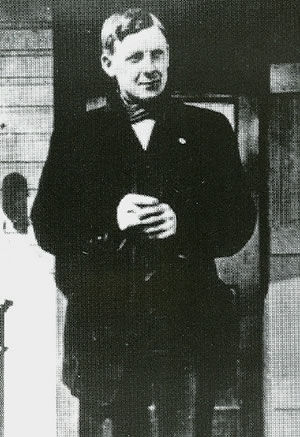
Ginger Goodwin the Trade Unionist
Albert Goodwin started working the coalmines at the age of 15 in Yorkshire, England. Though this may seem young to many, it was actually rather old to start work in those days. Ginger's parents kept him out of the coal mines long enough for him to learn to read and write. This must have been a great financial sacrifice, but it would help shape the rest of his life.
Little is known about Ginger Goodwin's life before he set sail for Canada, but it is almost certain that he was involved in the struggles of the time. According to one theory, he was blacklisted in Yorkshire and for that reason he moved to North America. The only thing that is really certain is that in August 1906 he stepped on to the SS Pretoria and set sail for a new life.
Ginger arrived in Halifax on September 2nd and found work in the coal mines around Glace Bay. In August of 1909 the United Mine Workers of America called a strike for better wages and working conditions. It was a bitter strike that lasted well into the next year. Ginger Goodwin was forced from his home at 471 New Aberdeen. This was company housing. It was a common tactic for the bosses to evict workers from company housing during strikes. The military was called in to help break the strike and scabs were brought in from far away towns. The Riot Act was invoked. The strike was eventually defeated. There were many arrests on a long list of charges including assault, obstructing police officers, preventing a man from going to work and calling a man a "scab".
Ginger headed West along with hundreds of other miners; blacklisted and broke they had no choice but to move on. Many found work in the coal mines at Crow's Nest Pass and Drumheller in Alberta. But in 1911 another strike called by the UMWA met the same fate.
Ginger Goodwin however, was already in Cumberland, British Columbia by that time. The coal mines of Cumberland were the most dangerous mines in the world. Even so, coal mining was one of the best jobs available. Ginger had to first work in the lumber camps around Comox Lake for a few months in order to save up enough money to bribe a manager. This was the only way to get work in Cumberland's mines.
In Cumberland Ginger Goodwin met Joe Naylor, a radical socialist and union organizer who would become his life long best friend. The Cumberland mines were organized by the United Mine Workers of America in 1911 and designated local 2299. Although this was one of the more bureaucratic unions at the time, Cumberland had a militant tradition. They only organized with the UMWA after the more radical Western Federation of Miners was banned following a failed strike in 1903 (William Lyon Mackenzie King called the WFM a "socialist conspiracy"). All of the activists in the union (including Ginger Goodwin) were members of chapter 70 of the Socialist Party of Canada. This set the stage for what is still known on Vancouver Island as "the Big Strike."
"It was way back in 19 and 12
-From the song, Are You from Bevan
Our gas committee was put on the shelf.
First we walked out, then we were locked out-
Then by a foul we were all but knocked out.
Our union miners faced guns and jail,
Hundreds of us were held without bail,
But by August 1914 our labor they were courting,
But they blacklisted me-"
The big strike started just as the song said. The UMWA called a "one day holiday to discuss working conditions". The meeting was a massive success with all of the mines shutting down. But the next day as they went to work they found themselves locked out and on September 15, 1912 the big strike began.
Ginger Goodwin did not lead this strike, but it is certain that he played an important role as an activist. Ginger was known as a capable public speaker and he certainly would have put his skills to use. The main leaders of the strike were Joe Naylor, John McAllister, William Greaves, James Smith, Peter McNiven, Barney Farmer, Oscar Mottishaw, Robert White and Chas Walker. At least that is according to the lawsuit filed by the company against the union activists for urging employees to break their individual contracts. The strike would rage on for two years and bring Vancouver Island to the brink of an all out class war.
The strike spread like wildfire. Within only a few weeks, every coalmine on Vancouver Island was shut down. The Industrial Workers of the World partially shut down the railroads in solidarity with the strikers, refusing to ship coal. The UMWA brought organizers from all over North America to help with the strike. Even Mother Jones herself addressed a crowd of striking workers at a rally. As the strike heated up there were a couple of attempted bombings, one at a railway bridge and the other at the entrance of a mine. Neither of the bombs detonated. Although the company blamed the strikers for these attempted bombings, it is more likely that they were staged provocations. The miners denied any involvement with the simple explanation that they worked with dynamite everyday and if they planted the bombs they wouldn't have been duds.
The strikers were immediately evicted from their homes. Nearly all of the houses in Cumberland were owned by the company, even the houses owned by workers were on rented company land. Those who would not leave willingly were forced out by company thugs. Many families tried to resist the evictions. The wives of the miners were particularly hard to deal with. The women of the town would surround the company's henchmen and poke at them with umbrellas. One woman refused to leave her seat and she was carried out, chair and all.
Strike breakers were brought from all over North America. The BC government sent in over 100 special police constables to "keep the peace". In reality they were mostly hooligans and thugs. The men patrolled the town on horseback armed with clubs and pistols. There were regular brawls between scabs and strikers and one instance known as the Cumberland riot saw hundreds of men clash in the streets. When the strike got out of control, the government sent the military into every mining town on the island. The Seaforth Highlanders, the Victoria Fusiliers and the Royal Canadian Artillery all occupied the island.
The Cumberland Riot took place on August 19, 1913 - already a year into the strike. Although the leadership of the strike was not involved, it was used as a pretext to arrest all of the union activists and hold them without bail. Even a sympathetic socialist MPP, Jack Place was arrested in Nanaimo.
At the time, Ginger wrote a letter of protest (designed more as an agitation piece) complaining "Strikers are given the maximum penalty while those who are helping the masters to defeat the strikers are let off with the minimum... Stop appealing and praying! Line up in the great world wide movement of socialism and use the concerted action of all workers to wrest from the master-class the means of wealth production."
Joe Naylor and the other leaders of the strike were held for four months, but the strike carried on. It wasn't until August 1914 that the strike was dealt a major blow. The United Mine Workers of America were growing tired of the dispute. They had already poured over one and a half million dollars into strike pay for the workers and their bank accounts were running low. But what came next was not expected by anyone.
The UMWA not only withdrew support for the strike, but they disbanded district 28 of the union. The entire Vancouver Island district (including Cumberland local 2299) was severed from the international union and from any further financial support. Though the union activists continued with their strike, without any support it withered. The strike was eventually completely cut across by the outbreak of WWI. The main union activists were blacklisted.
Most left Cumberland, but Joe Naylor stayed behind. Big Joe was a well known figure in the labour movement and knew he would not find work anywhere else. Joe Naylor went to the number four pit mine every morning to ask for work. Every morning he was told "No work for you today Joe, come back tomorrow". This lasted for years. Although Ginger Goodwin has been glorified as a labour martyr, the real hero of Cumberland was Joe Naylor. This outstanding comrade deserves much more attention than history has given him.
Ginger Goodwin the Socialist
"Wherever you go you see the same revolt implanted into the workingmen, and as this thing is gradually increasing why soon things will have to come to a climax.
If we study the condition of the workers it is only logical that this spirit of revolt is existing among them, for wherever we go we see the same miserable conditions and the same competition for jobs in order that they may live.
Now, then, we know that all this misery is the outcome of someone's carelessness, and that someone is the capitalists, those who own the machinery of production. Now, as this class of parasites have been living on the blood of the working class, they are responsible for the conditions existing at the present time.
... This tool-owning class are the masters of the situation, for in order for you to gain access to the means of life you have to go to an employer and sell yourself. Now, as you go to the boss and say ‘How are chances?' he will retort in this manner: ‘Come around in a few days and I might have a vacancy.' He means by this that you will have to wait until he can hire you and make a profit of you.
In order to throw this system over we have got to organize as a class and fight them as class against class.
And so I say we have got to back our forces against them, and our weapons are education, organization and agitation, and read and study up on the principles of Socialism, for it is necessary that you know when to strike and how to strike, and if we have not these weapons when the time comes, we shall not be able to predict the outcome of the fight.
All I know is this, that in every phase of society, whenever a change took place, it was the outcome of force which determined the winning side, so what we want is to educate you to your power, Mr Workingman, and when we realize it we have the power and the lever to overthrow the existing society."
- From Ginger Goodwin's article "The Iron Heel"
Goodwin emerged from the big strike as a veteran trade unionist, but in October 1914 he was hospitalized. Ginger was in the hospital for three weeks with what was probably an ulcer. He returned to the hospital in January with the "white plague". Goodwin, like many other miners, developed tuberculosis from the squalid conditions they were forced to live in during the strike.
Ginger Goodwin left Cumberland in the spring of 1915. He found work in Merritt's coal mines, then later in the year at Crow's Nest Pass near the town of Fernie. Though he kept working the mines, Ginger was also an organizer for the UMWA and the Socialist Party of Canada. He traveled around the region giving fiery speeches to groups of workers, barely paying his way by passing the hat at the meetings. He spoke tirelessly against the war in Europe and the working conditions at home, advocating the overthrow of capitalism.
He wrote for the Western Clarion, the paper of the Socialist Party of Canada. In a later letter to the SPC Ginger wrote:
"War is simply a part of the process of capitalism, and it needs money in the carrying out of the exchange of the commodities essential to its prosecution. The old saying that ‘you pay to learn' is evidently correct, whether it be with lives or with money. The Morgans, Rockefellers, Rotheschilds and other big financial interests are playing the game and it is they that will reap the victory, no matter how the war ends. It will be the law of the concentration of capital into fewer hands strangling the life out of the smaller capitalists in the process of creating a smaller number, but a more powerful master class, than before. Whether the capitalist system can survive this cataclysm remains to be seen. It is the hope of the writer that capitalism will fang itself to death, and out of its carcass spring the life of the new age with its blossoms of economic freedom, happiness and joy for the world's workers."
Ginger's passionate speeches and articles raised his public profile considerably. After moving to Trail in early 1916 to work as a smelterman, he was unanimously declared the candidate of the Socialist Party of Canada for the Ymir riding in the 1916 election. The socialists of Trail fought a hard campaign in a conservative stronghold. Goodwin traveled around the region organizing meetings and speaking to anyone who would listen. The bourgeois press slandered him ruthlessly. Even as far away as Victoria, the papers denounced Goodwin as a traitor. As expected the Conservative's James Schofield was re-elected. He won 558 votes out of a total of 1,275. Ginger came in third with 254 votes. This was a very strong showing for the Socialist Party of Canada. No socialist had ever received such strong support in this constituency.
In December of that year Ginger was elected secretary of the Trail Mill & Smeltermen's Union, Western Federation of Miners Local105. But before he could get into his new role, Ginger and others were off to the annual convention of the BC Federation of Labour. The convention had a strong anti-war mood. Joe Naylor was elected President of the BC Fed and Ginger Goodwin was elected Vice President for the West Kootenay region.
After several months of organizing and agitating in Trail, Goodwin had become a force to be reckoned with. Goodwin and his comrades were able to force concessions from the bosses with mere threats. The smelter had been garnishing the wages of its workers for the war effort; one simple letter hand delivered by Ginger Goodwin threatening a strike was enough to force them to stop. Instead, the bosses set up a voluntary donation account that was run through the bank, not the company, and promised no discrimination against workers who refused to contribute. But in November 1917 Ginger's latest demand would hit the company like a bomb shell.
The union demanded the eight hour day for all smelter workers. There was no room for maneuvering. Ginger delivered a twenty-four hour ultimatum. Either all the workers of the smelter would get the eight hour day, or they would all take the zero hour day. On November 10, 1917 1,500 smelter workers walked off the job under the leadership of Ginger Goodwin. The strike took on special significance during the war. The lead and zinc processed there was used to make arms for the war and the strike was being led by a high-profile anti-war activist. Goodwin not only called for an end to the war, but the overthrow of the capitalist system all together. The ruling class was planning to crush Ginger Goodwin.
The Assassination of Ginger Goodwin
On November 26, Ginger was called before the Trail exemption board. He had previously been declared unfit for military service due to his health problems. An ulcer, bad teeth and tuberculosis would normally be enough to get anyone out of the war, but Ginger was a special case. He was reclassified and declared fit for military service. Although he would launch a lengthy appeal process, this was the beginning of the end for Ginger Goodwin.
A mass meeting of over one thousand workers was held the next day. They loudly protested the persecution of Trail's most notorious socialist. An appeal was launched by the workers to have union leaders exempted from conscription. Their arguments were sound. They used the same reasoning that was used to exempt employers from conscription: they perform a valuable service to industry. But of course this appeal was flatly denied.
In early December the smelter workers sent an appeal to their international union for support. They were betrayed by their own international. With the US entry into the war, the leaders of the International Union of Mine Mill and Smelter Workers had taken a position in support of the war. They asked their members not to strike for the duration of the war so as not to hurt the war effort. This scandalous betrayal left the workers without strike pay. They heroically fought on, until December 20 when a mass meeting of workers faced the inevitable and voted to return to work.
The smelter workers lost 36 days wages without any strike pay. It was a terrible end to the first strike for the eight hour day in Canadian history. Union activists were blacklisted. Ginger wrote publicly about the blacklist:
"There is a number of men that will not be taken back by the appearance of things, men who had the conviction to fight for the cause of the eight-hour day and who at the time of writing have got it from good authority that they are not wanted any more at the smelter.
Those that are taken back have to sign a pledge to be of good behavior for the duration of the war (Why not life?)..."
Ginger focused on his appeal process. In his final appeal Ginger gave up arguing on health matters and focused his appeal on agitation. He argued that no officials of labour should be taken to war; they were needed at home for benefit of the population. He signed his letter, "Fraternally for Socialism, Albert Goodwin". It was finally decided on April 15, and his appeal was rejected.
Ginger failed to report for duty in Victoria. Knowing that sending a man with tuberculosis to the trenches was as good as a death sentence, Ginger went underground. He fled back to Cumberland where a network of supporters kept him supplied. He hid out at the far side of Comox Lake on the banks of the Cruikshanks River along with a few other men resisting conscription. Albert "Ginger" Goodwin was shot dead on the banks of one of his favorite trout streams where he had spent so many days fishing with his friend and comrade Joe Naylor. These so called police constables left Ginger's body on the forest floor to rot. It wasn't until July 30 that his friends were able to find Ginger Goodwin's body and bring it back for burial.
Dan Campbell claimed that he fired in self defense, but this "official" story is now believed by no one. Joe Naylor oversaw the autopsy of his best friend. The coroner's report showed that the bullet passed first through Ginger's wrist, then into his neck. It was clear from the angle of the wounds, that Ginger's hands were raised in the air in surrender when he was shot. Dan Campbell literally got away with murder. He was never punished.
Goodwin's funeral procession in Cumberland stretched for over a mile. Thousands came out to bid farewell to their fallen comrade. In Vancouver a general strike was called in protest of the murder. On August 2nd 1918, thousands of workers in Vancouver and across Vancouver Island downed tools in Canada's first General Strike.
The Second Assassination of Ginger Goodwin
There is much debate over the life and death of Ginger Goodwin. The reformist wing of the labour movement has attempted to paint Ginger Goodwin as a pacifist and a reformist. We believe that this amounts to nothing less than a second assassination. There is an old saying in the labour movement, "You cannot kill an idea". But this is precisely what is being attempted. The quotes already listed above are more than enough to show Ginger's commitment to the revolutionary transformation of society and the overthrow of the capitalist system.
Of particular note is the new children's novel "Red Goodwin", a historical fiction by John Wilson. In the opening pages of the book it reads
"Lest we forget - Ginger Goodwin - Shot July 26 - 1918 - A workers friend. Apart the missing apostrophe, there are two mistakes on the headstone. The hammer and sickle shouldn't be there. The man who lies below the symbol wasn't a communist - there wasn't even a communist party in Canada when he lived. It was added when the gravestone was erected in the thirties and the communists were looking for heroes. The date is wrong too. Ginger wasn't shot on July 26. It was July 27, another Saturday."
Although John Wilson is right about the error in the date and the fact that the gravestone wasn't erected until the thirties, it is undeniable that Ginger Goodwin was in fact a communist. His whole life was a whirlwind of organizing, writing and speaking for the overthrow of the capitalist system. True, there was no communist party in Canada at the time. It was founded in May 1921 mainly by members of the Socialist Party of Canada (which Ginger ran as a candidate for), the One Big Union, the Socialist Labour Party and the Industrial Workers of the World. The formation of the Communist Party wasn't the beginning of communism in Canada; it was simply the first time the communist movement achieved a truly national unified organization.
It is certainly true that the Communist Party of Canada was searching for heroes in the 1930's when it erected the headstone on Ginger's grave. But this was only after the Stalinists had consolidated control over the CP. Ginger Goodwin's life was a model of the real fighters for socialism. Those heroes of the labour movement who built the early trade unions in BC's coal mines, organized under the banner of the Socialist Party of Canada, formed the Communist Party of Canada and fought against the Stalinists for the dignity of the Russian Revolution. Ginger didn't live to see the formation of the CP, or its deformation, but we think it is very clear where he stood.
An article by Ginger Goodwin in the November 22, 1913 edition of the Western Clarion read
"The time for revolution is rotten ripe, but the mind of the vast majority is not ready and the struggle takes on the form of an intellectual one for the possession of the mind of the working class.
The forces that make for this struggle are represented for the capitalist class by the institutions of the pulpit, press, army and navy, YMCAs and so forth. The proletarians have at their disposal the teachings of Socialism, the materialist conception of history..."
The words of Ginger Goodwin make it perfectly clear where he stood. Ginger was a revolutionary Marxist organizer. We take it upon ourselves to rescue the name of Albert "Ginger" Goodwin. The comrades of Fightback and the International Marxist Tendency will fight for the real history of this outstanding comrade. The best monument we can build to Ginger Goodwin is to achieve his dream: to "line up in the great world wide movement of socialism and use the concerted action of all workers to wrest from the master-class the means of wealth production."
See also:
- Marxist.com at Canadian Miner's Memorial Day (July 26, 2006)