

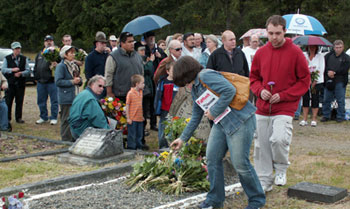
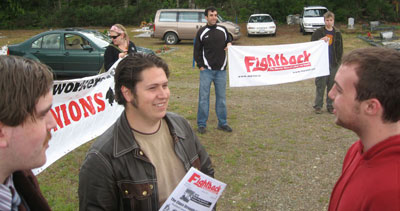
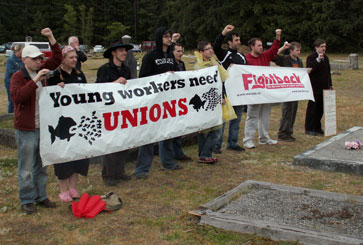
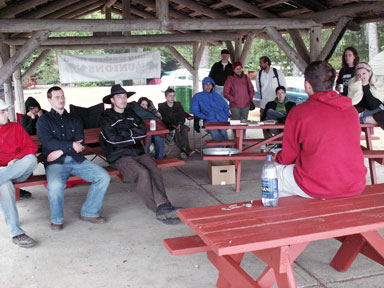
 Once again, Fightback has made a splash at the Miners' Memorial Day weekend in Cumberland, British Columbia. Despite constant drizzle and the occasional downpour, this year's events were well-attended, with up to thirty sisters and brothers attending Fightback's workshops: "Rank and File Organizing" and "Women in the Labour Movement" led off by Brent MacVicar and Miriam Martin respectively.
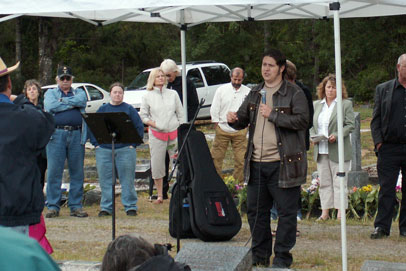
The ceremony itself attracted trade unionists from all around BC, with two American comrades from Portland, Oregon receiving special mention. Mike Palecek spoke at the ceremony on behalf of Fightback, defending Ginger Goodwin's outspoken revolutionary socialism, which is constantly under attack by historical revisionists who would like to limit his legacy to pacifism. Flowers were laid on Ginger's grave in the name of Fightback and the IMT, and the ceremony ended with the singing of the Internationale. Fast becoming known as "the youth contingent" and "the Marxists" at Miners' Memorial Day, we received special mention from the MC this year, who stated that the presence of militant youth gives hope for the future, ensuring that the struggle will not be forgotten or forsaken.
Ginger Goodwin
 Cumberland, BC is a lively little town about an hour north of Nanaimo on Vancouver Island. They may have some of the friendliest people and a cute false-fronted Main Street, but it is the rich labour history that draws a crowd of visitors each year in late June. From the late 1800s to the 1960s, Cumberland was home to some of the deadliest coal mines in the world.
 The Cumberland coal mines, like most of Vancouver Island at the time, were owned by the Dunsmuir family - responsible for more than three hundred deaths in Cumberland alone, and after whom countless BC streets, parks, bridges, and schools are still named. But in the early years of the twentieth century, working people all over the western world were beginning to lift their heads, organizing unions locally and fighting for socialism globally. Cumberland was no exception.
Albert Goodwin came to Canada in 1906 at the age of nineteen, after having worked for four years already in the Yorkshire coal mines in England. A small man, called "Ginger" on account of his red hair, Goodwin would become an outspoken trade union activist, leading several militant strikes - in Cape Breton in 1909, Cumberland in 1912-14 and in Trail, BC in 1917.
 The Big Strike in Cumberland began as a "one day holiday to discuss working conditions", but became a two-year battle that shut down every coal mine on Vancouver Island. Having stood up to eviction from their homes, the arrest of the leadership, scabs from across North America, one hundred armed special constables, and finally a military occupation of every mining town on the island, the strikers were finally sold out by their union. The United Mine Workers of America, having spent one and a half million dollars on strike pay not only withdrew support but disbanded the entire Vancouver Island district of the union, severing the Cumberland local from their financial support. The strike withered and was eventually cut across by World War I. The leaders, including Ginger Goodwin, were blacklisted.
Having been hospitalized in October 1914 with tuberculosis, Goodwin's health was rapidly deteriorating, but he continued organizing for the UMWA and the Socialist Party of Canada. He traveled around giving fiery speeches to workers, explaining that the only way to end the bosses' war in Europe and improve working conditions at home was with the overthrow of capitalism.
 In November 1917, now secretary of the Trail Mill & Smeltermen's Union and West Kootenay region Vice President of the BC Federation of Labour, Ginger Goodwin would lead one last strike, this time for the eight hour day. 1500 smelter workers walked off the job - an especially big blow to capitalism during the war, as the lead and zinc processed at the Trail smelter were used to make arms for the war. Meanwhile, Ginger had become a well-known and high profile anti-war activist. In the eyes of Canadian capital, he was going too far.
Having been declared unfit for military service due to his health problems, Goodwin was reclassified and declared fit to serve. Worse, at this time, the International Union of Mine Mill and Smelter Workers had taken a position in support of the war and had asked their members not to strike for its duration. While the workers fought on, this betrayal left them without strike pay and after thirty-six days, they voted to go back to work. This was Canada's first strike for the eight-hour day, defeated and resulting again in the blacklisting of its leadership.
Ginger Goodwin failed to report for military duty in the spring of 1918, knowing that serving in the trenches was a death sentence. He went underground, back to Cumberland, hiding out at the far side of Comox Lake. There he was shot on July 27th, at close range by special constable Dan Campbell, who claimed to be shooting in self-defense, despite the fact that the bullet had clearly passed through Goodwin's wrist before entering his neck, indicating that his hands had been raised in surrender.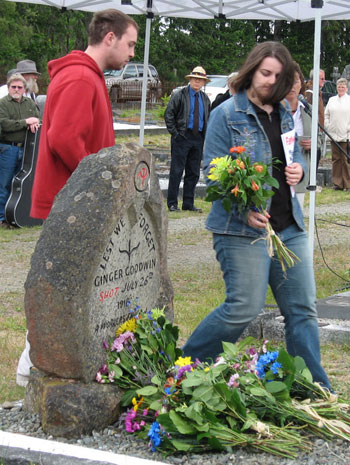
On August 2nd, in response to Ginger's assassination, thousands of workers downed their tools in Vancouver and across Vancouver Island. This was Canada's first General Strike.
For the complete story of Ginger Goodwin, read Mike Palecek's article Ginger Goodwin: Canadian labour martyr.
Today, we remember the traditions of Ginger Goodwin and all of the comrades who have fought for better working conditions and a better world. But we must not stop at remembrance, as the fight not only continues but becomes more and more urgent. In September 2001, the BC Ministry of Transportation removed signs from the stretch of highway named "Ginger Goodwin Way" - a petty move, but no surprise coming from a government elected to crush British Columbia's strong labour movement.
Instead of breaking the backs of labour Thatcher-style, the Campbell government has succeeded only in creating a new layer of militant workers, steeled in wildcat strike action and defying back-to-work legislation. These are the workers that will decide the future of British Columbia!
For more on BC and Canadian political perspectives, visit www.marxist.ca.