
Fifteen years ago on November 9th 1989, the Berlin Wall fell. Within a year East and West Germany were reunited. But unification was carried out on a capitalist basis. Thus it was a counterrevolution. But the movement in the East did not start with that aim in mind, far from it! The early movement had many elements of the political revolution, i.e. a movement against the bureaucracy and for genuine socialism. Unfortunately due to lack of leadership, in the end counterrevolution prevailed. Here we provide an analysis and also material produced by the Marxists in East Germany at the time.
The impression promoted in the mainstream German media, by the dominant political parties and the employers’ organisations is that Germany is ‘bankrupt’, on its knees, in need of profound structural reform. This, they argue, is due to worldwide competition and the huge costs of unification. Thus the Labour market and welfare state needs urgent reform, by which is meant attacks on the rights and living standards of the working classes and the poor.
The incredible benefits German Capital gained from annexing East Germany and the opening of the eastern markets are barely mentioned and are well concealed. It is true that the West German state transferred cash to Eastern Germany, perhaps one trillion DM in the first ten years. How much of this went to provide huge subsidies to sharks and swindlers and profiteers of all kinds? How much went on administrative and managerial staff? How much on consultants and advisors? How many assets now belong to West Germans and West German capitalists which before were public property? Some 80% of investments and transfers to the East were state finances paid mostly by taxes on West German and East German workers. Any capital saved was returned into the coffers of West German banks. The state assisted the establishment of a market economy by legalising robbery!
Erich, a business management student, says, “capitalism doesn’t mean everything runs smoothly. Rather, it means doing business. And the period 1989 to 1992-3 was a time for deal makers who wanted to make a lot of money fairly quickly. And very few were East Germans. They were primarily West Germans who enriched themselves at the expense of third parties – company bankruptcies and falsified bankruptcies and loan sharks. Cars were sold to people who signed instalment contracts, where after half a year, they had to give their car back or had to mortgage their little house (to keep up repayments). That’s capitalism.” (Charlotte Kahn, Ten Years of German Unification, p.31)
In the German Democratic Republic (GDR) all the factories were called “People’s Own Factory,” they were the property of the collective, of the people, made during the 40 years of the GDR. What happened to the people’s factories? They were handed to a newly created government agency, the “Treuhand”, whose sole objective was privatisation.
A former school teacher, Helga reflects popular opinion when she says: “I think the CDU representatives in the government have brutally destroyed the economy in the east. That was such a shameful, dishonourable little war that the CDU waged here, but I am not sure that under similar circumstances the SPD would have acted differently. When I have conversations with my friends in Frankfurt about the dismantling of the factories, I’m no longer quiet and let them talk. I tell them that an outrageous, scandalous wrong was perpetrated here. (Ten Years of German Unification, p.173)
By 1992, two million claims for pre-war property rights were asserted, and by some calculations West Germans and foreigners now own as much as 97% of all assets in the East. (Source BBC http://news.bbc.co.uk/1/hi/world/europe/890496.stm ). The housing stock was almost entirely handed over to private hands, with no consultation with the people.
Horst from East Berlin recalls:
“Almost all real property that anyone could have acquired by honest means in the GDR – land and houses... was declared null and void – forty years of the GDR were simply annulled and ‘return before compensation’ became law. Perhaps Americans understand this. It’s as if you were suddenly to restore all rights to American Indians, so that Chief Black Panther comes along and says: well this place is my tribal territory; my ancestors hunted here for 500 hundred years, and now it is mine again, so pay up. What would happen to all the cities and houses there?”
“After the Wende (change) I nearly lost (my) house, because a former owner, a woman from Argentina, showed up and immediately filed an application to get the house back. She came from the same city where Mengele used to live and is the daughter of the former owner, the man who built the house, a man who worked at Auschwitz. He never came back here after 1945. He knew what would have been in store for him...” (Ten Years of German Unification, p.36)
Though it is called the reunification of Germany in fact the precise definition is the annexation and expropriation of the people of the GDR by West German Capital. Erich, a small businessman from West Germany, says, “It was great. I was terribly happy about reunification. It happened a little too quickly, but it was a historically unique opportunity, and no one knows whether it would have worked later on. It was consensual rape. By definition, it was not rape. That’s the point. There was a democratic election, and it was possible to be thoroughly informed about events. But democracy required openness, a grasp of the situation and reflection. They didn’t have that there; they hadn’t learnt it. Socialism collapsed.” (Ten Years of German Unification, p.26)
Currency Union
On July 1st 1990 all the shops in East Germany were emptied of all the goods on the shelves, in came some 30bn DM to change East German currency for West German currency. The black market rate of exchange had swung wildly between 1:20 (W-E Marks) and 1:3 during the previous 9 months. The final exchange rate, set at 1:1 for savings below 4000DM, was aimed at the overwhelming majority of the population who had no savings to speak of. For those with more than 4000DM the exchange rate was 1:2 and for companies it was also 1:2.
As the sirens of armoured vans carrying the West Mark rang out on July 1st, most people were oblivious to the full impact of the penetration by the West Mark. Many pensioners had their savings halved and companies were unable to meet their wage obligations and at the same time unable to sell their goods. From a society with zero unemployment it rose to 30 per cent of the workforce in one year. Some 40% of East German exports were to East European countries, this trade immediately collapsed, dramatically sharpening the economic crisis in these countries. Lorries full of the goods that West German capitalists were unable to sell in the West filled the shelves in the East. There was enough readily available surplus in West Germany to meet the demands of 17 million people immediately!
“Perhaps it (unification) was an occupation after all. I have spoken with West German jurists about this subject, and one very high-ranking official from the state chancellery of one of the (West German) states told me: You know, all my professional life I thought about how things should be settled legally if reunification were ever really to come about. I thought of so many different variations; the only one I never thought of was the one that was actually implemented: Anschluss, Annexation.”, says Horst, a Ph.D in economics (Ten Years of German Unification , p.28)
A medium sized army of West German state bureaucrats, managers and supervisors of every type winged their way eastwards. They “always knew better” than the East Germans how things were to be done! And of course this game did not have to stop at the Oder Neisse boundary (the Polish border). Although this was sacrosanct, the eternally industrious German capitalists’ eyes scoured throughout the former iron curtain lands in search of bargains. If you take a trip through Eastern Europe now, German capital is visible everywhere, the lorries that pass, the goods they are carrying, the piles of bricks and building materials by the rail tracks, the houses for sale advertised in German, the supermarkets, the banks. A recent article in the weekly Die Zeit summarised the process like this: the masses wanted free movement to the west, capital wanted free movement to the east. Capital eventually reached freedom in the Far East; in Vietnam foreign companies pay an average of $0.6 US a day, and in South East Europe where in Romania average net wages are 150 Euros a month.
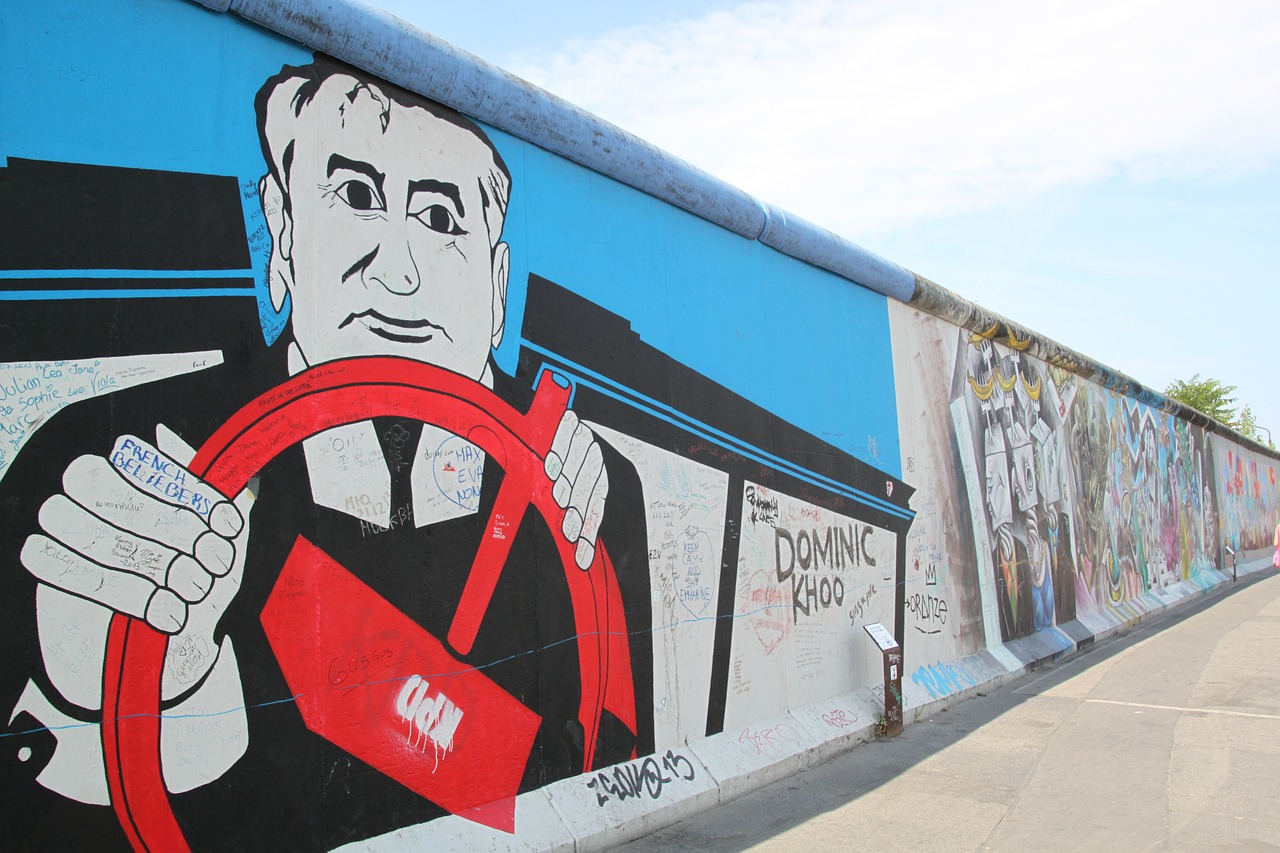
In the 15 years since the East German revolution began the broad sweep of ‘anti-communism’ most of the visual landmarks of the former era have been swept aside. In East Berlin, Lenin Allee was renamed Landsberger Allee, Karl Marx platz is now Hackisher Markt... The erasure is intended to normalise the society, to clear the memory of any ‘socialist’ or ‘Marxist’ scars, in case physical reminders jolt the collective mind into questioning how we got to the present. Just recently an artist who decided to rebuild part of the Berlin Wall, almost every meter of which has been removed, caused outrage in some quarters for suggesting that she won’t take her work down. Amusingly a recent poll in Stern magazine indicated that around 12% of East Germans and 24% of West Germans want the Berlin Wall back!
Nowadays the woman who is seen to beg to go through the Brandenburg gate on ‘the day the Wall fell’ is presented as the symbol of the revolution, which, it is claimed, was in fact not a revolution but a mass movement for German Unification. The real facts of history tell us something quite different. German reunification was barely even in discussion before 9th November 1989. No political organisation had raised this as a slogan, demand or objective.
The clamour for reunification started on one demonstration just after the wall was opened in November 1989. One banner read “If the Deutschmark doesn’t come to us... we will go to the Deutschmark!” Some simpleton had perfectly coined the ideal slogan of the counterrevolution. Of course ‘the mob’ had to be pacified and as they wanted democracy Chancellor Kohl figured that if he combined this desire for hard currency with East German elections and with nationalist appeals for reunification, the revolution could be steered into a counterrevolution, and a means of annexing East Germany. In this he succeeded at enormous cost to the East and West German working class.
Before the opening of the Berlin Wall the majority of East Germans wanted a new form of socialism. In fact even today the overwhelming majority of East Germans have a socialist consciousness as is indicated in official polls on the attitude of the masses to socialism over the last decade. The following comes from the report on the Poll conducted by the Centre for Political Education for the German Government:
“Attitude to Socialism
One of the reasons for the critical standpoint of the citizens of the New Federal Lands in relation to democracy in the United Germany is, that many prefer another model of democracy to that which is realised in Germany. Their preferred model can be described as a Socialist Democracy. It unifies the central concept of a Liberal Democracy such as guaranteed freedoms and competitive elections with a pronounced concept of social equality and security and direct participation by the citizens.
Those who indicated they agree with the following statement
‘Socialism is basically a good idea which was badly implemented'
| East | West | |
| 1991 | 76 | 40 |
| 1992 | 76 | 43 |
| 1994 | 81 | 44 |
| 1998 | 76 | 43 |
| 2000 | 76 | 51 |
(p.4 http://www.destatis.de/download/d/datenreport/2_20gesch.pdf Poll conducted by the German Centre for Political Education for the State Bureau of Statistics)”
At the start of October 1989 the main fear of the bureaucracy and of western leaders was that the revolution was radicalising, that the bureaucracy would face a revolt like that in Hungary in 1956, in which neither the Stalinists nor the capitalists could control the situation and mass democratic organs of the popular revolt might assume control over society.
On October 9th in Leipzig ‘the Chinese solution,’ the violent suppression of revolt, was ordered by Honecker, who said “there is a fundamental lesson to learn from the crushing of the counterrevolutionaries in Beijing in June.”
According to the Taz newspaper, preparation by Workplace Fighting Groups, Soldiers, Tanks and Soviet forces around Leipzig was observed, behind the railway station military forces were handed 18 rounds each and told, “when something happens, fire your magazine empty.”
Sections of the Workplace Fighting Groups from the Essener Street group refused to be involved.
Conscripts in the Peoples’ Police from the 5th Leipzig group were interviewed by Andreas Voigt:
“How were you motivated or prepared for the mission?
Before each mission we had to take part in a lesson and the correct line was laid down. Especially after the 2nd October other units from this and other districts were again specially spoken to in the sense, that finally the demonstrations had to be brought to an end and that a clean up was needed. They were being whipped up.
On the 7th October Aktuelle Kamera (GDR TV) wanted to film. In connection with the 9th, where ‘this finally had to be brought to an end,’ as they said. A report was to be prepared and be broadcast on Aktuelle Kamera. The TV did turn up and put cameras in place.
To us was said concretely on Monday morning on the 9th., today the demonstrators haven’t got a chance, today we have enough forces, today we have enough technology, today we will bring this spit-flem to an end.
...the whole thing was to take place at the railway station. But because of the large numbers of people, the plan fell into the water, that’s how I see it. It was a decision taken there and then. We all had terrible fear, and were mighty relieved, that the matter passed by so quietly and without any intervention on our part.” (October 1989, Wider den schlaff der Vernunft, p.77)
Gorbachev recalls the words of Chancellor Kohl when he spoke with him by phone on October 11th 1989:
Kohl: “I would like to assure you that the Federal Republic is in no way interested in a destabilisation of the GDR and wishes you nothing bad. We hope that the development there does not get out of control, that the emotions of recent times wane. The only thing we want is that the GDR adopts your course, the course of progressive reforms and renovation. The events of the recent time show, that the GDR is ready for this. As regards the people of the GDR we want them to remain in the country.” (Gorbachev, Die Deutsche Wiedervereinigung, p.87)
In these circumstances the East German Marxists issued their first programmatic statement, which we republish here for the first time in English.
Marxists for the Republic of Councils (Rate Republic)
Down with bureaucratic rule. For a Republic of Councils.
A wave of demonstrations and protests is flooding through the GDR. An international crisis of bureaucratic rule is shaking the world – from Budapest to Beijing, from Warsaw to Vorkuta. This explosive situation shows that the Stalinist system can no longer rule in the old way. In the face of a wide protest movement which is gripping ever greater parts of the population, the bureaucratic layers swing from reform to military rule, from centralisation to decentralisation in order to preserve the power and privileges of the bureaucracy as a whole.
The mass demonstrations and meetings of the last weeks show that we are no longer willing to tolerate the ruling system or allow ourselves to be silenced. Through pressure from below, in a mass movement for democracy, the rulers have been forced to accept the first democratic rights and to grant concessions, which until recently would have been unthinkable. These ‘reforms’ and the changing of personnel are presented as ‘Change’ which supposedly was brought about as a result of discussions within the SED leadership, put in place ‘from above’.
It is obvious that the bureaucracy is no longer able to rule in the old way and that the workers on their part are no longer willing to be ruled.
The background to the present crisis of bureaucratic rule is the economic stagnation and the inability to further develop the economy. The gap between the most developed capitalist countries and the so-called socialist countries is constantly increasing instead of getting less, even though the planned economy provides all the preconditions for rapidly escalating productivity.
When the economy was focused on the construction of heavy industry, the bureaucracy acted as a relative fetter on economic and social development, but with the development of advanced technology, the concentration on highly complex products and consumer goods, bureaucratic rule has become an absolute hindrance to societal development, that must be overcome. It is leading to stagnation in all areas of economic, cultural and social life.
Democratic control of the economy is needed, bureaucratic methods in which arbitrary and extremely subjective decisions are typical, cannot possibly carry out and achieve the necessary development.
This is a contribution by Marxists in the Opposition, a programme for revolutionary change. Our aim is to spread our ideas to the workers and youth, who are the main force which can carry through the revolution.
What is socialism?
Officially, it is claimed, countries like the GDR have already realised socialism. It is true that capitalism and landlordism have been expropriated, it is also true that there is a planned economy and state ownership is the dominant means of production, in other words the necessary preconditions for socialism. That alone does not make socialism.
Marx explained that socialism is the social form which surpasses the highest developed capitalism and thereby has a higher level of labour productivity and organisation. The decisive precondition for this is that the whole people exercise control over the production and distribution of goods.
Without such democratic administration of the planned economy, that means the self-management of the producers and consumers, the development of the productive power needed for socialism is impossible. That is why socialism means complete democracy, general self-management, which means that truly all can participate in the leadership of the state.
In so far as all members of society take into their hands the state and government, the need for rulers at all begins to disappear. The state withers away. In socialism all repressive functions of the state can immediately die away, as there are no privileges or claims to power to defend. Through the reduction in working time and the incorporation of all in the administrative and directive functions a gradual transfer to societal self-administration is possible.
How do things look here? The state always blows itself up more. A huge administrative apparatus, innumerable functionaries and state officials of every kind and a developed police and Stasi-network controls the society. The bureaucracy has seized unto itself the control over the economy, over production and distribution. It administers state property which is supposed to be peoples’ property.
The ruling bureaucracy is a social layer, raised above the rest of the society, which acts according to its interests to defend its power and privileges.
Lenin emphasised the need to fight against bureaucratism and privileges and to sweep aside bureaucratic growths and place-seeking, and to go over to real participation of the workers in the administration of the state. But the isolation of the Russian revolution led to a parasitical bureaucratic caste with Joseph Stalin as its leader. This counterrevolutionary caste eliminated not only the democratic rights fought for in the revolution. They also murdered the majority of genuine Marxists, including almost the entire Bolshevik Central Committee of 1917 and millions of other oppositionists. They repressed all independent thought and made the falsification of history into a general method.
Stalinism is not individual rule or personality cult, but is bureaucratic rule by innumerable privileged functionaries, who consume a huge proportion of production.
They will not freely give up their authority or power-privileges, so also with their material advantages, comforts and privileges. The bureaucracy will not dissolve itself. A political revolution is necessary in order to return to the ideas of Marx, Engels, Lenin and Luxemburg, to a real workers’ democracy.
Without deep reaching structural change the experience of the past years and decades will be repeated, as personnel were changed around, particular phrases which we hear again today, were already pronounced in 1953, 1956. We must create completely new state structures, which are from the ground up democratically legitimised. The power of the bureaucracy must be replaced by control ‘from below’, through general self-determination. That means, in the place of the old state apparatus a new one must be seated, namely organs of workers’ democracy.
From the experience of the Paris Commune Marx and Lenin drew the following conclusions, that four conditions are necessary so that a workers’ democracy can be built and the emergence of a privileged bureaucracy can be prevented.
- Election and the immediate right of recall for all functionaries and leaders.
- Limitation of wages of all functionaries to that of the average workers’ wage.
- Rotation of duties and the gradual incorporation of all in the leadership of the economy and state.
- No standing army but an armed people.
For a Democratically Planned Economy
It is impossible to manage a developed industrial society from above. A command economy, in which the decisions are made by decided and enforced by bureaucratic dictat, where if one asks as to the purpose of economic measures one receives the reply: it has been decided by the Politburo, must inevitably lead to misplanning, economic mistakes, wastage and corruption. Control over the efficiency of production in a planned economy can only possibly come from the producers themselves, in that the workers democratically control the economic processes.
Every worker in any factory can give hundreds of examples of completely purposeless bureaucratic decisions. It begins with the purchase of completely inappropriate machinery for vast sums of foreign currency. The worker, who through his work experience knows best which machine would be most rational, is not even asked his opinion, even though he must thereupon work on this machine. It goes on with the universally known set up when the regional leaders pay a visit, in order to present the desired image to the ‘high guest’: everything is cleaned, people are searched out, who can be sat in front of the guest, ‘by chance’ working according to protocol. In the shops for example all checkout tills are staffed, all displays and signs written anew and so on, and it continues to the point where the activation of a hospital department with pretend patients is acted out, in order to convince the guest that the targets have been met. And it leads to the presentation and introduction of robots, and even the instruction to produce parts and components for these robots costing millions of marks, even though from the start it was clear that its control systems don’t work, and its development has not been completed, all this so as to improve the statistics and conceal wrong decisions.
Initiative from below poses a danger for bureaucratic rule, which therefore blocks independent thought and creativity, as soon as the fixed parameters determined from above are overstepped (for example the defamation of ecological groups as ‘anti-socialist’). Firstly, in a democratically planned economy can the true talents and capabilities of the workers in industry and agriculture, the scientists, technicians and cultural creators be released.
The abolition of the bureaucratic caste would already in itself mean a tremendous saving. For example, the release of resources for all. Expensive luxury cars, houses with seven or 12 rooms for two or three people, special shops and department store floors for functionaries, officers and state officials are not needed. The many people employed to protect hunting reserves and castles, lakes, nature reserves and islands for health and recuperation reserved for the highest functionaries, can do productive work. The areas themselves, as with the special clubs, health spas, and so on, can be made accessible to the whole people. Alone the dismantling of the state-security apparatus can release enormous sums. Not only Aurich and such functionaries could spend their holidays in Italy and other countries. Why is the most modern equipment in government hospitals not available for use for all? The list continues endlessly...
Against Capitalist Elements
Bureaucratic rule has led to chaos in the planned economy. In Poland, Hungary and the Soviet Union a catastrophic situation has come into being, the living standards fall, the supply of goods worsens, conflicts between the nationalities break out, and criminality grows. The GDR, through bureaucratic mismanagement of the economy has also been brought to the edge of economic crisis.
In this situation a split inside the bureaucracy comes about. In order to find a way out of the crisis, a section of the bureaucracy attempts to bring in capitalist elements, some even seek capitalist restoration.
In China, Hungary, Poland, Yugoslavia and the Soviet Union the bureaucracy has sought to introduce a mixture of elements of capitalist economy and planned economy. This in every case has led to catastrophe, to the combination of the worst of both worlds. Factory closures, unemployment and inflation, and at the same time a shortage of goods, corruption, and bureaucratic mismanagement, have led to an anarchistic development of the economy.
In China, where this process has gone furthest, the masses rose up in a powerful movement in May-June of this year, in order to end corruption and the dictatorship of the bureaucracy.
The crushing of the democracy movement through the massacre in Tiananmen Square has shown that the bureaucracy cannot tolerate democratic development for long, as this inevitably brings into question the rule of this caste.
As distinct from capitalists in the capitalist system the bureaucracy plays no role in the production process. The capitalists play a role in so far as they invest capital to extract profits. This profit system checks what is produced for the market. Under bourgeois democracy the existence of certain democratic rights, which the workers’ movement has won (like the right to assemble, demonstrate, and strike), do not automatically bring into question the existence of the capitalist class. However, the riches, power and privilege of the bureaucracy are not necessary conditions for the existence of a planned economy. On the contrary, they are the greatest fetter to further development.
It is perfectly possible that under the pressure of the mass movement the ruling layer will decide to allow ‘free elections’. They could for example dissolve the National Front, allow more parties and organisations to legally operate, and allow that several candidates compete in elections. But that does not by a long way mean that the bureaucracy will give up its power. As long as the state apparatus is in the hands of this bureaucratic layer, they can secure their rule.
According to Marx, Engels and Lenin the state in the final analysis may be characterised as ‘special bodies of armed men’. That means: the military, police and enforcement structures of all sorts, for example, prisons and the judicial system attached to them. Who controls these structures controls the state. And it is exactly these structures which by all such changes, whether in Poland or in Hungary, remain firmly in the hands of the Stalinist bureaucracy, who would use all means to maintain their power.
No devil will ever freely cut its own claws off. The bureaucracy will not give up its position without a struggle. The development clearly leads to the path of revolution.
The workers have no fatherland
Under bureaucratic rule every attempt to coordinate the national economic plans has failed. The national bureaucracies are incapable of integrating the planned economies, since they place their own interests above international planning. Instead of the exchange of quality and highly developed products and to specialisation in economic development came the selling out of the ‘brother country’ for hard currency by the national bureaucrats. If in Eastern Europe, the Soviet Union and China, there had been in existence a plan for an international division of labour under true workers’ control, it would have easily been possible to overtake the productivity and productive capacity of the capitalist world. It is a crime that the Comecon countries are even less integrated than the European Union.
Under workers’ control it would easily be possible to increase productivity by 10% a year, at the same time as reducing the working week, initially to 35 hours. New machines must replace the old and elected workers’ representatives must replan the economy. Directly elected workers’ councils must take over the control of production. The national planning of the economy must be on the basis of the union of elected workers’ councils in every factory, in each district and on a regional basis.
A government of councils in the GDR cannot exist as an isolated experiment. The working class both in the east and the west would have to support us through the building of direct contact between factories and organisations, through the working out of practical economic plans for unified cooperation. Our example must act as a catalyst for the workers in Eastern Europe, the Soviet Union and China, as to how they can abolish their system of bureaucratic rule.
Such a democracy of councils in the GDR would also create an explosive situation in West Berlin, the FGR [West Germany], and all Western Europe. The workers in the west would come together to support their brothers and sisters. The question of control and ownership of the means of production will arise. The creation of a workers’ democracy in the GDR would lay the basis for an all German democracy of workers’ councils, as part of a United States of European Workers’ Democracies.
We the Marxists for a republic of workers’ councils propose the following programme for discussion:
- A free press, access to the media for all;
- the right of assembly for all political, cultural and social groups and parties with the exception of neo-nazis; no special rights for any individual or party;
- the immediate release of all political prisoners, no discrimination on their release;
- the right of all parties, groups and individuals, to stand as candidates-except for neo-nazis;
- the immediate building of independent organisations in the factories, universities and communities;
- for a government of workers’ representatives;
- the right to free and unhindered political activity – the right to assemble, demonstrate and strike;
- the right to genuine free, democratic unions independent of the state which really represent the workers;
- the abolition of all privileges! No functionary to earn more than the average wage of a skilled worker;
- free and direct elections once yearly; not only election but also the right of immediate recall of all representatives and functionaries;
- the right for soldiers and police to refuse to be used against demonstrators;
- democratic rights, the right for political and union organisations in the army and police;
- the continued payment of full wages during military service;
- the reduction of basic military training to 6 months;
- abolition of privileges for officers – for the right of election and recall of officers;
- the abolition of special units, put the Stasi to work on the production line!
- for the construction of genuine workers’ militias under the control of factory councils;
- the immediate introduction of a 35hour week and then a 30hour week;
- lengthen the annual holidays and reduce the age of retirement;
- the use of a part of working time for the education and training of all in management and administration as preparation for the rotation in the exercise of functions of the state;
- a minimum wage and pension of 1000DM;
- publish the facts and statistics about all areas of the economy and ecology as a necessary prerequisite for workers’ control;
- new redrawing of the planned economy according to the needs of the producers and consumers, whilst taking ecological protection into account;
- the creation of elected workers’ councils who take control over production;
- regional and national unification of these councils through elected representation bodies, in order to work out and implement a plan for the economic, social and political development of the country;
- All power to the People! For a democracy of workers councils!
---
Nationalism and German Reunification
Shortly after the opening of the wall the revolution began to divide. The demonstrations in Leipzig were an excellent barometer of the tendencies prevailing and the battle for the minds of the masses. The absence of protest movements of any significance from 1953 until 1989, meant the phase of being against Stalinism and in favour of discussion and democracy, created a tremendous sense of unity from September until November 1989, which rapidly turned into a more furious and divided internal conflict. The demonstration in Leipzig would meet at Karl Marx platz and march around the central ring road. For many weeks half the population would be out on the marches, come whatever weather. One night the demonstration began to split, physically split in half, those on the left of the march and those on the right chanted to each other, ‘Germany One Fatherland’ from one side, ‘the Internationale’ from the other.
At the rally and speeches at the end of the march, a group of right wingers gathered at the front and began to chant to stop speakers who were considered “red socks”, the lumpenised language of the right. When reunification slogans were mixed with attacks on the Stalinists it succeeded in isolating the left. This is because the left were extremely confused and diverse, predominantly from the intelligentsia and often SED Party members or ex-members. West German politicians began to make speaking tours on the mass demonstrations. This emboldened the far right, who as numbers declined on the demonstrations began to hunt the leftists after the end of the rally. The leftwing gathered at the back of the rally, the right at the front. At the end of the rally leftwing students were chased through the streets by stick wielding skinheads and had to seek shelter at the student’s union.
Freida, a CDU supporter, says, “...I am convinced a drawn out process would have made unification even more impossible. The two camps would have grown further and further apart.
We had hoped for a new party, but New Forum was opposed to that, didn’t want to try to establish itself as a party. They feared that the membership would splinter because of its many different views. They only wanted to point to the sore points, to point out the problems with the state so that they would be corrected. They wanted to be an impetus to improvements, but didn’t want to become a party.
When the GDR started to crumble, a sizable part of the population hoped for unification. Another large part wanted only to restructure the GDR into a more humane system. Naturally, if only that had come to pass, we would have been happy to have free elections and a new constitution.” (Ten Years of German Unification, p.171)
In Berlin after the Berlin Wall was opened, demonstrations were of a much smaller scale than in the provinces. Berlin was different, government and administration, a large intelligentsia, as well as the main base of the SED were here. The industrial workers at no stage made their mark on the revolution as an independent force, or took actions on a major scale during the revolution. The proletariat never spoke as a class. In December and January there was some discussion of calling a general strike in some New Forum groups in the provinces, nothing of any significance materialised. The attitude of many activists was that the calling of a general strike would make society collapse.
Chancellor Kohl began his call for a ten point plan for reunification which gained a huge echo and disarmed his opponents and the activists in the East. In a further telephone call to Chancellor Kohl, two days after the Berlin Wall was opened Gorbatchev said, “A forcing of the events will steer the development in an unforeseeable direction, into chaos...” ...to which Kohl replied that the Federal German Government completely agreed. (Gorbachev, Die Deutsche Wiedervereinigung, p.89)
However, the USSR was extremely unlikely to intervene militarily unless Gorbachev was overthrown. The East German State repressive apparatus had completely disintegrated. There was talk by the East German Government and Opposition of the United Nations sending troops to East Germany to implement and ensure elections. The old power had collapsed, but no organs of the masses had been created to replace it. There was a strange freedom, a society with no police or army able to control it, with no authority structure able to be enforced. Suddenly there were bomb scares and leaflets calling for witch hunts of the former SED leaders.
On December 2nd 1989 Bush met Gorbachev in Malta, “Kohl knows,” said the President of the USA, “that several western allies, who in words support the reunification, if the German people so desire, are disturbed by this perspective.” He continues by assuring Gorbachev that nothing will be done to speed up or assist the reunification, “Strange as it might sound, on this question you sit, Mr Gorbachev, in the same boat as our NATO allies.” (Gorbachev, Die Deutsche Wiedervereinigung, p.92)
The storming of the Stasi headquarters was presented by the new East German leader Hans Modrow as a symbol of descent into chaos. Modrow went to Moscow and met with Gorbachev late January-early February 1990, “Modrow and I saw that the Chancellor was determined to use the situation to emerge as the main figure behind reunification... Reunification had become the main issue in the election campaign, for those who wished to get the most votes. But Modrow proposed to put the brakes on, and use the Rights of the Victor Powers, who according to his words would make an agreement ‘to stabilise the situation.’ What he understood by ‘stabilisation’ I do not know to this day. Should the process be slowed down, or should order be established? But that would have meant, that the big powers were to propose re-establishing order, i.e. to do what the Chairman of the Council of Ministers of the GDR did not want to do. This would have meant violent suppression from outside of a strong mass movement demanding reunification.” (Gorbachev, Die Deutsche Wiedervereinigung, p.99).
Elections in the East were brought forward to March 18th 1990 and West German Parties took control of the game, the SPD and the Christian Democrats gained the most votes. (The East CDU until December 1989 had been Stalinist supporters and their leader was later exposed as a Stasi informer.) Both stood on a programme of rapid reunification. In this way counterrevolution took a democratic and nationalist form.