

"To build socialism: the working class must put itself at the forefront of the revolution"
The slogan that serves as a sub-heading to this article dominated the IV Congress of the Revolutionary Marxist Current, which took place on 28 and 29 April at the INVEVAL plant. This is a factory in Carrizal, close to Los Teques that was occupied and recovered for production by its workforce, and which is now being run under workers' control. Around 65 comrades attended the congress.
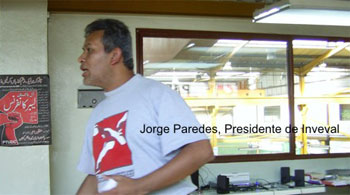
Already on the Saturday morning there was an atmosphere of great enthusiasm amongst the participants. A few minutes after 10am the congress was opened. Jorge Paredes, President of INVEVAL (elected by his workmates in an assembly), promoter of the USPV and leader of FRETECO (the Revolutionary Front of Workers in Factories Occupied and under Workers' Control), and José Quintero, also a member of the factory Executive Committee and a FRETECO leader, presented the Congress agenda.
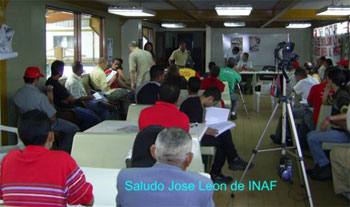
Greetings from the Ezequiel Zamora Peasants Front, Sanitarios Maracay and INAF
 The first item on the agenda was greetings from the guests attending the congress. The first greetings were from the comrades of the FNCEZ (Ezequiel Zamora National Peasants Front), who thanked the congress for being invited and proposed to continue developing the process of co-ordination and united action in the struggle with the CMR and FRETECO which had started during the last presidential elections of December 3, when the comrades of the FNCEZ invited us to participate, along with other well-known left organisations of the Bolivarian movement in the popular contingency plan known as "Tremble Oligarchs!" The comrades of the FNCEZ agreed with the CMR on the need to adopt as the central line of action for all revolutionaries the occupation and taking over of factories and land, as well as the construction of the PSUV (United Socialist Party of Venezuela), which - they pointed out - must come about as a result of a "popular birth".
After the FNCEZ, there was the intervention of comrades representing the workers of two factories that at this moment are the vanguard of FRETECO and the movement for the recuperation and expropriation of factories: INAF and Sanitarios Maracay. Both workers' collectives sent their warmest greetings and sizeable delegations to the congress, which actively participated in the worktables and discussions of the two-day congress.
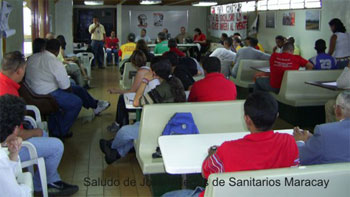 José Villegas, a leader of the occupation in Sanitarios Maracay and one of the workers arrested on April 24 (when the Police of the State of Aragua, under the orders of Governor Didalco Bolivar, organised an act of provocation against the workers in which the workers of Sanitarios were brutally attacked by the Aragua State and some units of the National Guard), recalled the events of that day, expressed his gratitude for the support and solidarity of the whole of the labour movement and, especially of the comrades of the CMR and FRETECO, and insisted on the need to keep up the struggle for workers' control and socialism against all obstacles and manoeuvres of the counter-revolution, reformists and capitalists.
The capitalist cancer and the international situation
Francisco Rivero, a leading member of the CMR, introduced to the congress the international section of the political document. He outlined the deep crisis of capitalism throughout the world and its inability to develop the productive forces and generate social welfare. The sudden drop in the world stock markets is a clear indication of how serious the crisis of the capitalist economy is. Francisco compared the decline of capitalism in its imperialist stage to the process of a cancer eating away the human body. "Just as a cancer ends up destroying the human body, capitalism threatens to destroy our planet, if the working class and all the exploited layers do not put an end to it by building socialism throughout the world."
Francisco emphasised the fact that the epoch of capitalist upswing is something that belongs to the long distant past. He also pointed out that presently a capitalist counter-revolution is taking place in China. "There is not socialism there but a nascent bourgeoisie which is subjecting the workers to conditions of exploitation that resemble very much those of XIX century capitalism."
He also touched upon the enormous popularity of President Chávez and the Bolivarian Revolution in the Middle East, which reflects the huge vacuum that exists on the left in that region, but also the tremendous revolutionary potential among the masses seeking a way out of all the misery generated by the capitalist system. The only way for the Middle East to find a way out of the horror that the local capitalists and the imperialists have imposed on it is through a socialist programme.
Perspectives and tasks for the working class in the Bolivarian revolution
Following this, José Antonio Hernández, a leading member of the CMR and a member of its Central Committee, introduced the part of the document that deals with Venezuela, "Perspectives and tasks of the working class in the Bolivarian revolution". José Antonio stressed a central point: the new period that has opened up after the crushing victory in the presidential elections of December 2006.
The stage we have entered confirms our perspectives that after the elections there would be an intensification of the contradictions within the Bolivarian movement itself, and that these would be expressed more openly. This can be seen in the tensions created by the proposal to found the USPV, the clash between Chávez on the one side and Ramón Martinez and Didalco Bolivar on the other (governors of Sucre and Aragua, respectively), the brutal aggression - already mentioned - by the Police of Aragua and sections of the National Guard against the workers of Sanitarios Maracay, etc. "We are moving towards a decisive confrontation with the capitalists and reformists".
Anther important element emphasised by José Antonio was the change in consciousness that millions of workers, peasants and youth are experiencing in their struggle to take their destiny into their own hands and to build a better society free from oppression and exploitation. "The political factor (consciousness) is beginning to condition the economic factor. This is true not only among the workers, but also among the bourgeois. That explains the economic sabotage being carried out by the bourgeoisie, in complicity with the counter-revolutionary and reformist bureaucracy."
"The battle between reform and revolution is becoming more intense", said José Antonio Hernández. "What is vital and most important for the revolutionary process, what is necessary, is the workers to put themselves at the forefront of the revolution to complete it, creating Workers' Councils side by side with the Communal Councils, to co-ordinate them from the bottom upwards, to create a stable organ of the workers and the people, capable of demolishing the old edifice created by the bourgeoisie. The only way in which the Communal Councils can accomplish their tasks is if the working class puts itself at the forefront of the revolution, developing Workers' Councils with revolutionary Marxist policies as a guide to promoting the co-ordination and unification of these Workers' Councils with the Communal Councils at a local, regional and national level, that will serve as a base for the new revolutionary workers' state that would dismantle and substitute the current state, which in its essence is still a bourgeois state".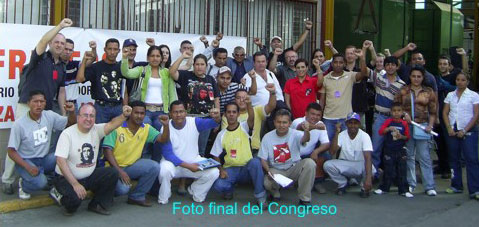
José Antonio pointed out that Chávez's call on the working class to play its role in this revolution and his appeal to study the Transitional Programme represents a historic opportunity for Marxists. "Never since 1917 has a figure who is recognised by the masses as the leader of their revolution publicly identified with Trotsky and called on the masses to study his ideas. This is an enormously favourable situation if we are able to understand it and know how to act with the correct methods and programme".
In his closing remarks José stressed the need for the working class to be in the vanguard of the revolution, to build socialism creating soviets, but also the need for a revolutionary and Marxist leadership, and that is why we need to grow and train new cadres so that we can play a role in future events.
The Workers' Councils, the USPV and the pending tasks of the revolution
After this introduction, in what was an excellent debate, some comrades dealt more in detail with the reasons why it is necessary that Marxists should enter the USPV to fight against reformism and for a genuine socialist programme based on the working class. Also, an interesting question came up about Workers' Councils and the confusion generated amongst certain section of the UNT. There are layers who believe that the Workers' Councils are an anti-union structure. This is completely incorrect, since it is the unions themselves which should promote and build up the councils. The unions must become the heart and soul of these councils and, with a revolutionary orientation, along with the other oppressed layers of society, create soviet type organs (Workers' councils with peasants, soldiers, etc...) to overthrow the capitalist order now.
This was followed by important interventions by several comrades, such as Luis Primo, UNT leader of Caracas-Miranda and promoter of the USPV within the labour movement, the INVEVAL comrades, who are promoting a socialist battalion to build the USPV in the factory and in other factories taken over by the workers or under co-management, and Pablo Cormenzana, founder of the CMR in Los Teques and INVEVAL and also a promoter of the USPV in that area.
Several comrades intervened along the same lines, stressing the need to build a genuine revolutionary state. These were comrades with a lot of experience in the struggle to build a new and genuinely revolutionary state apparatus, such as Elisabeth Alves, a founder of the CMR, ex-secretary of the UBV and currently an adviser to the Vice-chancellery for Latin America, or Jacobo Mora, ex deputy minister of Health at the time of the 2002 coup and ex-leader of the Communist Youth and the Communist Party in the 1970s, who highlighted the importance of the work that the CMR have been carrying out in the occupied and recovered factories.
Of great interest were also the interventions of comrades from those areas where the CMR has undergone rapid development and have a huge potential for growth, such as in Bolivar or Merida. The comrades from Bolivar drew a balance sheet of the student struggles they had led in their areas based on the group of comrades at the Simón Rodríguez University of Ciudad Bolivar and they described the opportunities for growth that the CMR has there, as well as the possibilities of strengthening the student organisation they have built (the MEI, Integrationist Student Movement). They also spoke of their important work in the "Karl Marx" School of Political Training as well as the work they are starting to develop through the "Moral y Luces" (Moral and Enlightenment) Mission in the basic industries.
The comrades form Merida also spoke about the participation of the CMR in the Frente de Fuerzas Socialistas (Front of Socialist Forces), a united front that brings together the revolutionary left of Merida, and also about the speaking tour in support of the nationalisation of Sanitarios Maracay that they organised. The Executive Secretary of SINTRACORREOS in Caracas and Miranda, comrade Jacobo Acosta, also took part in the congress, as did an ex-councillor of the MVR in La Guaira (Vargas State) who later became leader of the Movement for Direct Democracy (MDD) in Vargas, Miguel Montes, who stressed the relevance of Marxism and agreed with the need to fight for a Marxist programme within the USPV.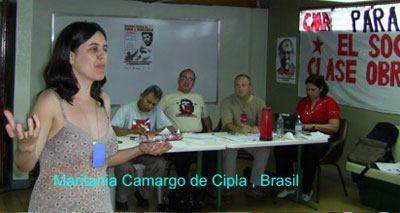
A very important intervention in the congress and one that filled us all with enthusiasm was the speech of comrade Maritania Camargo, who was there as a representative of the "O Trabalho" Marxist Tendency in Brazil and of those comrades in Venezuela who identify with it. This tendency is at the forefront of the struggle for workers' control, occupations and recovery of factories in Brazil as well as in the struggle against the reformists within the PT, building the Marxist Left of the PT to win over the rank and file to a socialist programme.
Revolutionary enthusiasm
 A resolution was passed at the Congress sending greetings to the conference of the "O Trabalho" tendency, which was taking place at the same time in Brazil. Also a message of solidarity was sent to the Danish Marxists grouped around the journal "Socialistik Stadpunkt". The resolution expressed opposition to the attempt by the reformist leaders of the left youth organisation SUF to expel them for defending a Marxist policy. Another resolution was passed in support of the Marxist comrades of the Socialist Youth in Vienna, who had played a key role in the historical solidarity meeting with the Venezuelan revolution organised by "Hands off Venezuela", with the presence of Alan Woods, President Chávez himself and more than 5,000 youth. These excellent comrades are now being threatened with expulsion by the most right wing sections of the Social Democracy simply for defending the ideas and the internationalist and revolutionary programme of Marxism.
A most moving moment of the congress was when greetings were read out from around the world encouraging us in our struggle in defence of Marxism and against reformism, opportunism and sectarianism. The biggest welcome was given to the message sent by Alan Woods, a founder of the International Marxist Tendency, who is very well known in Venezuela. Messages from the comrades of "El Militante" in Argentina and Spain, "Falce Martello" in Italy, "Marxistiki Foni" in Greece, and many other countries, such as Israel, Iran, Poland and Russia were read out.
Then there followed a report on the work developed over the last year by the International Marxist Tendency, which the CMR is a part of. This was followed with great interest and enthusiasm by everybody present. Then the Congress moved on to draw up a balance sheet of the previous year of work and the aims and tasks for the next twelve months.
The Marxists in the USPV
Amongst the more important decisions taken, it is important to highlight the resolution that calls on the comrades of the CMR to affiliate to the USPV and to fight to build it as a revolutionary, democratic and socialist party with a Marxist programme which will serve as a tool in the hands of the working class and of all exploited layers to carry out the revolution to the end. Also, a very positive balance sheet was drawn up of the work of FRETECO and the congress reiterated the point that a priority of the CMR was the work of organising and expanding the occupation and recovery of factories with the demand for expropriation. The task is to defend this position in all rank and file bodies and tendencies of the UNT.
The enormous advances made in the sales of our journal "El Militante" were also highlighted. These have tripled in the last months. This success has allowed us to purchase a copy printer machine, not on the basis of state subsidies or of large individual donations, but thanks to the effort and militant work of every single comrade. This will make us completely self-sufficient in terms of printing our own leaflets and study bulletins, which will undoubtedly play a fundamental role when it comes to spreading our Marxist ideas within the Bolivarian movement, the UNT, FRETECO and, of course, the USPV.
Several comrades stressed the importance of basing ourselves on the activity of every single comrade, following the "Marxist tradition of sacrifice", as Trotsky used to say, to finance our activities, rejecting alien methods to the workings class such as dependence on state institutions or individual methods not rooted in the daily activity within the working class and the revolutionary masses. An indication of the revolutionary enthusiasm of everyone present at the congress was the collection held at the end of the congress, which raised five million of Bolivars, almost double the target we were going for.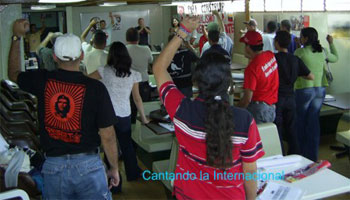
Another aspect that several comrades highlighted was the distribution of Marxist literature in general, especially at meetings of the USPV which, together with the sale of "El Militante", has become a distinguishing feature of the Marxists of the CMR within the labour movement and the USPV. We are the only tendency that intervenes by distributing Marxist literature, leaflets and a journal with our programmatic and strategic proposals to build and develop the new party as a genuine revolutionary party.
Everyone at the congress recommitted themselves to continue along these same lines, improving the quality of the work and redoubling everyone's efforts to build the Marxist Tendency and win over the best activists amongst the youth, the workers, the peasants and in the neighbourhoods to the ideas and methods of Marxist socialism with the target of doubling the number of comrades in the next months.
The enthusiasm of all the comrades present built up into a crescendo at the end of the congress with everyone singing the "Internationale", the anthem of the world working class.